Contributions
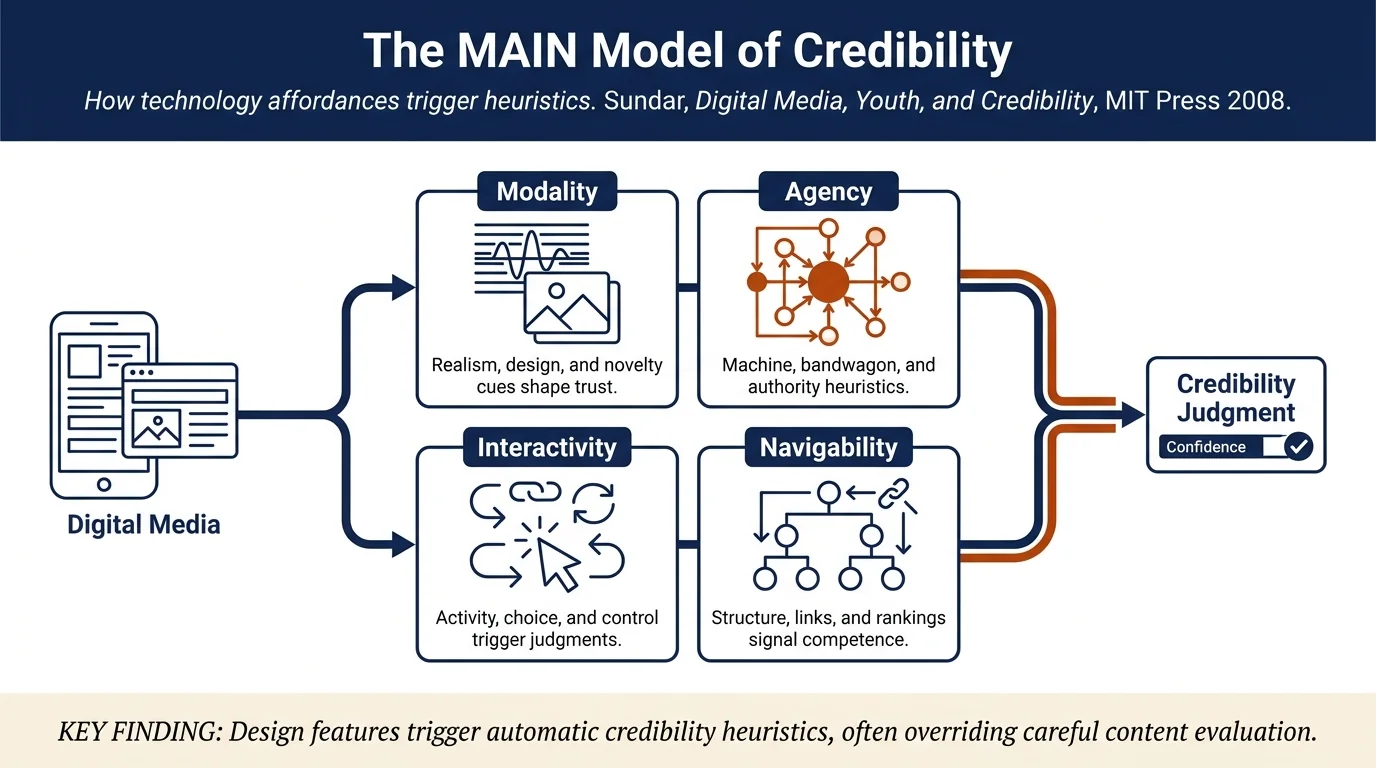
- MAIN affordances model: identifies four distinct technological features (Modality, Agency, Interactivity, Navigability) that systematically influence credibility cues
- Heuristics inventory: catalogs specific judgment rules triggered by each affordance, with detailed psychological justification for each rule
- Design-to-judgment pathway: explains the mechanism by which media features → perceptual cues → heuristic activation → quality perceptions → credibility judgments
- Youth-specific framing: applies heuristic theory to digital-native decision-making, noting that youth are especially prone to relying on surface features and design affordances
- Practical implications: suggests that understanding these heuristics can inform both media literacy interventions and technology design that promotes accurate credibility assessment
Method
The chapter is primarily conceptual and theoretical, drawing on ten years of experimental research at the Media Effects Research Laboratory at Penn State University. Sundar synthesizes findings from prior empirical work on source credibility, heuristic processing, and technology design to propose an integrative model.
Core theoretical structure:
-
Affordances are capabilities that technologies possess (e.g., text modality, agency cues from algorithms or agents, interactivity via customization, navigability via hyperlinks). Each affordance is embedded in the medium's design and is salient to users.
-
Cues are specific elements that affordances make perceptually available. For example, the modality affordance produces cues like perceptual bandwidth (audio vs. text), presence of animation, bells and whistles. The agency affordance produces cues like source labeling (news editor, algorithm, friend, bot), presence of collaborative filtering indicators.
-
Heuristics are judgment rules triggered by cues. The machine heuristic ("if a machine chose it, it must be objective") is triggered by agency cues showing algorithmic agency. The bandwagon heuristic ("if many others like it, it's good") is triggered by collaborative-filtering cues. These heuristics are not consciously applied; they operate automatically.
-
Quality perceptions integrate across multiple heuristic judgments. Quality encompasses utility, importance, relevance, completeness, clarity, trustworthiness, etc.
-
Credibility judgment is the final assessment: a user's confidence in the information or source.
The model is nonlinear: not all cues trigger all heuristics; different heuristics can reinforce or contradict each other; and context (user goals, motivational state, familiarity with the system) modulates which heuristics are active.
Results and Key Findings
Modality cues trigger heuristics including:
- Realism heuristic: audiovisual modality (more lifelike) is judged as more credible than text
- Bells and whistles heuristic: aesthetic design elements, animation, and cool features trigger positive impressions (but research is mixed on their effect on credibility; they can also trigger the intrusiveness heuristic if perceived as intrusive or distracting)
- Novelty heuristic: new modality combinations (e.g., 3D virtual reality, multimodal interfaces) evoke credibility boosts due to perceived innovation and intensity
Agency cues (collaborative filtering, machine agents) trigger:
- Machine heuristic: "if a machine chose this, it must be objective"—algorithmic recommendations are trusted as bias-free
- Bandwagon heuristic: "if many others like it, it's good"—collaborative popularity signals increase credibility, particularly among youth seeking trends
- Authority heuristic: official sources (news editors, labeled experts) trigger trust in expertise and reduce perceptions of bias
- Social presence heuristic: when systems present themselves with anthropomorphic features, users ascribe social qualities and trust the system more
- Helper heuristic: systems that assist the user gain credibility; perceived benevolent intent is an affective pathway to trust
- Identity heuristic: when users personalize content or see their own identity reflected in the system, credibility of the system and its recommendations increase
Interactivity cues (customization, real-time responsiveness, choice) trigger:
- Activity heuristic: engagement and dynamism on a site suggest active, up-to-date content; passive or slow-loading sites trigger skepticism
- Interaction heuristic: sites allowing user input (e.g., dialog boxes, comment sections, search) are perceived as more responsive to user needs and thus more credible
- Choice heuristic: systems offering options and control are judged as allowing specificity, hence higher credibility
- Control heuristic: when systems explicitly highlight user control, users feel empowered and attribute credibility to the system
- Telepresence heuristic: real-time interactivity can evoke a sense of being present with the information source, increasing credibility and intensity of experience
- Flow heuristic: smooth, responsive interaction without breaks or delays promotes a sense of immersion and positive evaluation
- Contingency heuristic: message threading and sequential interaction (as in email or chatrooms) create a sense of mutual exchange, enhancing perceived credibility
- Similarity heuristic: when interactive features allow customization matching user preferences, similarity fosters credibility
- Own-ness heuristic: when users customize their space (desktop, playlist, profile), they develop psychological ownership and credit the system for quality
Navigability cues (hyperlinks, hierarchical structure, search results ranking) trigger:
- Browsing heuristic: sites with well-organized links invite exploration; navigation ease promotes the impression of competence and trustworthiness
- Elaboration heuristic: hierarchical navigation with detailed information at multiple levels suggests depth and expertise
- Scaffolding heuristic: clear organizational structure reduces cognitive load and signals that designers have invested in user experience; users reciprocate with credibility judgments
- Play heuristic: navigational features that feel playful (e.g., games, interactive maps) reduce perceptions of effort and promote positive affect, which transfers to credibility
- Prominence heuristic: search results appearing first or featured prominently are presumed more relevant and credible (the prominence heuristic)
- Similarity heuristic: when search results are ranked by relevance to the user's query, credibility benefits from perceived alignment with user interests
Notes
Strengths: The MAIN model is elegant and comprehensive, synthesizing cognitive psychology (heuristics) with communication theory (source credibility) and technology design (affordances). The detailed heuristics inventory provides researchers with a vocabulary for empirically testing design effects on credibility. The focus on youth is timely and important. The model explains why surface features (design, layout, source signals) so powerfully influence judgments, independent of content accuracy—a crucial insight for understanding misinformation vulnerability.
Scope: Primarily theoretical; the chapter draws on prior empirical work but does not present new experiments. The heuristics are proposed, not all exhaustively tested. Some heuristics are well-established in the literature (e.g., expertise heuristic, source credibility); others (e.g., scaffolding, play) are more novel and await rigorous empirical validation.
Limitations and open questions: The model assumes users access and process cues through affordances; it does not deeply address selective attention or how users with different motivations (e.g., critical media literacy students vs. casual browsers) may differentially activate heuristics. The chapter predates algorithmic recommendation systems (algorithmic feeds, recommendation engines, generative AI), so its treatment of agency and machine heuristics would benefit from updating in light of contemporary platforms. Additionally, the model does not address cultural differences in trust heuristics or how heuristics evolve as youth become media-savvy.
Relevance to GUIDE: This model is essential for misinformation and credibility research because it explains the mechanisms by which people assess trust—not just the outcomes (they believed false information) but why (design features triggered heuristics that bypassed content evaluation). Understanding these mechanisms is prerequisite to designing interventions that build media literacy or alert systems that counteract misinformation.