Contributions
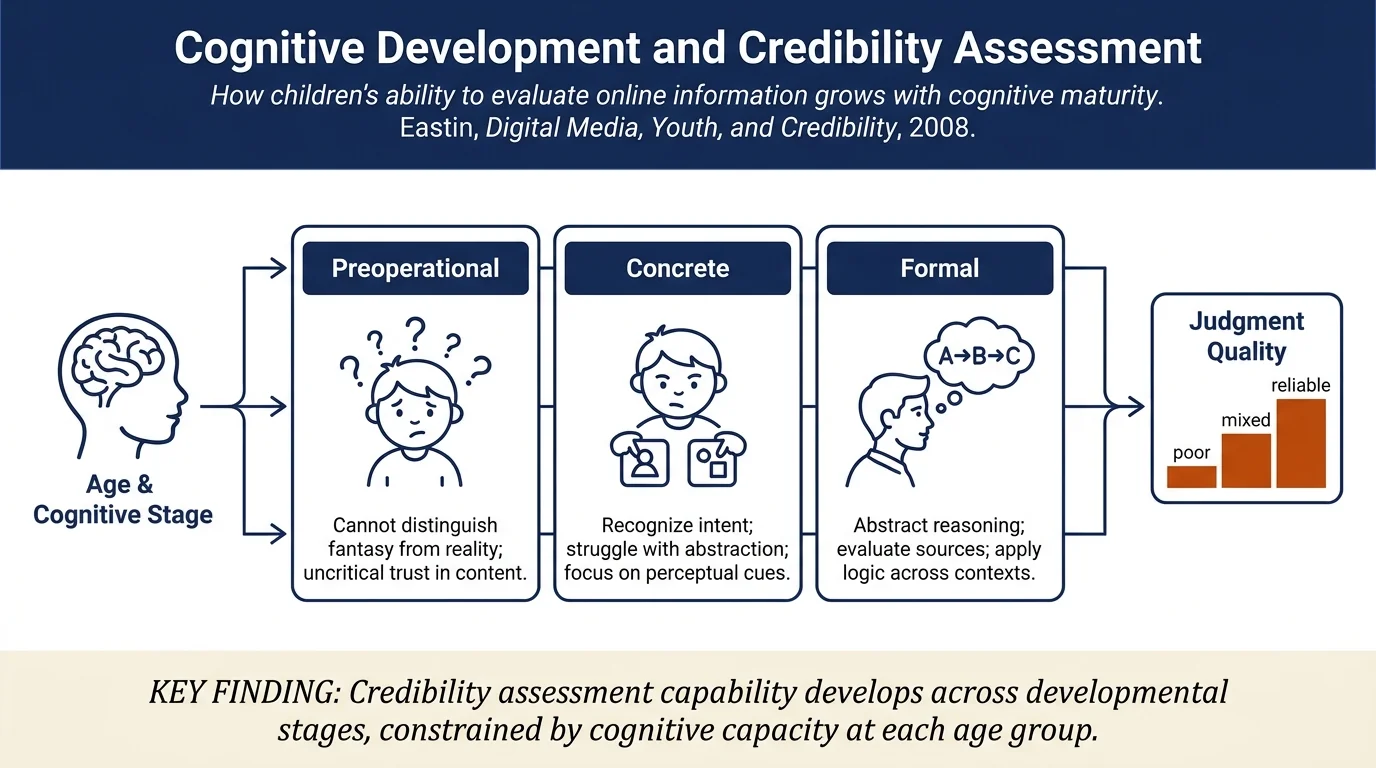
- Applies Piaget's developmental stages (preoperational, concrete operational, formal operational) to explain age-related differences in online credibility judgment.
- Identifies specific cognitive limitations at each stage: preoperational children cannot distinguish fantasy from reality; concrete-operational children struggle with abstract reasoning and multiple cues; only formal-operational adolescents can apply logical principles across contexts.
- Bridges cognitive development theory and information-processing models (Limited Capacity Model, schema theory) to explain why children rely on surface cues (dynamic content, design) rather than source analysis.
- Demonstrates that early concrete-operational children (ages 8–11) have particular difficulty recognizing advertising and commercial intent online, conflating content source with page design.
- Argues that credibility assessment curricula must be developmentally sequenced: surface-level cue evaluation for younger children, source-expertise evaluation for older children, logical evaluation for adolescents.
Method
The chapter is a theoretical integration, not an empirical study. It synthesizes Piaget's cognitive development framework, contemporary media research on credibility, and information-processing studies to build a developmental model of online credibility judgment.
Key theoretical foundations:
- Piaget's stages: Sensorimotor (0–2), preoperational (2–7), concrete operational (7–11), formal operational (11+). The chapter focuses on stages relevant to digital media use: preoperational (symbolic thought, egocentrism, difficulty with multiple dimensions), concrete operational (logical reasoning within concrete contexts, difficulty with abstraction), and formal operational (abstract reasoning, hypothesis testing, logical principles).
- Information-processing perspective: Limited Capacity Model—the idea that cognitive resources for encoding, storage, and retrieval are finite and unevenly distributed across age groups. Younger children have less working memory and are more distracted by perceptually salient (but content-irrelevant) features.
- Schema theory: How children organize and assimilate new information into existing mental structures, and how that organization enables or constrains comprehension.
Application to online environments: Examines three dimensions of digital credibility challenges:
- Source information: How children identify and evaluate author credentials and expertise.
- Dynamic presentation: How animation, color, interactivity, and multimedia affect credibility perception.
- Advertising and commercial content: How children distinguish editorial from commercial content.
Results
The chapter does not report experimental data but develops propositions about developmental progression in credibility assessment:
- Preoperational (ages 2–7): Children cannot distinguish fantasy from reality; they equate information quantity with quality and lack the ability to recognize multiple perspectives. Online credibility judgments are unreliable; children trust content uncritically and cannot evaluate source expertise.
- Concrete operational (ages 7–11): Children can organize multiple information objects and think logically about concrete, tangible situations. They begin to recognize and understand intentionality (e.g., advertising), but cannot apply logical principles abstractly across contexts. They struggle with complex online environments and tend to focus on perceptually salient cues (bright colors, animation) over source identity. They confuse website design attractiveness with credibility. Research shows mixed effectiveness of media literacy interventions at this stage because children cannot yet generalize learned principles.
- Formal operational (ages 11+): Adolescents can reason abstractly, test hypotheses, and apply logical rules across different contexts. They can evaluate implicit credibility cues, recognize bias, and understand perspective-taking. Credibility assessment becomes more reliable, though still subject to cognitive load and information-processing limitations (e.g., distraction by advertising).
Key empirical references cited:
- Eastin et al. found that in a sample of third- through fifth-graders, children in the concrete operational stage had difficulty recognizing differences between commercial and noncommercial content, with 71% failing to identify an advertisement on a website lacking explicit source labeling.
- Studies of television viewing show that younger children (ages 2–5) focus on perceptually salient features (color, animation) over central message content, reducing comprehension of educational material.
- Research on web credibility (Watson, Hirsh, Agosto) finds that 8- and 12-year-olds rarely question the accuracy or credibility of online information and do not develop skepticism toward sources.
Notes
Strengths: Theoretically grounded application of Piaget to a contemporary problem. The developmental perspective is essential for understanding why younger children are vulnerable to online misinformation and why interventions cannot assume uniform cognitive capacity across ages. The integration of information-processing models strengthens the argument beyond pure developmental stage theory. Practical implications for education are clear.
Limitations and extensions: The chapter is primarily theoretical synthesis rather than primary empirical work. Piaget's stage theory, while influential, has been criticized for being too coarse-grained and for not capturing the variation within age groups. More recent neo-Piagetian work (e.g., Case, Demetriou) suggests cognitive development is more continuous than stage-based. The chapter does not deeply engage contemporary research on how algorithms and personalization affect credibility perception. Applications to social media and peer-based credibility signals (likes, shares, followers) are not discussed. Health misinformation, political polarization, and conspiracy theory spread—domains where credibility failure is consequential—receive limited treatment.
Relevance to GUIDE: Central reference for understanding why youth are targets of misinformation campaigns and why media literacy interventions must be developmentally appropriate. The cognitive-load perspective (why dynamic, complex online environments overwhelm younger children) explains why surface-level design manipulation and advertising interference with credibility judgment. Essential for designing interventions or studying credibility in populations spanning childhood and adolescence.