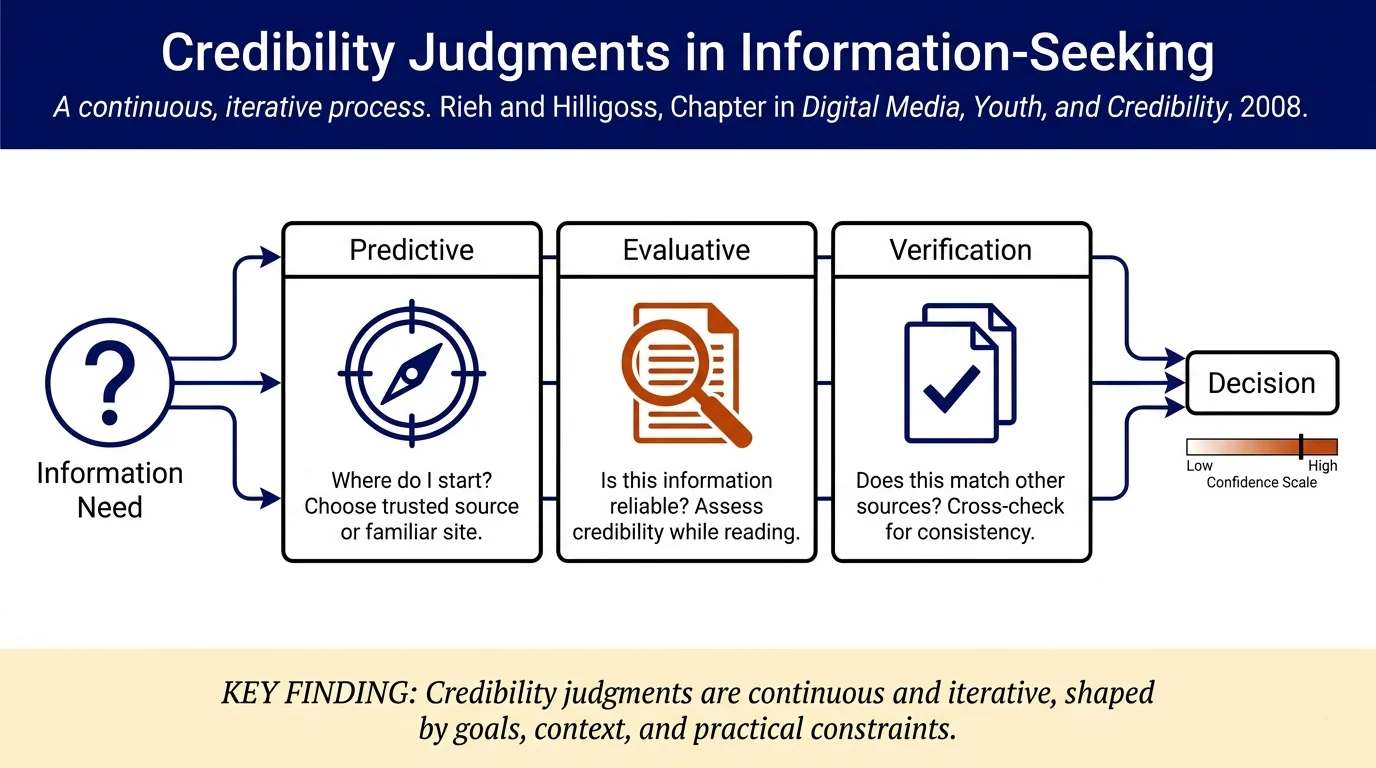
Contributions
- Empirical characterization of how credibility judgments are made within the information-seeking process, not as a separate evaluation task
- Identification of three types of credibility judgments: predictive (before accessing information), evaluative (while assessing found information), and verification (when encountering contradictory information)
- Evidence that credibility concerns vary by information-seeking context and goal (higher for academic and health information, lower for entertainment)
- Description of three information-seeking strategies related to credibility: (1) starting at trusted places, (2) using multiple sources and cross-referencing, (3) sacrificing credibility for speed and convenience
- Insight that credibility judgments are socially situated—influenced by trusted individuals, instructors, and contextual norms
Method
Qualitative study with 24 undergraduate students (diverse majors, three institutions across the U.S. Midwest) conducted 2005–2006. Participants recorded their information-seeking activities via password-protected web diary for ten consecutive days, capturing details of search processes, resources used, and decisions made. Participants were then interviewed individually about their entries. Data were analyzed to identify patterns in credibility concerns, judgments, and their relationship to information-seeking goals, contexts, and strategies.
Results
Information-seeking goals and credibility concerns: Credibility concerns are strongly tied to perceived stakes. Students were more concerned with credibility for academic achievement, health/personal information, and situations where information had social impact. Credibility concerns were lowest for entertainment-oriented information seeking.
Credibility judgments as ongoing process: Rather than a single evaluation event, credibility assessment is continuous and iterative—made at multiple points (before, during, and after accessing information) and refined as new information is encountered. College students make predictive judgments (where to start), evaluative judgments (is this information good?), and verification judgments (does this contradict other sources?).
Social context and credibility: Credibility judgments are inherently social. Students rely on trusted individuals (professors, teaching assistants, parents, friends) as authorities and sources of information. Trust is earned through personal experience and expertise recognition. Students also bound their credibility assessments to specific social contexts (e.g., information trusted in a classroom may not transfer to personal research).
Three information-seeking strategies related to credibility:
- Starting at a trusted place: Many students initiate searches by consulting trusted human sources (asking professors, coaches, parents) or familiar, regularly-used websites (Google, favorite news sites). This strategy reflects what others call "earned credibility."
- Using multiple resources and cross-referencing: Students often verify information by consulting multiple sources and checking for consistency across them. If sources agree, information is judged more credible; if they conflict, students may engage in further verification or visit additional sources.
- Compromising credibility for speed and convenience: When stakes are perceived as lower or time is limited, students prioritize speed and ease of access over credibility. They may use search engines, familiar sites, or the most accessible resource even when they acknowledge more credible alternatives exist.
Quality control and verification: Students generally distinguished web resources from scholarly publications, recognizing that web content lacks quality-control mechanisms. Many expressed preference for peer-reviewed journals and books as more credible. Some participants discussed the credibility benefits of Google Scholar (linking to peer-reviewed content) versus general web search. College students verify information when uncertain or when encountering contradictions—more so than in prior studies of younger populations.
Notes
Strengths: Rich qualitative data capturing credibility judgments in naturally occurring information-seeking contexts. The diary method and follow-up interviews reveal the implicit and embedded nature of credibility concerns—not always articulated explicitly but shaping behavior. Findings are grounded in participants' own language and reasoning. The identification of three types of judgments (predictive, evaluative, verification) provides a useful framework for understanding credibility as a process rather than a snapshot decision.
Scope and limitations: Exploratory study with 24 participants from three U.S. institutions; sample size is small and may not generalize to all college populations. Data collected 2005–2006, prior to widespread social media and mobile search. The focus on college students (a population with higher education and information-literacy exposure than general adults) means findings may not transfer to younger teens or adult populations without formal educational support.
Methodological contribution: The diary method is particularly valuable for capturing how credibility assessments are embedded and sometimes implicit in everyday information seeking—avoiding the limitation of studies that ask people to evaluate hypothetical sources outside of real contexts. This approach has influenced subsequent research on credibility and information behavior.
Relationship to misinformation: The chapter reveals why people fall victim to misinformation: credibility is not always a priority (speed/convenience trade-offs), judgments often rely on heuristics or trusted-person authority rather than content analysis, and the iterative nature of verification suggests some false information may pass initial screening if it seems to fit expectations or comes from an apparently credible source.