Contributions
- Apomediation framework: Introduces the concept that digital media don't eliminate intermediation but transform it—from expert gatekeepers ("intermediaries") to peer networks and algorithmic guides ("apomedaries") that assist information consumers in evaluating and accessing information.
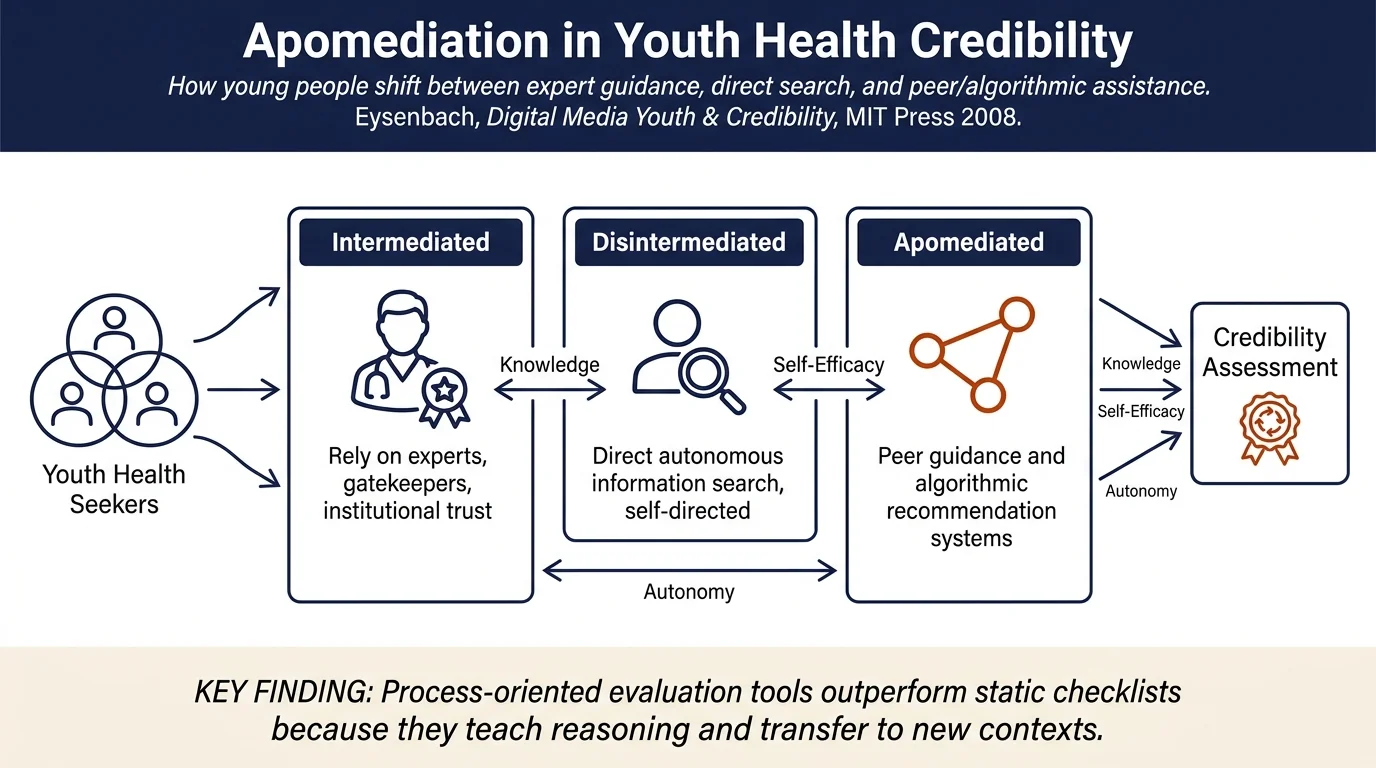
- Dynamic Disintermediation/Apomediation (DIDA) model: Proposes a formal model showing how individuals shift between relying on intermediaries (parents, doctors, teachers), direct information access (autonomy, self-sufficiency), and apomediary guidance (peers, tools, collaborative filtering) depending on knowledge, self-efficacy, and autonomy levels.
- Unique credibility challenges in digital health: Documents five dimensions of digital media that complicate credibility assessment: context deficit (inability to determine source identity or motives), blurred advertising/content boundaries, lack of editorial control, ease of content replication and manipulation, and mass customization enabling filter bubbles and information bias.
- Youth-specific vulnerabilities: Analyzes developmental differences showing youth rely more on peer/intermediary guidance than content analysis, have incomplete cognitive abilities for evaluating source credentials, and may prioritize autonomy over information quality in sensitive health topics.
- Next-generation credibility tools: Reviews limitations of traditional credibility checklists and proposes FACT algorithm and similar process-oriented tools that teach corroboration (cross-checking across sources), credibility assessment, and trustworthiness verification—moving beyond static source cues toward dynamic evaluation strategies.
Method
The chapter is a theoretical synthesis integrating cognitive science (developmental stages, autonomy, self-efficacy), communication theory (intermediation, source credibility, media effects), medical informatics research (health information-seeking patterns, quality assessment initiatives), and empirical studies of youth online behavior. Eysenbach develops a conceptual model by:
- Analyzing survey data on health information-seeking prevalence among youth (finding health information ranks as one of the top online activities).
- Mapping how digital media characteristics differ from traditional health information channels (television, print, physician consultation).
- Integrating theories of intermediation, disintermediation, and autonomy from multiple disciplines to explain the shift in information-seeking patterns during adolescence.
- Proposing a process model (DIDA) showing dynamic transitions between intermediated, disintermediated, and apomediated states conditional on individual knowledge, self-efficacy, autonomy, and situation.
Results
Prevalence of youth health information-seeking: 25–75% of U.S. youth report seeking health information online (varying by age group and topic specificity). Many youth begin searches on general engines rather than trusted portals and use convenience and speed as evaluation criteria, compromising credibility concerns.
Disintermediation process parallels adolescent development: Just as adolescents become more autonomous from parents/teachers and rely more on peer guidance during adolescence, digital disintermediation mirrors this developmental shift—youth increasingly seek information without institutional intermediaries and rely on peer networks for guidance.
Credibility assessment limitations: Empirical research shows most youth cannot distinguish between primary and secondary sources, have difficulty identifying source credibility markers (even on sites that appear professional), and rely on surface design cues rather than content quality.
DIDA model predictions: The model predicts that individuals with higher knowledge, self-efficacy, and autonomy will prefer disintermediated environments, while those with lower self-efficacy or high uncertainty will prefer intermediary guidance. For sensitive health topics (sexuality, drug use), older/more mature youth may seek autonomy; for severe conditions, even experienced patients may revert to intermediary (doctor) consultation.
Educational tool effectiveness: Process-oriented tools (FACT algorithm, fact cross-checking practices) outperform static checklist approaches because they teach evaluation reasoning rather than checklist compliance, enabling transfer to new contexts and adaptation to evolving platforms.
Notes
Strengths: Forward-thinking introduction of apomediation as a theoretical concept predating algorithmic intermediation and social media influence; grounded in cognitive development theory and health informatics research; proposes actionable educational interventions (process-oriented tools) rather than deterministic recommendations. The DIDA model elegantly explains why youth simultaneously become more information-autonomous and more reliant on peer/algorithmic guidance.
Concepts likely underutilized in later work: "Apomediation" as a framework is introduced here but rarely picked up by subsequent misinformation literature. The specific emphasis on health information's high-stakes consequences for credibility assessment is notable—health misinformation carries direct physical harms, making credibility judgment consequences more salient than for political misinformation.
Dated elements: The chapter predates algorithmic recommendation systems and generative AI; references to "Web 2.0" and specific portal designs are outdated. Health-specific social media (Facebook pages, online support communities) are mentioned but not deeply analyzed.
Methodological stance: Primarily theoretical synthesis rather than empirical primary research; strength lies in conceptual integration across disciplines rather than new data.
For misinformation research: The apomediation framework is relevant to understanding how fact-checkers, community notes, and crowdsourced credibility ratings function as modern apomediation tools; the DIDA model's emphasis on autonomy, knowledge, and situational factors provides psychological grounding for why platform interventions targeting credibility have heterogeneous effects.