Explore papers
Filter by research area, year and venue. Every filter is in the address bar, so you can share a view as a link.
 Detection methodsLLMs & generative AI
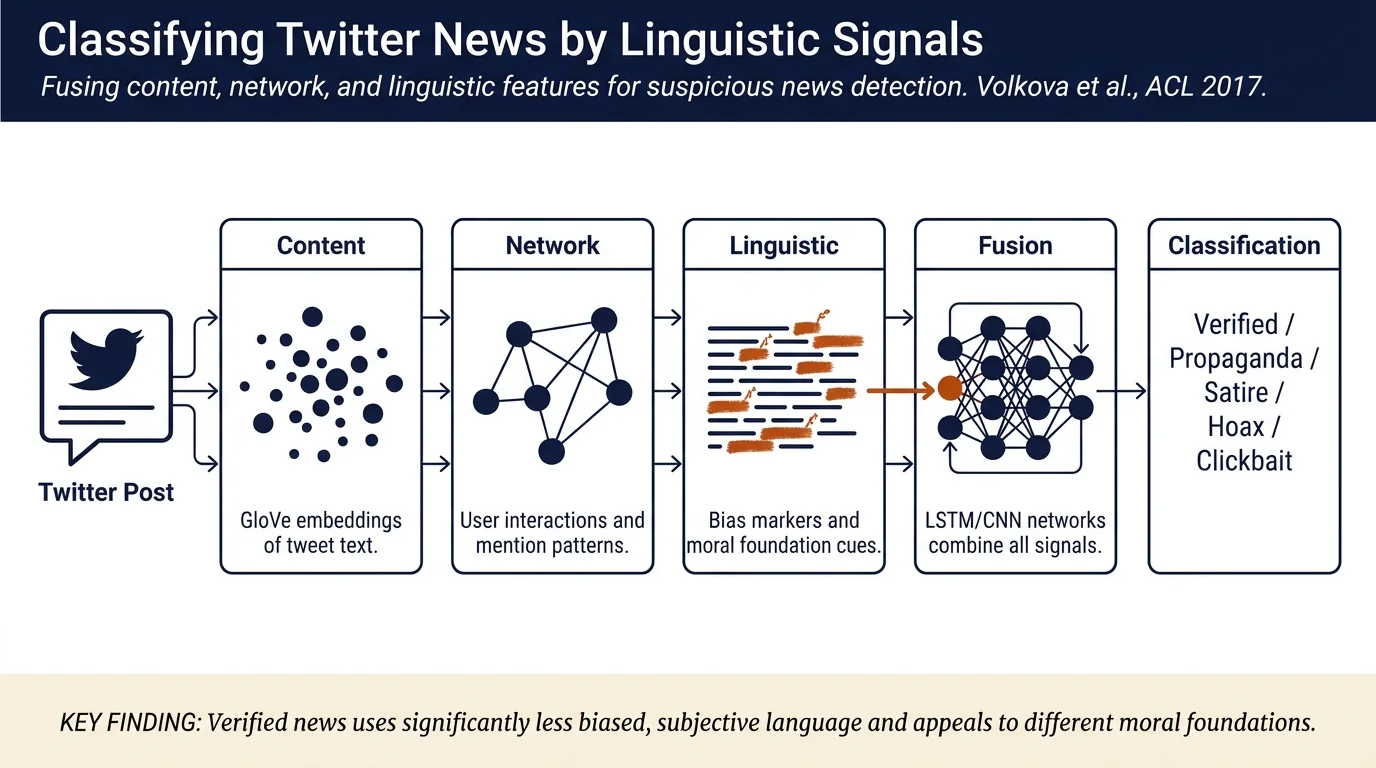
Separating Facts from Fiction: Linguistic Models to Classify Suspicious and Trusted News Posts on TwitterThis paper presents neural network models combining tweet content, social network interactions, and linguistic features (bias markers, subjectivity cues, moral foundations) to classify Twitter news posts as suspicious (propaganda, hoaxes, clickbait, satire) or verified. The models achieve 95% accuracy on binary classification and 0.7…
 Detection methodsDatasets & evaluation
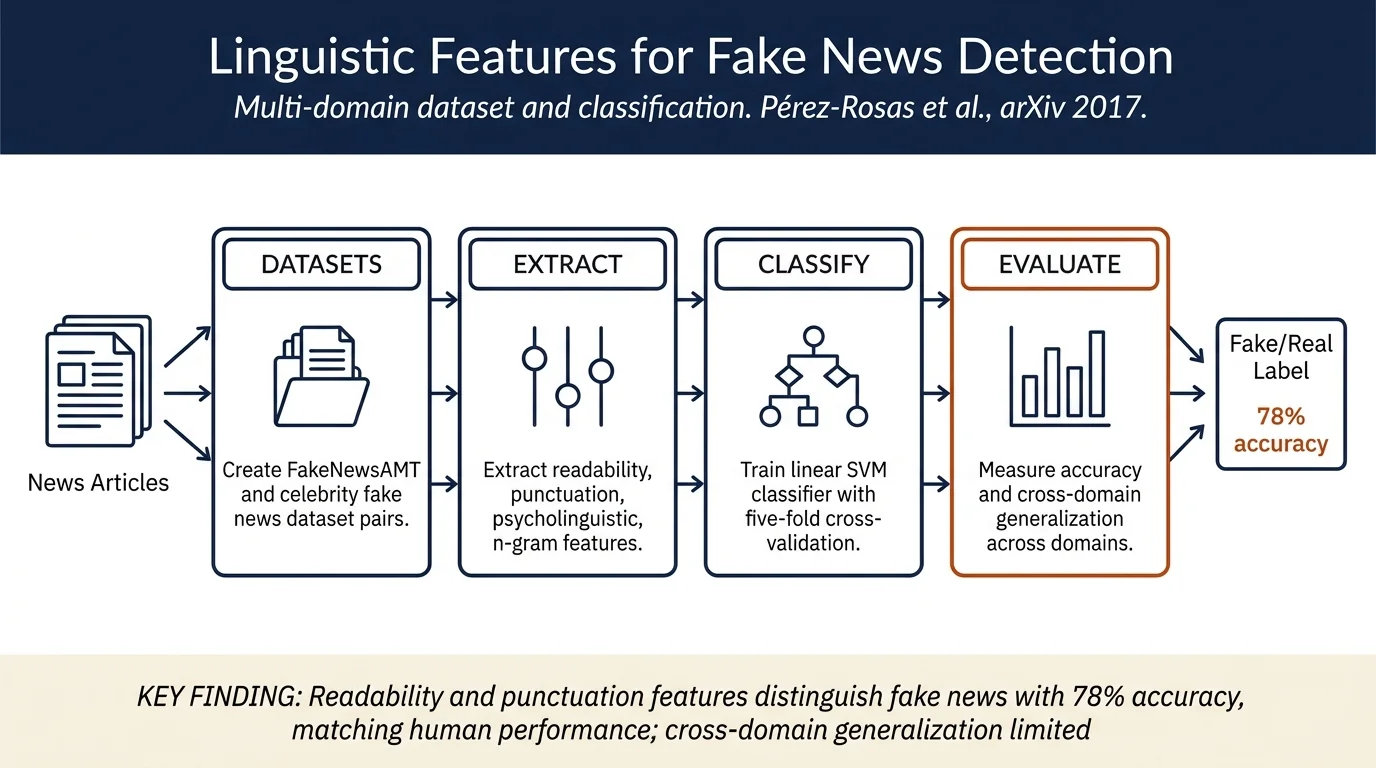
Automatic Detection of Fake NewsThis paper introduces two novel fake news detection datasets covering seven news domains and analyzes linguistic properties that distinguish fake from legitimate content. Using linguistic features including readability metrics, word categories, and punctuation patterns, the authors build classifiers achieving up to 78% accuracy and…
 Detection methodsSpread & networks
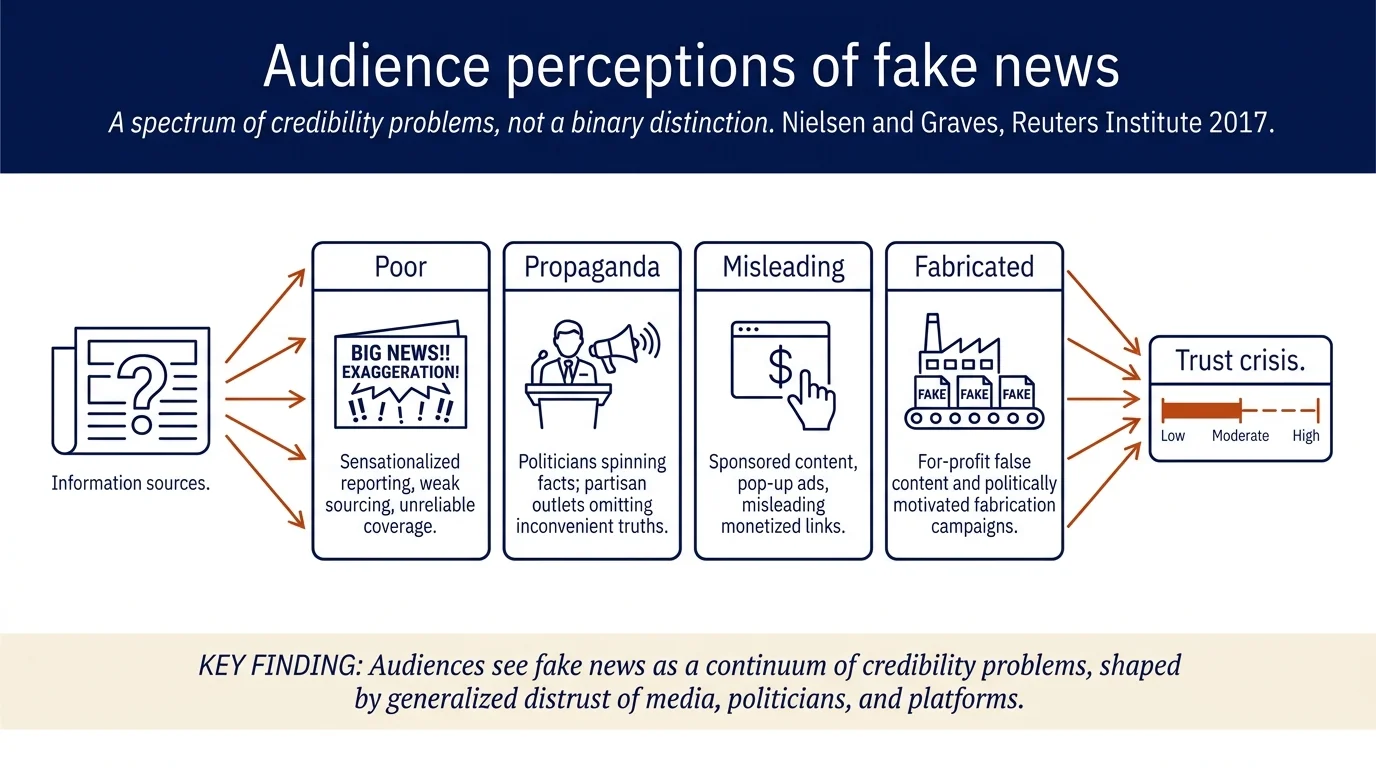
"News you don't believe": Audience perspectives on fake newsUsing focus groups and surveys across the US, UK, Spain, and Finland, Nielsen and Graves find that ordinary people see fake news as a spectrum rather than a binary distinction—encompassing poor journalism, political propaganda, misleading advertising, and fabricated content. Audiences experience the "fake news" problem as one of degree,…
 Spread & networksDetection methods
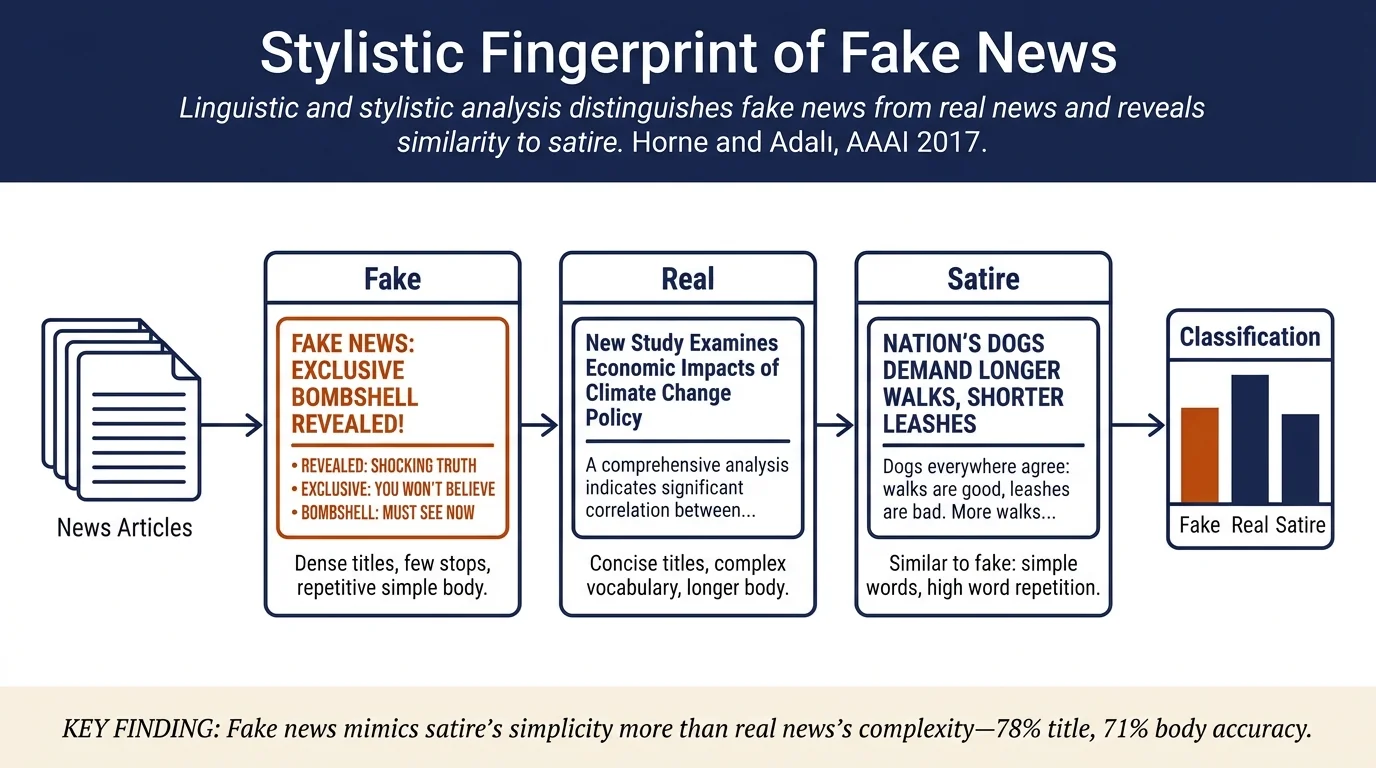
This Just In: Fake News Packs a Lot in Title, Uses Simpler, Repetitive Content in Text Body, More Similar to Satire than Real NewsFake news differs systematically from real news in stylistic features, especially titles. Contrary to the assumption that fake news mimics real news, it is actually more similar to satire: packed titles with fewer stop words and more proper nouns, combined with shorter, repetitive body text with simpler language.
Fact-checking & verificationDatasets & evaluation
ClaimBuster: The first end-to-end fact-checking systemFoundational work introducing ClaimBuster, an end-to-end automated fact-checking system. Introduces a dataset of 23,533 human-annotated U.S. debate statements with check-worthiness labels, establishing baselines for automated claim check-worthiness detection and ranking.
 Fact-checking & verificationPsychology & interventions
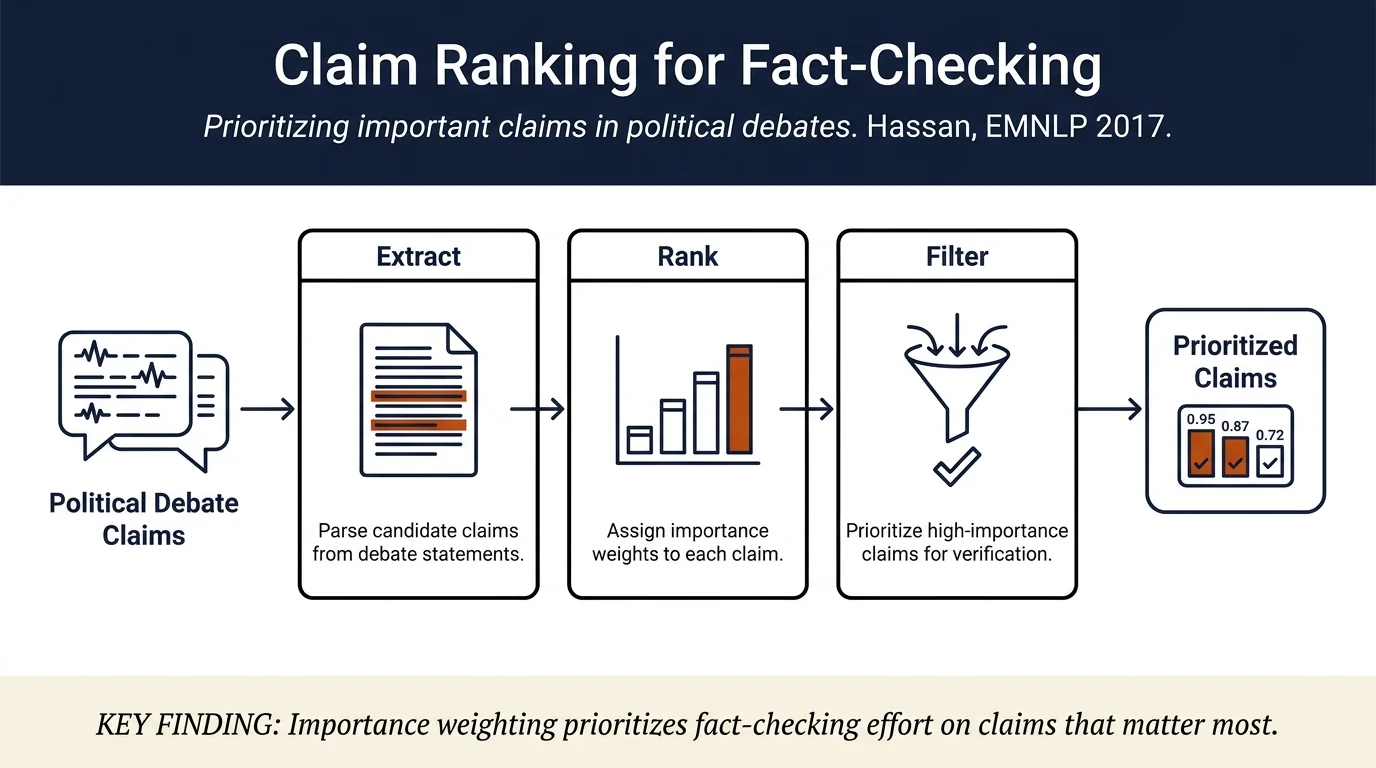
Claim Ranking in Political DebatesEarly work framing check-worthiness as claim ranking; introduces the notion of "importance weighting" for prioritizing claims for fact-checking in political debates. Foundational for understanding which claims warrant verification effort.
 LLMs & generative AI
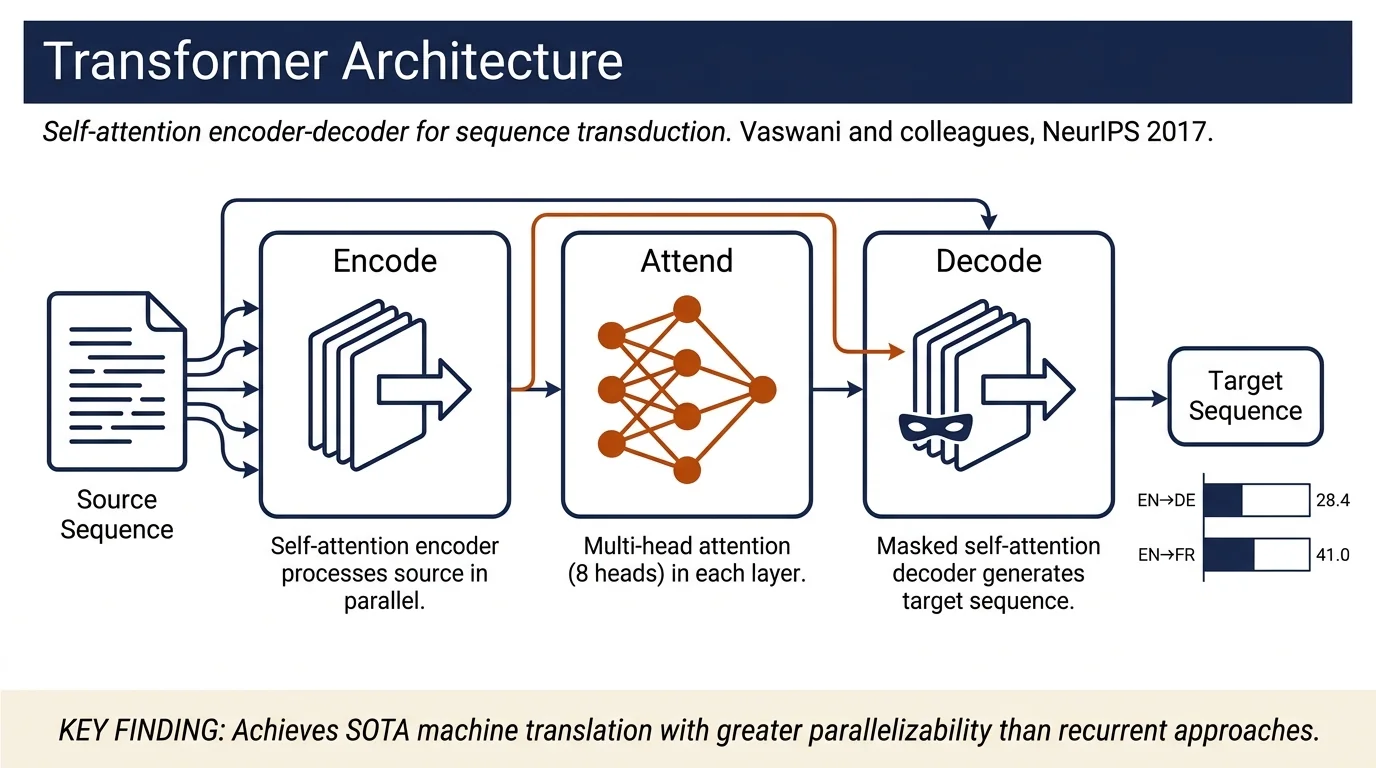
Attention Is All You NeedThe authors introduce the Transformer, a sequence transduction model based entirely on self-attention mechanisms that dispenses with recurrence and convolution. The model achieves state-of-the-art BLEU scores on machine translation tasks while being significantly more parallelizable and requiring less training time.
 Detection methodsDatasets & evaluation
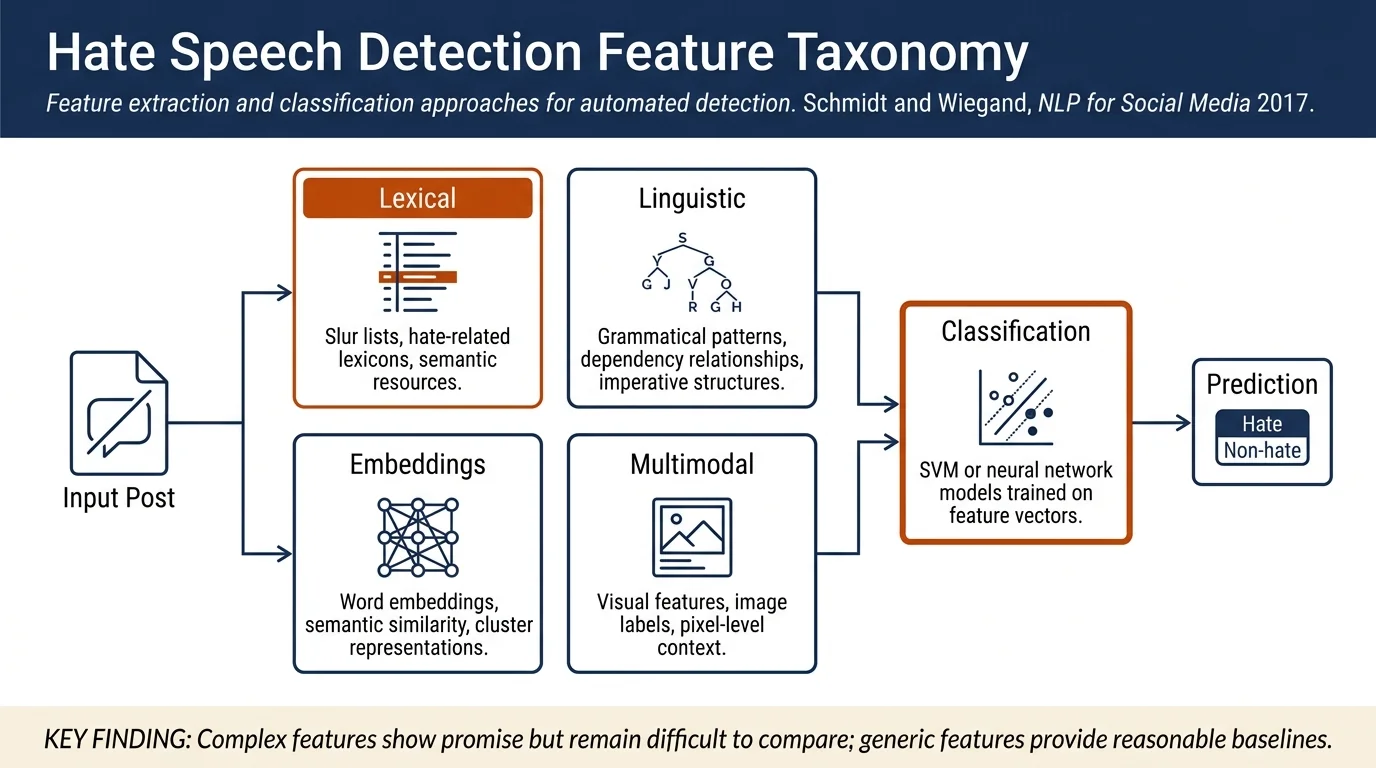
A Survey on Hate Speech Detection using Natural Language ProcessingThis survey systematically reviews automatic hate speech detection methods, covering feature extraction techniques (surface features, embeddings, sentiment analysis, lexical resources, linguistic features, knowledge bases), classification approaches (mostly supervised learning with SVMs and neural networks), annotation practices, and key…
 Spread & networksFact-checking & verification
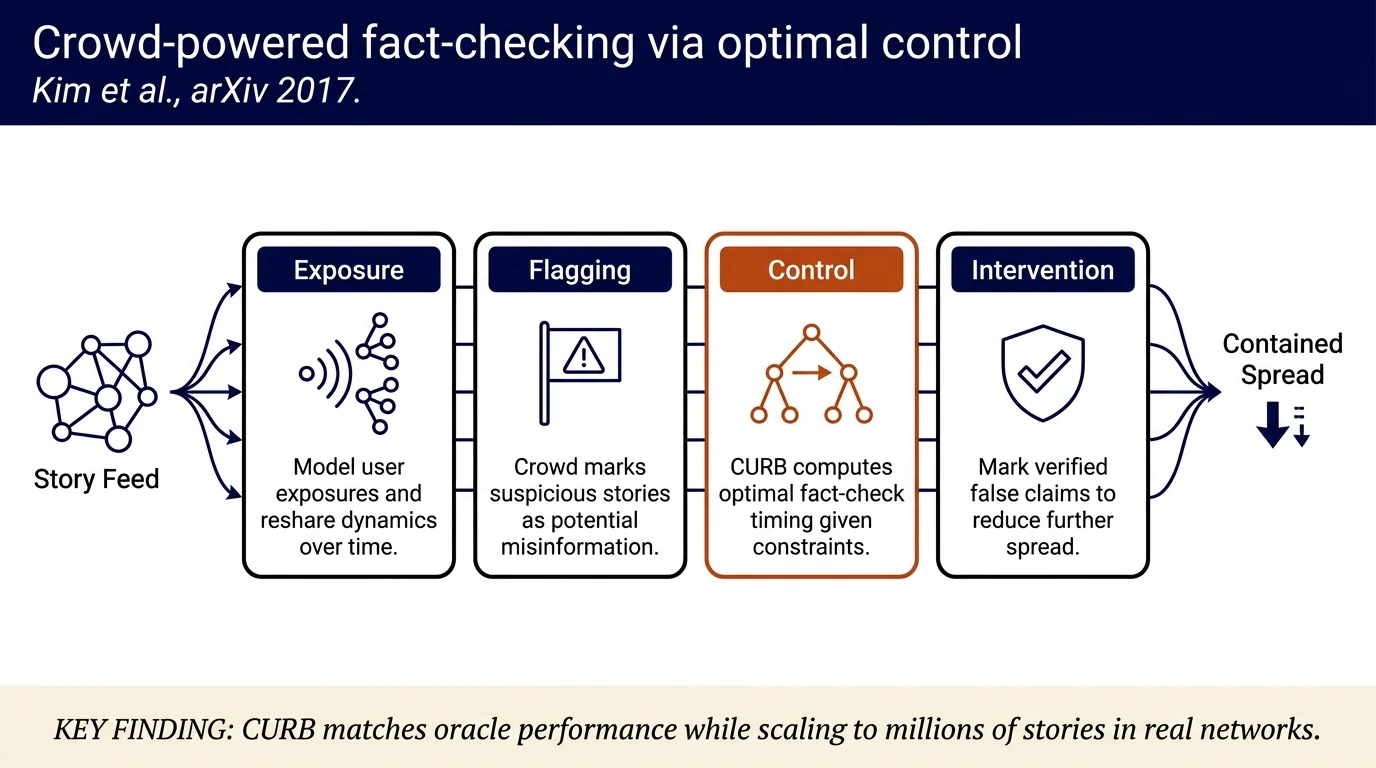
Leveraging the Crowd to Detect and Reduce the Spread of Fake News and MisinformationOnline social networks use crowd-powered flagging to identify misinformation: when users flag a story, enough flags trigger fact-checking, which disputes false claims. This paper formulates the problem of deciding which stories to fact-check and when, subject to limited fact-checking resources, as a stochastic optimal control problem.
 Spread & networksDetection methods
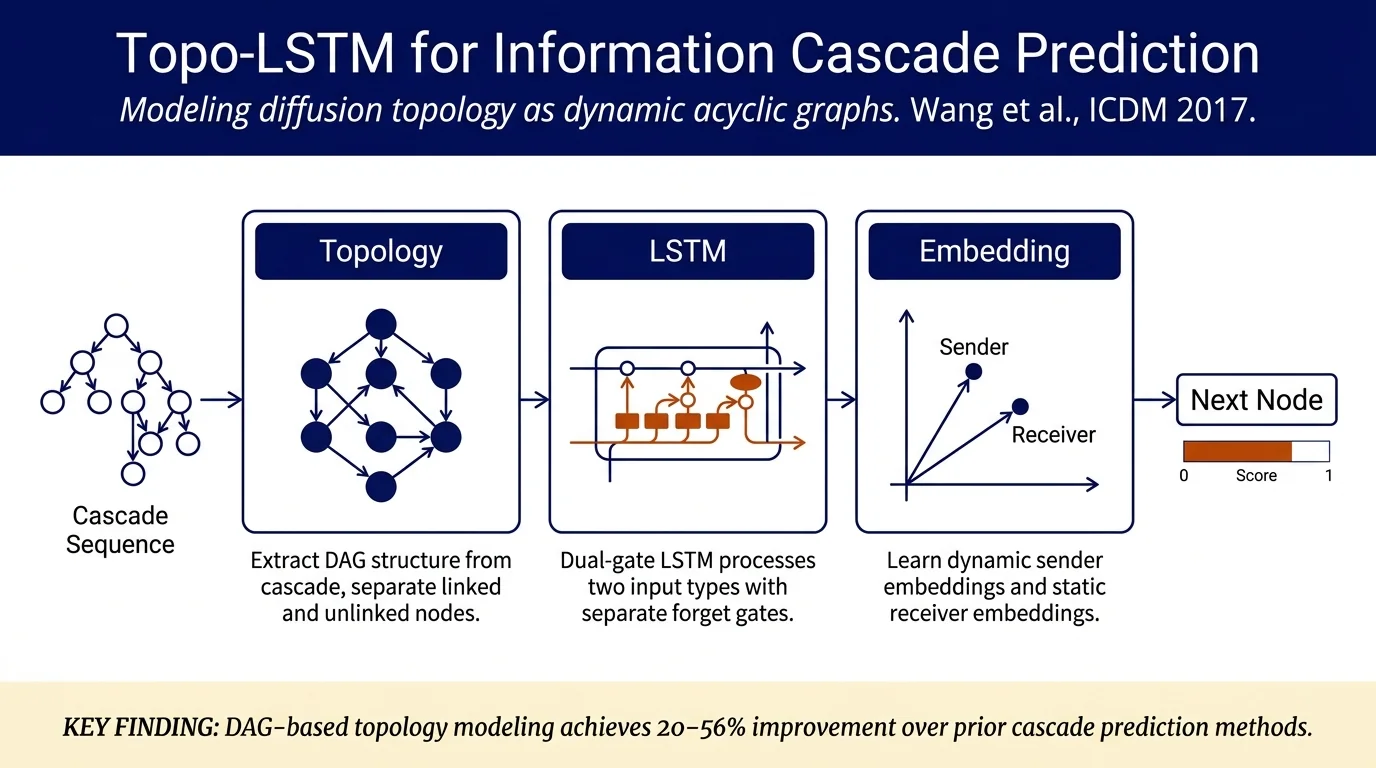
Topological Recurrent Neural Network for Diffusion PredictionWang et al. propose Topo-LSTM, a novel LSTM architecture for modeling dynamic directed acyclic graphs (DAGs) to predict which node will be activated next in information cascades. The key insight is that information diffusion on networks should be modeled explicitly as diffusion topologies—graphs showing how information spreads from…
 Datasets & evaluationFact-checking & verification
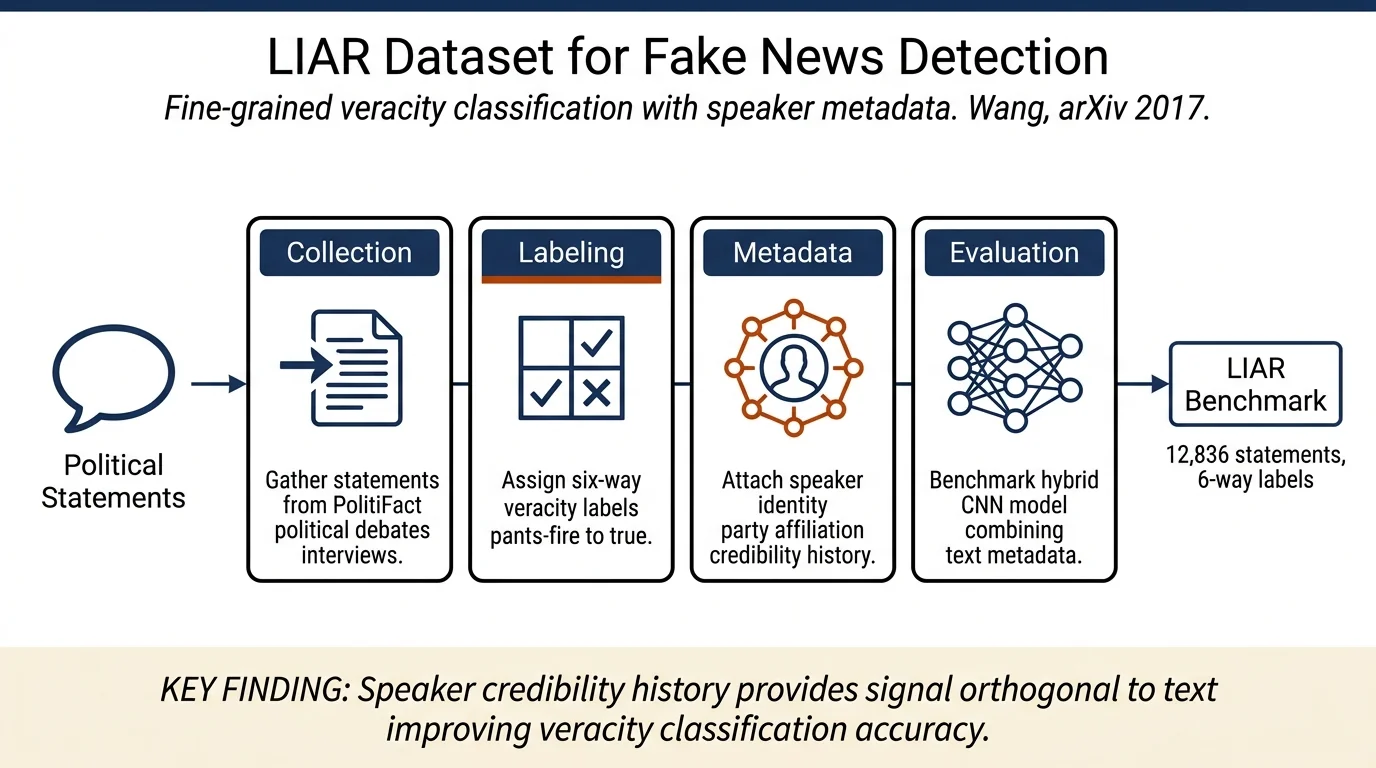
Liar, Liar Pants on Fire: A New Benchmark Dataset for Fake News DetectionThis paper introduces LIAR, a benchmark dataset of 12,836 manually labeled short statements from POLITIFACT.COM spanning 2007–2016, addressing the critical lack of labeled data for fake news detection. Each statement is annotated with fine-grained veracity labels (pants-fire, false, barely-true, half-true, mostly-true, true) and rich…
 Detection methodsSpread & networks
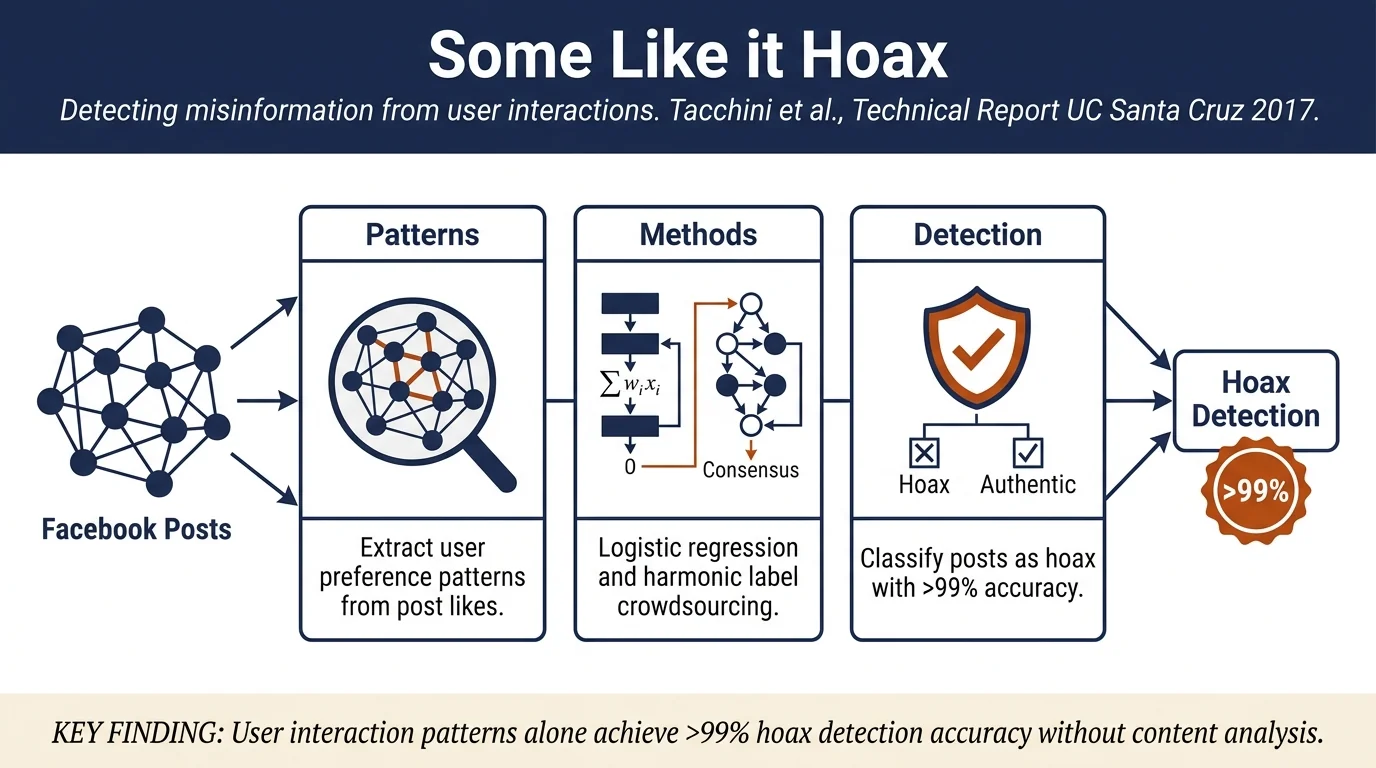
Some Like it Hoax: Automated Fake News Detection in Social NetworksHoaxes on Facebook can be detected with 99% accuracy using user interaction patterns (who "liked" posts) rather than content analysis. Two algorithms—logistic regression and harmonic boolean crowdsourcing—achieve high accuracy even with minimal labeled training data, and knowledge transfers across different Facebook communities.
 Fact-checking & verificationDatasets & evaluation
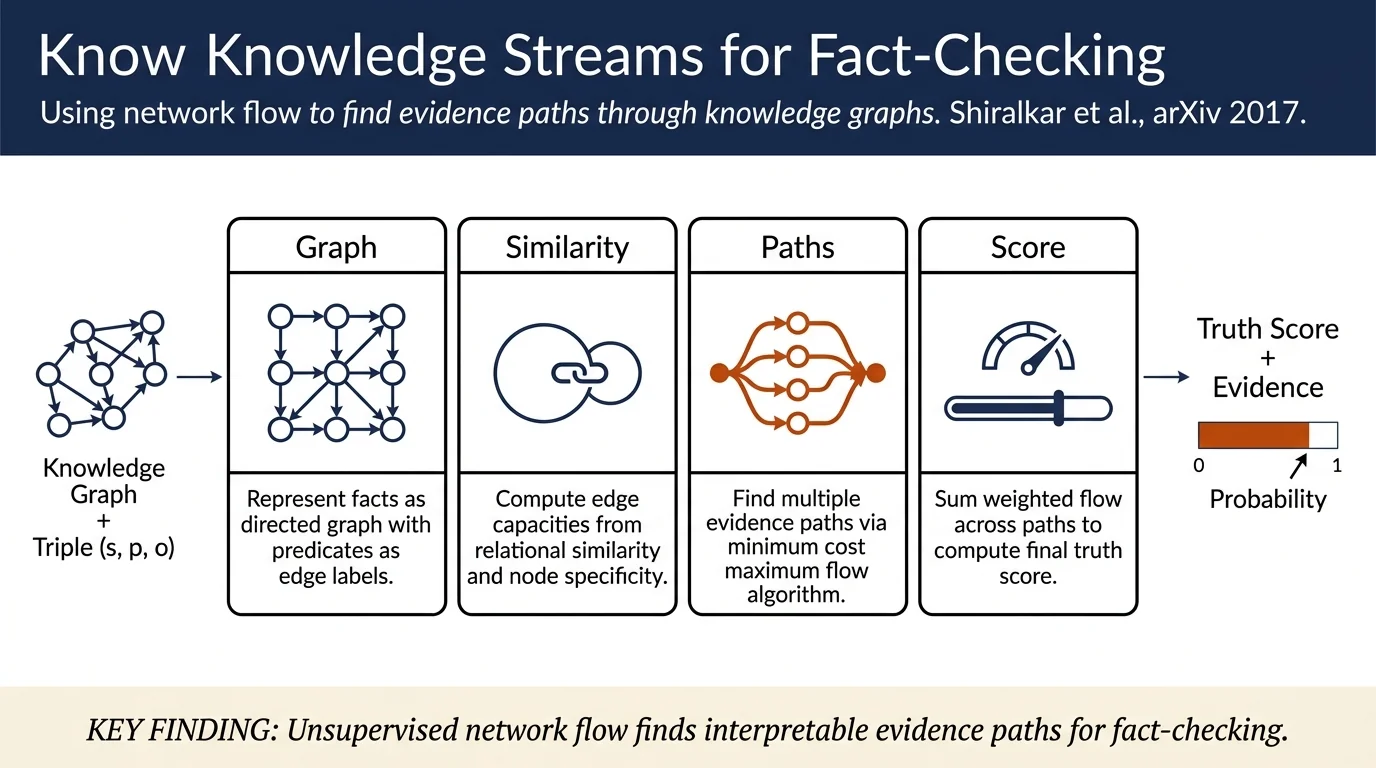
Finding Streams in Knowledge Graphs to Support Fact CheckingKnowledge Stream (KS) is an unsupervised network-flow approach for computational fact-checking that treats a knowledge graph as a flow network. For a triple (subject, predicate, object), KS finds multiple paths connecting subject to object and uses edge capacities (based on relational similarity and node specificity) to compute a truth…
 Spread & networksDetection methods
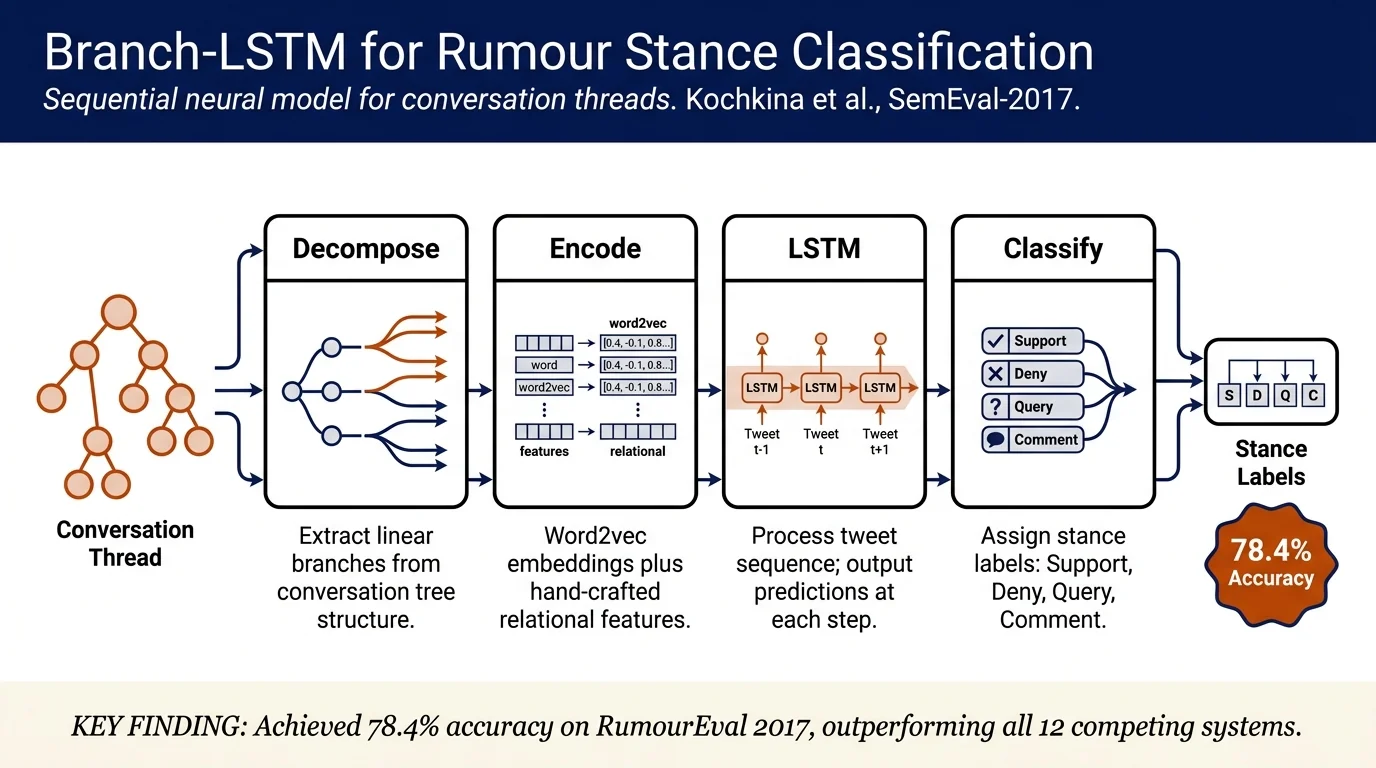
Turing at SemEval-2017 Task 8: Sequential Approach to Rumour Stance Classification with Branch-LSTMThis paper proposes Branch-LSTM, a sequential neural model for rumour stance classification in Twitter conversations. By decomposing conversation threads into linear branches and modeling them with LSTM layers, the approach captures conversational context while assigning stance labels (Support/Deny/Query/Comment) to each tweet.
 Bots & coordinated campaignsDetection methods
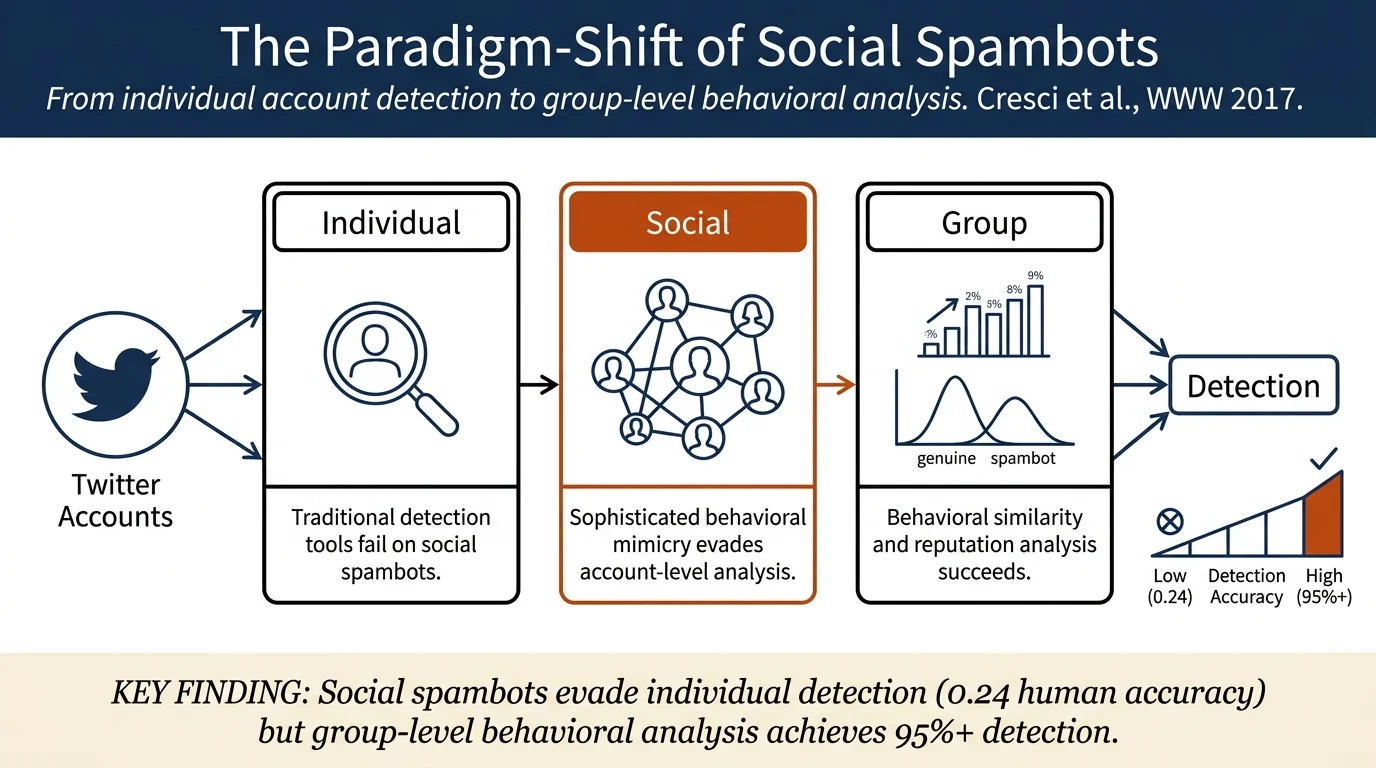
The Paradigm-Shift of Social Spambots: Evidence, Theories, and Tools for the Arms RaceThis paper provides empirical evidence of a paradigm shift in spambot design on Twitter, where new "social spambots" closely mimic genuine user behavior and successfully evade detection. Neither Twitter's automated systems, human annotators, nor established academic detection tools can effectively identify these accounts; however,…
 Bots & coordinated campaignsDatasets & evaluation
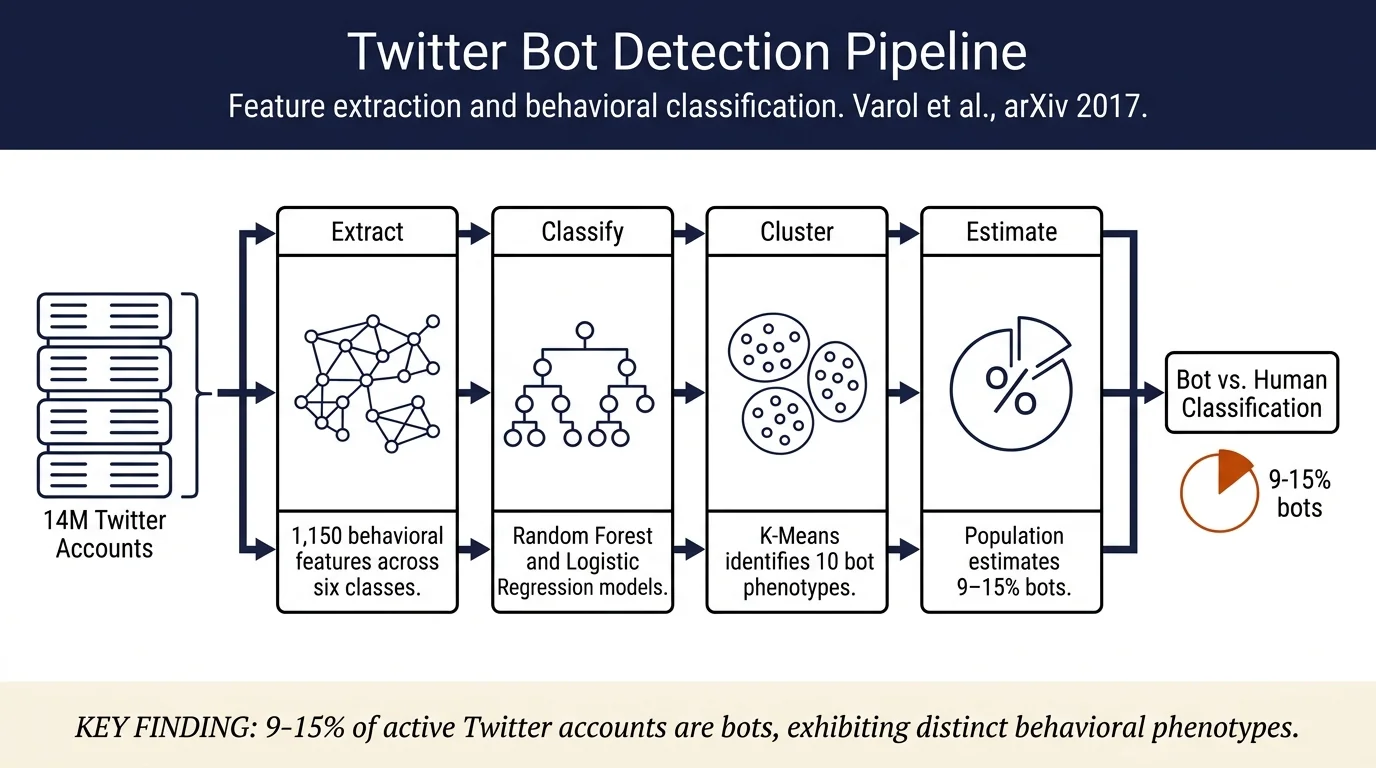
Online Human-Bot Interactions: Detection, Estimation, and CharacterizationSocial media accounts controlled by software can mimic human behavior while executing coordinated campaigns. This paper develops a machine-learning framework extracting 1,150 behavioral features from Twitter account metadata, posting patterns, and social networks to classify bots with 95% accuracy on honeypot data.
 Detection methodsDatasets & evaluation
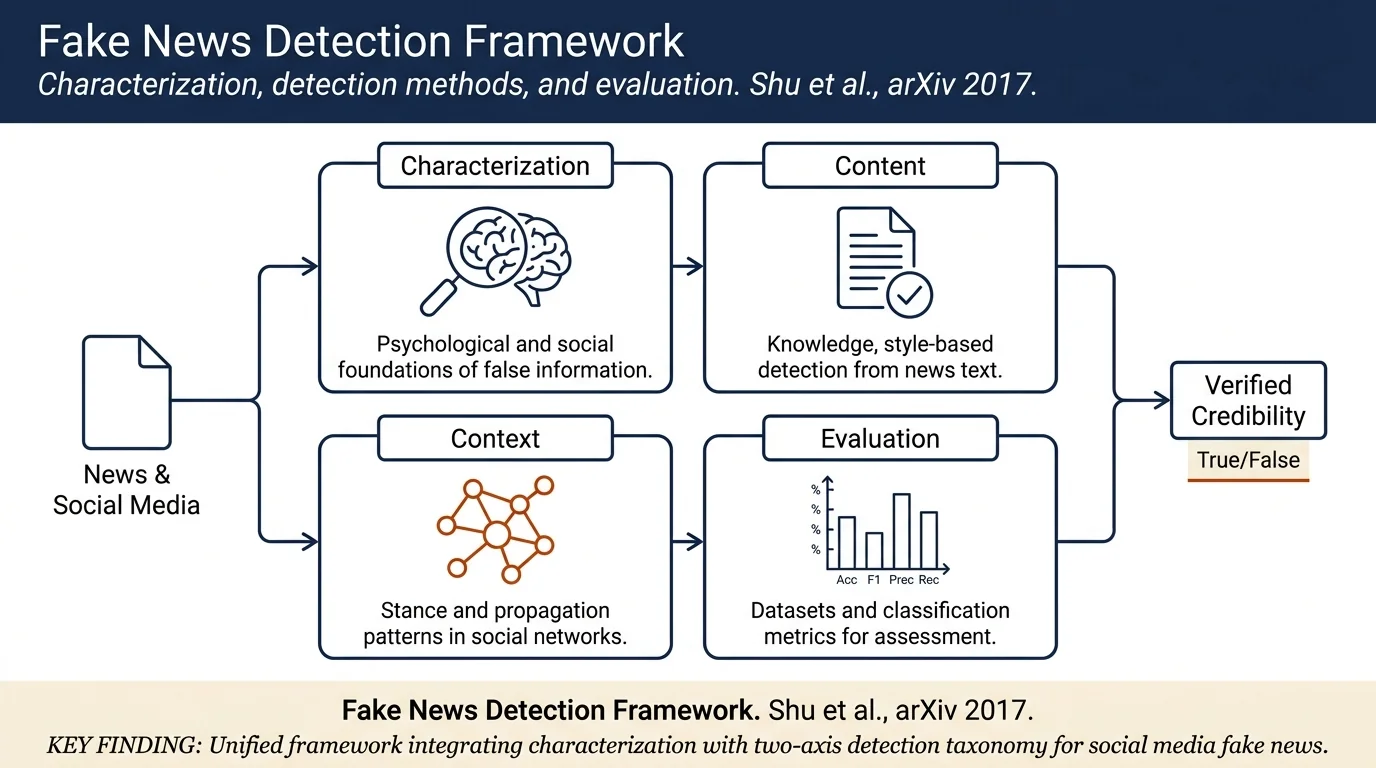
Fake News Detection on Social Media: A Data Mining PerspectiveThis comprehensive survey reviews fake news detection on social media through a data mining lens. It frames the problem around two key aspects—characterization (understanding the psychological and social foundations of fake news) and detection (building computational methods using news content and social context features).
 Spread & networksBots & coordinated campaigns
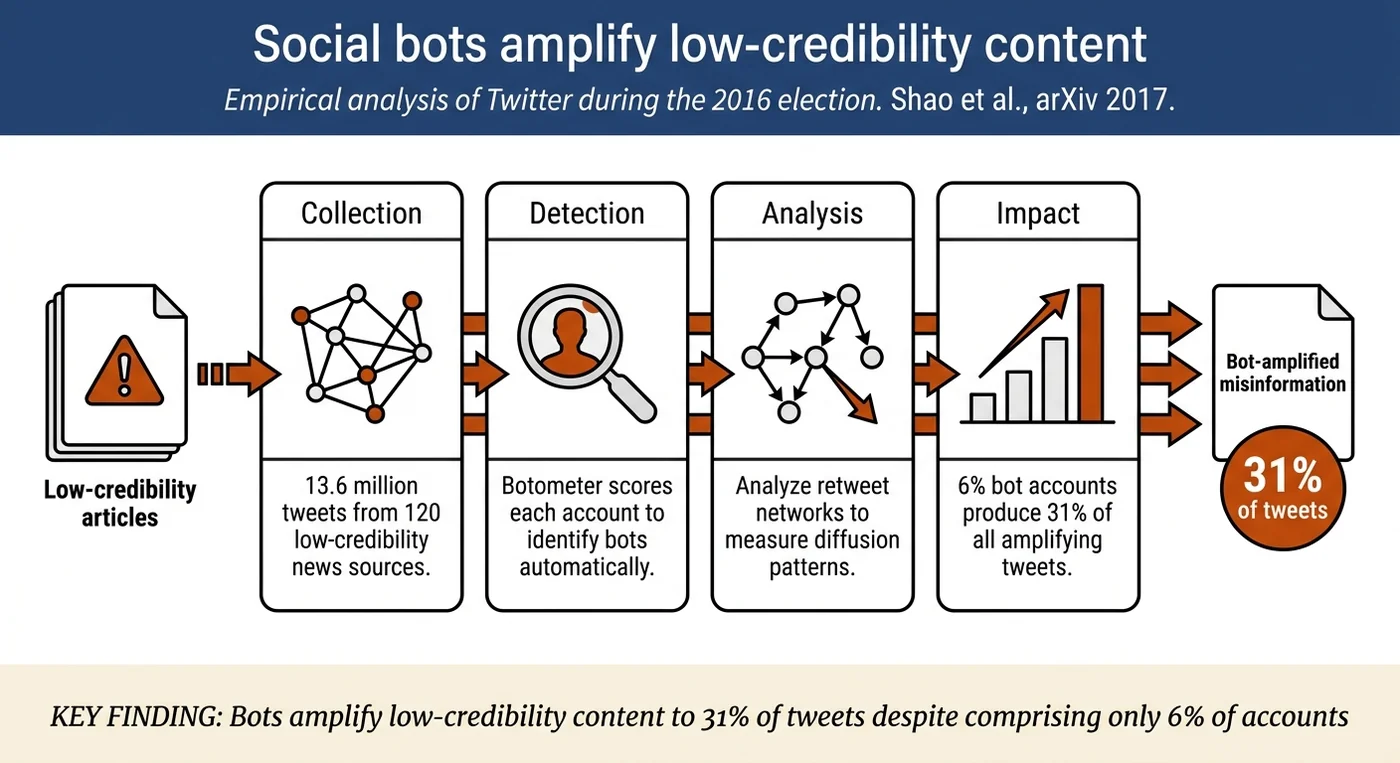
The spread of low-credibility content by social botsEmpirical analysis of 14 million Twitter messages during the 2016 U.S. election finds social bots disproportionately amplify low-credibility content: though bots comprise only 6% of accounts sharing such content, they account for 31% of tweets. Bots employ two strategies—rapid early amplification and targeting of influential users—making…
 Detection methodsLLMs & generative AI
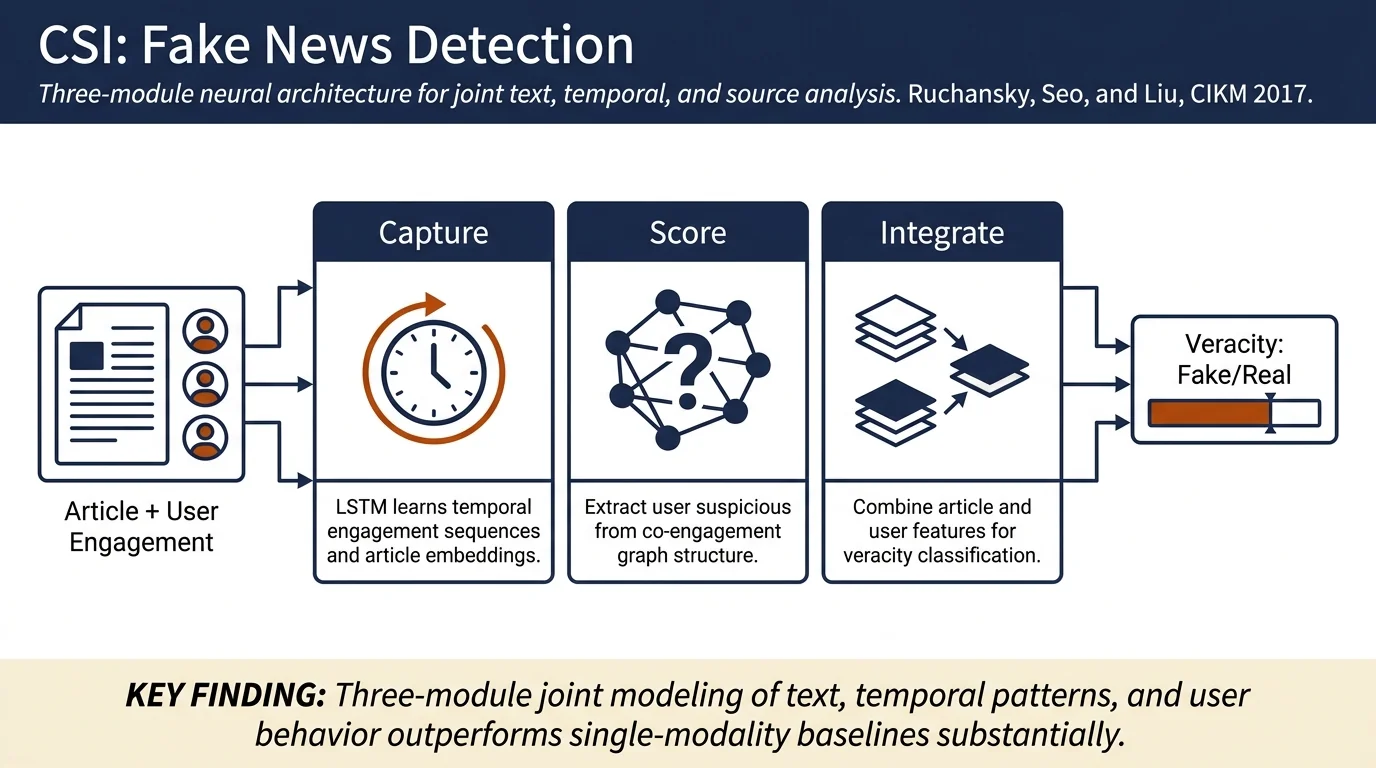
CSI: A Hybrid Deep Model for Fake News DetectionCSI is a three-module deep learning model that detects fake news by jointly modeling article text, temporal patterns of user engagement (response), and user behavior patterns (source). The Capture module uses LSTM to learn temporal response signals; the Score module learns user suspiciousness from co-engagement patterns; the Integrate…
 Detection methodsFact-checking & verification
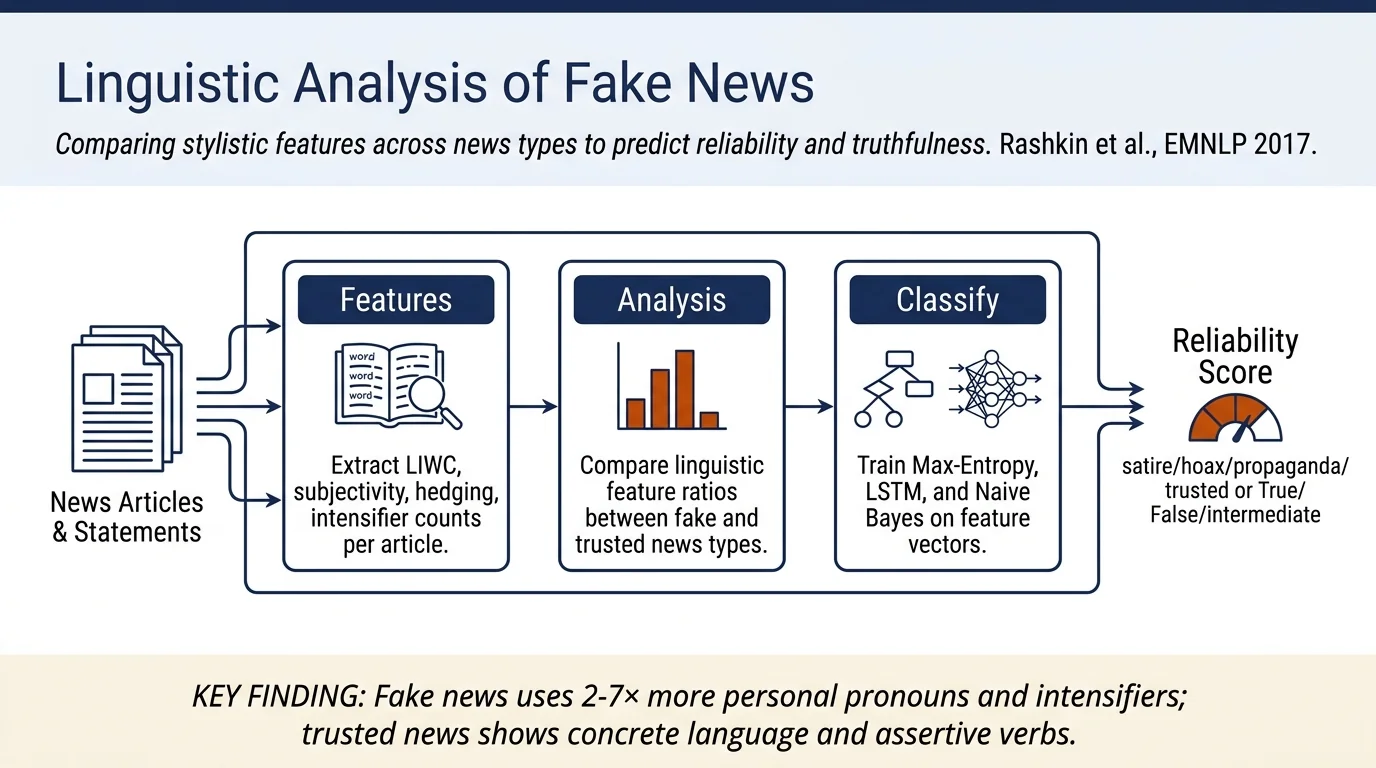
Truth of Varying Shades: Analyzing Language in Fake News and Political Fact-CheckingThis paper performs a linguistic analysis of fake news across four categories—satire, hoaxes, propaganda, and trusted news—using lexical features (LIWC, subjectivity, hedging, intensifiers). Experiments show that fake news articles use more first-person pronouns, exaggerative language (superlatives, modal adverbs), and hedging, while…
 Detection methodsDatasets & evaluation
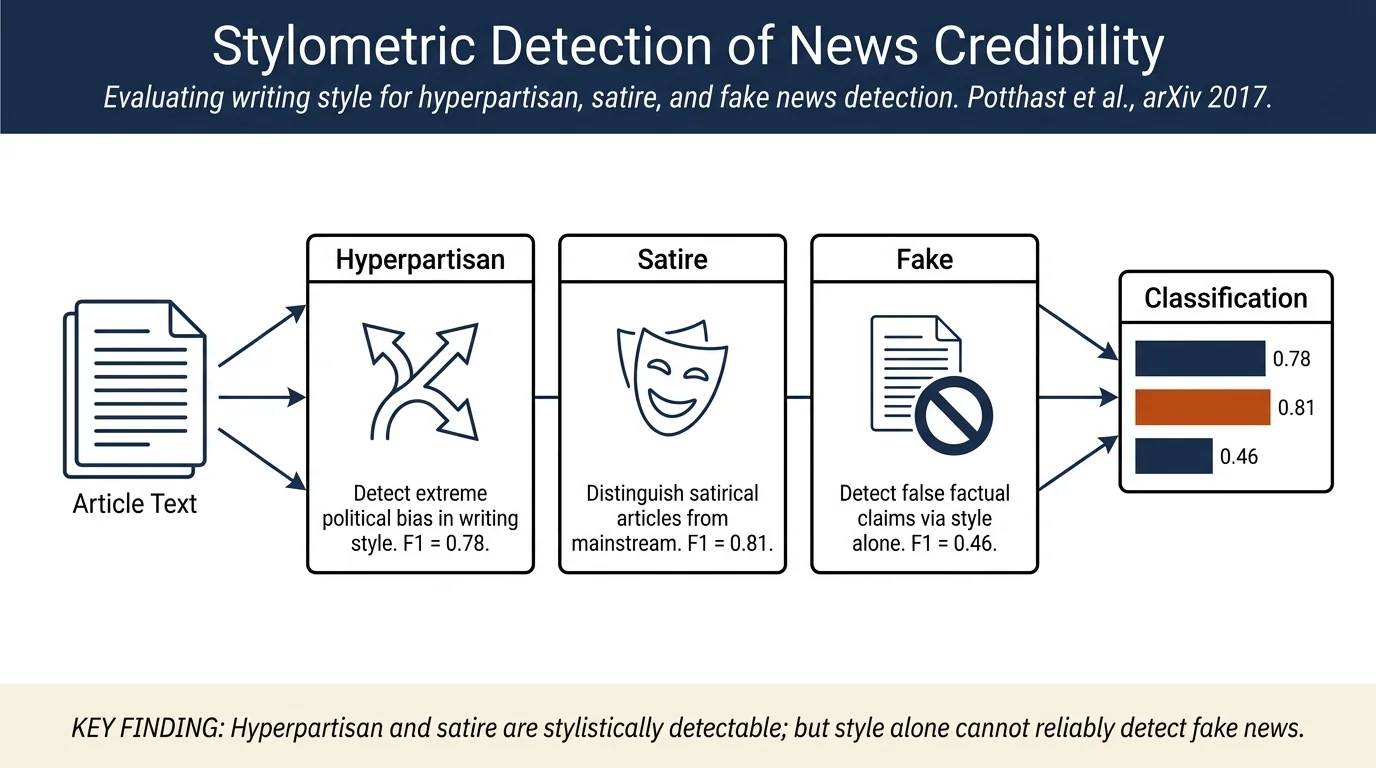
A Stylometric Inquiry into Hyperpartisan and Fake NewsThis paper investigates whether writing style alone can distinguish hyperpartisan news from mainstream and fake news from real news. Using a manually fact-checked corpus of 1,627 articles from BuzzFeed, the authors find that hyperpartisan news is stylistically distinct from mainstream (F1 = 0.78), satire is easily distinguishable from…
 Detection methodsSpread & networks
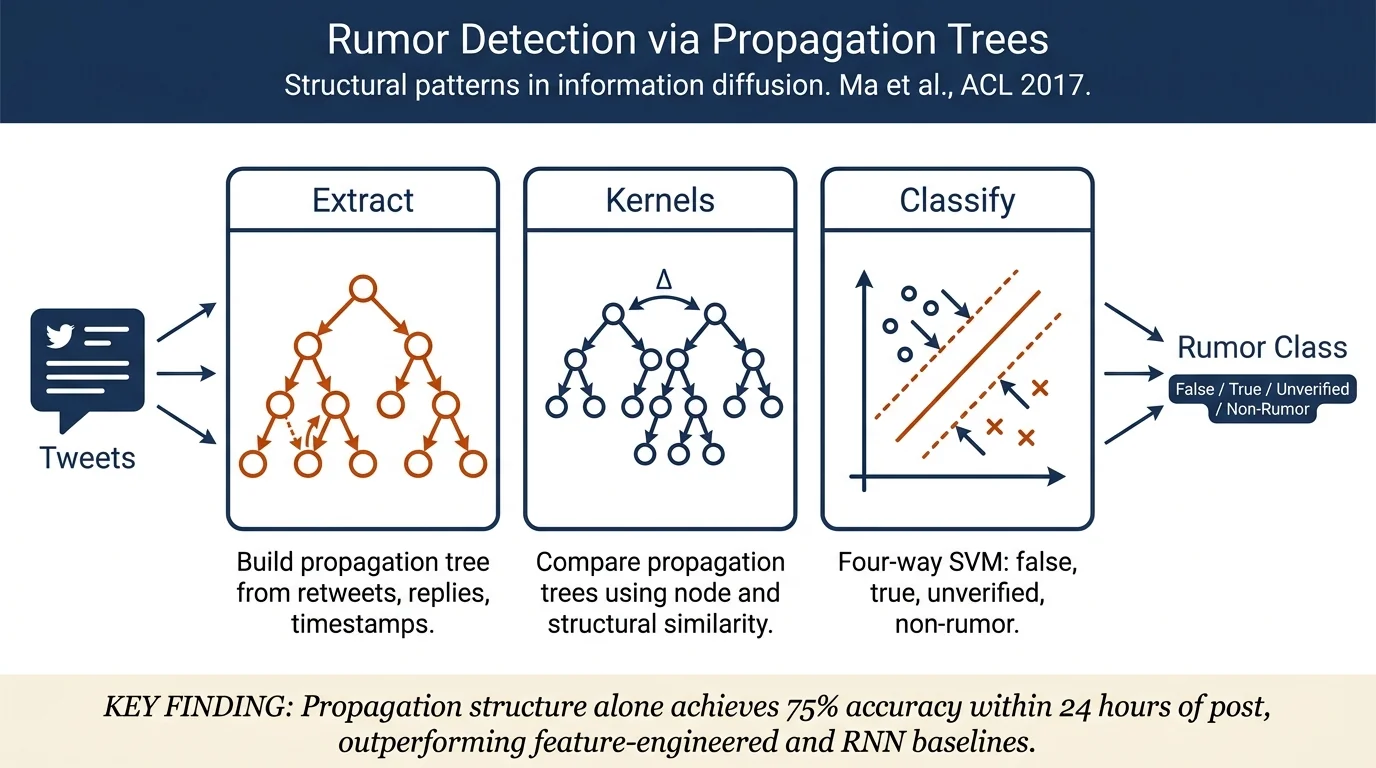
Detect Rumors in Microblog Posts Using Propagation Structure via Kernel LearningThis paper addresses rumor detection in microblog posts by modeling information diffusion as propagation trees and proposing a kernel-based method (PTK) that captures high-order structural patterns differentiating rumors from non-rumors. The approach extends to context-sensitive variants (cPTK) and achieves superior early detection…
 Spread & networksDatasets & evaluation
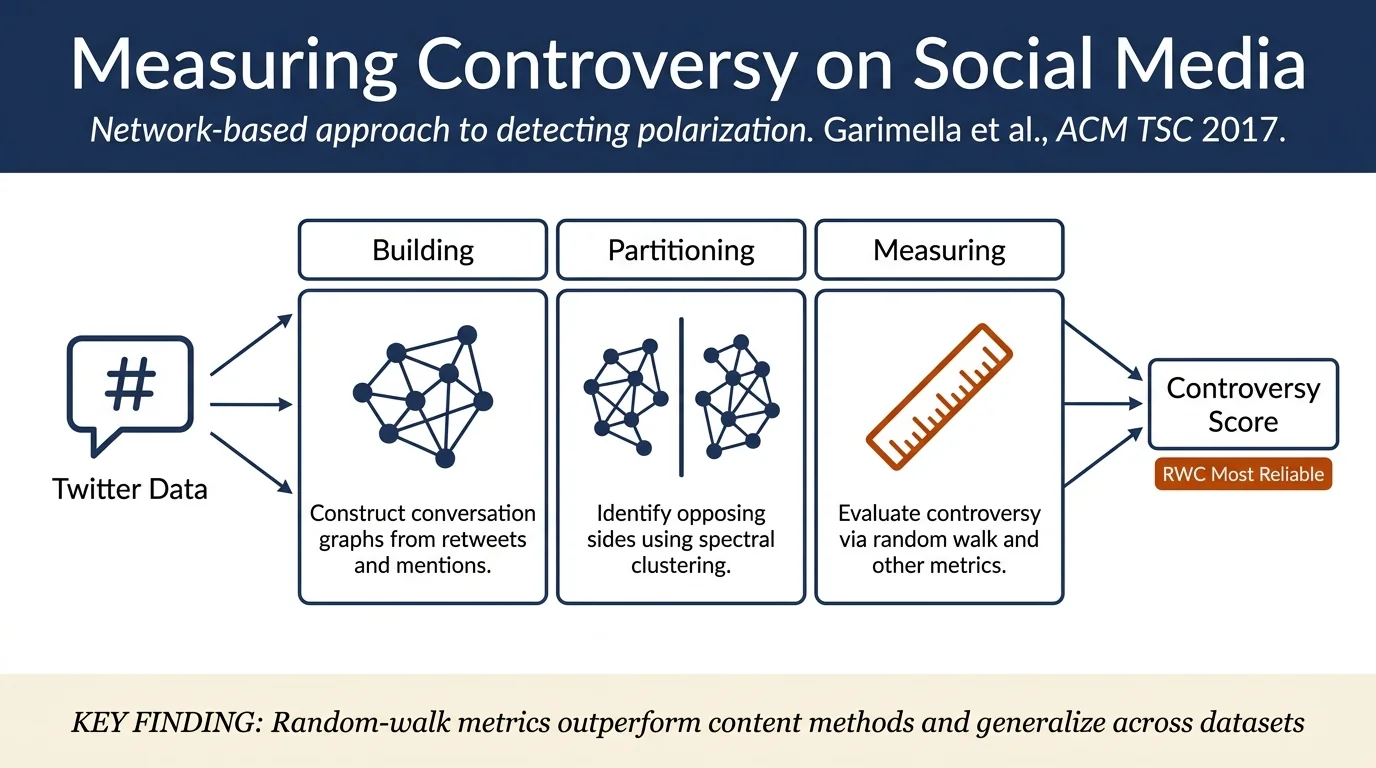
Quantifying Controversy on Social MediaThis work presents a graph-based pipeline to measure controversy in social media discussions. The authors build conversation graphs from Twitter interactions (retweets, follows, mentions), partition them to identify opposing sides, and apply multiple controversy measures—with a random-walk-based metric (RWC) emerging as the most reliable…
 Spread & networksDatasets & evaluation
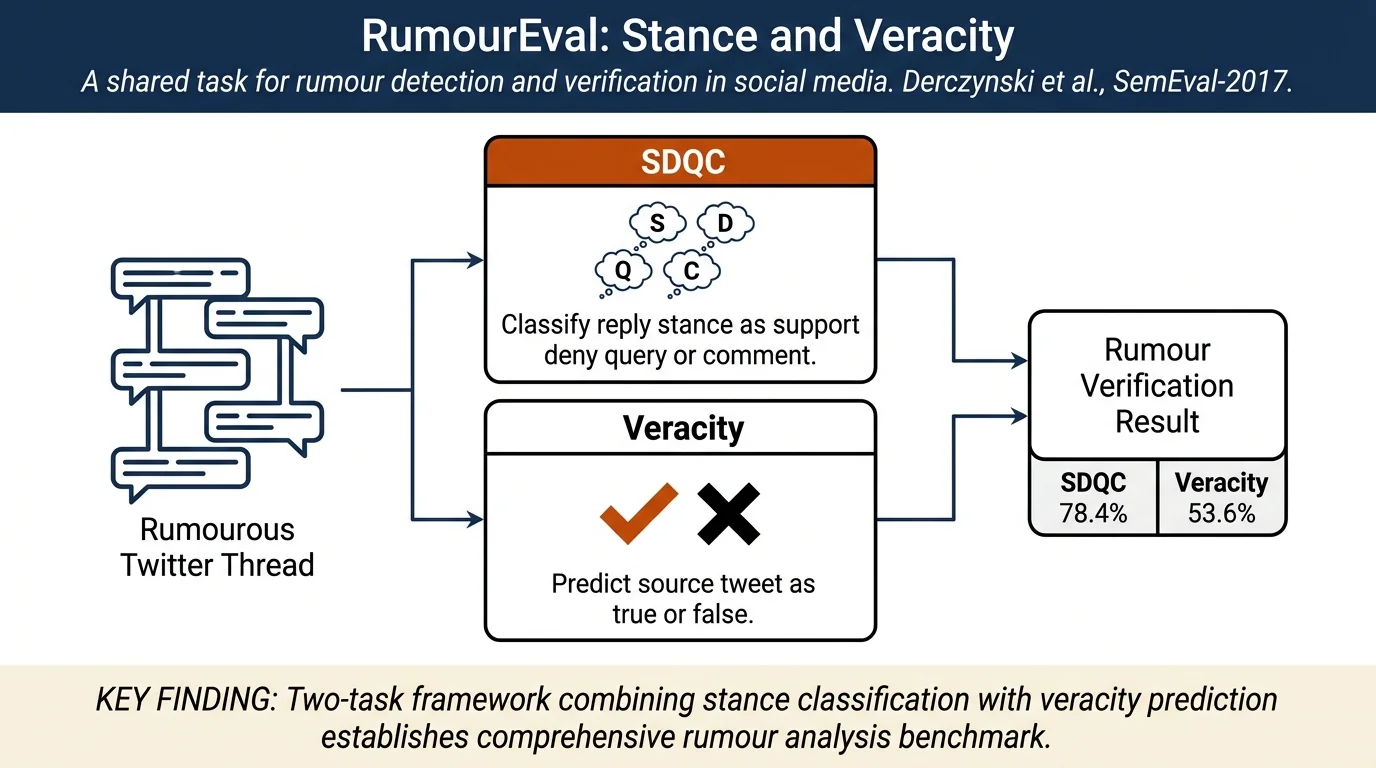
SemEval-2017 Task 8: RumourEval: Determining rumour veracity and support for rumoursRumourEval is a shared task benchmark for detecting and verifying rumours in social media. It introduces two subtasks: (a) stance classification (SDQC: Support/Deny/Query/Comment) of replies to rumourous claims, and (b) veracity prediction (true/false) of source tweets.