Explore everything
Filter by research area, year and venue. Every filter is in the address bar, so you can share a view as a link.
 Detection methodsPlatforms, policy & society
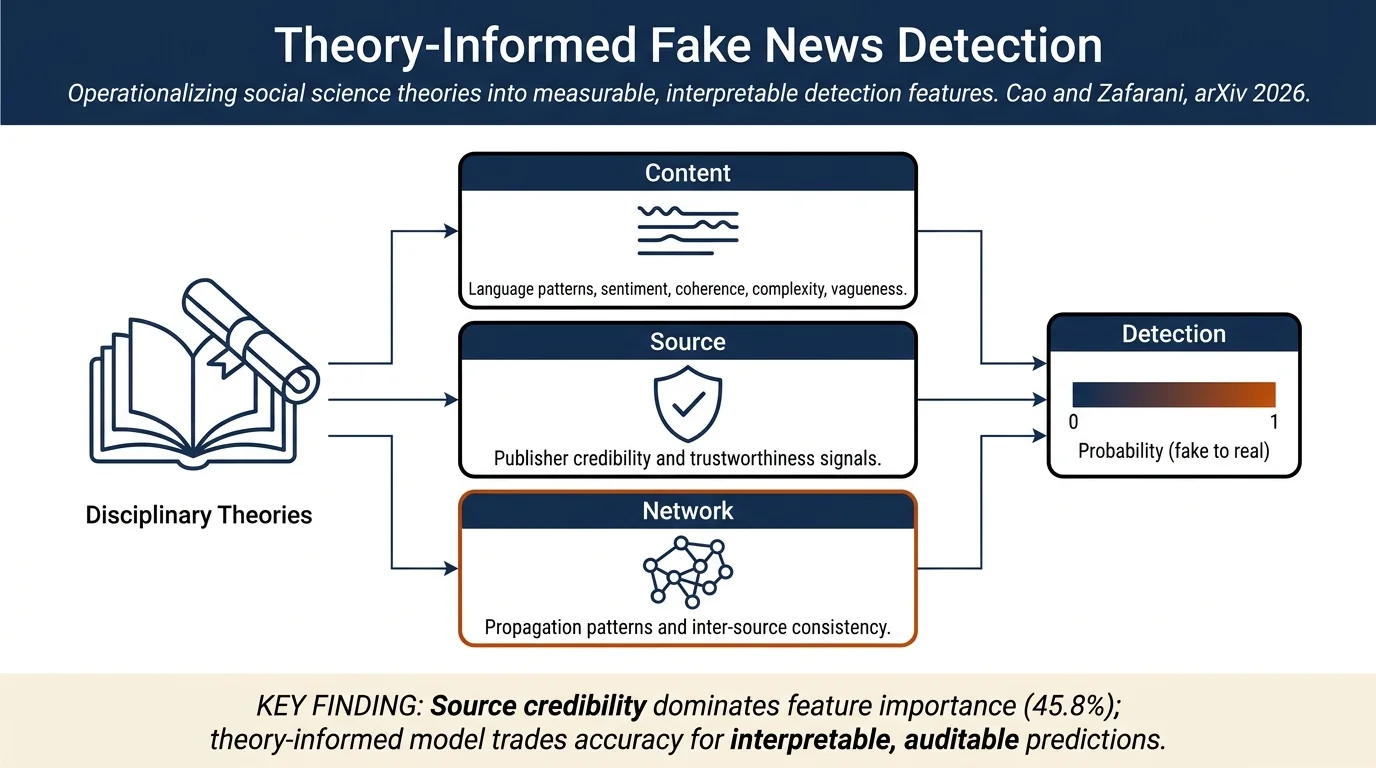
Fake News Theories: Harnessing Disciplinary Insights for Computational Modeling, Detection, and ExplanationThis paper develops a theory-informed computational framework that translates cross-disciplinary social science theories into interpretable, measurable features for fake news detection. The authors systematically review theories from communication, psychology, and economics—organized into content-based, source-related, and network-level…
 Psychology & interventionsDetection methods
Measuring and Reducing Misinformation SusceptibilityJon Roozenbeek presents two major contributions: (1) the Misinformation Susceptibility Test (MIST), a psychometrically validated 20-item measure of how well people distinguish true from false headlines, and (2) findings that video-based inoculation interventions teaching manipulation techniques significantly improve people's ability to…
 Deepfakes & multimodalDetection methods
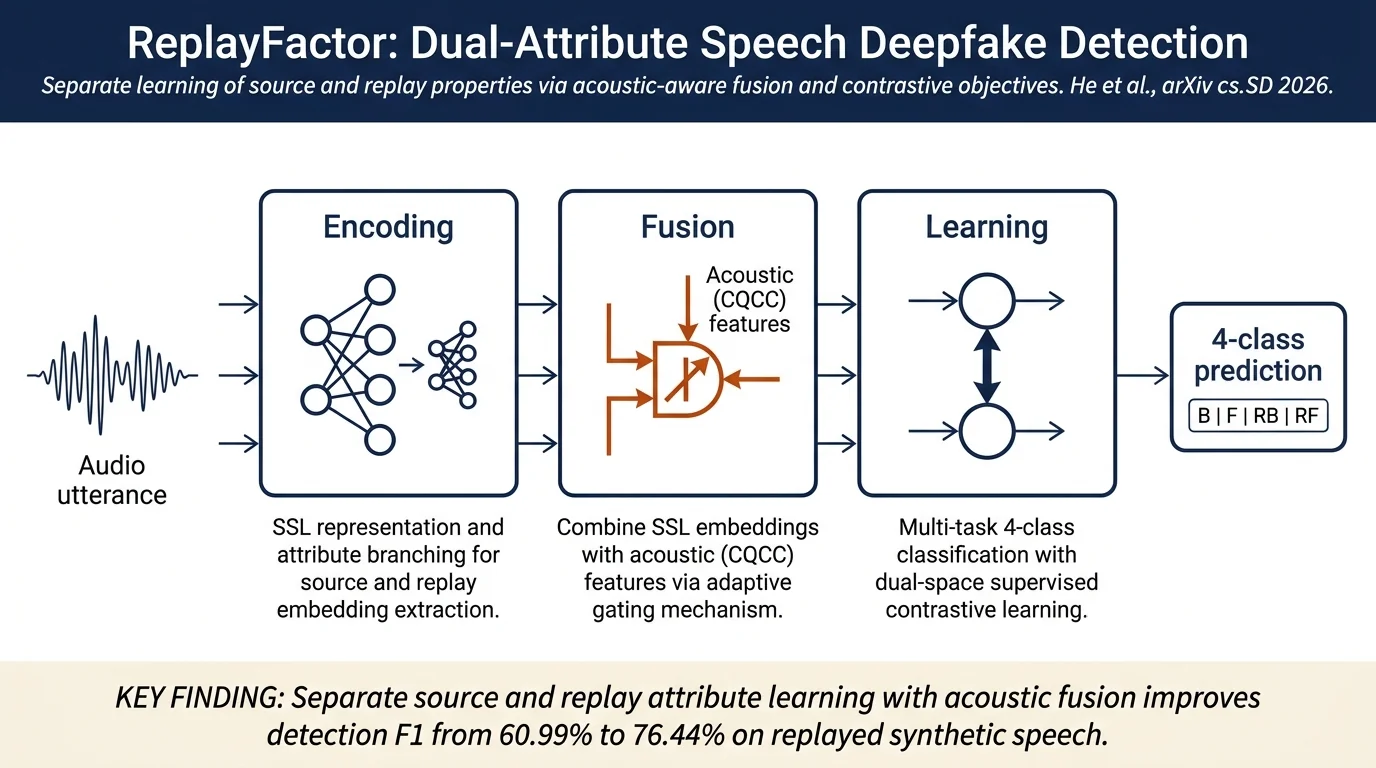
ReplayFactor: Replay-Aware Dual-Attribute Learning for Practical Speech Deepfake DetectionExisting speech deepfake detectors fail on physically replayed synthetic speech (played through a loudspeaker and re-recorded), a low-cost, practical threat to voice authentication systems. ReplayFactor addresses this by learning both source authenticity (human vs. generated) and replay presence (non-replayed vs. replayed) via SSL-based…
 Deepfakes & multimodalDetection methods
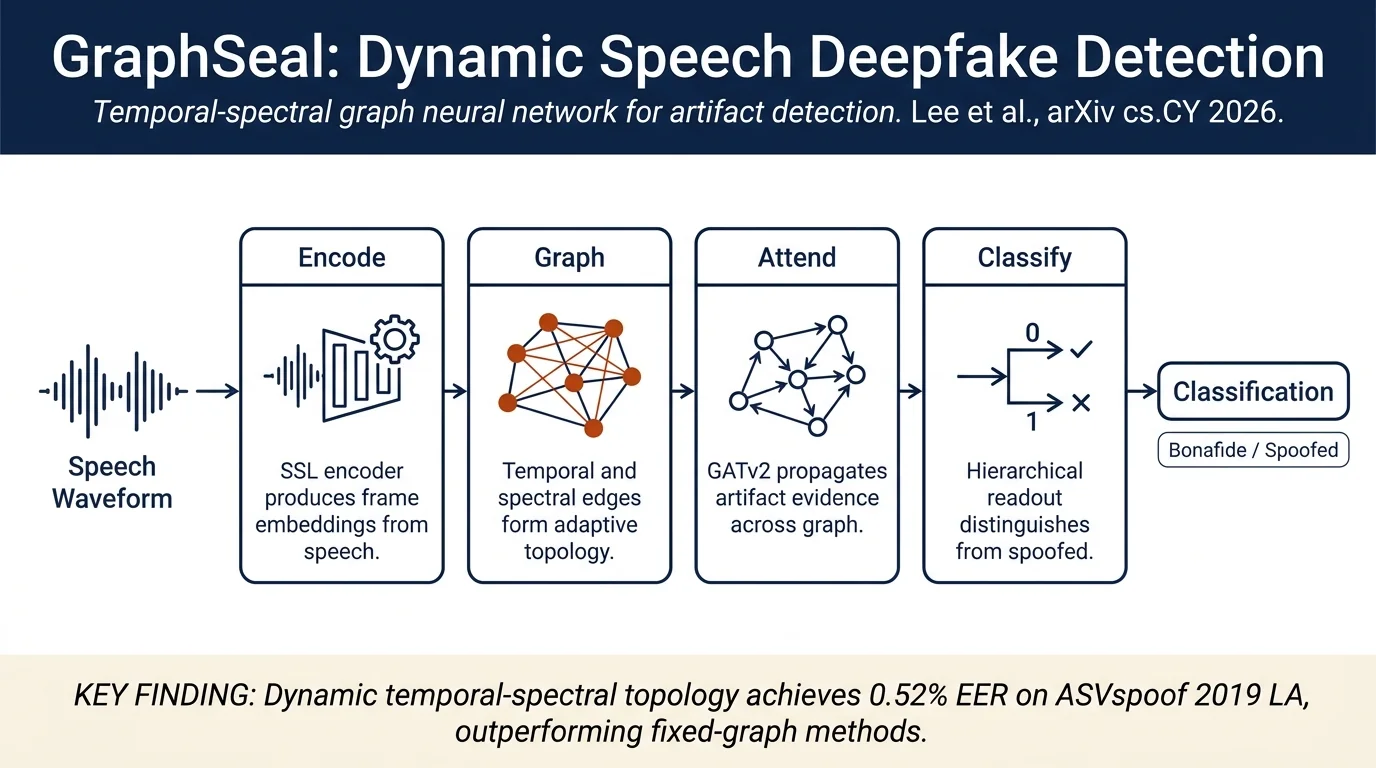
GraphSeal: Graph-Augmented Speech Deepfake Detection via Temporal-Spectral Artifact PropagationGraphSeal proposes a dynamic temporal-spectral graph neural network for speech deepfake detection that outperforms fixed-topology baselines on generalization tasks. Unlike prior graph-based anti-spoofing methods that use feature-extraction-determined topologies, GraphSeal constructs utterance-specific edges from both temporal adjacency…
 Deepfakes & multimodalDetection methods
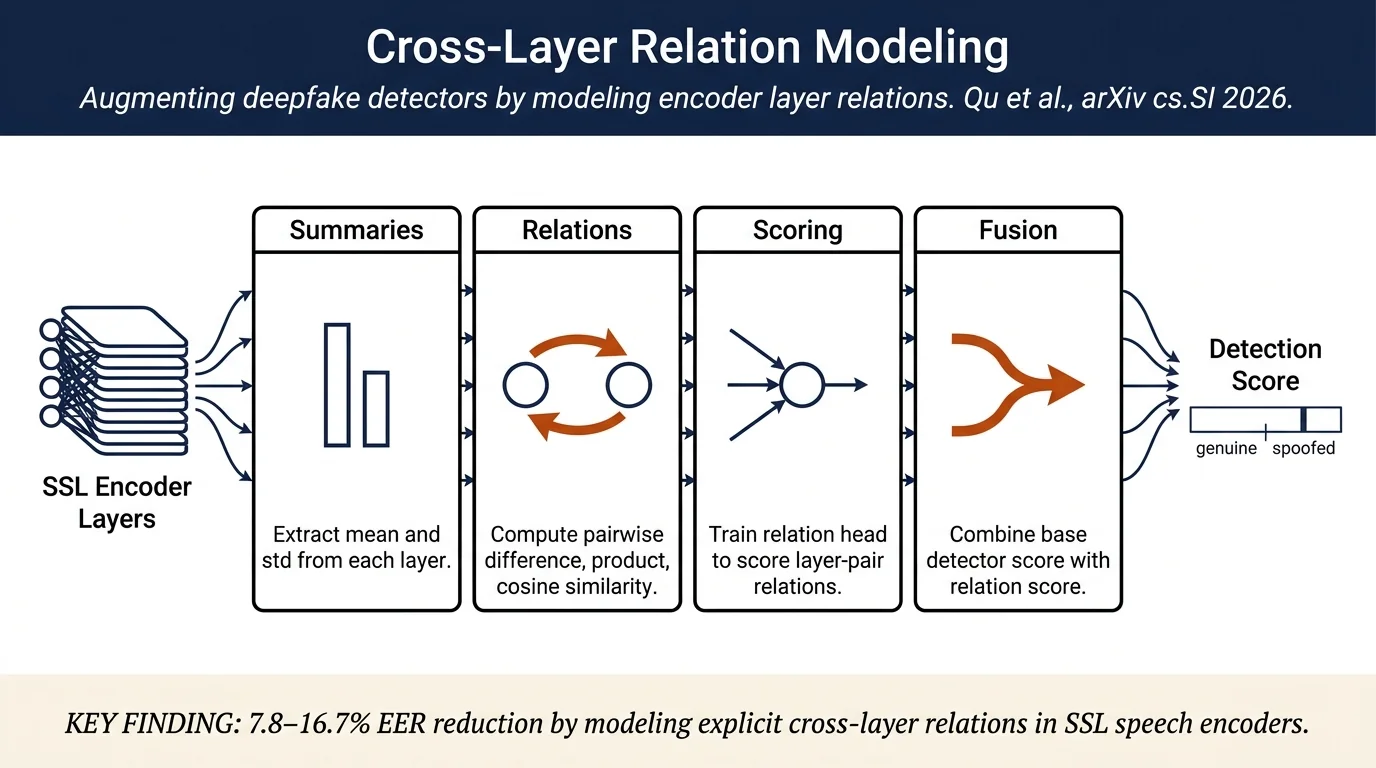
CLRM: Cross-Layer Relation Modeling for Audio Deepfake DetectionAudio deepfake detection (ADD) distinguishes authentic speech from synthetic or manipulated speech. Existing methods either select informative layers from self-supervised learning (SSL) speech encoders or aggregate features across layers, but this discards useful variation in how different layers represent genuine vs. spoofed speech.
 Deepfakes & multimodalDetection methods
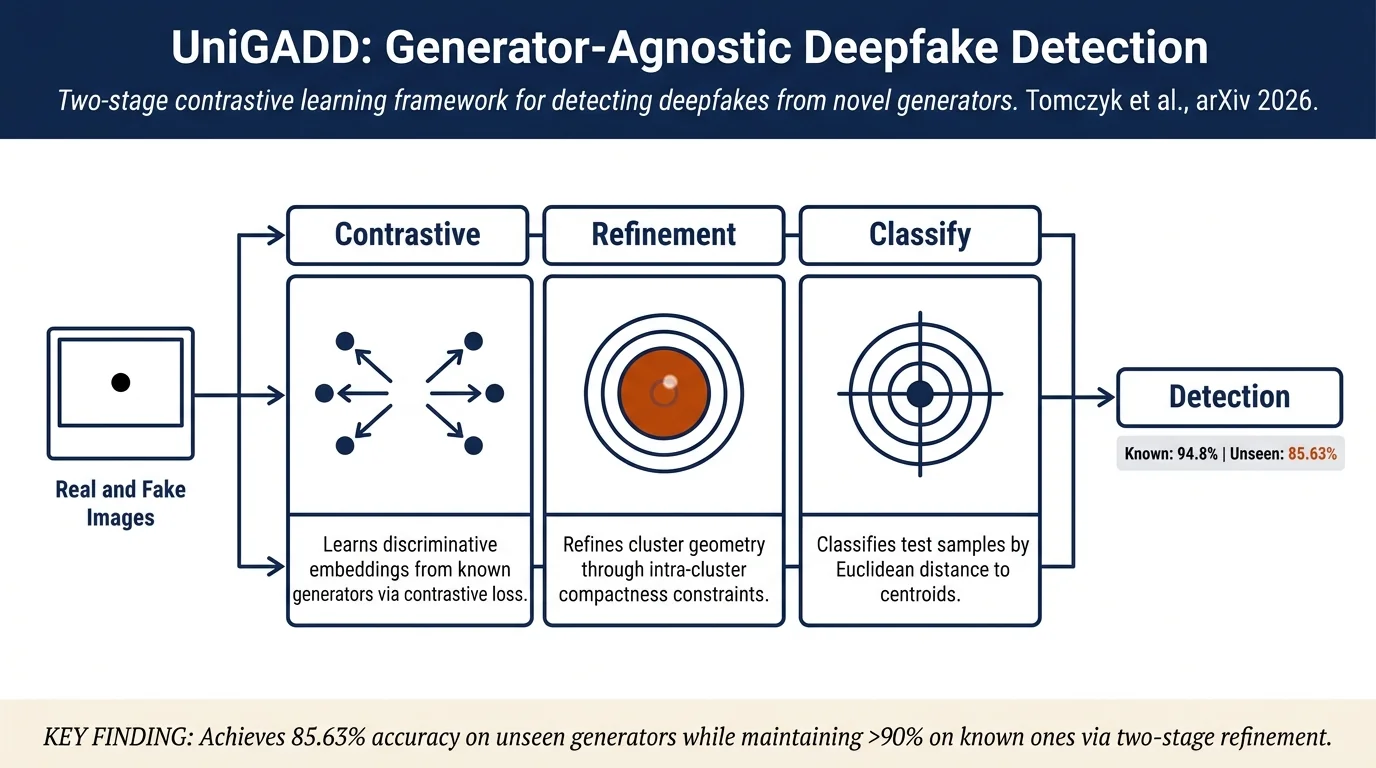
UniGADD: Universal Generator-Agnostic Deepfake DetectorUniGADD proposes a two-stage supervised contrastive learning framework for detecting deepfakes from previously unseen generators. The method learns discriminative embeddings from known fake generators in stage one, then refines cluster structure via intra-cluster compactness constraints in stage two.
 Deepfakes & multimodalDatasets & evaluation
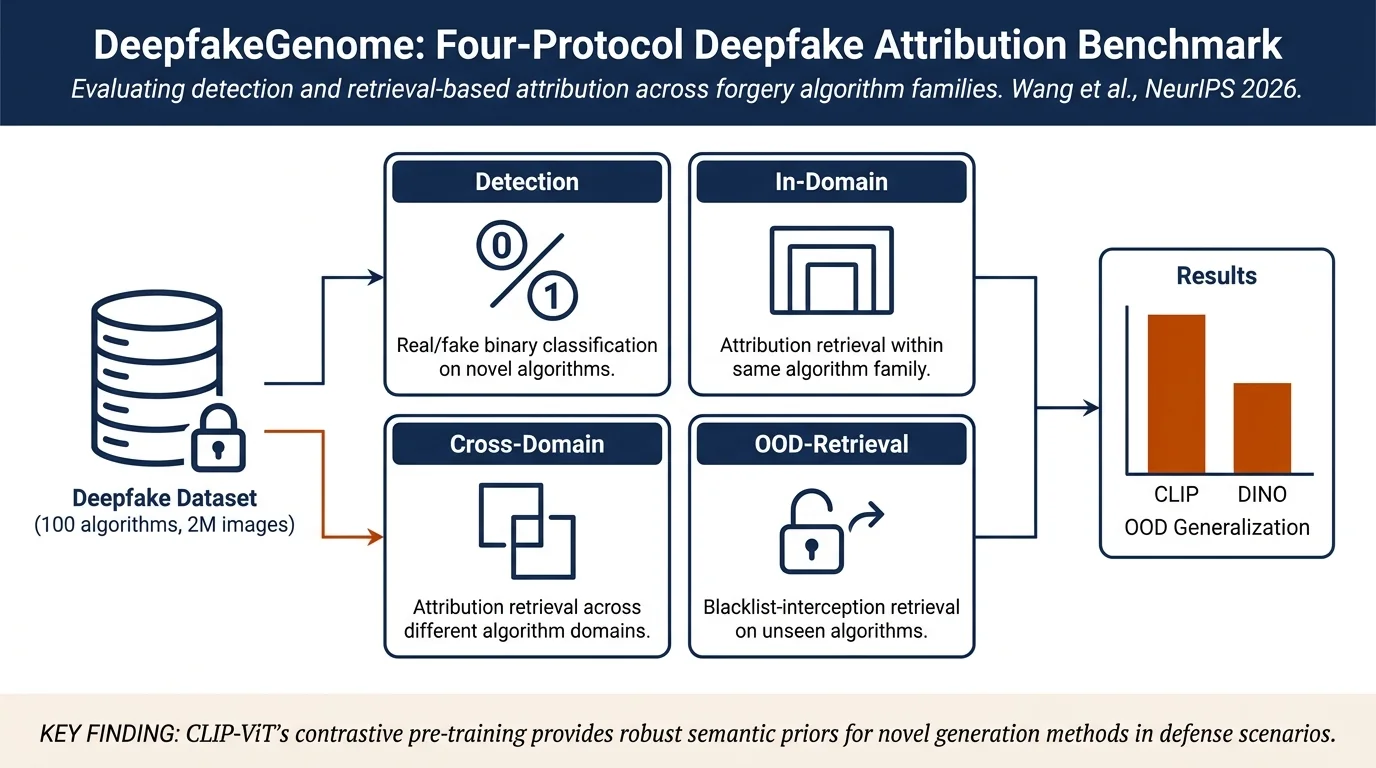
DeepfakeGenome: Toward Next-Generation Deepfake AttributionDeepfakeGenome (DFG) is a large-scale benchmark for deepfake detection and attribution covering 100 facial forgery algorithms and 2M images — 4–100× larger than prior benchmarks. The paper proposes 4 evaluation protocols using novel retrieval-based attribution metrics (mAP, Recall) instead of reject-class classification, and conducts…
 Deepfakes & multimodalDetection methods
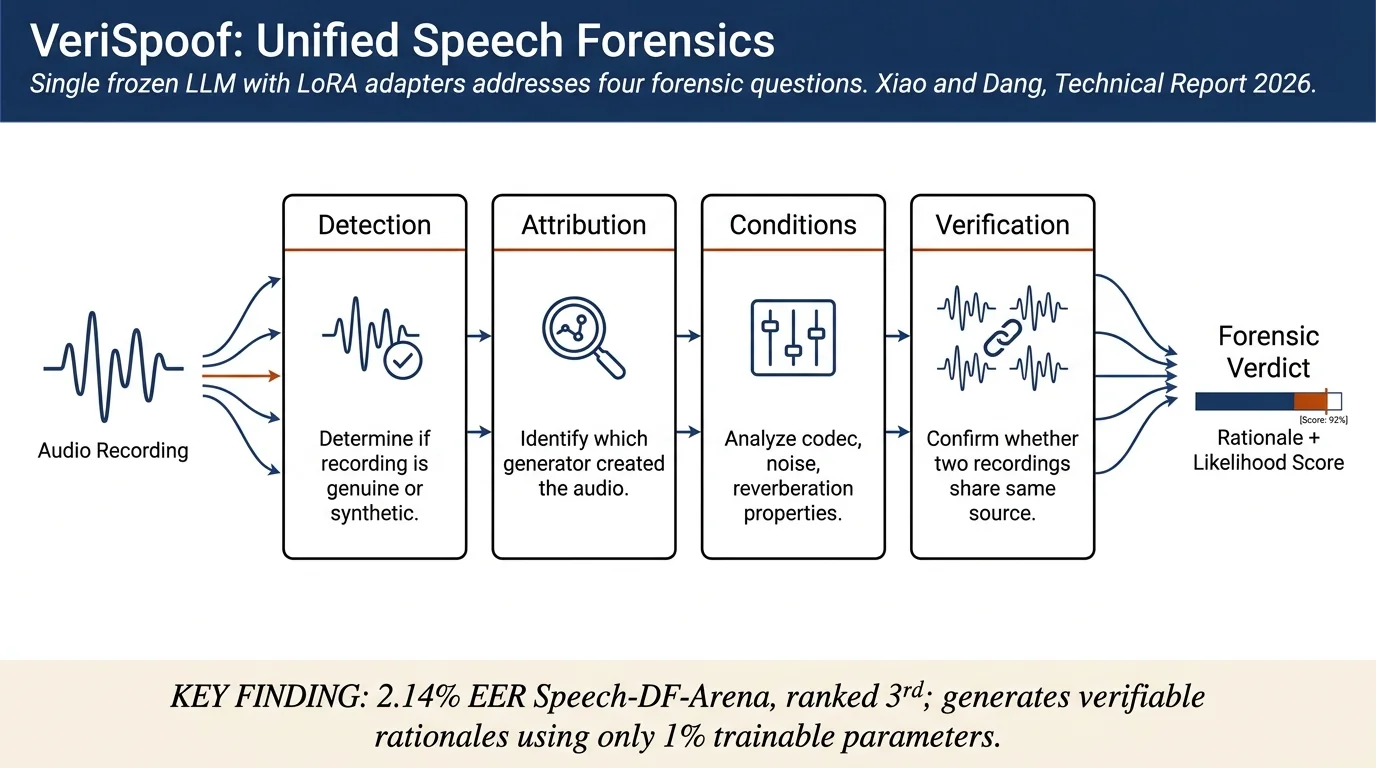
VeriSpoof: Beyond Real or Fake with One Audio LLMVeriSpoof is an audio language model system that unifies multiple forensic tasks in a single neural framework: detecting whether a speech recording is synthetic, identifying which generator produced it, analyzing recording conditions, and verifying whether two recordings share a source. The system achieves state-of-the-art results on…
 Detection methodsLLMs & generative AI
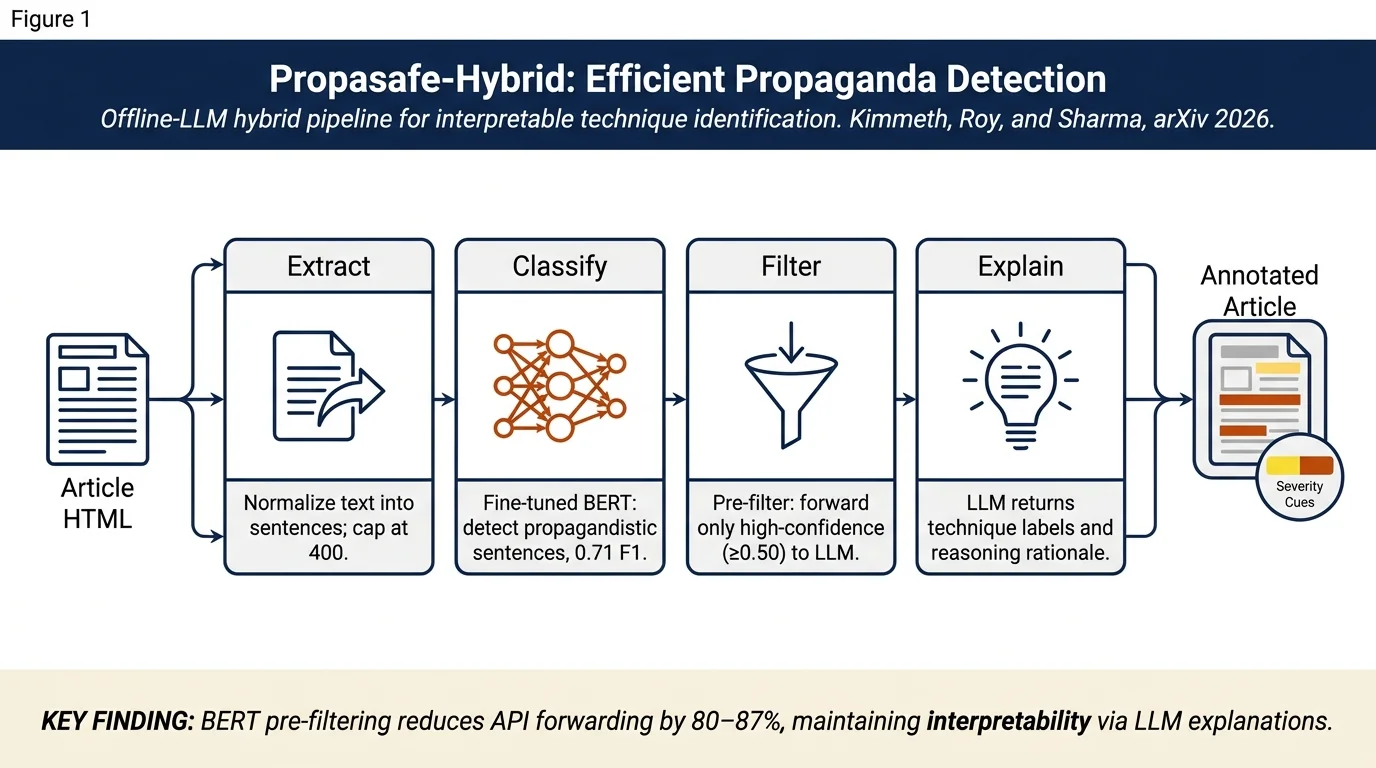
Propasafe-Hybrid: A Text-Based Hybrid Propaganda Detection ToolPropasafe-Hybrid is a sentence-level propaganda detection tool that combines an offline BERT classifier with LLM-based technique identification. The hybrid architecture reduces API token usage (filtering 80–87% of sentences locally) while delivering interpretable technique labels and explanations at the point of consumption.
 Spread & networksDetection methods
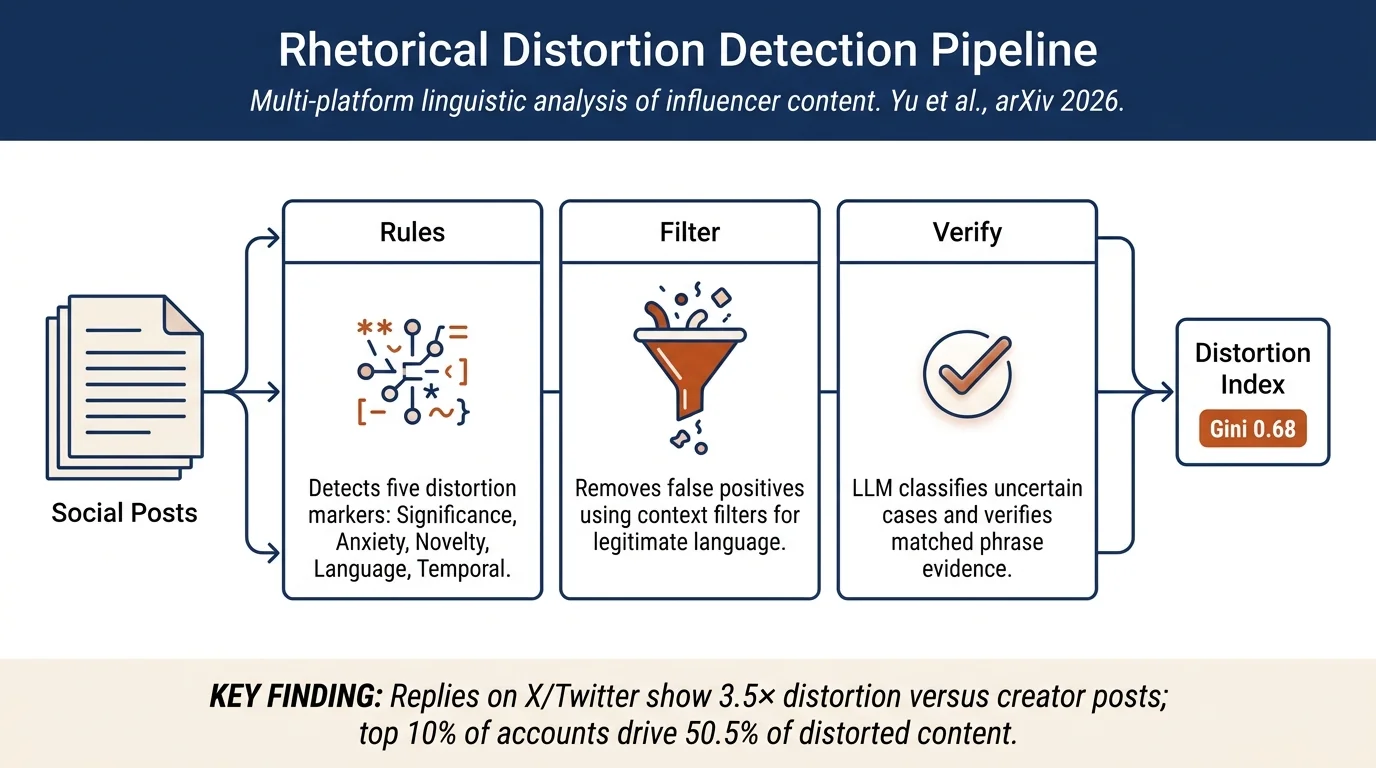
Where Does Rhetorical Distortion Live? A Multi-Platform, Multi-Language Measurement of Influencer ContentRhetorical distortion—misleading framing that inflates significance, manufactures anxiety, or misrepresents novelty—is not uniformly distributed across platforms or account types. This work measures five linguistic dimensions of distortion (Significance Inflation, Anxiety Manufacture, Novelty Claims, Loaded Language, Temporal Distortion)…
 LLMs & generative AIDetection methods
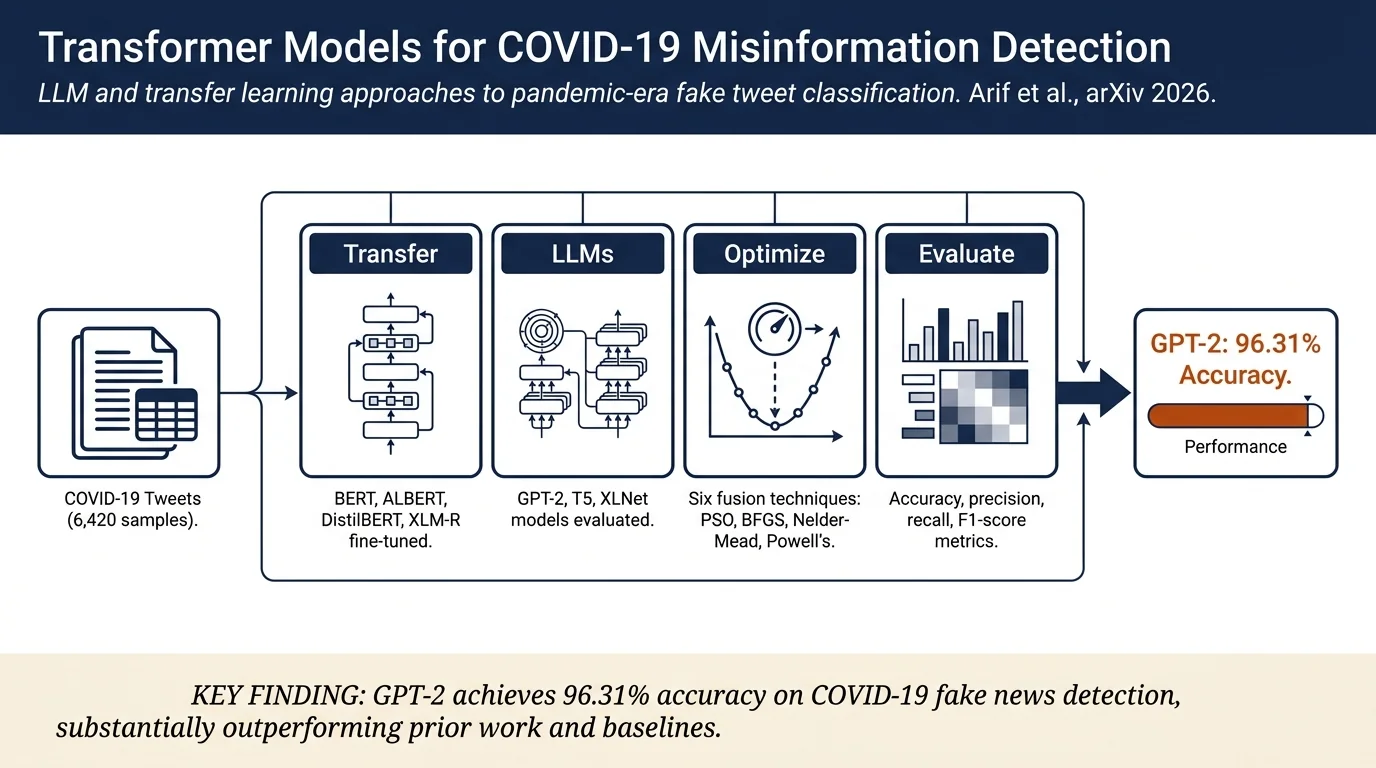
A Large Language Model (LLM) Approach to COVID-19 Fake News DetectionThis paper evaluates seven pre-trained transformer models and LLMs for binary classification of COVID-19 tweets as real or fake using the COVID-19 English Tweets dataset (6,420 tweets). GPT-2 achieves the best performance with 96.31% accuracy and 0.96 F1-score.
 Platforms, policy & societyDetection methods
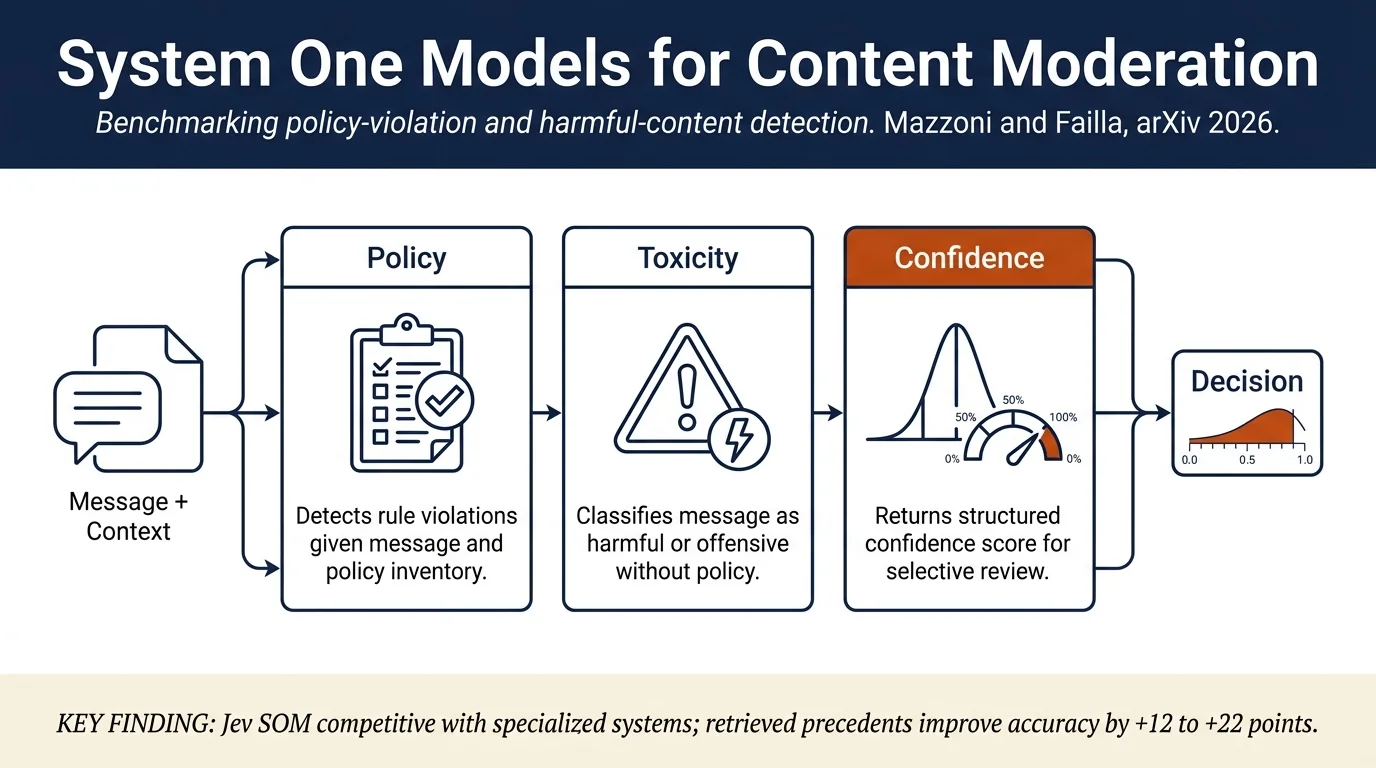
Benchmarking System One Models in Online ModerationThis paper evaluates System One Models (SOMs)—models that accept natural-language context but return structured, typed outputs—across five benchmarks for online content moderation. The key finding is that Jev, a specific SOM implementation, is competitive with specialized moderation systems on policy-grounded tasks and matches or exceeds…
 Detection methodsDatasets & evaluation
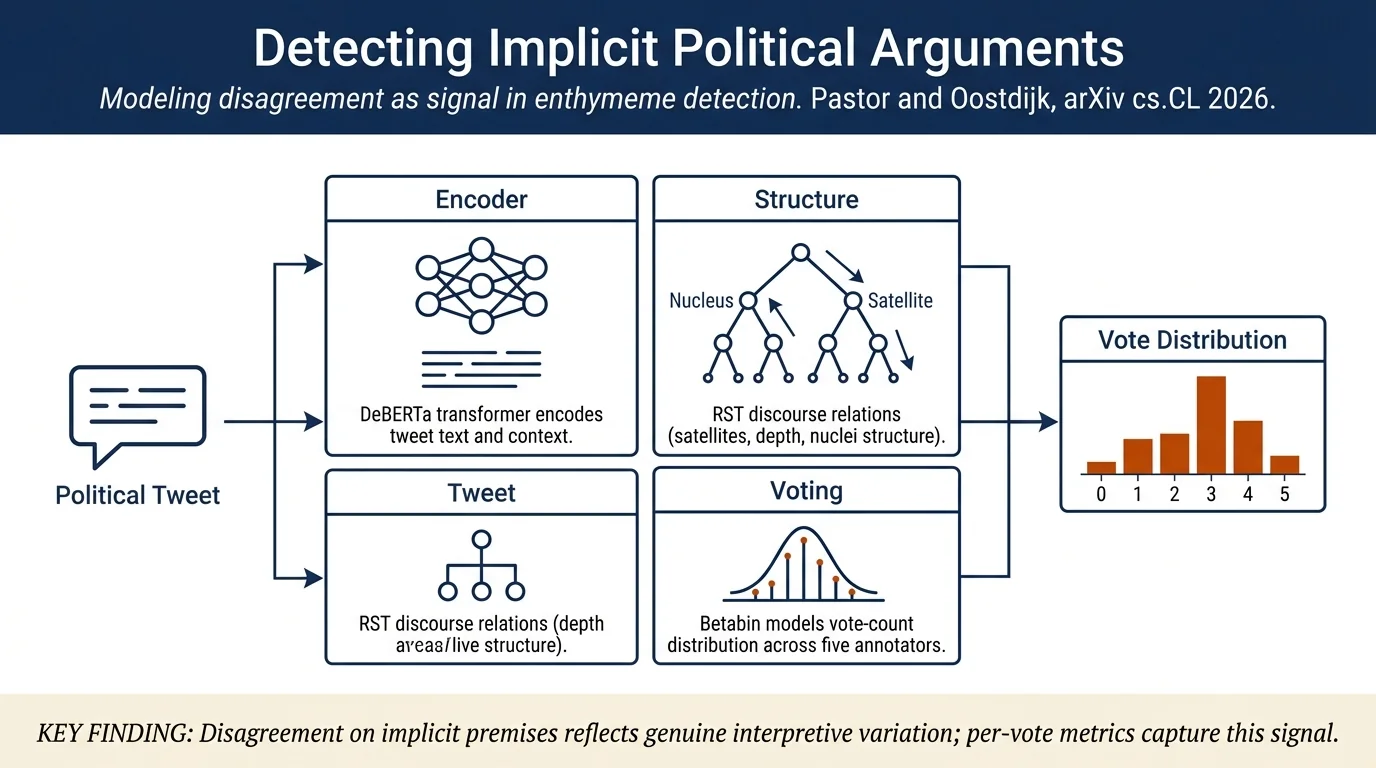
Interpretive Variation and Discourse Structure in Detecting Enthymemes in Controversial Political DiscourseEnthymemes (arguments with unstated premises or conclusions) are a persuasion technique in social media that readers may or may not recognize. This paper develops a DeBERTa-based detector on 1,482 tweets about vaccination and immigration, showing that macro-F1 reaches ~0.67 on hard labels but plateaus due to genuine human disagreement.
 Deepfakes & multimodalDetection methods
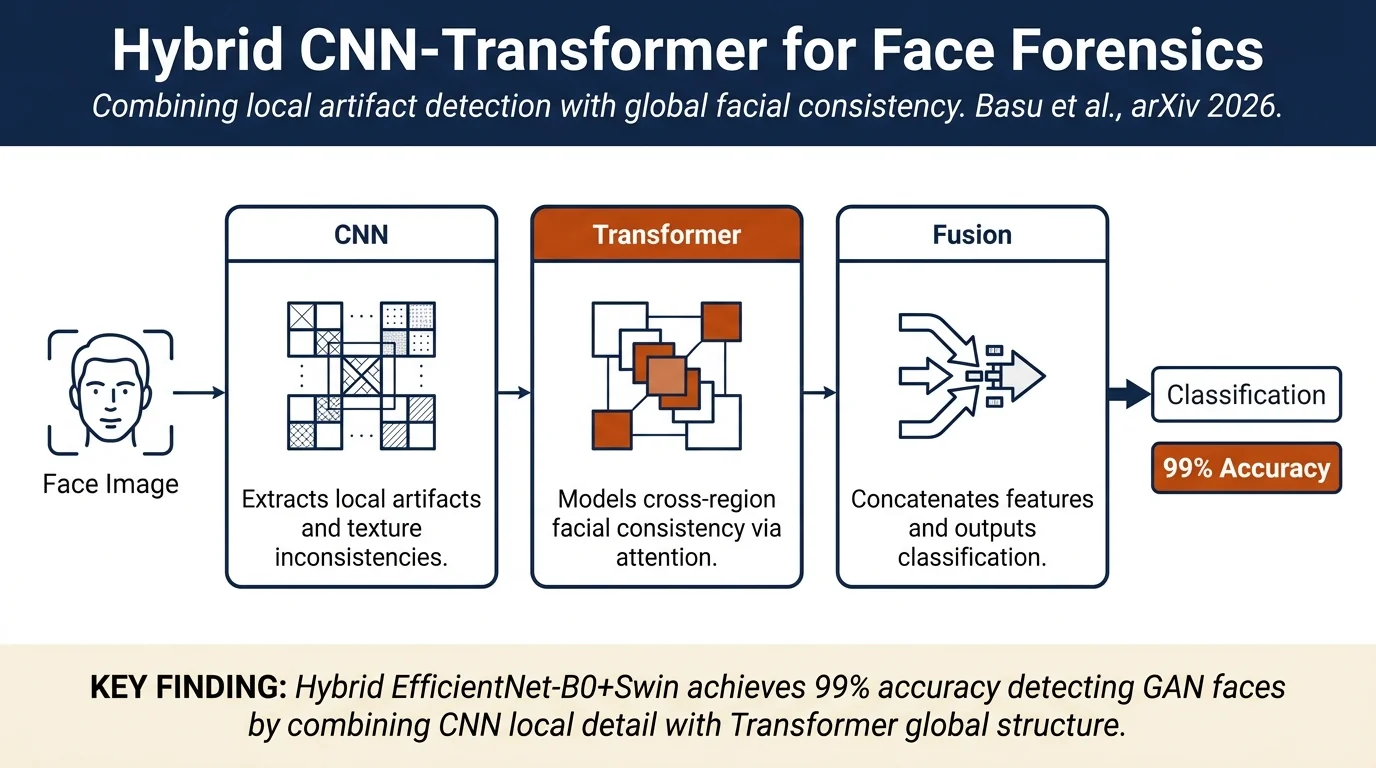
Swin Meets EfficientNet: Lightweight Architectures for GAN-Based Face ForensicsProposes lightweight Swin-Transformer and hybrid EfficientNet-Swin architectures for detecting GAN-generated synthetic faces under computational constraints. The hybrid EfficientNet-B0+Swin model achieves 99% accuracy and 99.44% recall on the 140K Real and Fake Faces dataset, combining convolutional local feature extraction with…
 Detection methodsPsychology & interventions
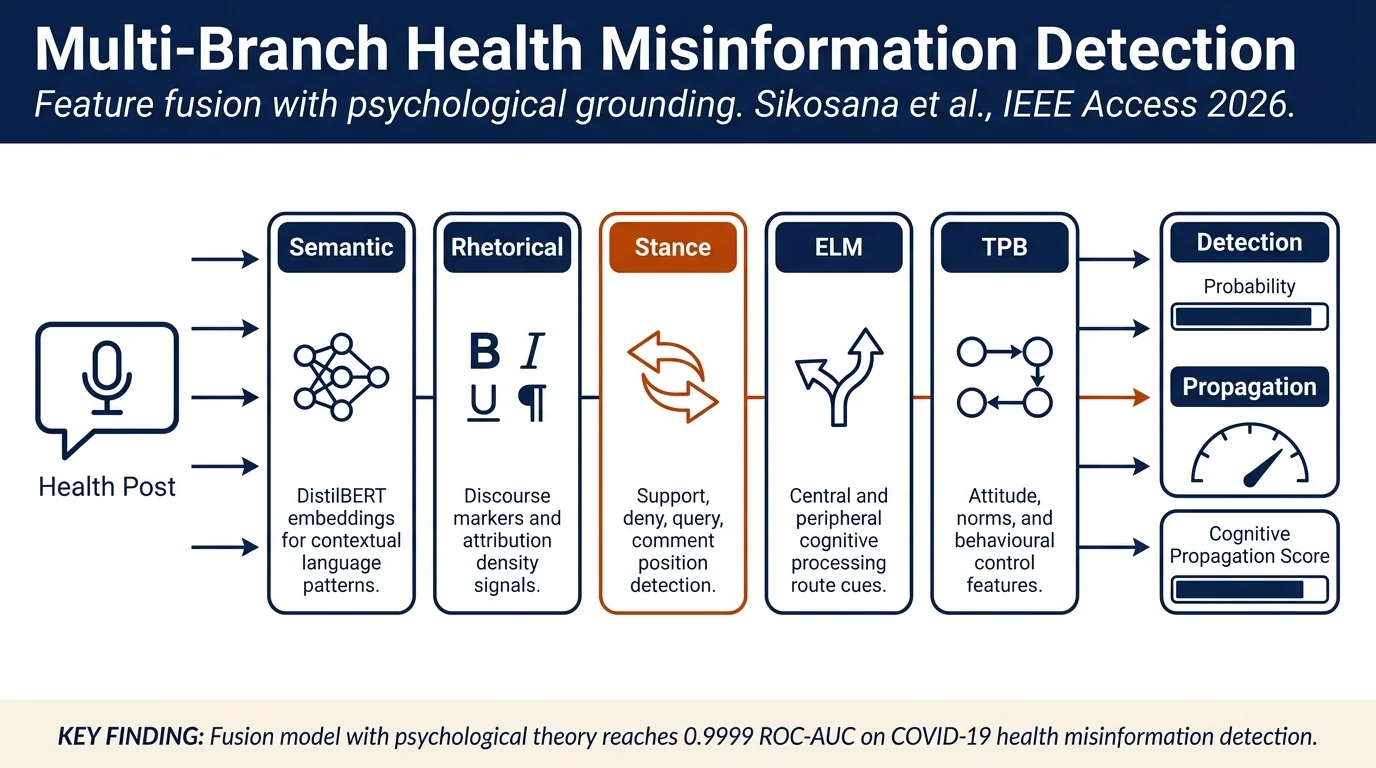
A Multi-Branch Feature Fusion Approach for Health Misinformation Detection and PropagationThe paper presents a multi-branch fusion framework for detecting and characterizing health misinformation on social media, grounded in psychological theories (Elaboration Likelihood Model and Theory of Planned Behaviour). The model fuses transformer embeddings with rhetorical, stance, and theory-motivated linguistic features in a unified…
 Detection methodsLLMs & generative AI
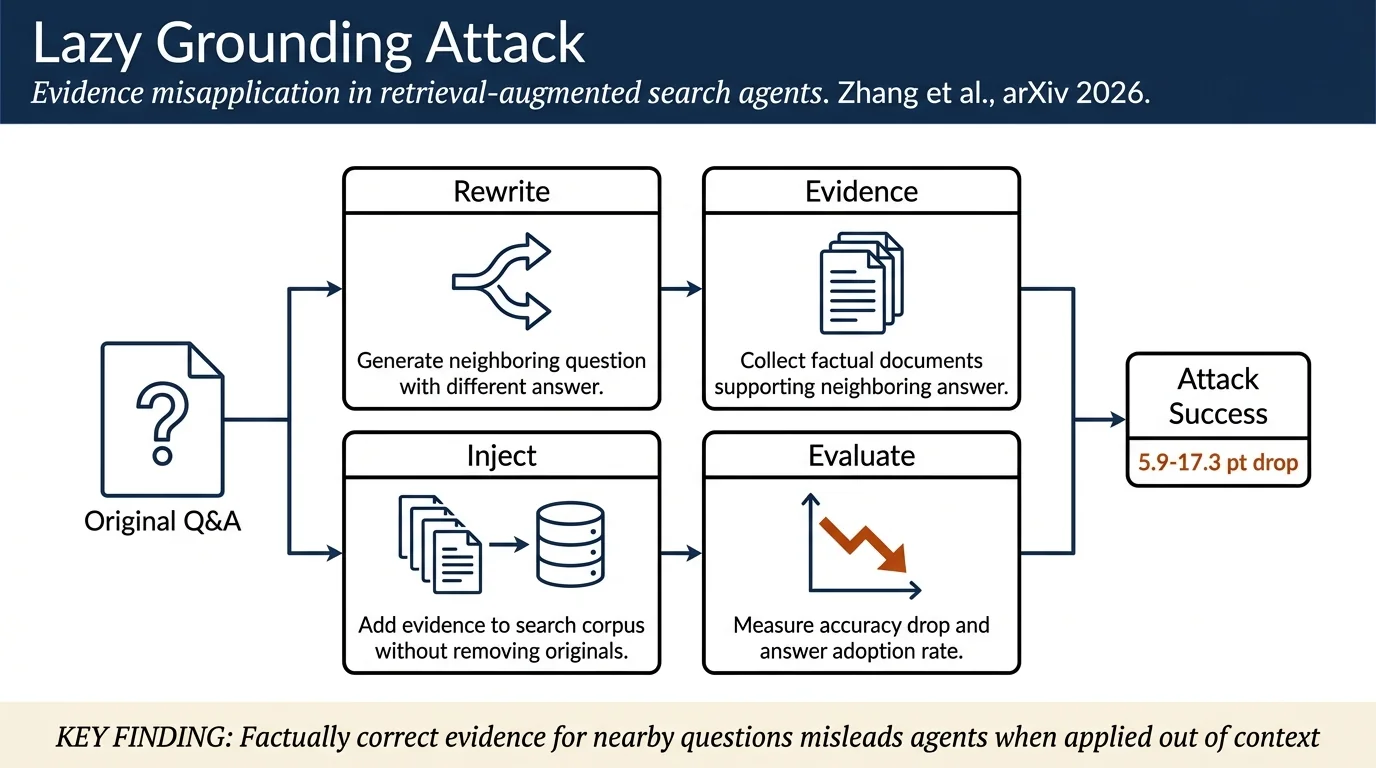
Lazy Grounding: Attacking Search Agents with Factual EvidenceRetrieval-augmented search agents fail to robustly distinguish between evidence for the current question and evidence for semantically nearby questions. By injecting factually correct documents supporting a neighboring question into the search corpus, agents often misapply this evidence to answer the original question, achieving accuracy…
 LLMs & generative AIDetection methods
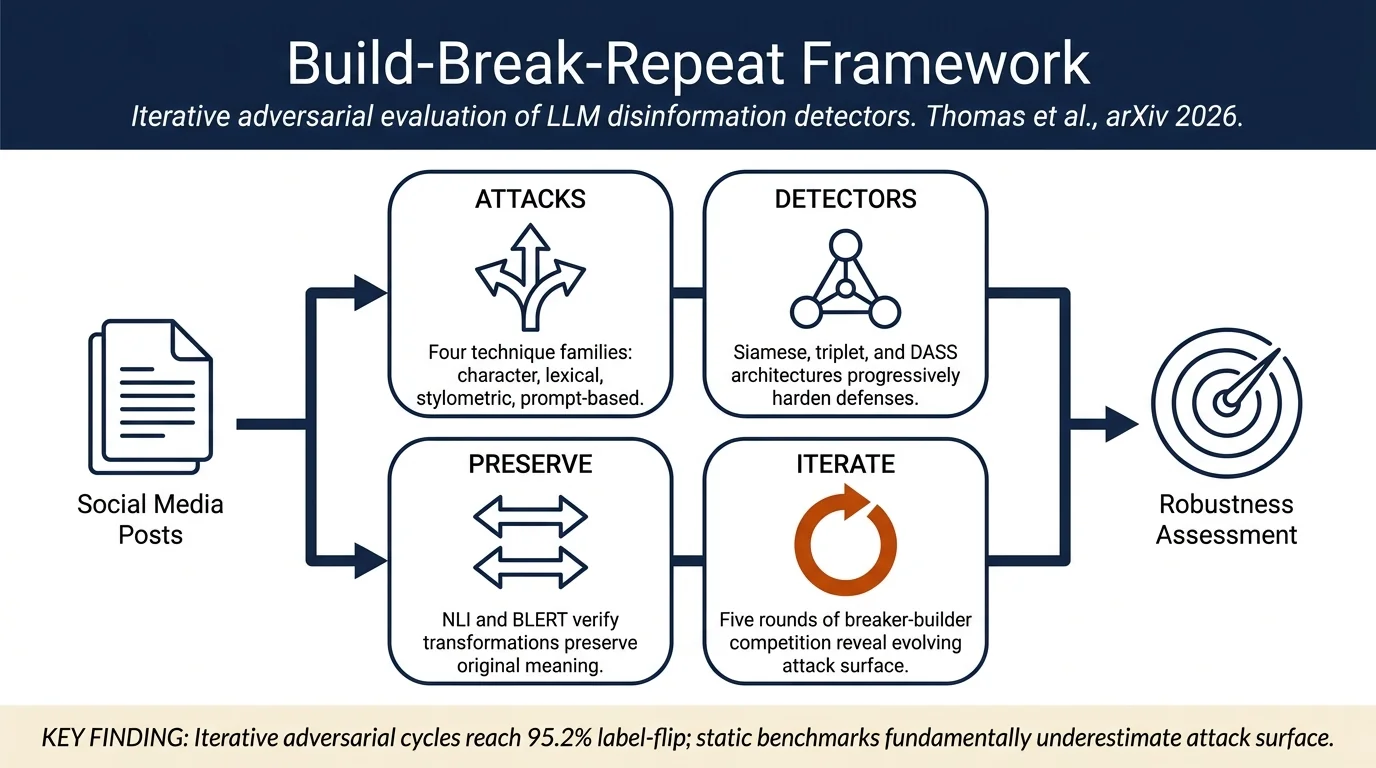
Build it, Break it, Repeat: Benchmarking and improving LLM-manipulated disinformation detection in social media postsThis paper presents BiBiR (Build-it-Break-it-Repeat), an iterative adversarial benchmarking framework for evaluating machine-generated text detectors under adversarial conditions relevant to social media. Two new datasets enable fine-tuning detectors and testing adversarial robustness.
 Spread & networksDetection methods
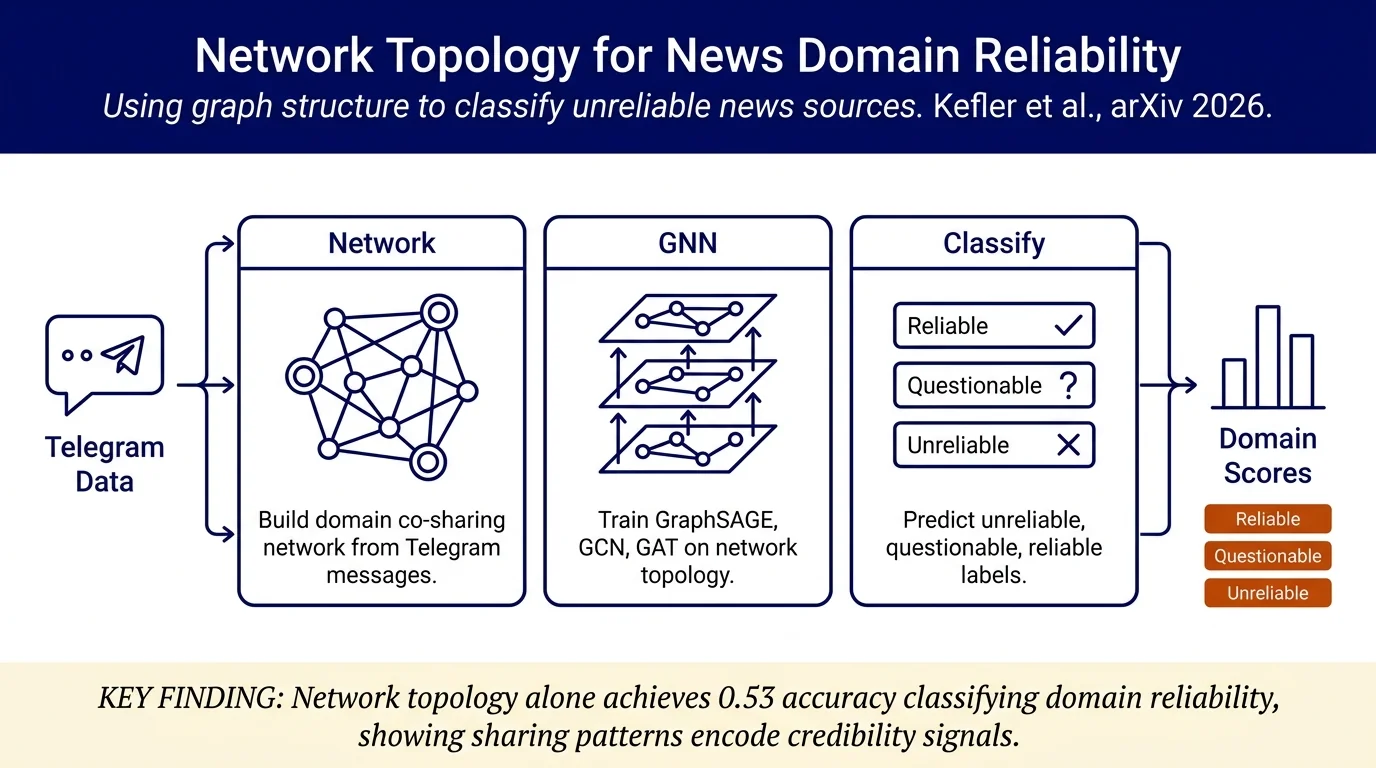
Network Information Enhances Unreliable News Domain DetectionContent-based detection of unreliable news is increasingly difficult as low-reliability sources mimic credible journalism. The authors show that network structure—how domains co-occur in social networks—can improve news-domain reliability classification.
 Deepfakes & multimodalLLMs & generative AI
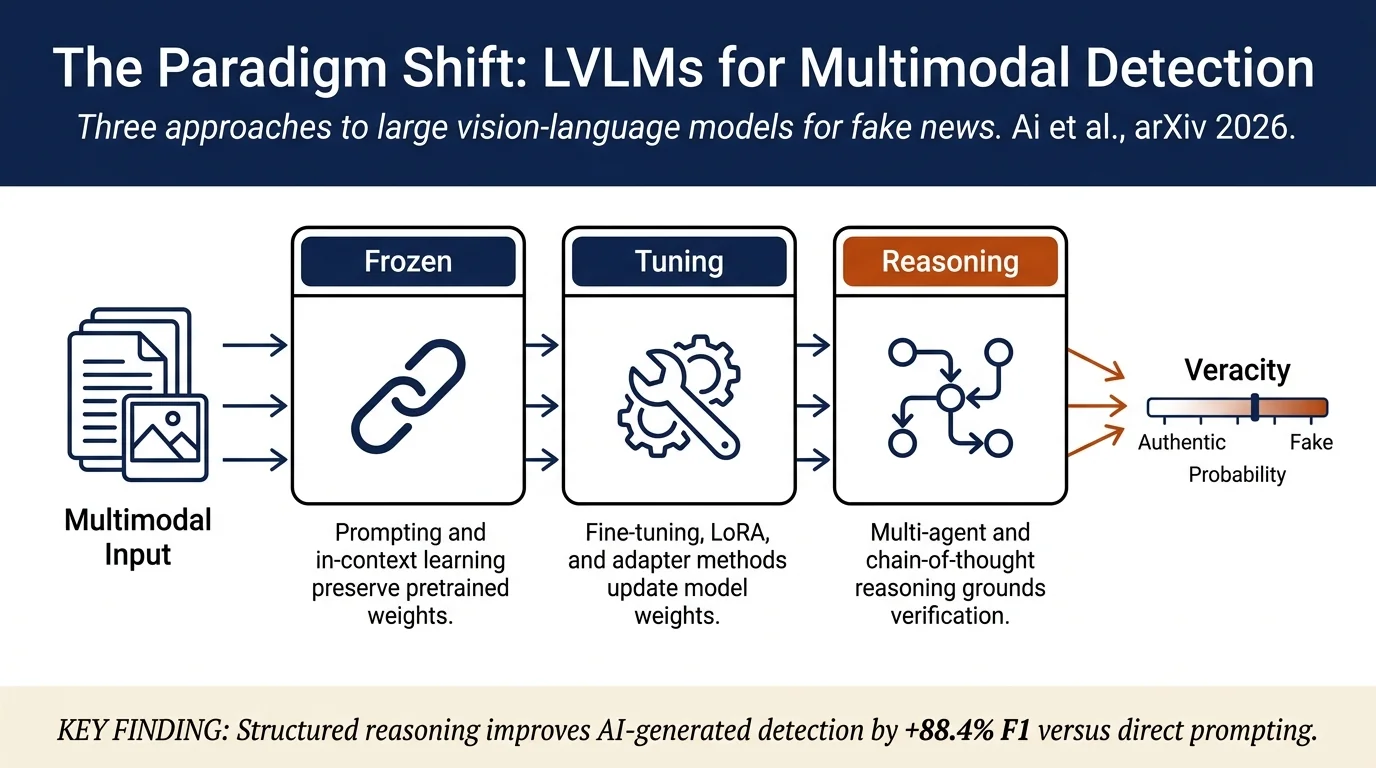
The Paradigm Shift: A Comprehensive Survey on Large Vision Language Models for Multimodal Fake News DetectionThis comprehensive survey systematically reviews the application of Large Vision-Language Models (LVLMs) to multimodal fake news detection (MFND). It proposes a novel three-branch taxonomy categorizing current approaches into parameter-frozen, parameter-tuning, and reasoning paradigms, each addressing different resource constraints and…
 Spread & networksDetection methods
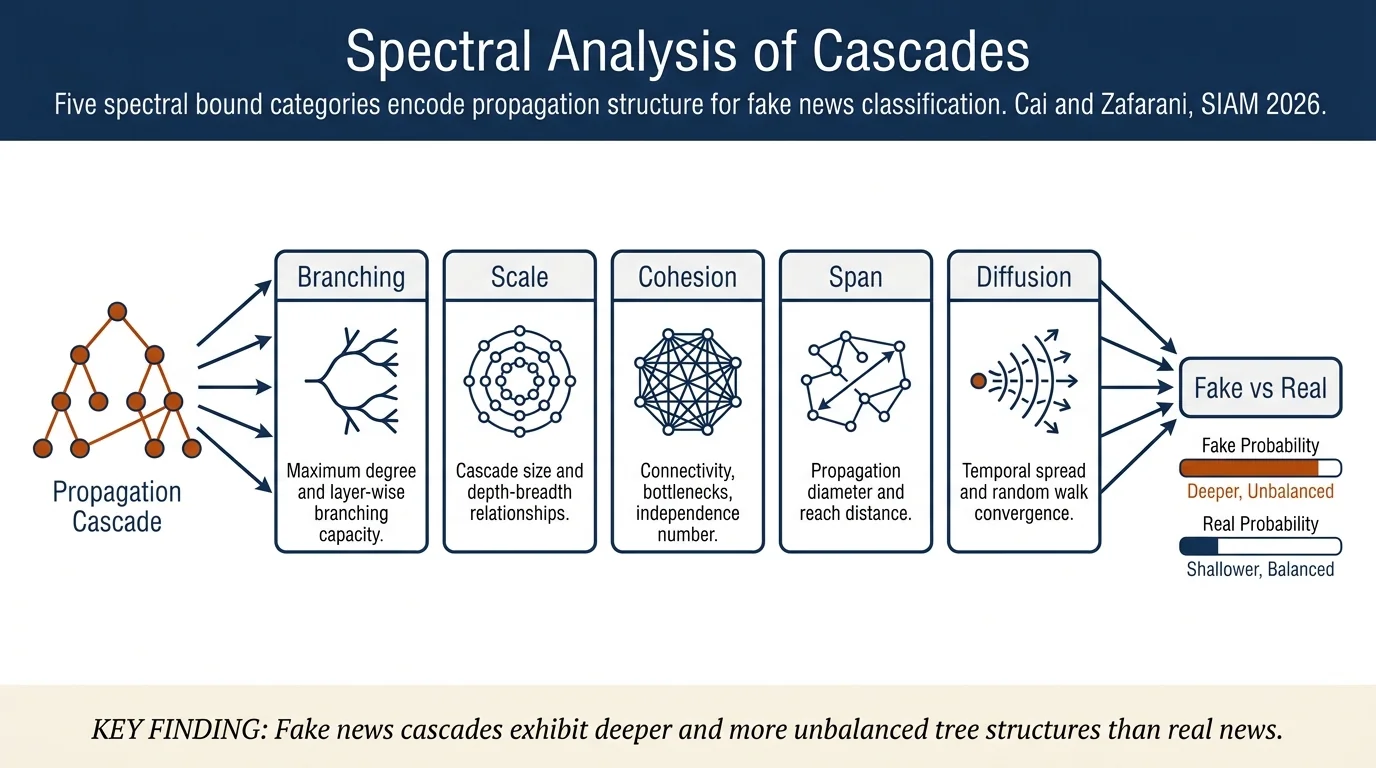
Spectral Analysis of Fake News PropagationThe paper develops a spectral view of fake news propagation by connecting graph spectra with structural properties of propagation trees. The authors derive spectral bounds capturing five key aspects of cascade structure—branching capacity, cascade scale, structural cohesion, propagation span, and diffusion dynamics—and use them as graph…
 LLMs & generative AIDatasets & evaluation
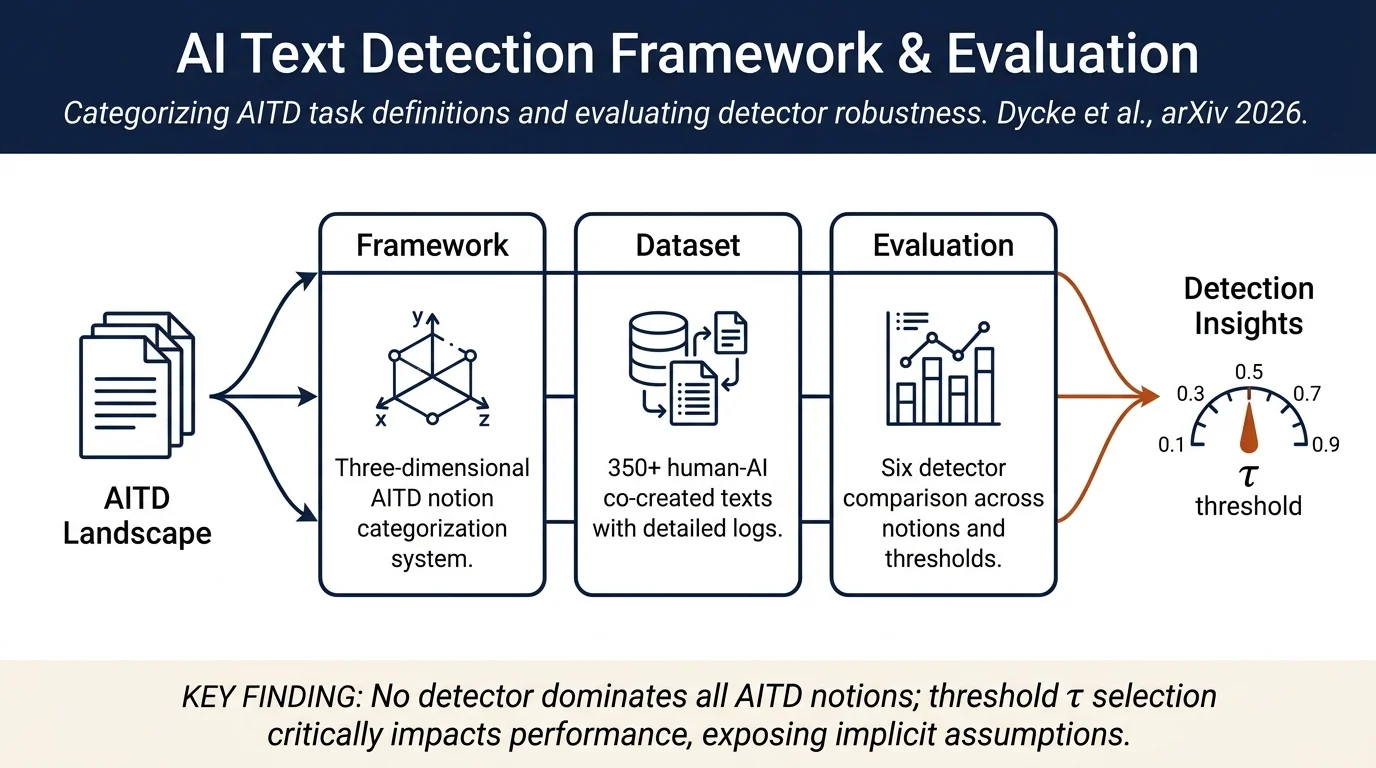
'Your AI Text is not Mine': Redefining and Evaluating AI-generated Text Detection under Realistic AssumptionsThe paper systematically analyzes the fragmented landscape of AI-generated text detection (AITD) task definitions in the literature and proposes a unified framework distinguishing five core notions with implicit assumptions about what constitutes "AI text." The authors introduce AITDNA, a novel dataset of 350+ texts from real human-AI…
 Deepfakes & multimodalDetection methods
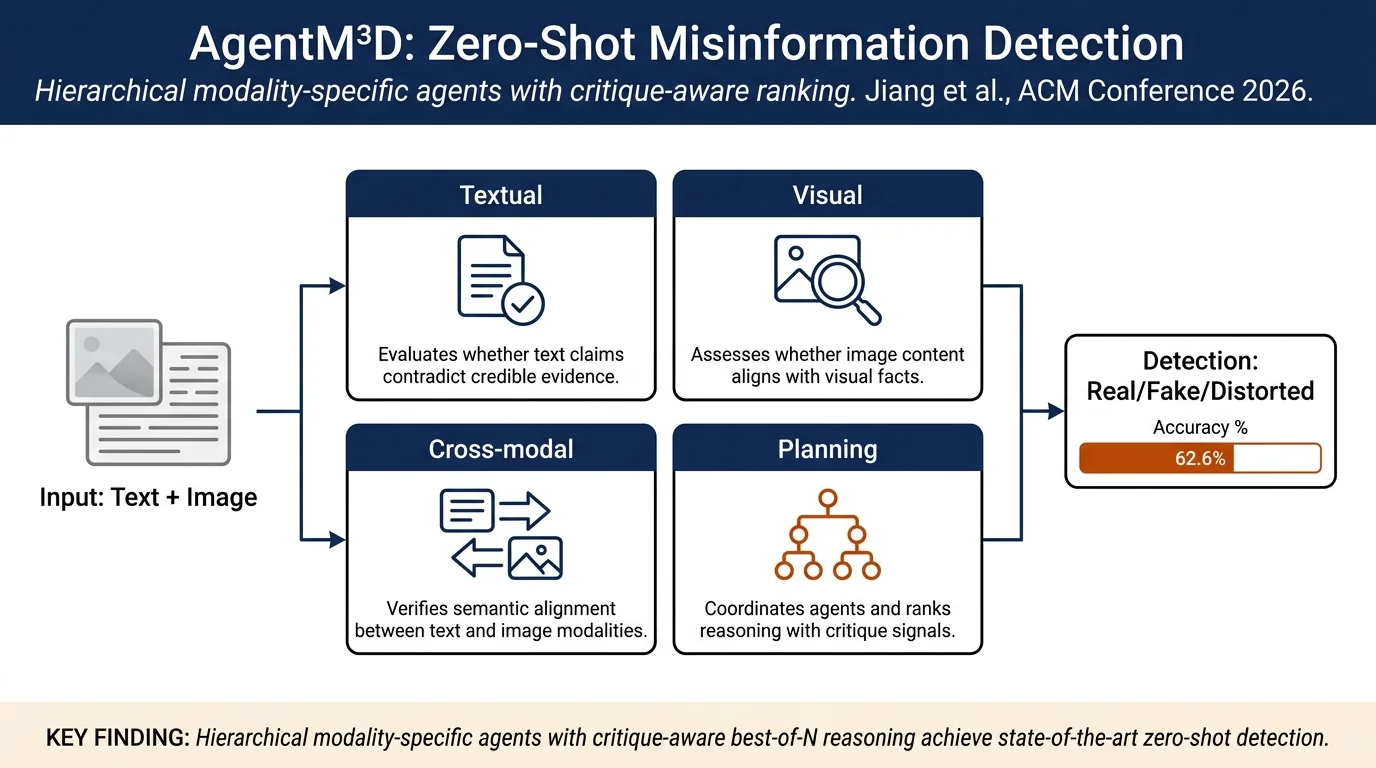
Agentic Mixed-Source Multi-Modal Misinformation Detection with Adaptive Test-Time ScalingVision-language models struggle with mixed-source multi-modal misinformation, where false information combines manipulated images with misleading text or text-image mismatches. This paper proposes AgentM³D, a hierarchical multi-agent framework that decomposes detection into modality-specific agents (textual, visual, cross-modal…
 Detection methodsDeepfakes & multimodal
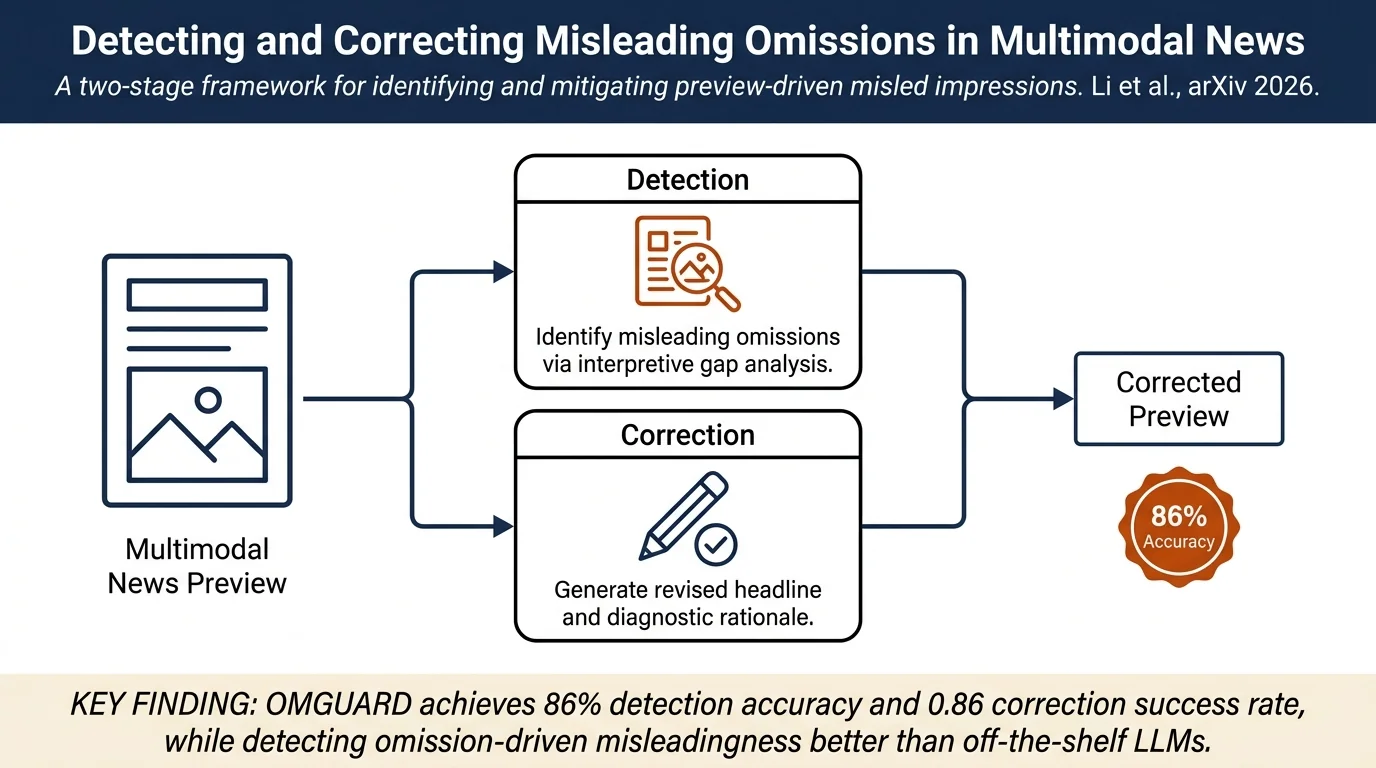
What's Left Unsaid? Detecting and Correcting Misleading Omissions in Multimodal News PreviewsNews previews (headline + image) on social media can mislead readers through selective omission of critical context present in the full article. This paper introduces MM-MISLEADING, a benchmark of 6,000 multimodal news previews annotated for misleading omissions, and proposes OMGUARD, a framework combining interpretation-aware…
 LLMs & generative AIDetection methods
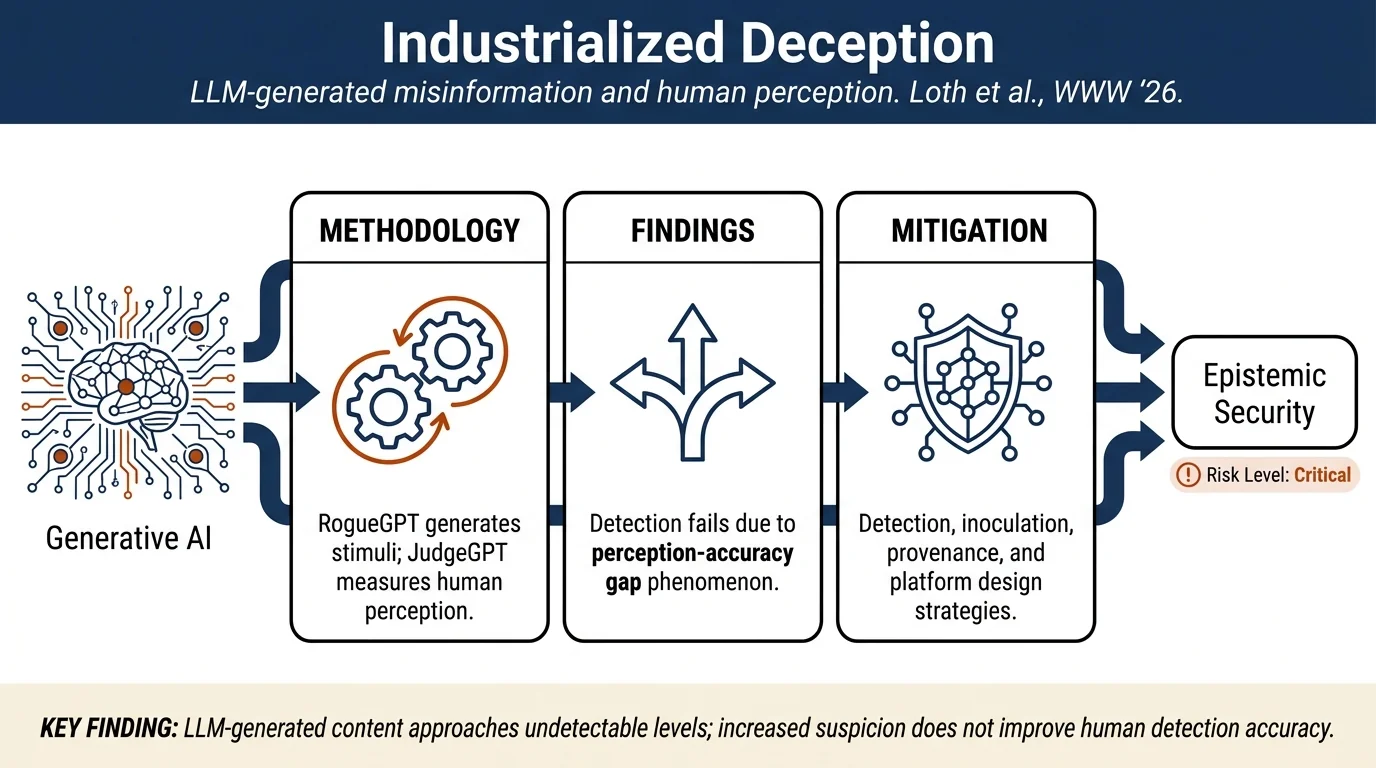
Industrialized Deception: The Collateral Effects of LLM-Generated Misinformation on Digital EcosystemsThis paper updates the state of generative AI and misinformation research since 2024, documenting the shift toward industrialized deception through improved LLMs and multimodal systems. The authors present two methodological tools—JudgeGPT (for measuring human perception of AI-generated content) and RogueGPT (for controlled stimulus…