'Your AI Text is not Mine': Redefining and Evaluating AI-generated Text Detection under Realistic Assumptions
Authors: Nils Dycke, Marina Sakharova, Nico Daheim, Iryna Gurevych Affiliation: Ubiquitous Knowledge Processing Lab (UKP Lab), Technische Universität Darmstadt; National Research Center for Applied Cybersecurity ATHENE, Germany; Zuse School ELIZA
Venue: arXiv preprint — arxiv.org/abs/2606.04906
TL;DR
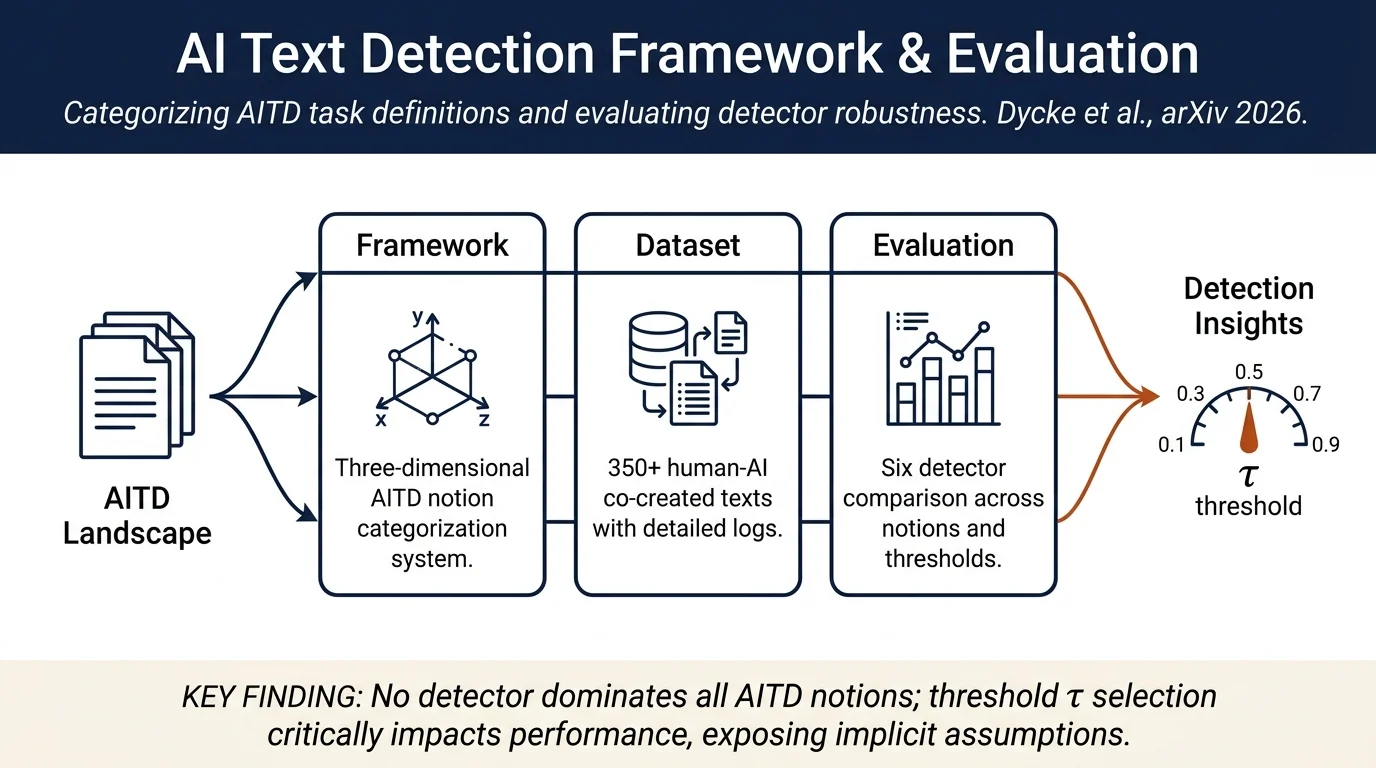
The paper systematically analyzes the fragmented landscape of AI-generated text detection (AITD) task definitions in the literature and proposes a unified framework distinguishing five core notions with implicit assumptions about what constitutes "AI text." The authors introduce AITDNA, a novel dataset of 350+ texts from real human-AI co-creation with detailed interaction logs, and show that existing detectors often fail when their underlying assumptions are violated—highlighting the need for explicit, aligned definitions in AITD research.
Contributions
- Analysis framework: Categorizes AITD notions along three dimensions: normative standard (what AI use is acceptable), genesis assumptions (how text originates), and attacker model.
- New AITD notions: Proposes content-based AITD and authorship-ID-based AITD to fill gaps in existing problem definitions and align with real-world policy needs.
- AITDNA dataset: A notation-agnostic benchmark of 350+ human-AI co-created texts from 99 human authors across multiple LLMs, interaction modes, and writing genres, with detailed prompt and revision logs.
- Empirical study: Tests six existing detectors on AITDNA and prior benchmarks, revealing that detector performance strongly depends on threshold selection (τ ∈ [0.1, 0.9]) and that no detector outperforms all others across all assumptions.
Method
The paper structures AITD notions along three orthogonal dimensions:
Normative standard: Ranges from entirely-prohibitive (no AI allowed) to permissive (AI use acceptable if from human author). Reflects normative choices, not detection feasibility.
Genesis assumptions: How the text originated. Divided into two branches: - Genesis-based notions: Document-level (author is human or AI), boundary-level (fixed number of alternating human-AI passages), sentence-level (each sentence is human or AI). - Population-based notions: Membership-based (text spans match or don't match a reference human corpus), authorship-ID-based (text is from a specific human author, not just "human").
Attacker model: Degree to which the AI's output violates genesis assumptions; parameterized by τ ∈ [0, 1].
The AITDNA dataset was collected via a collaborative writing interface where 99 participants co-created texts with LLMs (llama, OpenWeights models, proprietary systems) across four conditions: argumentative, creative, explanatory writing, plus a human-only baseline. The interface logged all edits, prompts, and LLM interactions.
Results
Performance across datasets and notions: Table 2 shows six detectors (AUROC, Log Rank, Likelihood, MinK, Binoculars, moBERT) evaluated on AITDNA and five prior benchmarks. Key findings:
- Best detector varies by dataset and metric; no single detector dominates.
- CoAuthor dataset is most challenging; AITDNA shows higher detector performance, likely because the synthetic data generation is simpler than real human-AI interaction.
- Threshold selection (τ) has dramatic impact: varying τ from 0.1 to 0.9 causes F1 scores to drop >0.07 on AITDNA and up to 0.8 on SenDetEx.
- Detectors optimized for one notion often fail when assumptions shift, showing that detection assumes implicit normative standards.
Assumption violations: The paper shows that enforcing a consistent notion across datasets (e.g., controlling for τ in document-level AITD) dramatically improves rank stability and reduces performance variance—suggesting that existing datasets conflate different AITD definitions.
Connections
- Related to deepfake detection and synthetic media via shared challenges in distinguishing machine-generated content.
- Applies language modeling and NLP techniques to forensics and content integrity.
- Connects to content moderation policy—the normative standards for AITD depend on use-case and organizational values.
- Shares methodological foundations with LLM-generated text detection and machine-generated text detection literature.
- Related to human-AI interaction studies and dataset construction practices.
Notes
Strengths: - Addresses a critical gap: existing AITD work uses inconsistent task definitions, making results hard to compare and policy guidance unclear. This paper systematizes the landscape. - AITDNA is valuable: real human-AI co-creation with detailed logs, not synthetic data, makes the benchmark ecologically valid and useful for understanding real-world detection challenges. - Empirical findings are clear: no detector works across all notions at fixed thresholds, and τ selection is critical. This is actionable for practitioners.
Limitations: - Dataset is collected under lab conditions (TU Darmstadt participants), which may not represent broader authoring patterns or adversarial scenarios. - Authorship-ID-based AITD is proposed but not deeply explored empirically—future work should test this notion on dedicated datasets. - The framework is comprehensive but adds complexity; practitioners may still face ambiguity choosing which notion aligns with their use-case.
Future directions: - Investigate robust detectors that explicitly account for hidden assumptions and work across multiple notions. - Extend AITDNA with adversarial writing and low-resource language scenarios. - Study how human readers detect AI text and compare against algorithmic detectors.