Industrialized Deception: The Collateral Effects of LLM-Generated Misinformation on Digital Ecosystems
Authors: Alexander Loth, Martin Kappes, Marc-Oliver Pahl Venue: ACM Web Conference 2026 (WWW Companion '26), April 13–17, 2026, Dubai — DOI ArXiv: 2601.21963
TL;DR
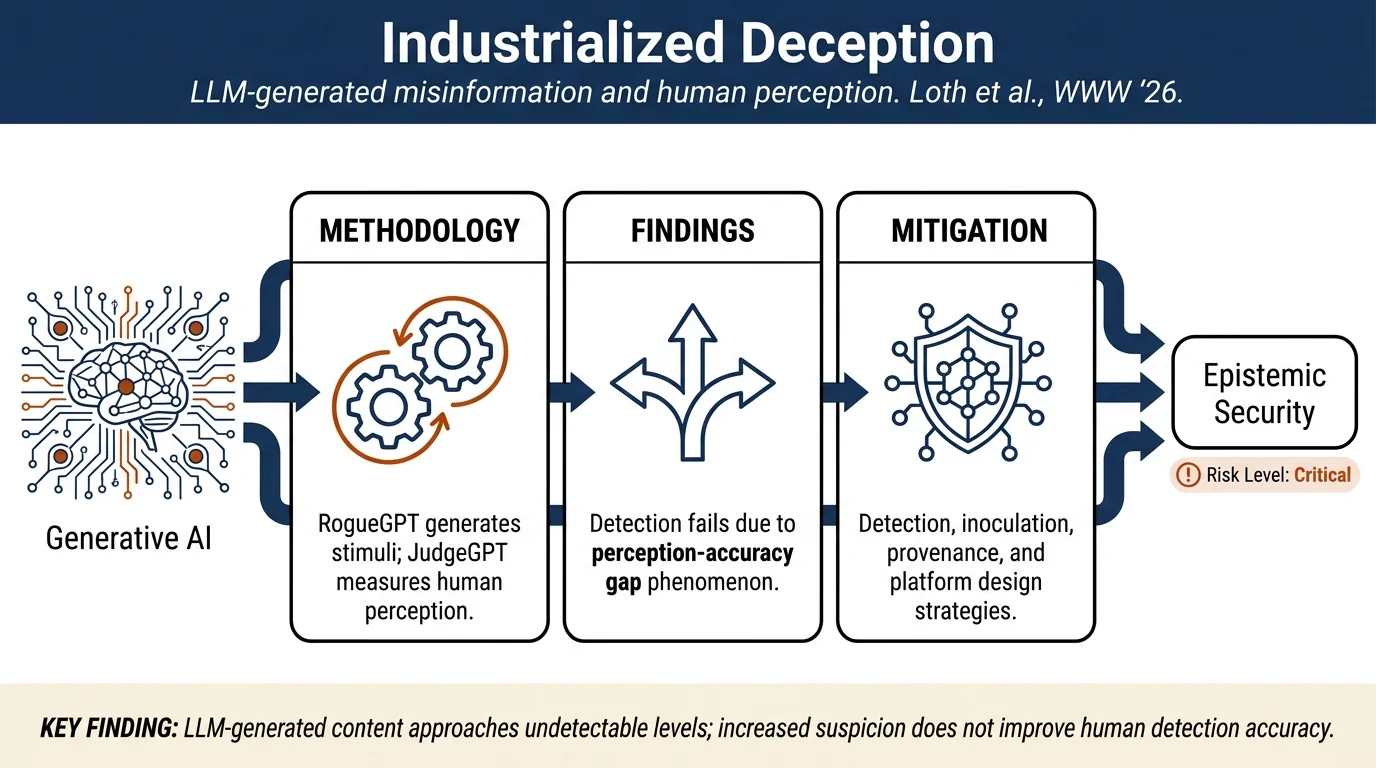
This paper updates the state of generative AI and misinformation research since 2024, documenting the shift toward industrialized deception through improved LLMs and multimodal systems. The authors present two methodological tools—JudgeGPT (for measuring human perception of AI-generated content) and RogueGPT (for controlled stimulus generation)—and report that participants struggle to distinguish LLM-generated news from human-written text. The paper synthesizes mitigation strategies including detection, inoculation, and provenance infrastructure, arguing that purely technical countermeasures face an adversarial arms race.
Contributions
- Landscape review: Documents evolution of generative AI and fake news since 2024, including improved LLM capabilities, emergence of multimodal misinformation, and shift toward agentic AI systems capable of autonomous content generation and dissemination.
- Methodological tools: Introduces JudgeGPT and RogueGPT as an experimental pipeline for measuring human perception and deceptive potential of AI-generated news fragments under controlled conditions.
- Empirical findings: Demonstrates that LLM-generated content is increasingly difficult to detect, with accuracy approaching chance levels for certain news styles; documents perception-accuracy gap where increased suspicion does not improve detection.
- Mitigation synthesis: Discusses technological approaches (LLM-based detection, adversarially aware training), inoculation and prebunking strategies, provenance infrastructure (C2PA), and platform design interventions.
Method
The paper combines systematic literature review with empirical studies. The experimental apparatus comprises two coupled components:
RogueGPT addresses reproducibility in misinformation research by replacing static datasets with a deterministic generation engine that allows controlled injection of generative variables—Model Architecture (M), Temperature (T), Style (S), and Format (F)—expressed as Stimulus = f(M, T, S, F). The engine serializes full generative context alongside artifacts, enabling retrospective analysis of deceptive strategies.
JudgeGPT serves as a psychometric evaluation platform for human epistemic resilience. Participants rate perceived origin (definitely human to definitely machine-generated) and perceived veracity (definitely legitimate to definitely fake) on continuous scales. Response latency metrics and demographic profiling enable intersectional analysis of susceptibility to AI-generated misinformation.
The integrated pipeline allows measurement of the "Perception-Accuracy Gap": RogueGPT generates stimuli with full provenance metadata; JudgeGPT collects participant judgments; responses are stored with links to generation parameters, enabling precise attribution of perception effects to model choices.
Results
Detection capability findings: - Participants struggle to distinguish GPT-4 generated content from human-written text; accuracy rates approach chance levels for certain news styles. - A perception-accuracy gap exists: increased suspicion of AI authorship does not improve actual detection accuracy. - Asymmetric cognitive fatigue degrades fake detection by 10.2 percentage points under sustained exposure. - Topic familiarity correlates with improved detection accuracy, supporting the value of domain expertise. - Demographic predictors (age, education, political orientation) show weaker effects for AI-generated content than for human-written disinformation.
Expert perception survey findings: - Experts view large-scale text generation as posing systemic risks of "epistemic fragmentation" and "synthetic consensus"—risks now formalized in Ferrara's "Generative AI Paradox." - Experts express skepticism toward purely technical detection tools, preferring provenance standards and regulatory frameworks aligned with emerging "epistemic security" objectives.
Mitigation landscape: - Detection algorithms using the same LLMs employed for generation show measurable effectiveness, but competition between generation and detection has become adversarial. - Many state-of-the-art detectors rely heavily on sentiment correlations; adversaries can degrade F1-scores by over 20% using "sentiment attacks" that rewrite false claims to sound neutral or positive. - Inoculation and prebunking approaches (preemptive source discreditation) show greater effectiveness than reactive debunking. - C2PA provenance infrastructure has matured with v2.3 supporting live streaming and text manifests, but a "validity gap" persists: provenance proves origin, not truth.
Key Concepts
The Generative AI Paradox: Ferrara (2026) argues that as synthetic media becomes indistinguishable from authentic content, societies rationally discount all digital evidence because verification cost exceeds generation cost, leading to market failure in the information ecosystem.
Synthetic Reality stack: A layered threat model comprising (1) Synthetic Content (raw artifacts), (2) Synthetic Identity (coherent fabricated personas), (3) Synthetic Interaction (simulated social engagement), and (4) Synthetic Institutions (coordinated networks manufacturing consensus). This final layer implies automation of credibility itself.
Agentic shift: Shift from human actors leveraging GenAI tools to autonomous agents capable of independent reasoning, planning, and execution. Multi-agent pipelines can systematize Foreign Information Manipulation and Interference (FIMI), with specialized components mapping behaviors to standardized Tactics, Techniques, and Procedures (TTPs). Constraint on disinformation campaigns is no longer human labor but compute.
Epistemic security: Shift in defense objectives from "correcting false information" (assumes functioning marketplace of ideas) to "securing conditions for knowledge creation" (acknowledges marketplace flooded with synthetic content). Requires infrastructure-level approaches.
Connections
- Synthetic media — paper explicitly discusses multimodal misinformation and "Synthetic Reality" frameworks.
- Content moderation — addresses platform design interventions and platform accountability as mitigation.
- Inoculation and prebunking — detailed discussion of prebunking and inoculation theory as prevention strategy rather than detection.
- Fake news detection — core focus on detection methods, challenges, and adversarial arms race.
- Misinformation spread and diffusion — discusses digital ecosystems, platform algorithms, and information diffusion dynamics.
- Propaganda — addresses coordinated inauthentic behavior and agentic campaigns manufacturing consensus.
- LLM-Generated Misinformation — directly addresses LLM-generated misinformation and dual-use nature of generative AI.
Notes
Strengths: - Timely update capturing rapid shifts in generative AI landscape (2024–2026). - Strong methodological contribution via JudgeGPT-RogueGPT pipeline for measuring both generative capability and human perception gaps under controlled conditions. - Comprehensive framing of the problem beyond binary detection: acknowledges structural shifts (agentic automation, multimodal coordination, epistemic fragmentation) that content-level detection cannot address. - Honest acknowledgment of adversarial arms race: sentiment attacks, latent feature optimization, and detection evasion are now commoditized.
Limitations and questions: - RogueGPT/JudgeGPT pipeline appears novel and promising, but full validation and dataset release remain pending (referenced as "companion publications"). - Expert survey results are discussed qualitatively; sample composition, coding scheme, and quantitative breakdowns are not fully detailed in this 8-page paper. - Emphasis on provenance infrastructure (C2PA) assumes adoption and enforcement; whistleblower/activist privacy concerns and manifest-stripping attacks are acknowledged but not resolved. - Paper focuses heavily on text generation; multimodal misinformation discussion relies largely on citing other 2025–2026 works (SAFF, CM-GAN, LVLM systems) rather than original empirical contribution.
Research directions: - Cross-lingual detection (global misinformation campaigns). - Behavioral-level detection of agent pipelines beyond content artifacts. - Bias and fairness audits in AI detection systems to avoid creating new forms of harm. - Integration of provenance, watermarking, and heuristic metadata analysis (defense-in-depth).
Dual-use note: Paper acknowledges that the same LLMs enable both generation and detection of misinformation, requiring governance frameworks and transparency mechanisms to prevent weaponization.