A Large Language Model (LLM) Approach to COVID-19 Fake News Detection
Authors: Muhammad Arif, Samah Fodeh-Jarad, Elyas Irankhah, Uroosa Fatima, Lama Ayash, Sreeraj Ramachandran
Venue: arXiv cs.CY, October 2026 — arXiv:2610.23800
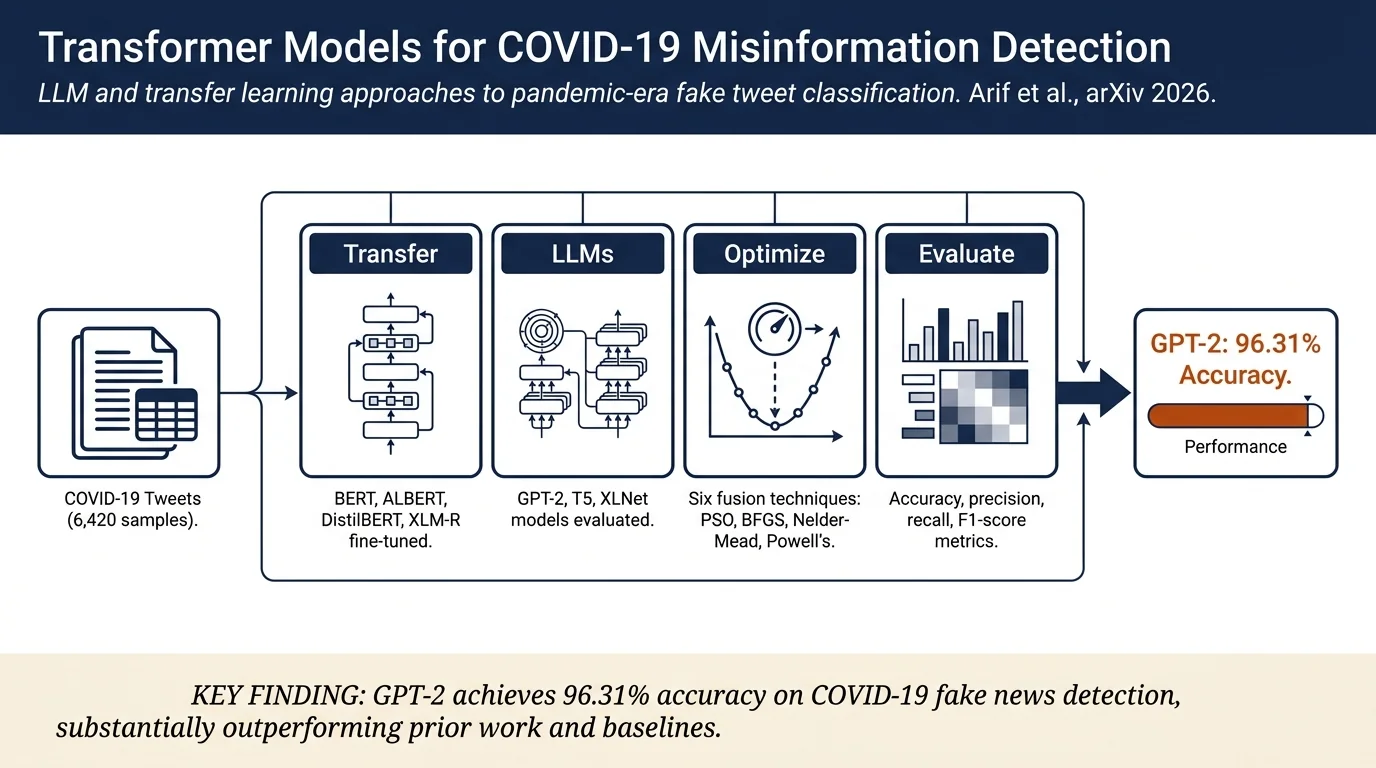
TL;DR
This paper evaluates seven pre-trained transformer models and LLMs for binary classification of COVID-19 tweets as real or fake using the COVID-19 English Tweets dataset (6,420 tweets). GPT-2 achieves the best performance with 96.31% accuracy and 0.96 F1-score. The study also explores six optimization techniques (weighted fusion, PSO, Nelder-Mead, Powell's method, BFGS, trust-region constrained) to improve model results. Transfer learning with pre-trained models substantially outperforms classical ML baselines, demonstrating the effectiveness of transformer-based approaches for pandemic-era misinformation detection.
Contributions
- Comprehensive empirical comparison of four transfer learning models (BERT-base, ALBERT-base, XLM-RoBERTa-base, DistilBERT) and three LLMs (GPT-2, T5, XLNet) on COVID-19 fake news detection
- Application of six meta-heuristic and optimization-based fusion techniques to improve model ensemble performance
- Demonstration that GPT-2 achieves state-of-the-art results (96.31% accuracy) compared to prior work (prior SOTA: 79–98% depending on dataset and method)
- Analysis of model performance via confusion matrix heatmaps showing error patterns and strengths/weaknesses across methods
Method
Dataset: COVID-19 English Tweets (6,420 tweets: 3,360 real, 3,060 fake). Balanced binary labels. Split: 70% train, 10% validation, 20% test.
Preprocessing: URL removal, special character and punctuation removal, lowercase conversion, multi-space normalization. No class-balancing applied due to adequate sample sizes.
Models: - Transfer learning: BERT-base, ALBERT-base, DistilBERT, XLM-RoBERTa-base (all fine-tuned) - Large language models: GPT-2, T5, XLNet (all fine-tuned)
Default hyperparameters used except where modified (e.g., GPT-2 learning rate reduced from 5×10⁻⁵ to 2×10⁻⁵).
Optimization techniques applied to TL models: 1. Weighted fusion — assigns learned weights to each model's predictions based on validation performance 2. PSO (Particle Swarm Optimization) — meta-heuristic to find optimal fusion weights via fitness function 3. Nelder-Mead algorithm — derivative-free simplex optimization 4. Powell's method — derivative-free line search along conjugate directions 5. BFGS (Broyden-Fletcher-Goldfarb-Shanno) — quasi-Newton second-order method 6. Trust-region constrained — constrained optimization within trust regions
Evaluation: Accuracy, precision, recall, F1-score. Confusion matrix heatmaps visualize per-model results.
Results
Transfer learning models (no optimization): - BERT-base, XLM-RoBERTa-base, ALBERT-base: 95.32% accuracy (tied) - DistilBERT: 95.17% accuracy
Optimization results (best improvement): - Nelder-Mead fusion: 96.10% accuracy, 0.9627 F1-score (best among fusion methods) - Weighted fusion: 95.95% accuracy, 0.9613 F1-score
Large language models: - GPT-2: 96.31% accuracy, 0.9612 precision, 0.9610 recall, 0.9600 F1-score (best overall) - XLNet: 95.32% accuracy (tied with TL baselines) - T5: 92.99% accuracy (lower performance)
Comparison to state-of-the-art: - Prior work [56]: 79.00% accuracy - Prior work [57]: 61.00% accuracy - This work (GPT-2): 96.31% accuracy
The paper attributes similar performance across several models to the balanced dataset size and similar initialization/hyperparameter choices converging toward similar solutions.
Connections
- Transfer learning is the core technique enabling strong performance with limited COVID-19-specific labeled data
- BERT and transformer embeddings form the foundation of all TL and LLM approaches tested
- COVID-19 misinformation is the application domain; this paper contributes methodological advances specific to pandemic-era fake tweets
- Text classification is the underlying task (binary real/fake detection)
- Natural language processing provides the theoretical and methodological framework
Notes
Strengths: - Comprehensive model comparison across TL and LLM families addresses practical question of which approach best suits COVID-19 fake news detection - Optimization fusion techniques systematically explored with clear results (Nelder-Mead marginal winner) - Balanced dataset avoids class-imbalance confounds - Clear preprocessing pipeline and hyperparameter reporting support reproducibility
Limitations: - Single dataset (COVID-19 English Tweets) limits generalization claims; COVID-19 misinformation linguistic patterns may not transfer to other health crises or non-English corpora - No analysis of failure modes or linguistic patterns the models successfully exploit (ablation studies absent) - Limited discussion of why T5 substantially underperforms other LLMs (92.99% vs. 96.31%) - Transfer learning comparison uses only pre-trained models on Wikipedia/BookCorpus; domain-specific pre-training (e.g., CT-BERT) mentioned in related work but not tested here - Optimization fusion improvements over base models are marginal (95.32% → 96.10%), raising questions about practical significance and generalization
Future directions (per authors): Multiclass classification on larger, multilingual datasets; real-time Twitter stream integration; cross-platform generalization.