Contributions
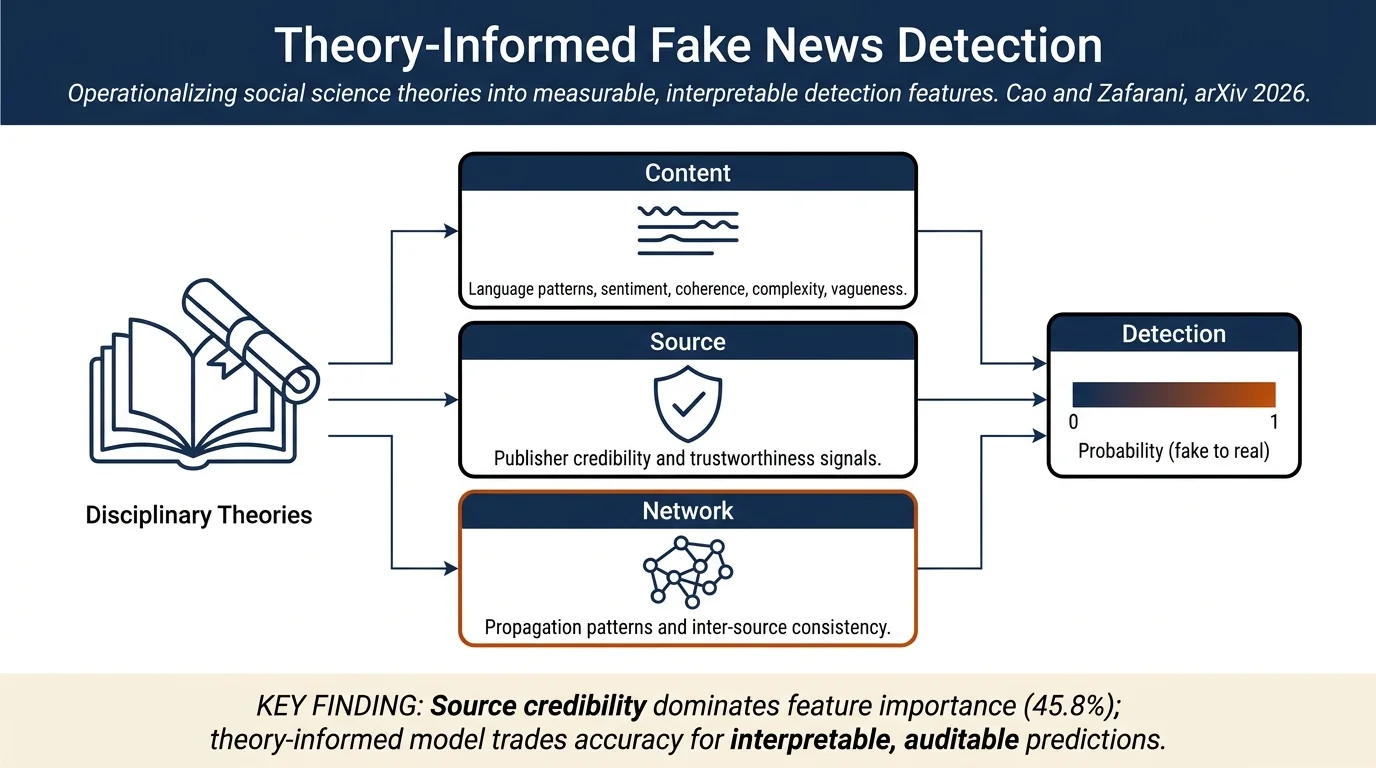
- Cross-disciplinary theoretical review: Systematic synthesis of theories from communication, psychology, information systems, and economics that explain why and how fake news persuades and spreads; organized into three categories (content, source, network) with explicit predictions for how fake news differs from real news.
- Theory-to-computation operationalization: Translation of 11 theoretical concepts into measurable computational features using diverse technical approaches—lexicon-based measures (LIWC, VADER), statistical models (entity-grid coherence, NLI for logical consistency), and LLM-guided feature extraction (scarcity, illusory truth, information gap).
- Empirical validation across datasets: Demonstrates theory-informed features capture meaningful signals for fake news classification with stable patterns across RECOVERY, FAKE_AND_REAL_NEWS, and GOSSIPCOP; shows source credibility as the dominant signal (when available) and reveals dataset-specific heterogeneity in feature importance.
- Explainability and directionality: Uses SHAP analysis to reveal how individual features push predictions toward/away from misinformation label, providing transparent basis for model decisions; explicitly trades off predictive performance for interpretability and theoretical transparency.
Method
Theoretical Foundation
The authors identify theories in three categories:
I. Content-based theories predict differences in message composition between real and fake news:
- Information Processing Theory and Confidence Heuristic: fake news uses more intense, sensational, or hyperbolic language
- Emotion Theories and Negativity Bias: fake news contains more emotive and negative language
- Expectancy Violation Heuristic: fake news has less clear, organized, accurate writing
- Narrative Paradigm: fake news is less coherent with internal logical contradictions
- Sourcing Theory: fake news includes less supporting evidence and external attribution
- Illusory Truth Effect: fake news has more repetitive content
- Linguistic Differences and Cognitive Load Theory: fake news has lower lexical/syntactic complexity, more personal pronouns and function words, fewer nouns and named entities
- Information Manipulation Theory – Maxim of Manner: fake news contains more vague/ambiguous expressions
- Uncertainty Reduction Theory: fake news headlines include more uncertainty-inducing cues (?, ..., !)
II. Source-related theories focus on credibility and trustworthiness:
- Source Credibility Theory and Authority Heuristic: fake news comes from less reputable sources
III. Network-related theories (theoretically reviewed but not empirically evaluated due to dataset limitations):
- Consensus Heuristic and Homophily Principle: fake news exhibits less external consistency across outlets, more linkages to known fake news sites
Feature Engineering
The authors operationalize 11 features:
-
Confidence Heuristic (binary): Classifies article as "certain" or "uncertain" using LIWC (Linguistic Inquiry and Word Count) by comparing frequency of certainty vs. uncertainty words.
-
Scarcity Principle (binary): LLM-guided feature using gemma-2-9b-it with prompt based on original scarcity paper definitions.
-
Negativity Bias (continuous): VADER sentiment analysis; compound score ranging [-1, +1], with scores below -0.5 indicating negative sentiment.
-
Coherence (continuous): Entity-grid model tracking syntactic role transitions (S/O/X) of entities across sentences; coherence computed as average log-probability of observed transitions.
-
Logical Consistency (continuous): Proportion of consecutive sentence pairs exhibiting ENTAILMENT relationship, using RoBERTa MNLI model.
-
Supporting Evidence (continuous): Aggregated heuristic combining five sub-features (URL frequency, quotations, temporal references, attribution phrases, proportion of URLs from .gov/.edu domains), normalized per thousand words.
-
Illusory Truth Repetition (continuous): GPT-4o-mini identifies distinct claims and counts repetitions; higher score indicates stronger repetitive persuasion.
-
Information Complexity (continuous): Flesch-Kincaid Reading Ease score; higher scores indicate greater complexity.
-
Language Vagueness (continuous): BERT-based classifier fine-tuned on vagueness dataset (privacy policies) to predict softmax probability of vagueness.
-
Information Gap (continuous): Combines punctuation-driven curiosity cues (?, !, ...) and topic surprisingness via LDA and KL divergence; fusion: IG(x) = w_P · P(x) + w_S · S(x).
-
Source Credibility (one-hot encoding): Publisher-level categorical encoding capturing latent source-specific credibility when metadata available.
Classification
Features fed to XGBoost for binary fake news classification. Experiments report AUC and macro-averaged F1 scores on benchmark datasets.
Results
Individual and Combined Performance
- Individual features achieve AUC 50–70.5% (F1: 47.9–67.5%)
- Combined model on RECOVERY: AUC 79.1%, F1 76.8%
- TF-IDF baseline: AUC 95.5%, F1 94.7% (higher due to full lexical coverage, but non-interpretable)
- Interpretation: Theory-informed model trades predictive performance for compactness and interpretability—deliberately sacrifices some predictive power for theoretical transparency.
Feature Importance (RECOVERY dataset)
- Source Credibility: 45.8%
- Information Complexity: 9.0%
- Language Vagueness: 8.5%
- Coherence: 7.2%
- Illusory Truth: 6.5%
- Logical Consistency: 6.4%
- Negativity Bias: 5.8%
- Information Gap: 5.4%
- Supporting Evidence: 4.3%
- Scarcity Principle: 0.9%
- Confidence Heuristic: 0.3%
Key observation: Source credibility dominates when publisher metadata available (97.2% on GOSSIPCOP, 45.8% on RECOVERY), reflecting strong dataset-publisher associations; other content features show stable, moderate contributions.
Cross-Dataset Patterns
- Source credibility consistent top feature across GOSSIPCOP and RECOVERY (where metadata available)
- Content-based theories (information complexity, logical consistency, coherence, negativity bias) generalize moderately across datasets
- Scarcity Principle more prominent in FAKE_AND_REAL_NEWS, suggesting stronger urgency rhetoric in that domain
- Weak rank correlation between RECOVERY and FAKE_AND_REAL_NEWS (Spearman ρ=0.167), indicating dataset-specific heterogeneity
Content Analysis
Wilcoxon rank-sum tests show statistically significant differences (p < 0.001):
- Fake news exhibits lower sentiment (stronger negativity bias)
- Fake news shows lower information complexity (simpler narratives, reduced lexical/syntactic diversity)
- Fake news displays greater linguistic vagueness (ambiguous/imprecise expressions)
- Fake news demonstrates larger information gap (more uncertainty-inducing headline cues)
Feature Interactions
- Pairwise combinations: Best two-feature pairs—confidence heuristic + supporting evidence (AUC 0.740), scarcity principle + supporting evidence (0.737)—suggest assertive language + verifiable evidence jointly capture persuasive intent.
- Triple combinations: Best three-feature set—(confidence heuristic, scarcity principle, supporting evidence)—achieves AUC 0.745, reflecting interaction among language intensity, urgency, and evidence transparency. Gains are modest, not uniformly additive.
SHAP Analysis
- Source credibility most decisive factor for distinguishing fake/real
- Information complexity and negativity bias show consistent influence with directional effects: higher values (red) push toward misinformation; lower values (blue) shift opposite direction
- Information gap and coherence demonstrate noticeable but less dominant effects
- SHAP vs. feature importance: SHAP reveals directionality of feature impacts, whereas simple feature importance does not.
Feature Independence
- Most pairwise correlations fall below |0.1|, indicating features capture unique information
- Feature correlation heatmap validates diversity of theoretically-grounded features
Notes
Strengths:
- Systematic, disciplinary cross-review grounding computational features in established theory; rare and valuable for interpretability.
- Comprehensive operationalization: diverse techniques (lexicon, statistical, LLM) show how different theoretical concepts can be implemented.
- Multi-dataset evaluation demonstrates generalization of some features (information complexity, coherence) while surfacing dataset-specific heterogeneity.
- SHAP analysis provides directional transparency often missing from black-box fake news detectors; useful for practitioners.
- Honest about trade-off between interpretability and predictive performance, rather than overstating predictive gains.
Weaknesses:
- Source credibility dominance on some datasets likely reflects dataset artifact (publishers strongly associated with labels) rather than intrinsic strength of source credibility signal in the wild.
- Network-level theories (consensus heuristic, homophily) theoretically reviewed but not empirically evaluated; benchmark datasets lack propagation traces and inter-source network metadata.
- Weak cross-dataset feature rank correlations (ρ=0.167) suggest limited universality of feature importance hierarchy; relative contribution of theories is dataset-dependent, limiting generalization.
- Some feature extractions rely on pretrained/LLM models (BERT for vagueness, LLMs for claim identification) sensitive to domain shift and prompting; robustness across diverse news domains not systematically evaluated.
- Comparison to TF-IDF baseline shows substantial predictive cost (~16% AUC gap); unclear whether this trade-off is acceptable for specific application scenarios (e.g., real-time detection vs. ex-post auditing).
Open questions:
- How do theory-driven features perform on out-of-domain news corpora (non-English, emerging fake news narratives, new platforms)?
- Can network-level theories be operationalized and evaluated on datasets with propagation or inter-source linking metadata?
- What is the relative importance of individual theories vs. their combinations for different fake news genres (political, health, clickbait, satire)?
- How sensitive are LLM-based features to model choice, prompting strategy, and instruction tuning? Can smaller/open-source LLMs replicate performance?
Significance for the field: This work exemplifies a needed shift toward theory-informed, explainable fake news detection. Rather than pursuing ever-higher black-box accuracy on benchmark datasets, it demonstrates how social science theory can structure interpretable detection systems, making predictions auditable and trustworthy for domain experts (journalists, fact-checkers, policy researchers). The systematic mapping between theory and computation is a methodological contribution applicable beyond misinformation to other credibility-assessment tasks.