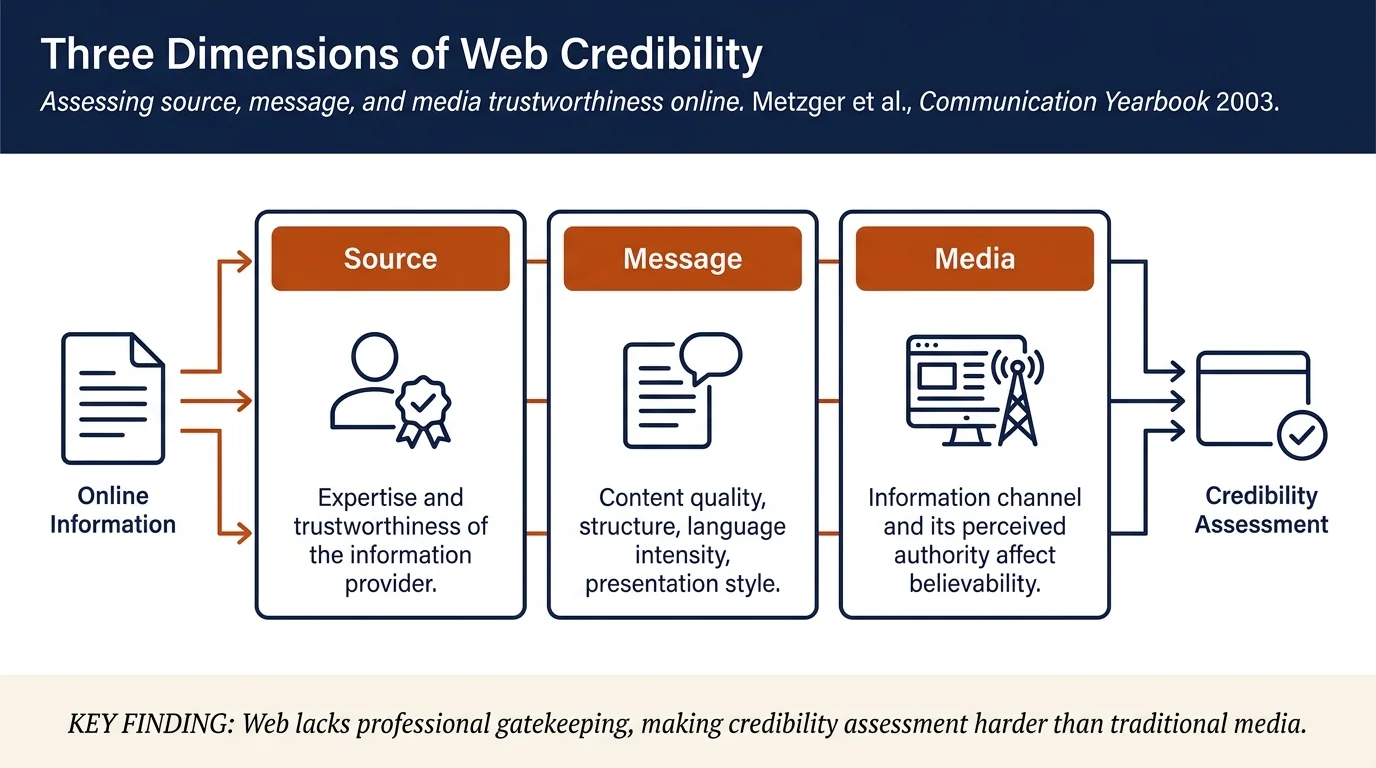
Media credibility refers to the perceived trustworthiness and reliability of communication channels themselves—newspapers, television, radio, websites, social media platforms—as distinct from the credibility of individual sources or messages they carry. It encompasses judgments about institutional reputation, editorial standards, technological features, and the perceived intent and bias of media organizations.
Historical development
Research on media credibility dates to the 1930s, when the Roper Organization began tracking which media sources audiences found most believable. Early findings showed newspapers rated highest in trustworthiness, though television gained ground as it became dominant, eventually surpassing newspapers in perceived credibility by the 1960s. Subsequent research explored why: television's visual nature, authority of live coverage, and apparent immediacy enhanced perceived believability, despite the lack of editorial depth compared to newspapers.
Key dimensions
Editorial gatekeeping: Media with professional fact-checking, editorial oversight, and correction mechanisms (traditional newspapers, major broadcast news) rate higher in credibility than unmoderated sources (social media, blogs).
Organizational reputation: Established institutions with track records (major news organizations, universities) carry more credibility than anonymous or newly-formed outlets.
Visual and technological features: Television's visual presentation and ability to show events in real-time enhance credibility perceptions; the same advantage accrues to multimedia content online. By contrast, sites with broken links, poor design, or amateurish appearance suffer credibility judgments.
Perceived bias and commercial interests: Media associated with political or ideological bias, or heavy advertising and commercial content, are judged less credible.
Structural features: The format and presentation of information—professional layout, clear attribution, transparent funding disclosures—communicate credibility.
Credibility in online environments
The rise of the Web created a new category: websites as media channels. Unlike traditional media, most websites lack professional gatekeeping, can be created and modified easily, and blur boundaries between advertising and editorial content. Research shows users apply media-credibility heuristics learned from traditional media to websites: sites resembling reputable newspapers or institutions (clear branding, professional design) are judged more credible, even if the information quality is identical to that on poorly-designed sites.
Role in misinformation
The lack of media-level gatekeeping on social platforms and user-generated content sites enables the rapid spread of misinformation. Conversely, platform-level credibility interventions (source labeling, warning labels, post-quality ratings) attempt to reconstruct media-level credibility cues in algorithmically-driven environments.
Key papers
- Metzger (2007) — Comprehensive review of credibility assessment models with emphasis on how presentation, design, and organizational signals shape user judgments; identifies media-level factors (site design, professionalism, navigation) as significant determinants of perceived credibility.
- Metzger et al. (2003) — Comprehensive synthesis of media credibility research; traces evolution from print to television to Web; identifies technological features and editorial structures as primary drivers of media credibility; discusses how Web-specific characteristics (lack of professional gatekeeping, convergence of genres) reshape credibility assessment.
- Flanagin & Metzger (2000) — Empirical study of how Internet information is rated compared to traditional media; shows Internet information rated less credible than newspapers but equivalent to television, suggesting users transfer media-credibility heuristics from established channels to new platforms.
Related topics
- source-credibility — Credibility of individual information sources (authors, organizations, experts)
- message-credibility — Credibility of information content itself (accuracy, evidence, presentation)
- information-literacy — User ability to assess credibility across sources, messages, and media
- platform-governance — Institutional structures and policies that shape what content appears on media platforms