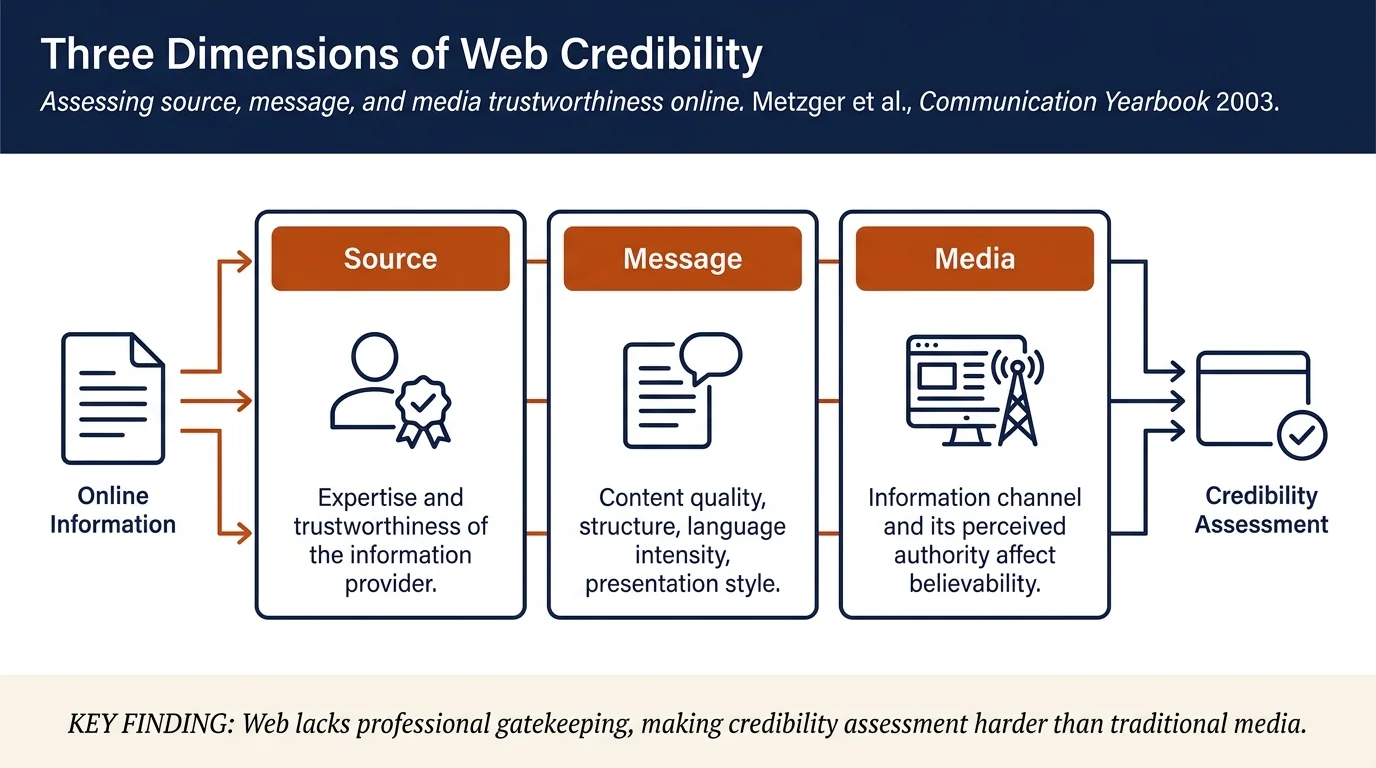
Message credibility refers to the perceived accuracy, reliability, and truthfulness of information content itself, independent of its source or the medium through which it is conveyed. It encompasses judgments about evidence quality, logical consistency, stylistic markers, and the alignment of messages with prior knowledge or attitudes.
Key dimensions
Message structure: How information is organized affects credibility. Well-organized messages with clear logical flow are judged more credible than disorganized or rambling content. Unorganized messages are perceived as less credible even when factually identical to organized versions.
Content quality: Factors affecting perceived information quality include:
- Use of evidence and citations (presence of evidence enhances credibility)
- Logical consistency (contradictions reduce credibility)
- Typographical and grammatical accuracy (errors reduce credibility)
- Specificity and detail (general claims are less credible; specific facts are judged more believable)
- Comprehensiveness (incomplete coverage reduces credibility)
Language intensity and style: Opinionated language and emotionally charged tone reduce message credibility. Neutral, measured language enhances believability. Exaggeration and superlatives trigger skepticism.
Message-source congruence: Messages that align with known positions of the source are judged as more credible (familiarity effect and illusory-truth effect), while messages that contradict the source's apparent ideology are scrutinized more carefully.
Novelty vs. prior knowledge: Messages that confirm existing knowledge or attitudes are more readily believed (consistency bias), while novel claims require higher evidence standards.
Measurement challenges
Unlike source or media credibility, message credibility is difficult to measure directly because credibility judgments depend heavily on receiver characteristics (prior beliefs, knowledge, motivation), making it hard to isolate message factors from receiver effects. Experimental designs with minimal pairs (identical content from different sources) or counterfactual interventions (varying only message structure while holding source constant) are essential for isolating message effects.
Role in misinformation
Misinformation often combines low message credibility (unsourced claims, emotional language, logical fallacies) with source spoofing (appearing to come from trusted outlets). Conversely, fact-checkers rely on message-credibility assessment: identifying inconsistencies, checking evidence, and evaluating logical coherence.
Key papers
- Metzger et al. (2003) — Comprehensive review of message credibility research; identifies dimensions including structure, content quality, language intensity, message discrepancy, and presentation style; synthesizes findings on how message characteristics interact with source and media credibility; discusses application to Web-based information assessment.
Related topics
- source-credibility — Credibility of information sources
- media-credibility — Credibility of communication channels and platforms
- credibility-assessment — Integrated framework for assessing source, message, and media credibility
- information-literacy — User ability to evaluate message quality and consistency
- evidence-based-fact-verification — How evidence and citations are used in verification processes