In Related News, That Was Wrong: The Correction of Misinformation Through Related Stories Functionality in Social Media
Authors: Leticia Bode, Emily K. Vraga Venue: Journal of Communication, Vol. 65, No. 4, 2015 — DOI
TL;DR
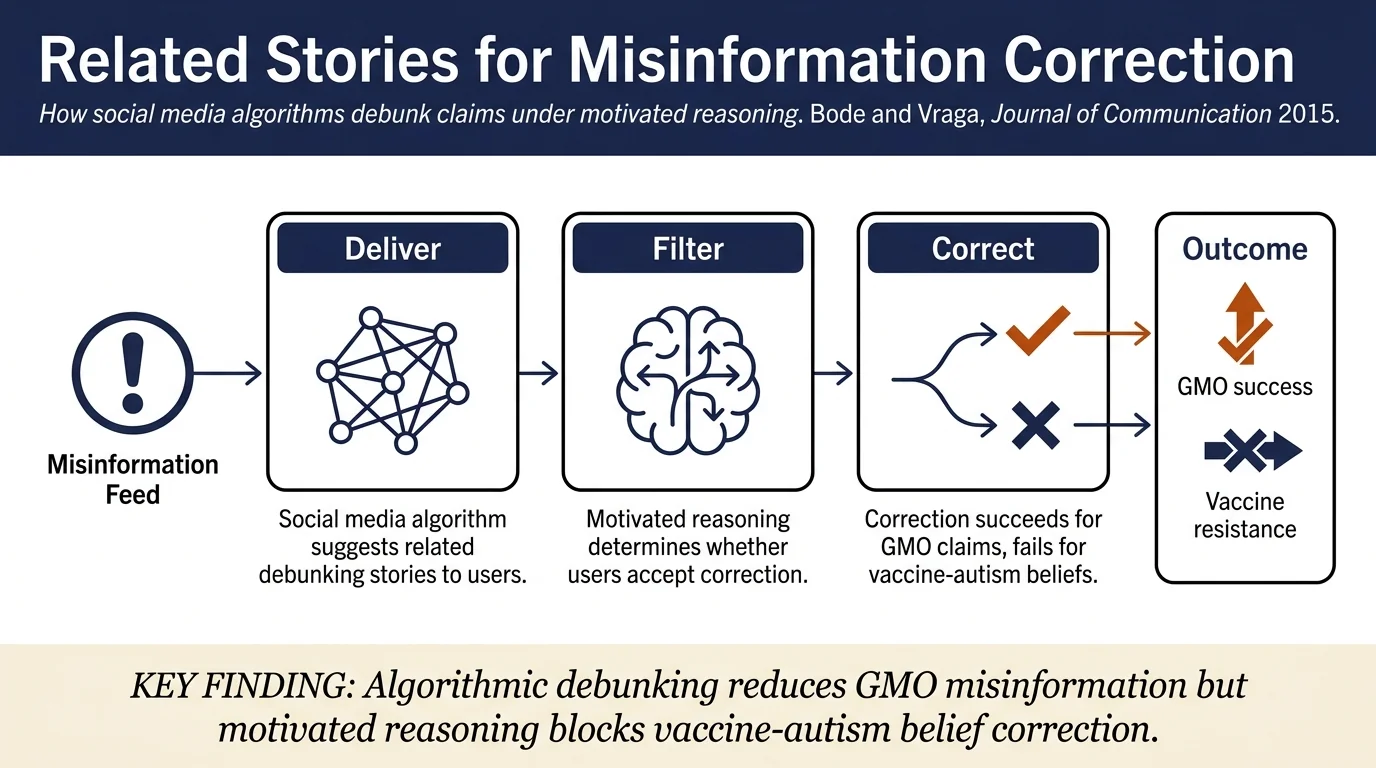
This study tests whether Facebook's "related stories" feature can correct misinformation by exposing users to debunking information. Two experiments (students and Mechanical Turk workers) examined vaccine-autism and GMO-illness misperceptions. Related stories successfully reduced GMO-related misperceptions for those who initially held them, but had no effect on vaccine-autism beliefs, suggesting issue-specific and motivated-reasoning constraints on algorithmic correction.
Contributions
- First empirical test of Facebook's "related stories" algorithm for misinformation correction
- Demonstrates that related stories can reduce misperceptions—but only when they debunk and match the user's initial position
- Shows motivated reasoning limits correction efficacy: harder to change vaccine-autism beliefs than GMO beliefs
- Evidence that social media algorithms can serve a corrective function without explicit user action
Method
Two experimental studies testing whether exposure to related stories that debunk, confirm, or contradict misinformation affects attitude change.
Study 1 (College students, N=524): Participants completed a pretest on vaccine-autism and GMO attitudes. They then viewed a simulated Facebook feed containing a false claim (e.g., "Vaccines cause autism") followed by one of four related stories: (a) debunking the claim, (b) confirming the claim, (c) mixed (one debunking, one confirming), or (d) unrelated. Participants rated the related stories on seven dimensions (novel, useful, interesting, trustworthy, credible, accurate, entertaining) and completed a posttest measuring attitudes.
Study 2 (Mechanical Turk, N=500): Replicated the design focusing on GMOs among a more diverse adult sample (M age = 34.65, 56% female, M ideology = 4.49 on 7-point liberal scale).
Measured misinformation outcomes: attitudes toward the claim (pretest/posttest) and evaluations of recommended related stories.
Results
GMO-illness issue (both samples): For those initially holding the GMO-causes-illness misconception, related stories that debunked the claim significantly reduced the misperception (Study 1: p < .01; Study 2: p < .01). Debunking stories were rated more highly than confirming or unrelated stories. Change scores showed debunking reduced misperceptions by approximately 0.5 units on a 7-point scale.
Vaccine-autism issue (Study 1 only): No significant effect of related stories on attitude change, regardless of story type. This contrasts with the GMO findings and suggests the vaccine-autism belief is more resistant to correction, possibly due to stronger prior conviction and motivated reasoning.
Participant evaluations: Related stories matched to one's initial position (debunking for those with misconceptions) were evaluated most favorably, supporting the hypothesis that motivated reasoning affects acceptance of corrective information.
Connections
- Related to Debunking and correction interventions via algorithmic delivery of corrections without user selection
- Complements Motivated reasoning in explaining when and why corrections succeed
- Tests Facebook algorithms as a mechanism for misinformation intervention
- Relevant to Vaccine hesitancy and vaccine safety concerns mitigation via social media
- Cited by work on Social media and misinformation platform affordances for health communication
Notes
The paper demonstrates that platform-driven correction is possible, but limited by motivated reasoning and the established nature of beliefs. The finding that GMO claims are more correctable than vaccine-autism claims reflects differing levels of prior conviction—vaccine-autism misperceptions have been in the public discourse longer and may benefit from stronger prior attitudes and social reinforcement.
A key limitation is the simulated environment; Facebook's actual related stories algorithm may or may not produce these effects in real use. The study also assumes people click on or engage with the related stories, which may not occur at scale. Future work should investigate whether the corrective effect persists over time and across different misconceptions.
The paper is important for understanding how social media platforms can move beyond content moderation toward active correction, though motivated reasoning remains a persistent constraint.