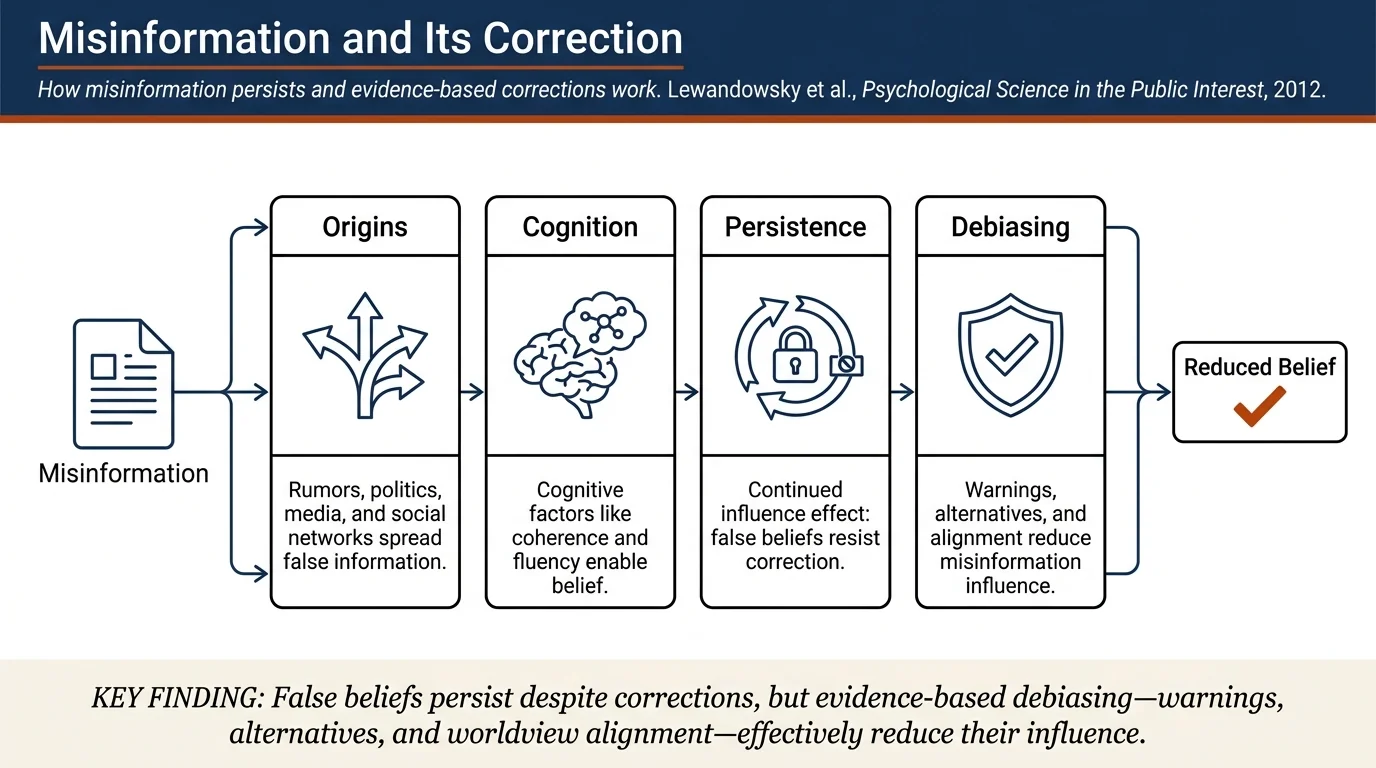
Misinformation and Its Correction: Continued Influence and Successful Debiasing
Authors: Stephan Lewandowsky, Ullrich K. H. Ecker, Colleen M. Seifert, Norbert Schwarz, John Cook
Venue: Psychological Science in the Public Interest, 13(3), 106–131, 2012 — DOI
TL;DR
This comprehensive review synthesizes literature on why false beliefs persist despite corrections, examining cognitive mechanisms (coherence, credibility, source confusion, fluency) that render misinformation resistant to change. The authors propose evidence-based debiasing strategies—warnings, alternative explanations, repeated corrections, and worldview-consonant framing—with practical recommendations for practitioners seeking to design effective interventions.
Contributions
- Taxonomy of misinformation origins: dissemination through rumors, fiction, governments, politicians, media, vested interests, and new media (including blogs and social networks)
- Mechanistic framework for persistence: explains the "continued influence effect" through mental models, retrieval failure, negation tags, and fluency heuristics
- Cognitive factors enabling belief in misinformation: incompatibility with prior knowledge, source credibility, logical coherence, familiarity, and processing fluency
- Debiasing strategies with empirical grounding:
- Preexposure warnings about forthcoming misinformation
- Providing alternative (causal) narratives that explain why misinformation was believed
- Repeated retractions coupled with coherence-filling explanations
- Worldview-affirming framings to reduce ideological backfire
- Skepticism cultivation to increase scrutiny of information
- Boundary conditions: includes discussion of when corrections backfire (worldview threats, identity protection, familiarity-based reinforcement) and ethical constraints on debiasing
Method
The article synthesizes experimental psychology literature on information processing, memory, and belief change. Structure progresses from:
- Origins of misinformation — documenting sources (rumors, fiction, political/government actors, media oversimplification, NGOs and industry interests, internet/social media)
- Cognitive processes enabling belief — examining how people assess truth (compatibility with prior knowledge, source credibility, story coherence, familiarity and fluency effects)
- The continued influence effect — reviewing mechanisms of persistence (mental model formation, retrieval failure due to source confusion, negation tag attachment, and fluency illusions)
- Reducing misinformation impact — analyzing techniques to enhance correction effectiveness (warnings, alternative accounts, repeated retractions, worldview alignment, skepticism cultivation)
- Backfire and boundary conditions — documenting when corrections fail or worsen belief (worldview-incongruent information, affective backlash, belief polarization)
Key mechanisms reviewed include mental models (how people integrate misinformation into narrative schemas), source attribution (difficulty distinguishing fact from misinformation source), fluency heuristics (mistaking repeated exposure for truth), and coherence effects (tendency to maintain consistency across beliefs).
Results
Empirical findings reviewed include:
- Corrections often fail to fully eliminate misinformation influence, particularly when misinformation is simple, emotionally laden, and consistent with worldview
- Repeated corrections strengthen retraction efficacy, even when misbelief is deeply encoded
- Preexposure warnings significantly reduce acceptance of misinformation compared to reactive corrections
- Providing alternative causal explanations for why misinformation exists more successfully fills coherence gaps than simple fact-checking
- Worldview-consonant reframing of corrections reduces ideological backlash and defensive belief polarization
- Skepticism (about information source credibility) offers protective effects that persist across topics, particularly when cultivated explicitly before exposure to misinformation
Effects vary significantly with individual differences (political orientation, prior knowledge, cognitive reflection, need for closure) and messaging characteristics (simplicity, emotional arousal, narrative coherence, presentation format).
Connections
- Related to psychological drivers of misinformation belief via shared cognitive mechanisms
- Cited extensively by Neutralizing misinformation through inoculation: Exposing misleading argumentation on effective messaging for correction
- Complements propagation studies like The Spread of True and False News Online with psychological mechanisms underlying why false claims persist
- Informs debiasing and fact-checking approaches discussed in In Related News, That Was Wrong: The Correction of Misinformation Through
- Overlaps with Fake news game confers psychological resistance against online misinformation on inoculation against misinformation
Notes
This is a foundational review that bridges psychology and misinformation research. Its strength lies in systematically reviewing why corrections often fail—a central puzzle in the field—and grounding recommendations in cognitive theory. The debiasing strategies reviewed here have informed subsequent work on effective fact-checking, prebunking/inoculation approaches, and the design of fact-checking campaigns. The discussion of worldview effects and backfire remains particularly relevant for understanding polarization dynamics. Some limitations: the review predates recent work on social media amplification algorithms and coordinated misinformation campaigns; it also focuses primarily on Western, educated, industrialized, rich, democratic (WEIRD) populations.