Explore everything
Filter by research area, year and venue. Every filter is in the address bar, so you can share a view as a link.
 Spread & networksBots & coordinated campaigns
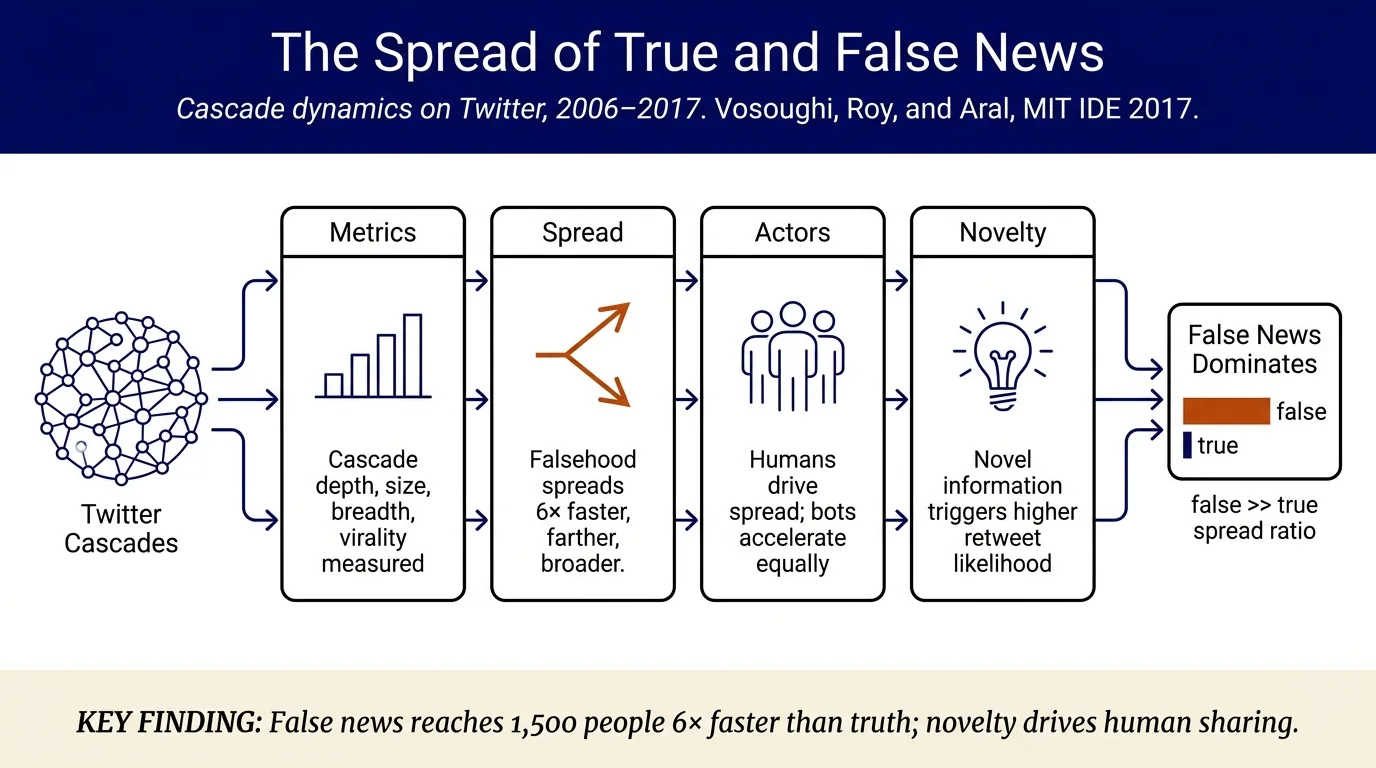
The Spread of True and False News OnlineAnalyzes 126,000 verified true and false news cascades from Twitter (2006–2017) covering 3 million users and 4.5 million shares. False news diffuses significantly farther, faster, deeper, and more broadly than truth across all categories, with false political news spreading fastest.
 Spread & networksPlatforms, policy & society
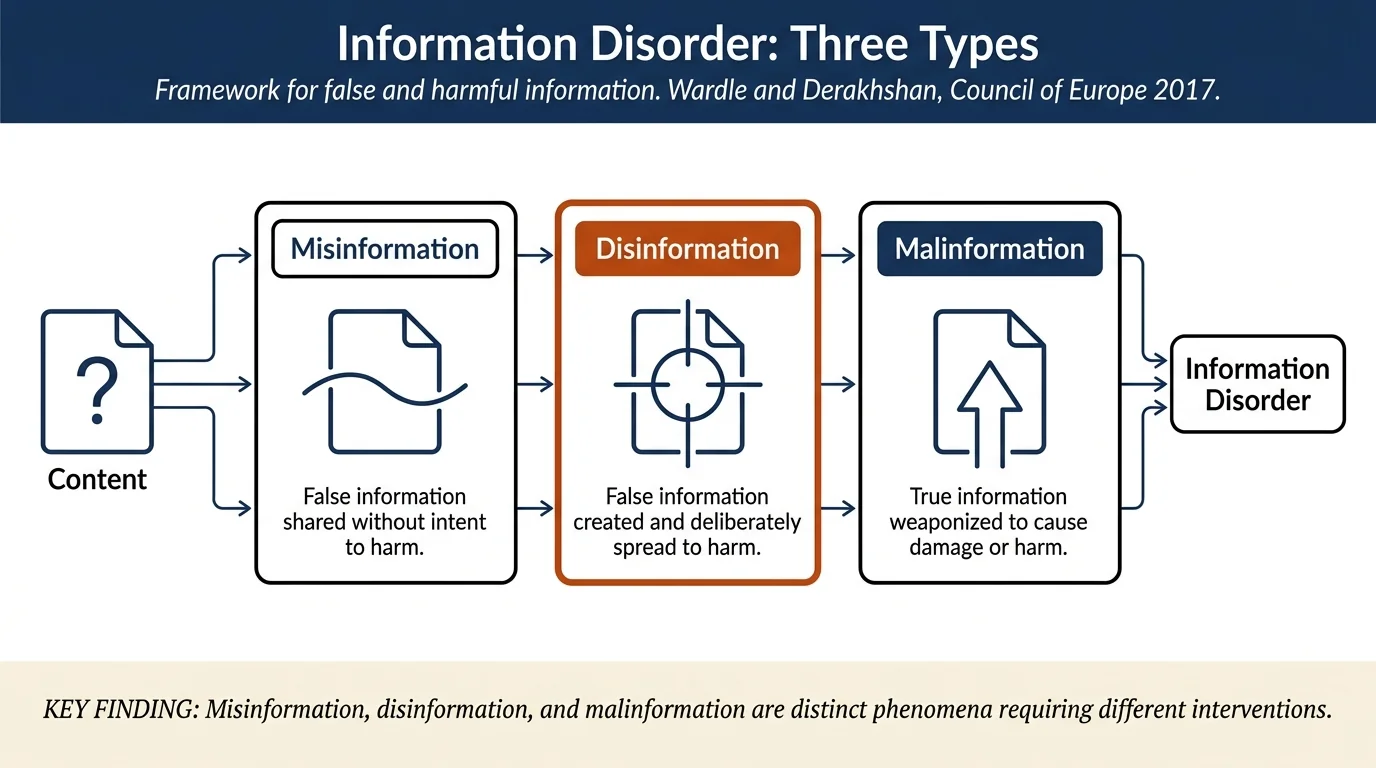
Information Disorder: Toward an Interdisciplinary Framework for Research and Policy MakingThis Council of Europe report introduces a comprehensive framework for understanding "information disorder" via three types (mis-, dis-, mal-information) defined by falseness and intent-to-harm. It examines the agents, messages, and interpreters involved, the creation-production-distribution lifecycle, and proposes 34 recommendations…
 Spread & networksPsychology & interventions
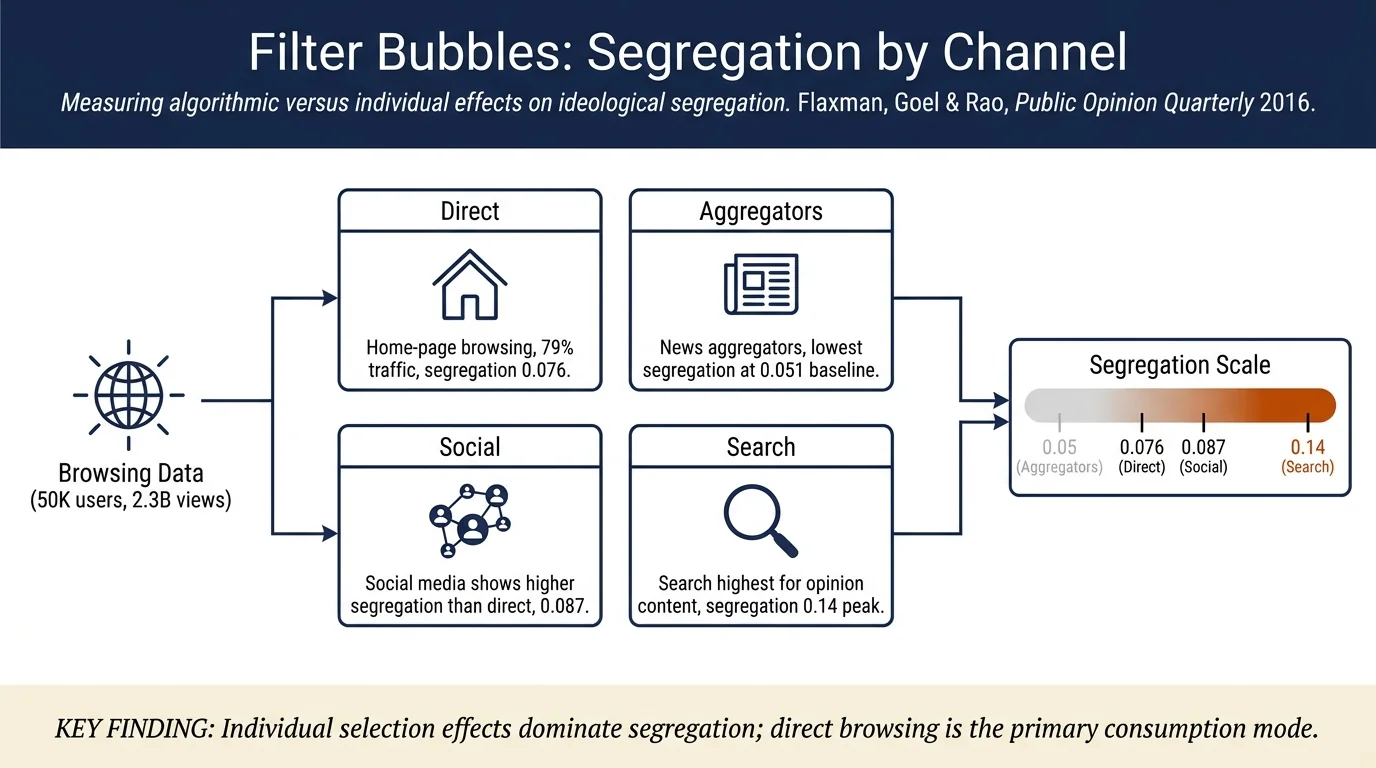
Filter Bubbles, Echo Chambers, and Online News ConsumptionThis paper examines whether technological changes (social media, search engines) increase ideological segregation in online news consumption by analyzing web-browsing data from 50,000 active news readers. They find that while social media and search are associated with higher segregation than direct browsing, the overall effects are…
 Spread & networksPlatforms, policy & society
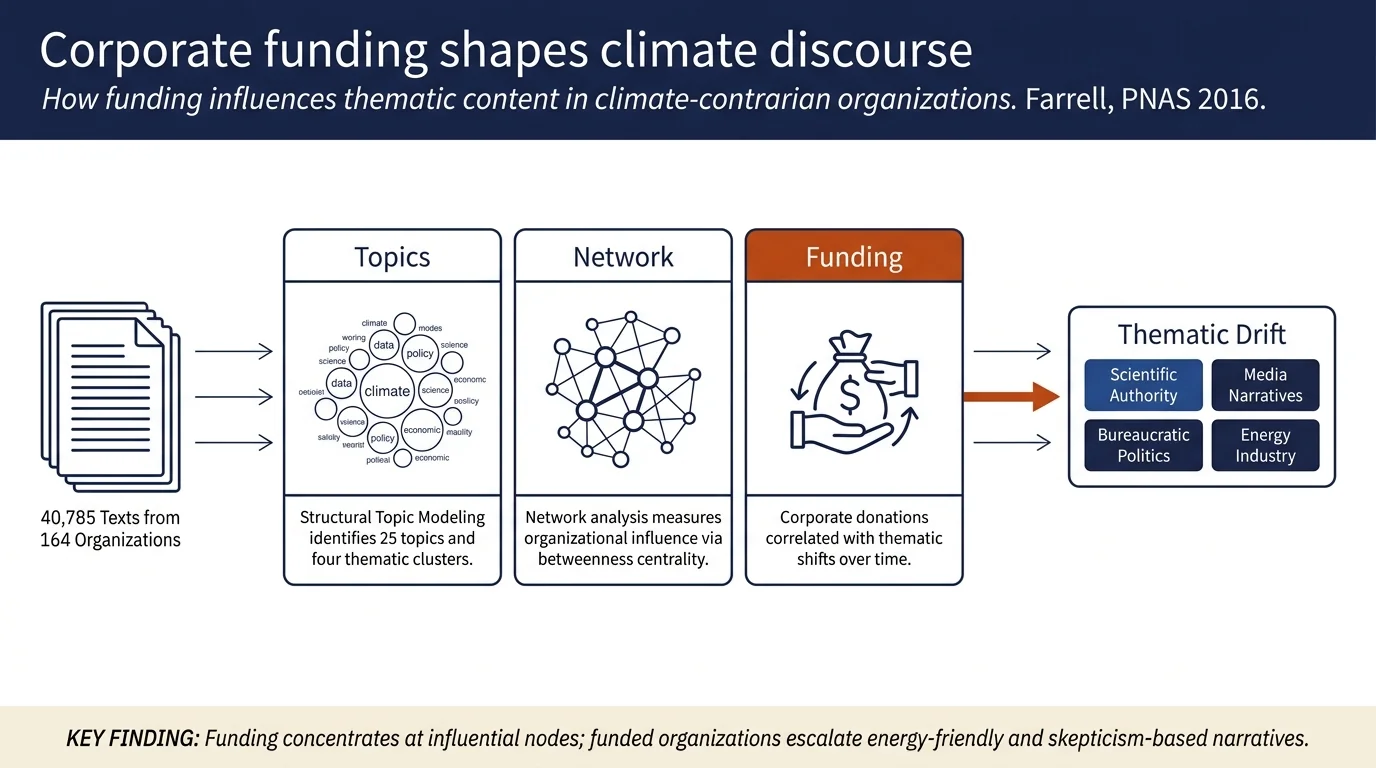
Corporate funding and ideological polarization about climate changeFarrell analyzes 40,785 texts (39+ million words) from 164 climate contrarian organizations between 1993–2013, employing Structural Topic Modeling and social network analysis to demonstrate that corporate funding from entities like ExxonMobil and Koch family foundations directly influences which polarization themes are created and…
 Fact-checking & verificationPlatforms, policy & society
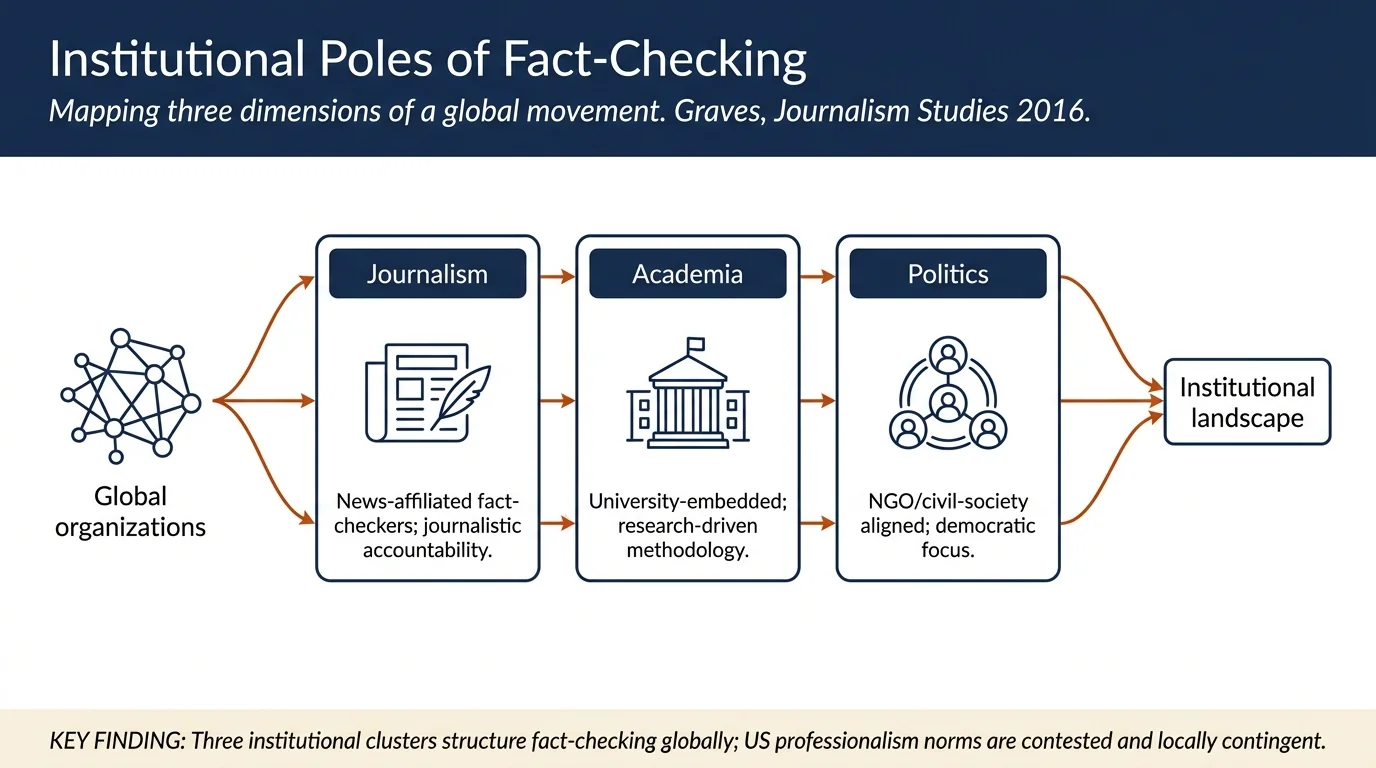
Boundaries Not Drawn: Mapping the institutional roots of the global fact-checking movementGraves maps the institutional landscape of 64+ fact-checking organizations globally across two summits (2014–2015), using ethnographic fieldwork and ternary plots to sort organizations along three axes: journalism, academia, and politics/civil society. The movement has a journalistic core but exhibits striking institutional diversity and…
 Platforms, policy & societyPsychology & interventions
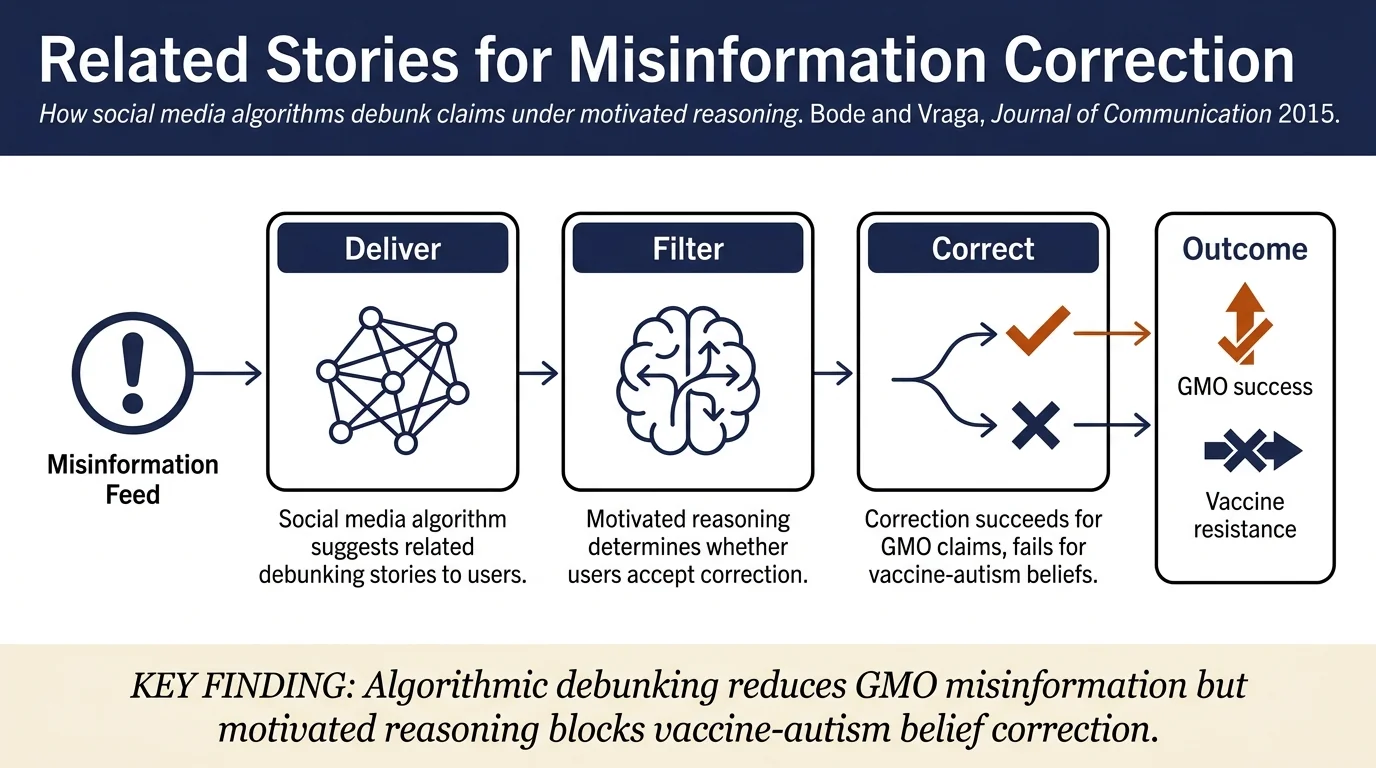
In Related News, That Was Wrong: The Correction of Misinformation Through Related Stories Functionality in Social MediaThis study tests whether Facebook's "related stories" feature can correct misinformation by exposing users to debunking information. Two experiments (students and Mechanical Turk workers) examined vaccine-autism and GMO-illness misperceptions.
 Fact-checking & verificationPsychology & interventions
How to separate fact and fiction onlineMarkham Nolan, editor of Storyful, explains how journalists use open-source intelligence tools to verify content in the age of information overload. Through real-world case studies—including fake Hurricane Sandy photos and identifying locations in Syrian conflict videos—he demonstrates that truth-seeking requires human judgment combined…
 Psychology & interventionsFact-checking & verification
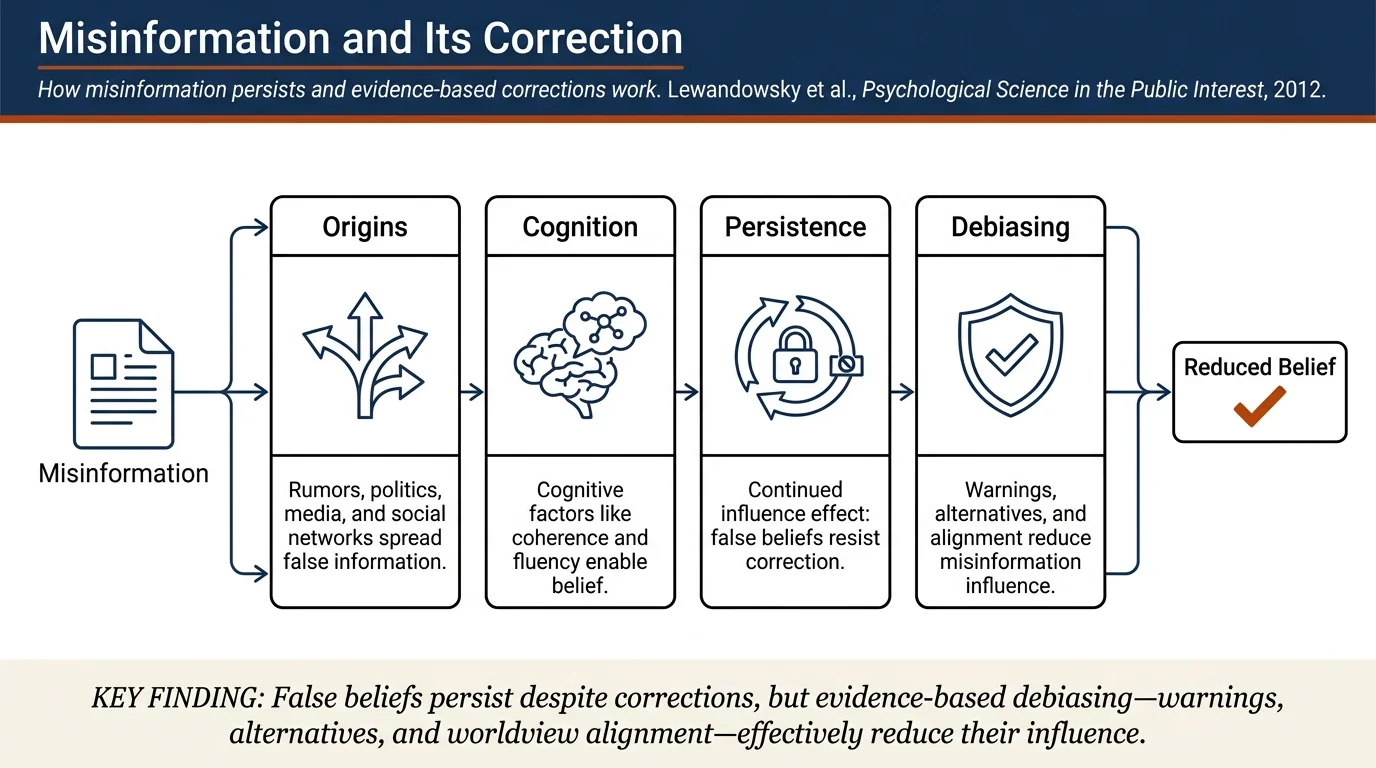
Misinformation and Its Correction: Continued Influence and Successful DebiasingThis comprehensive review synthesizes literature on why false beliefs persist despite corrections, examining cognitive mechanisms (coherence, credibility, source confusion, fluency) that render misinformation resistant to change. The authors propose evidence-based debiasing strategies—warnings, alternative explanations, repeated…
Spread & networksPsychology & interventions
A Theory of Fads, Fashion, Custom, and Cultural Change as Informational CascadesFoundational theoretical framework explaining how fads, fashions, and beliefs spread through sequential information cascades: when individuals use others' actions to infer information while ignoring their own private signals, widespread adoption of incorrect beliefs and practices can occur.
 Psychology & interventionsDetection methods
Why People Fall for MisinformationJoseph Isaac traces how misconceptions persist using the tongue map myth as exemplar: David Hänig's 1901 research found modest taste-sensitivity variations across tongue regions, but through translation barriers, visual simplification, and our preference for clean narratives, it became the false claim that sweetness is imperceptible at…
 Psychology & interventionsPlatforms, policy & society
How We Create Our Own Fake NewsBobby Duffy's "Perils of Perception" research (100,000+ interviews across 40 countries) reveals that people systematically misestimate social realities by factors of 2–3×. Using concrete examples (teenage pregnancy, murder rates, immigration, social media adoption), Duffy traces these perception gaps to four psychological mechanisms: (1)…
Spread & networksPsychology & interventions
Avoiding the Echo Chamber About Echo Chambers: Why selective exposure to like-minded political news is less prevalent than you thinkThis Knight Foundation white paper reviews the academic literature on echo chambers and filter bubbles and argues that the narrative of pervasive ideological self-segregation in media consumption is significantly overstated. While people do prefer congenial political information, most Americans consume diverse media diets; most partisan…
Spread & networksPlatforms, policy & society
Social Media, Political Polarization, and Political Disinformation: A Review of the Scientific LiteratureThis comprehensive literature review examines the relationships among social media usage, political polarization, and political disinformation, synthesizing research across six topic areas: online political conversations, consequences of disinformation exposure, producers of disinformation, spreading strategies, content and polarization…
Spread & networksPlatforms, policy & society
WhatsApp vigilantes: an exploration of citizen reception and circulation of WhatsApp misinformation linked to mob violence in IndiaThis LSE report examines how WhatsApp misinformation circulation in India relates to lynchings and mob violence since 2015. The study investigates citizen reception, technological affordances, motivations for sharing, and the broader socio-political context shaping how false information spreads through messaging platforms and triggers…
 Psychology & interventionsPlatforms, policy & society
How to Pre-Bunk Misinformation and DisinformationJon Roozenbeek discusses psychological inoculation as a scalable defense against misinformation. Rather than focusing on veracity (which becomes politically contested), he proposes teaching people to recognize predictable manipulation techniques before encountering false content.
 Psychology & interventionsDetection methods
The Psychology of MisinformationEcker presents evidence that misinformation continues to influence reasoning even after people receive, believe, and remember corrections. Drawing on cognitive psychology, he demonstrates that corrections are only partially effective—typically halving (not eliminating) reliance on misinformation.
 Detection methodsPsychology & interventions
From WMDs to the vaccine-autism myth: Understanding misperceptions in politics and health careNyhan presents research on why people hold and resist correcting false beliefs, spanning political misperceptions (Iraq WMDs, Obama birth certificate, death panels) and health misinformation (vaccine-autism link). His core finding is that simple fact-based corrections often fail and sometimes backfire—especially among politically…
 Psychology & interventionsDetection methods
Towards psychological herd immunity: Cross-cultural prebunking against COVID-19 misinformationJon Roozenbeek presents a cross-cultural randomized controlled trial testing two psychological interventions against COVID-19 misinformation. Comparing the "Go Viral" game (technique-based inoculation) against UNESCO infographics and a Tetris control condition across 1,777 participants in the UK, Germany, and France, he demonstrates that…
 Psychology & interventionsPlatforms, policy & society
The Misinformation AgeFalse beliefs persist and spread through social factors—conformity, institutional curation of evidence, and network structure—rather than individual cognitive biases alone. O'Connor examines historical cases (variolation in 18th-century England, tobacco industry strategy) and mathematical models to show how unbiased actors (journalists,…
 Platforms, policy & societyFact-checking & verification
How Polarization Can Help Solve the Misinformation ProblemDavid Rand presents a counter-intuitive argument: while polarization is widely viewed as exacerbating misinformation, it may actually improve crowd-sourced fact-checking systems like Twitter's Birdwatch/Community Notes. Rather than a traditional technology approach (machine learning classifiers), platforms can scale fact-checking by…
 Psychology & interventionsFact-checking & verification
How You Can Help Combat Fake NewsA researcher presents empirical findings challenging the "motivated reasoning" account of why people believe false headlines. Instead, a multi-study investigation with 25,000+ participants shows that critical thinking and cognitive reasoning—not willful bias—are the primary determinants of misinformation susceptibility.
 Psychology & interventionsPlatforms, policy & society
Psychological Inoculation Against Misinformation (Trinity College, Cambridge)Van der Linden presents psychological inoculation as an alternative to reactive fact-checking. Rather than debunking false claims after people have been exposed, inoculation preemptively builds resistance to misinformation techniques.
 Psychology & interventionsPlatforms, policy & society
Prebunking and Inoculating Against DisinformationVan der Linden argues that reactive fact-checking fails to scale and leaves misinformation's psychological influence intact. Instead, he proposes psychological inoculation: preemptively exposing people to weakened examples of misinformation techniques before they encounter the real thing, building cognitive resistance.
 Psychology & interventionsLLMs & generative AI
Misinformation and Data LiteracyData and numbers are surprisingly effective misinformation tools because they convey false authority and precision—people trust numbers even more than words. West illustrates how charts can deliberately mislead through axis manipulation, bin-width distortion, and selective framing; these occur regularly in mainstream media and academic…