Boundaries Not Drawn: Mapping the institutional roots of the global fact-checking movement
Author: Lucas Graves
Venue: Journalism Studies, Vol. 19, No. 5, pp. 613–631, 2016 — DOI
Published: June 24, 2016
TL;DR
Graves maps the institutional landscape of 64+ fact-checking organizations globally across two summits (2014–2015), using ethnographic fieldwork and ternary plots to sort organizations along three axes: journalism, academia, and politics/civil society. The movement has a journalistic core but exhibits striking institutional diversity and contested professional boundaries—US-style journalistic professionalism is neither universal nor uncontested internationally.
Contributions
- First systematic global mapping of the fact-checking movement's organizational structure and institutional diversity.
- Ternary plot methodology for visualizing organizations' ties to journalism, academia, and political/civil society; identified distinct institutional clusters.
- Documentation of boundary work across countries: professional journalism boundaries are drawn, maintained, and contested differently in different national and organizational contexts.
- Contrast between US and international practice: US fact-checkers position themselves as founders and authorities; international groups challenge this narrative and practice journalism differently (e.g., less concern with contacting claimants, different rating systems, closer alignment with activism).
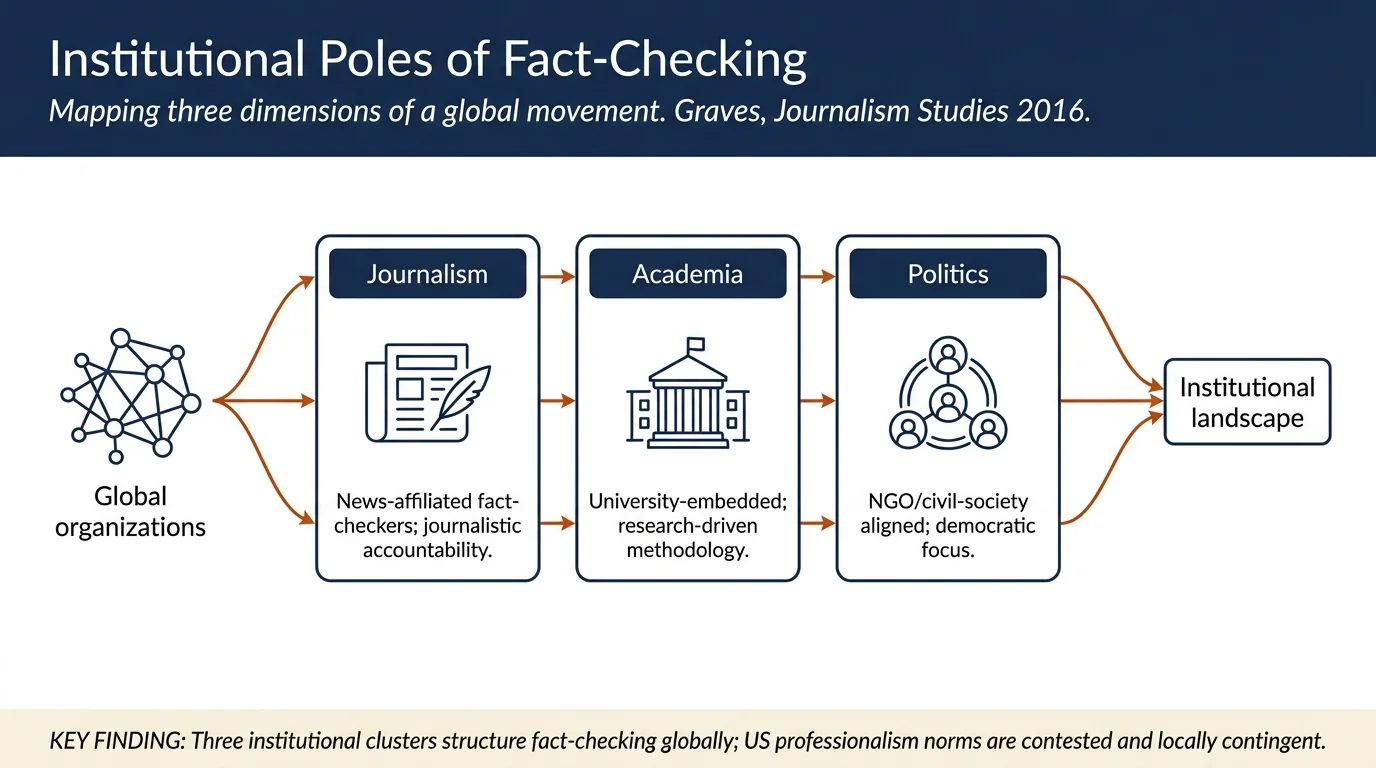
- Identification of three institutional poles:
- Journalistic core: 64% of active fact-checkers have news-organization ties; includes traditional newsroom-based fact-checking (Washington Post, Le Monde, Channel 4 Fact Check).
- Academic axis: universities and research centers; fact-checkers using scholarly methods or embedded in university journalism departments (FactCheck.org at University of Pennsylvania, The Conversation).
- Political-civic axis: NGOs, activist groups, civil society organizations; includes democracy advocates, human rights monitors, good governance initiatives (Africa Check, StopFake, Dogruluk Payı).
Method
Mixed-methods ethnographic study:
- Primary fieldwork: attended two global fact-checking summits (June 2014 in London; July 2015 in London); conducted 30+ structured interviews and 200+ hours of participant observation with three leading US fact-checking organizations.
- Data collection: fieldwork notes, attendance surveys, interviews, website analysis, organizational mission statements, staff backgrounds.
- Scoring methodology: reviewed each of ~16 fact-checkers selected for breadth/clarity at summits; distributed 10 points across three axes (journalism, academia, politics) according to organizational affiliation, staff background, funding sources, mission statement, and research practices. Plotted on ternary diagram.
- Qualitative analysis: examined institutional ties, professional practices, funding models, treatment of ratings vs. descriptions, and boundary work (willingness to collaborate with vs. distance from non-journalists).
Results
Institutional heterogeneity within a broad shared discourse:
-
Journalistic anchors — roughly two-thirds of tracked organizations have newsroom ties (Washington Post, PolitiFact, Le Monde's Les Décodeurs, Chile's El Mercurio, Germany's Der Spiegel, Brazil's O Globo, UK's Channel 4 Fact Check, Australia's ABC Fact Check). These tend to operate as journalistic units, hire journalists, and frame fact-checking as accountability reporting.
-
Academic hybrids — organizations with university affiliations or research-driven approaches; staff include academics, policy analysts, researchers; use scholarly methods (FactCheck.org, The Conversation, FactCheckCan, Chequeado). Often have explicit research components and Ivy League home bases.
-
NGO/activist fact-checkers — civil-society and political-alignment clusters; include human-rights monitors, good-governance initiatives, political reformers, and democracy advocates (Africa Check, StopFake, Dogruluk Payı, Demag). Often founded in response to specific political crises (Arab Spring, Gezi Park protests, Russian propaganda).
Key institutional tensions:
- Boundary disputes on methodology: US fact-checkers routinely contact claimants before publishing; many international peers skip this step or conduct it differently. US outlets emphasize rating systems (Truth-O-Meter); others resist meters as unscientific or reductive.
- US primacy narrative contested: US practitioners position themselves as founders and models; international fact-checkers resisted this framing at summits, emphasizing independent development and local appropriateness.
- Professional autonomy vs. activism: US fact-checkers stress journalistic autonomy and distance from political campaigns; international peer-checking includes political reformers and civil-society actors who embrace alignment with democratic norms or anti-corruption missions.
- Funding and institutional ties: foundation funding (especially US foundations) flows to fact-checking; academic ties provide legitimacy; news-outlet ties provide legitimacy through journalism but create credibility problems in polarized environments where news media itself is distrusted.
Practitioners' common ground: Despite differences, a shared professionalization discourse emerged at summits. Organizations converged on emphasis of accuracy, fairness, impartiality, transparent methodology, and high-quality fact-checking standards. Yet this discourse plays out differently: US-style professionalism (arm's-length neutrality, systematic contact with claimants, quantified ratings) is practiced inconsistently and sometimes rejected internationally as inapplicable or ideologically coded.
Connections
- Fact-checking as risk communication: the multi-layered risk of misinformation — Krause et al. build on Graves' observation that fact-checkers' institutional ties affect credibility; they show how mismatches between fact-checker and audience risk definitions undermine effectiveness.
- Fact-checking and corrections — foundational institutional analysis of the fact-checking field globally.
- Journalism and professionalism — examines how journalistic professional norms (autonomy, objectivity, distance from politics) are contested in the global fact-checking movement.
- Institutional analysis — example of organizational boundary mapping and field-theoretic analysis.
- Disinformation — fact-checking presented as a key response to disinformation, though with institutional and cross-cultural challenges.
Notes
Strengths: - First comprehensive empirical mapping of the global fact-checking landscape; rare transnational ethnography of a journalism-adjacent field. - Ternary plot methodology is elegant and reproducible; can be extended with new organizations or re-scored over time. - Careful attention to boundary work and how professional norms vary: avoids false universalism. - Clear articulation of institutional tensions (US vs. international, journalist vs. activist, meter vs. description) that remain salient.
Limitations: - Sample of 64 organizations reflects ~50% of active sites in 2015; selection bias toward summits attendees and English-language sites. - Ternary scoring is impressionistic (qualitative annotation rather than quantitative proxy variables); reproducibility on new organizations may be challenging. - Limited follow-up on how institutional ties affect fact-checking output (accuracy, speed, audience reach, influence on policy). This work is institutional sociology, not outcomes analysis. - US-centric framing remains despite effort to distance from it; some international practitioners may still feel their autonomy is being filtered through a US-researcher lens.
Follow-up research: - Longitudinal rescore (2015 → 2026) to track institutional drift: are boundaries becoming clearer or more fluid? - Link institutional characteristics (journalism vs. NGO vs. academic) to fact-checking practices and outputs (claim selection, rating style, correction formats, audience engagement). - Comparative content analysis: do journalistic vs. NGO fact-checkers choose different claims, frame them differently, or target different audiences? - Qualitative study of international fact-checkers' resistances to journalistic professionalism: what alternative professional models are they proposing?