Key themes
-
The continued influence effect as primary phenomenon. Misinformation shapes people's reasoning and inference-making even after clear, credible, repeated corrections that people believe and remember. This is not primarily a memory or motivation problem but a cognitive mechanism: people struggle to update their representations and continue using the once-believed claim to make sense of new information.
-
Corrections work but incompletely. Across studies with neutral (fictional warehouse) and worldview-relevant (climate, vaccines, political) content, corrections reduce reliance on misinformation but do not eliminate it. Graphically, corrections move belief partway back toward baseline but not all the way. On average, Ecker observes about a 50% reduction in continued influence—statistically significant but practically incomplete.
-
Subtle misinformation has measurable effects. Misleading headlines, false balance framing, and rhetorical framings (e.g., "we can only do one or the other" regarding climate and economy) all influence reasoning even when the false claim is not explicit. People reading identical articles with misleading versus congruent headlines show different policy support and threat estimates.
-
Five design principles improve correction effectiveness: 1. Explain why the misinformation is wrong, not just that it is. Discredit the source if applicable; provide alternative facts. 2. Keep corrections salient: use simple language, diagrams, and visualizations. Quantified evidence is harder to counter than vague descriptions. 3. Use trustworthy correction sources. Expertise does NOT significantly predict correction effectiveness, but source trustworthiness does. 4. Account for audience values and worldview. Affirming a person's values (e.g., freedom, economic opportunity for conservatives) makes them more receptive to worldview-inconsistent corrections. Avoid triggering words (e.g., "tax") that cause dismissal. 5. Leverage social norms. Communicate expert consensus and injunctive norms (what most people believe is right). Shifting perceived norms can shift both belief and behavior, especially among moderates.
-
Backfire effects are rare and declining in replication. Contrary to early concerns, repeating misinformation does not reliably boost its familiarity or backfire. Pre-warning audiences about misinformation they will encounter prevents initial belief and reduces need for later retrospective evaluation. Well-designed studies with larger samples have largely failed to replicate backfire or political asymmetry claims.
-
Worldview threats do not reliably trigger resistance. Even worldview-congruent misinformation (e.g., told Democrats embezzle, if you are a Democrat) responds to corrections as effectively as worldview-incongruent misinformation. The emerging consensus is that worldview effects matter less than previously feared, though they still shape policy outcomes in real-world settings.
-
Corrections change misperceptions but not necessarily feelings or behavior. Ecker cites a study fact-checking Trump and Bernie Sanders statements: even when 80% of statements were identified as false, corrections reduced factual misperceptions but had almost no effect on feelings toward the candidates or voting intentions. (The effect was six times larger in Australia, suggesting cultural and institutional factors mediate the link between belief and behavior.)
-
Inoculation against future misinformation. Teaching people the argumentation techniques used in past disinformation campaigns (fake experts, cherry picking) protects them against future attempts using the same technique on different topics. Example: understanding how tobacco industry used fake experts to cast doubt on smoking–cancer link protected people against the same "fake expert" framing in climate denialism.
-
Misinformation campaigns target multiple goals beyond belief. Many disinformation efforts aim to confuse, fatigue, polarize, and create uncertainty rather than to establish false beliefs. Challenges to the very notion that truth is knowable are particularly dangerous to democratic reasoning.
Notes
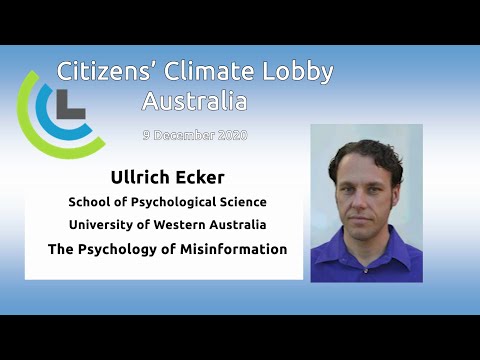
A practitioner-focused presentation on the psychology of misinformation for a climate-engaged audience. Ecker balances research findings with explicit acknowledgment of limitations: corrections are one lever among many; worldviews still matter despite weaker backfire evidence; and real-world policy change depends on institutional trust, media environment, and political incentives beyond psychology. He emphasizes pluralistic ignorance (majorities believing they are minorities, silencing their views) and recommends speaking up to shift norms. The climate-specific framing (examples centered on climate skepticism, renewables, COVID-climate tradeoffs) makes the work immediately relevant to the submitter's context while drawing on Ecker's broader cross-domain research (autism interventions, political fact-checking, fictional scenarios). Strong emphasis on honest reporting of what corrections can and cannot achieve.