Explore everything
Filter by research area, year and venue. Every filter is in the address bar, so you can share a view as a link.
 Bots & coordinated campaignsSpread & networks
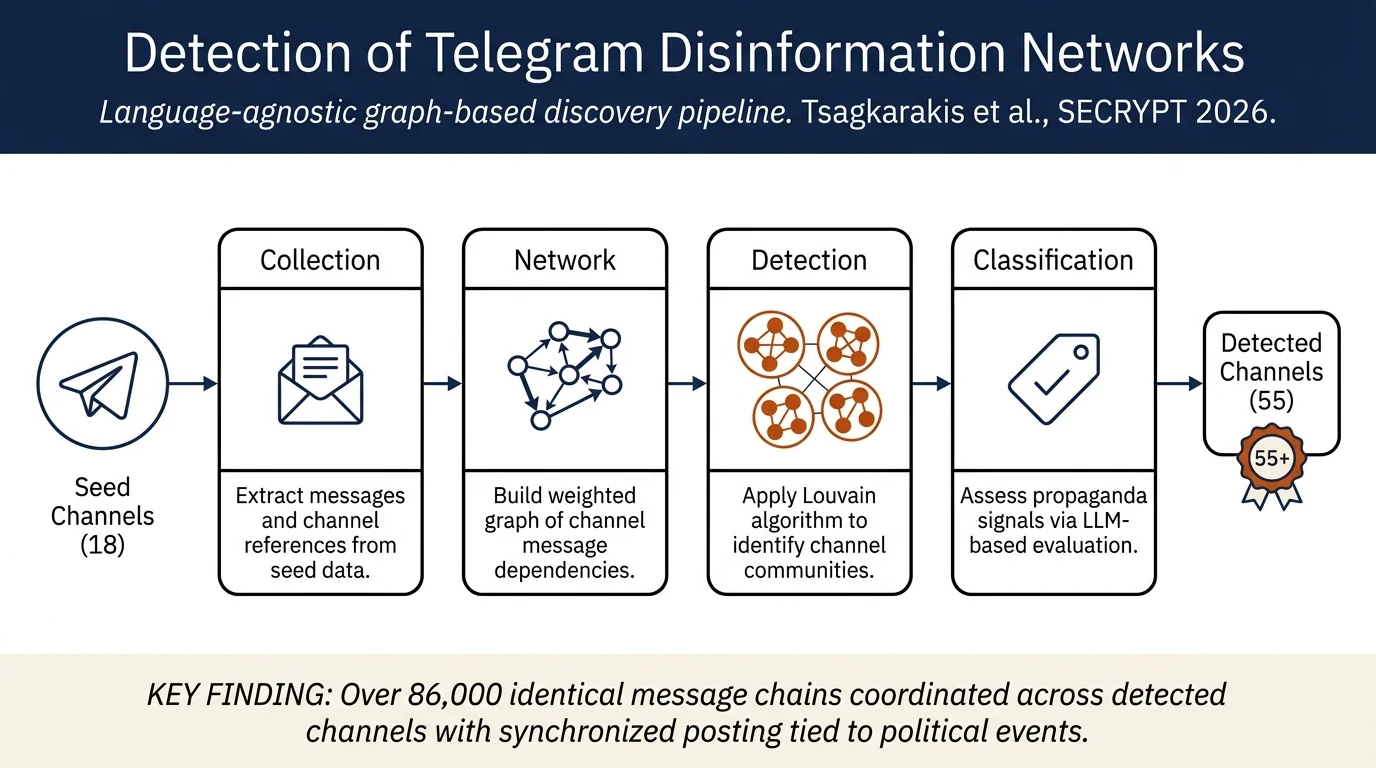
Birds of a Feather Flock Together: Network-Based Detection of Coordinated Disinformation Campaigns on TelegramA graph-based methodology discovers coordinated disinformation campaigns on Telegram by analyzing message-sharing patterns rather than content, requiring only structural relationships. The authors identified 55 disinformation channels and over 86,000 identical message chains spanning multiple channels, revealing a highly synchronized…
 Bots & coordinated campaignsDatasets & evaluation
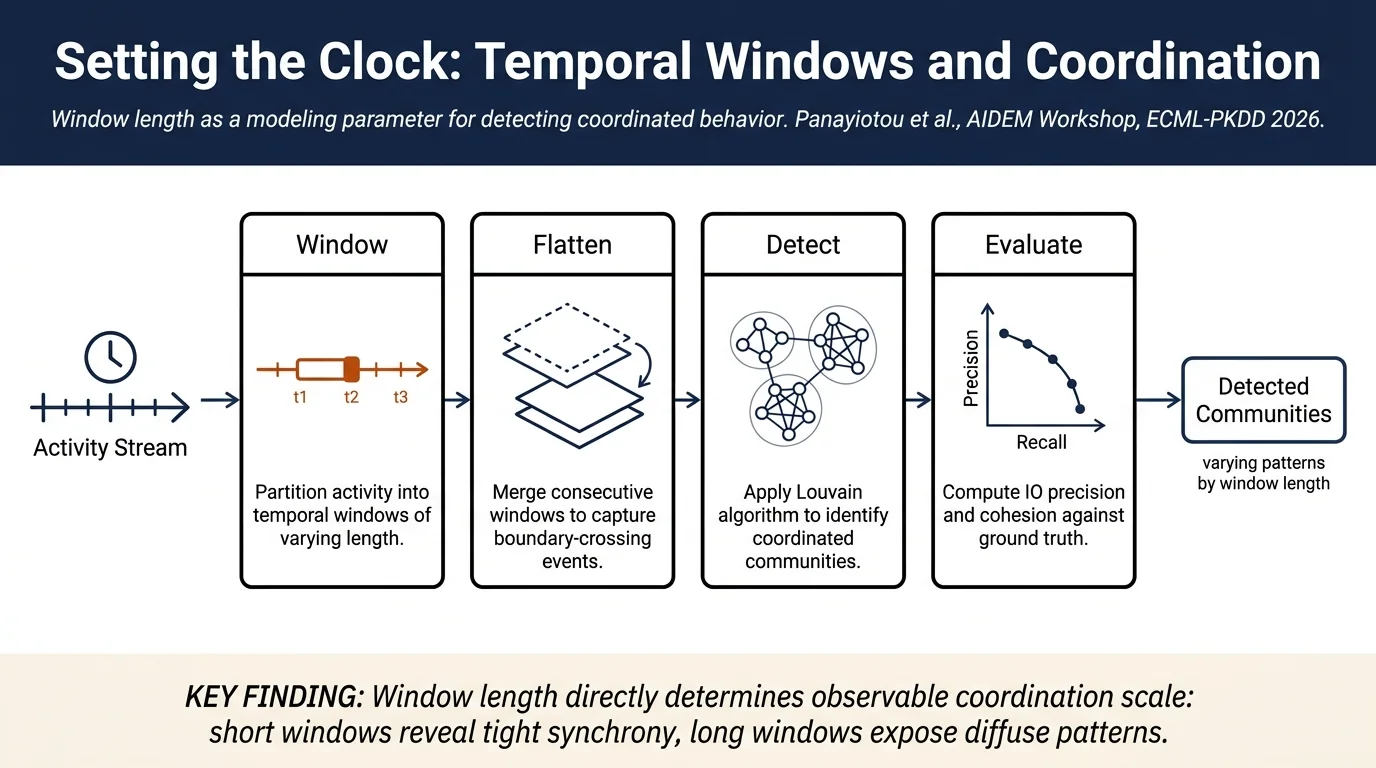
Setting the clock: Evaluating temporal window parameters for coordinated behavior detectionThe paper systematically evaluates how temporal window parameters (length and stride) affect detection of coordinated communities in co-repost networks. Using 14 labeled information operation datasets, the authors find that window length is a central modeling parameter: short windows (seconds to minutes) detect tight, highly synchronized…
 LLMs & generative AIDetection methods
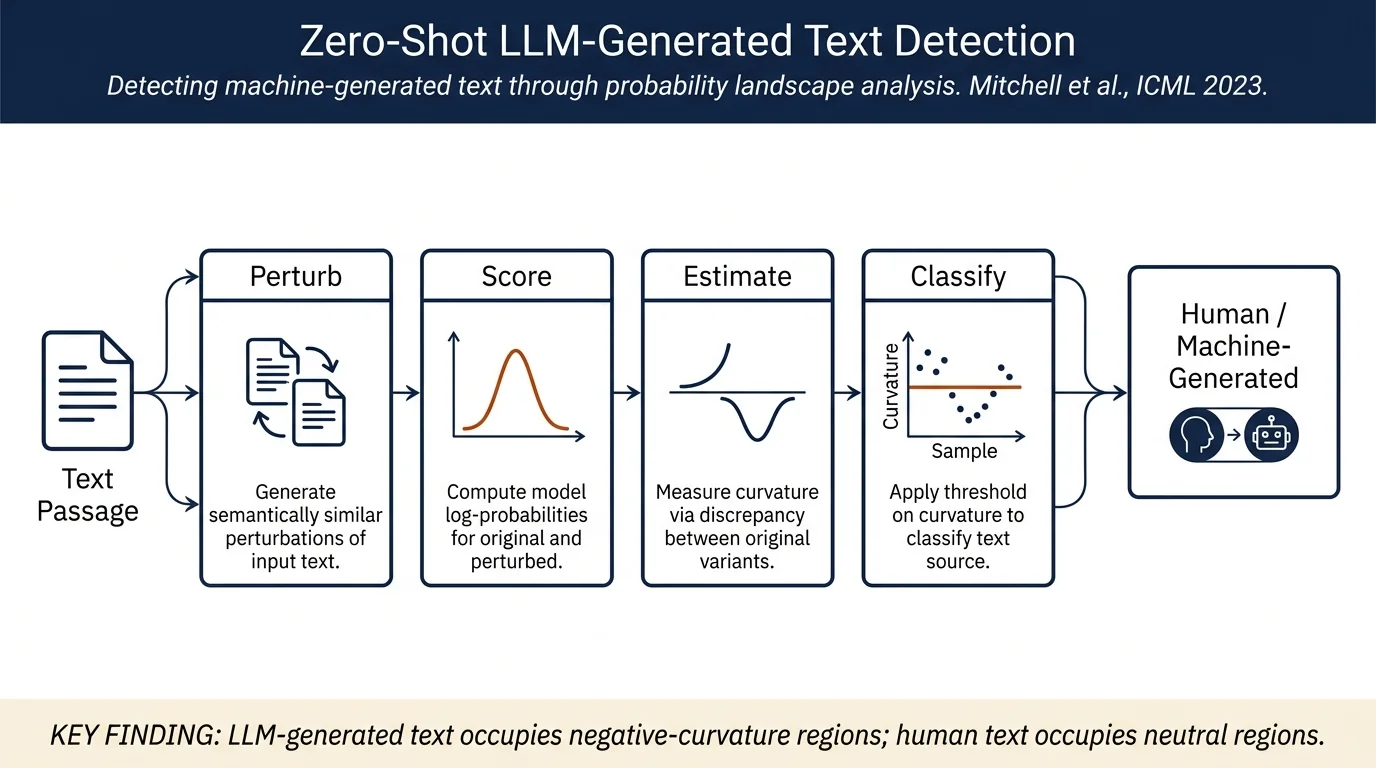
DetectGPT: Zero-Shot Machine-Generated Text Detection using Probability CurvatureThis paper identifies that text sampled from language models tends to occupy negative-curvature regions of the model's log-probability landscape, whereas human-written text occupies more neutral regions. DetectGPT leverages this observation to detect machine-generated text in a zero-shot manner by analyzing probability curvature, without…
 Platforms, policy & societySpread & networks
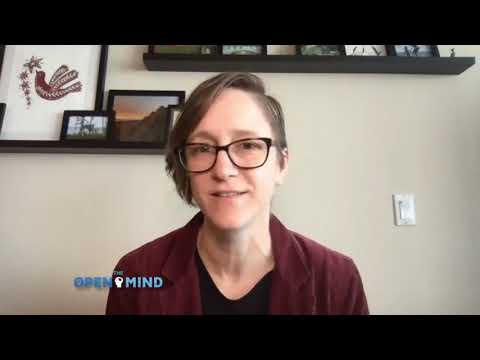
How to Demolish the Disinformation InfrastructureKate Starbird, co-principal investigator at the University of Washington's Center for an Informed Public, discusses the state of disinformation in the aftermath of platform removals (Trump, QAnon), focusing on how moderation actions redirect harmful activity to alternative ("alt-tech") platforms rather than eliminating it. She emphasizes…
 Platforms, policy & societyBots & coordinated campaigns
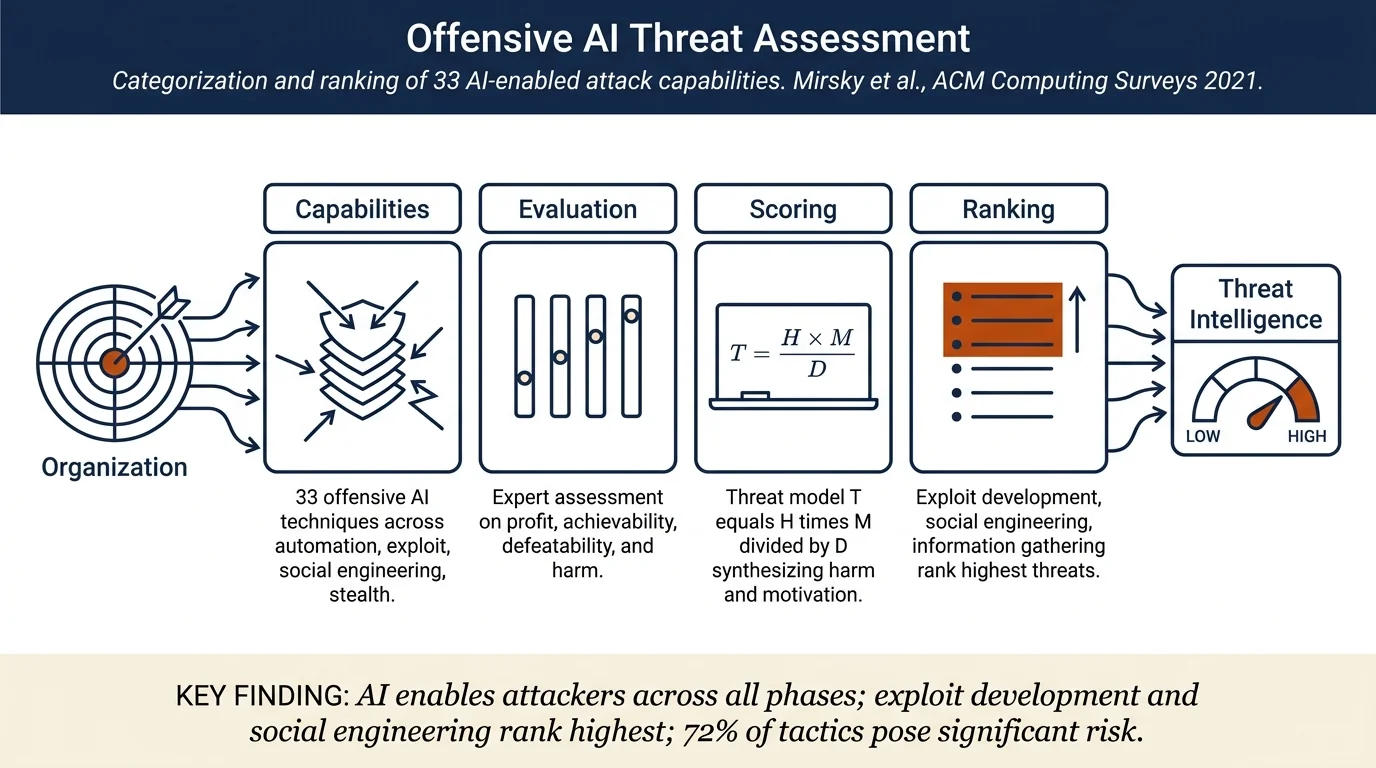
The Threat of Offensive AI to OrganizationsA comprehensive survey identifying 33 offensive AI capabilities that adversaries can use to attack organizations, organized into seven categories: automation, campaign resilience, credential theft, exploit development, information gathering, social engineering, and stealth. Through a user study with 22 experts from academia and industry,…
 Bots & coordinated campaignsSpread & networks
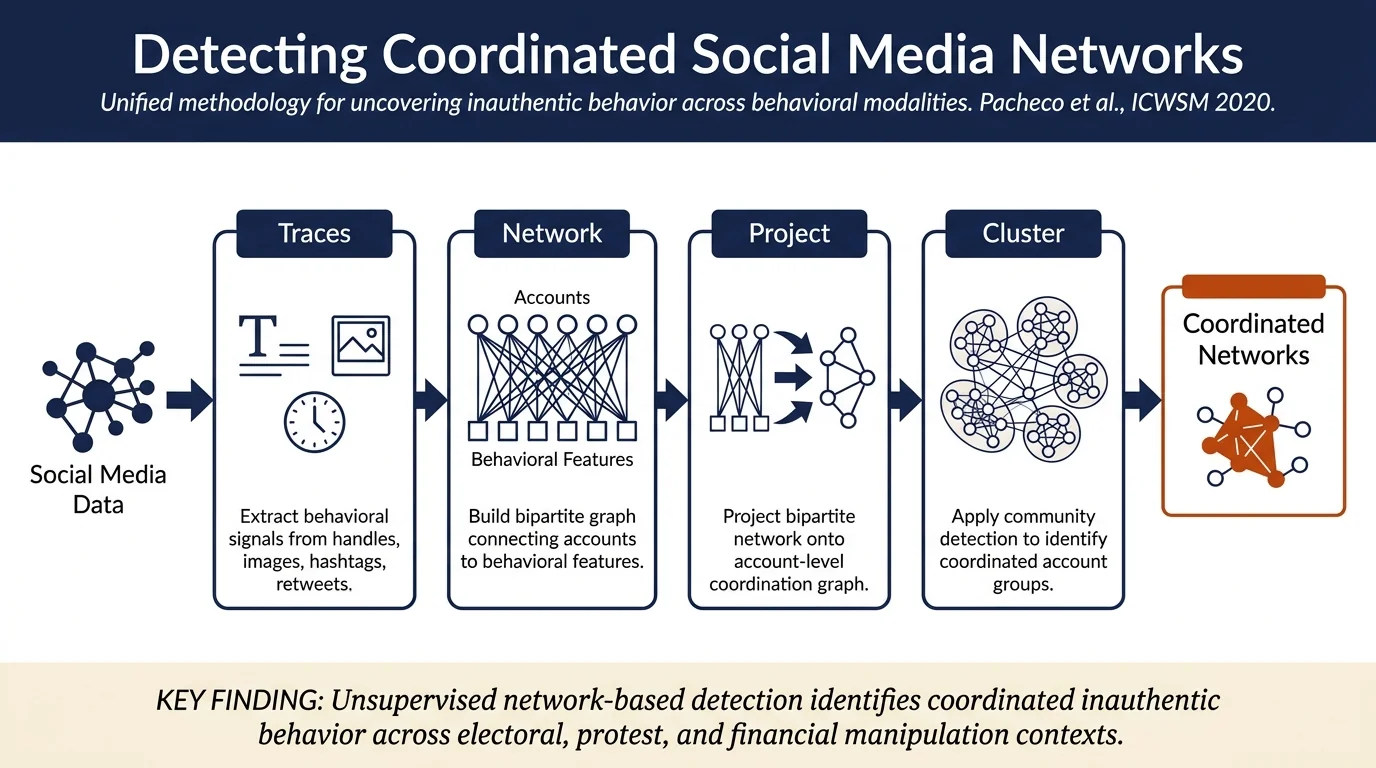
Uncovering Coordinated Networks on Social Media: Methods and Case StudiesThis paper proposes a general, unsupervised, network-based methodology to detect coordinated inauthentic behavior on social media. The approach identifies behavioral traces (handle changes, image sharing, hashtag sequences, co-retweets, synchronized actions) and constructs bipartite networks to discover clusters of accounts likely…
 Spread & networksBots & coordinated campaigns
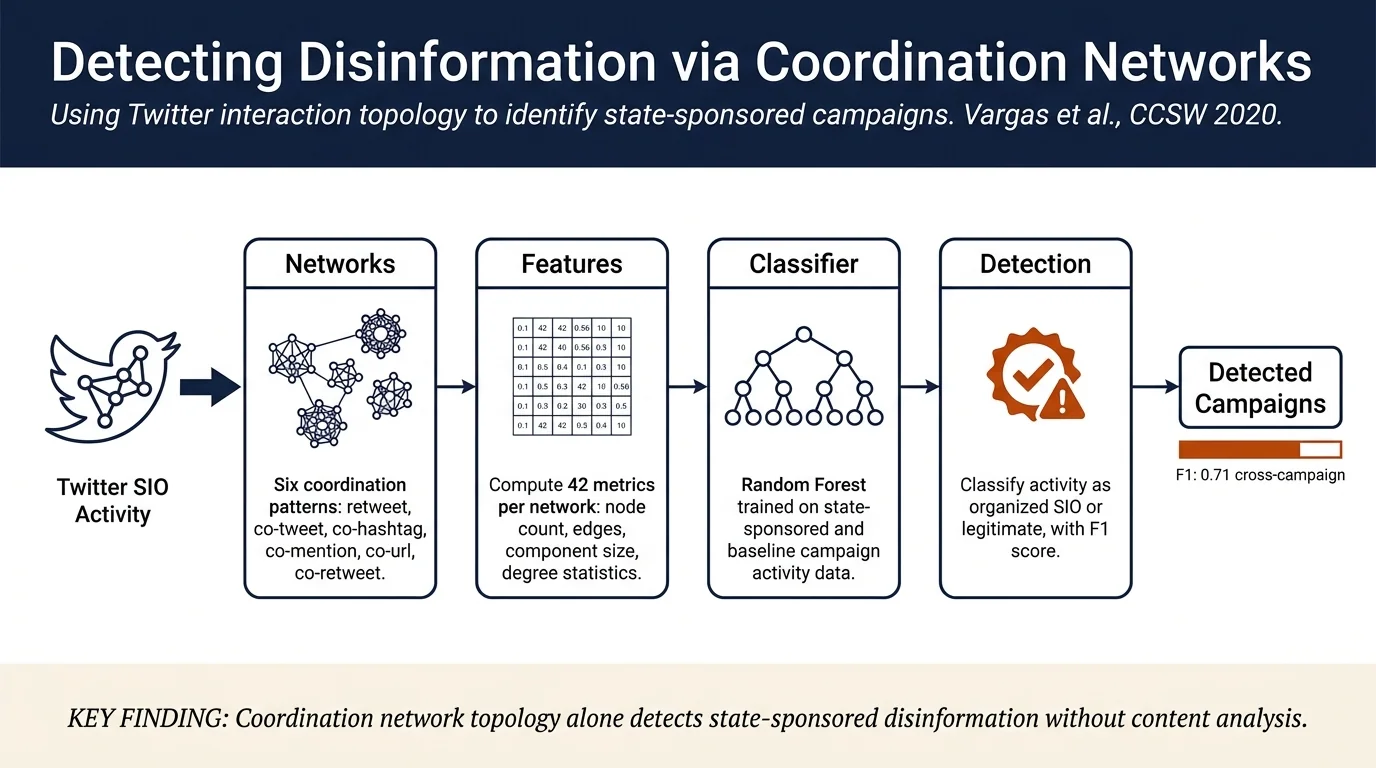
On the Detection of Disinformation Campaign Activity with Network AnalysisState-sponsored disinformation campaigns on Twitter exhibit distinct coordination patterns (shared messages, hashtags, URLs, retweet cascades) that differ from legitimate coordinated activity. The paper proposes using coordination network features—extracted from daily account interactions—to train a binary classifier that detects…
 Bots & coordinated campaignsDatasets & evaluation
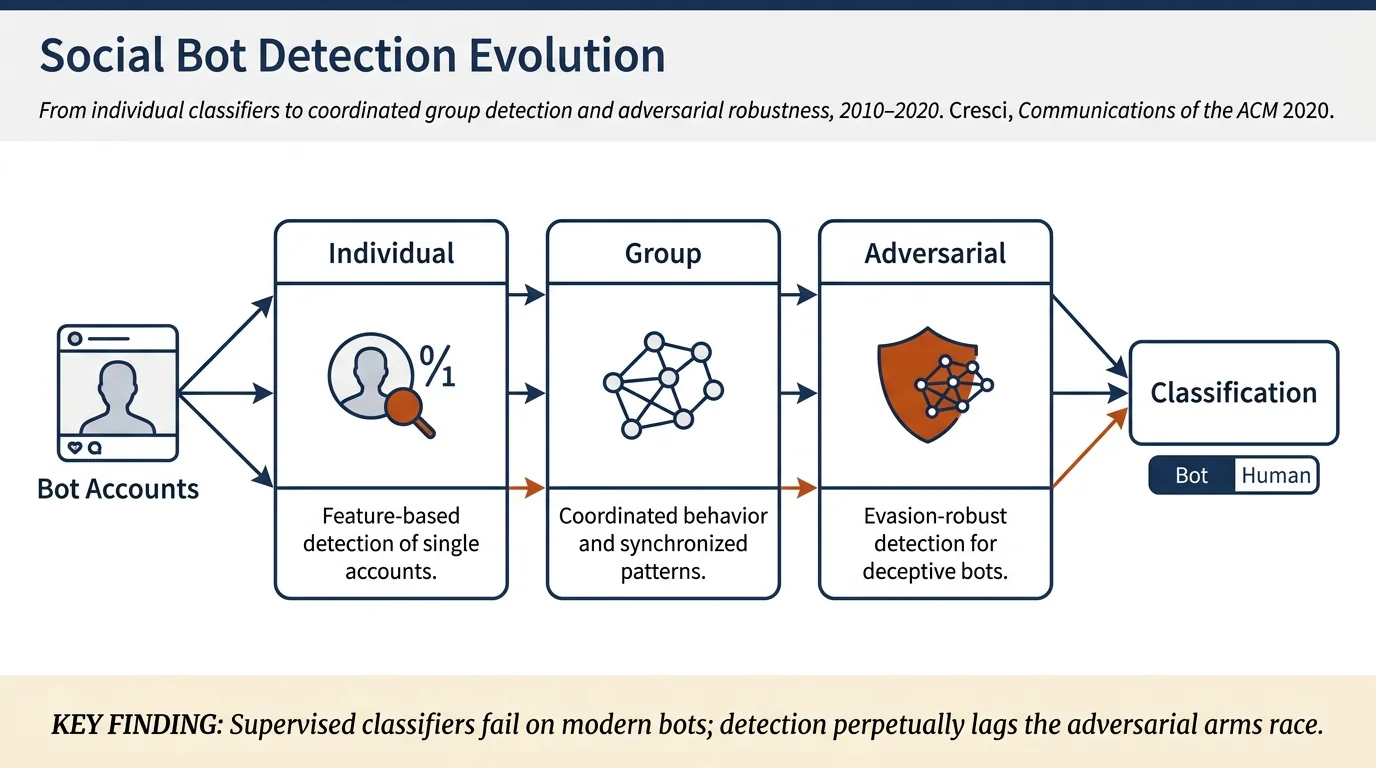
A Decade of Social Bot DetectionA comprehensive review of social bot detection research from 2010 to 2020, documenting the evolution from supervised individual-account detection to group-level approaches targeting coordinated inauthentic behavior. The paper traces the escalating "arms race" between bot developers and detection researchers, illustrates bots' documented…
 Bots & coordinated campaignsPlatforms, policy & society
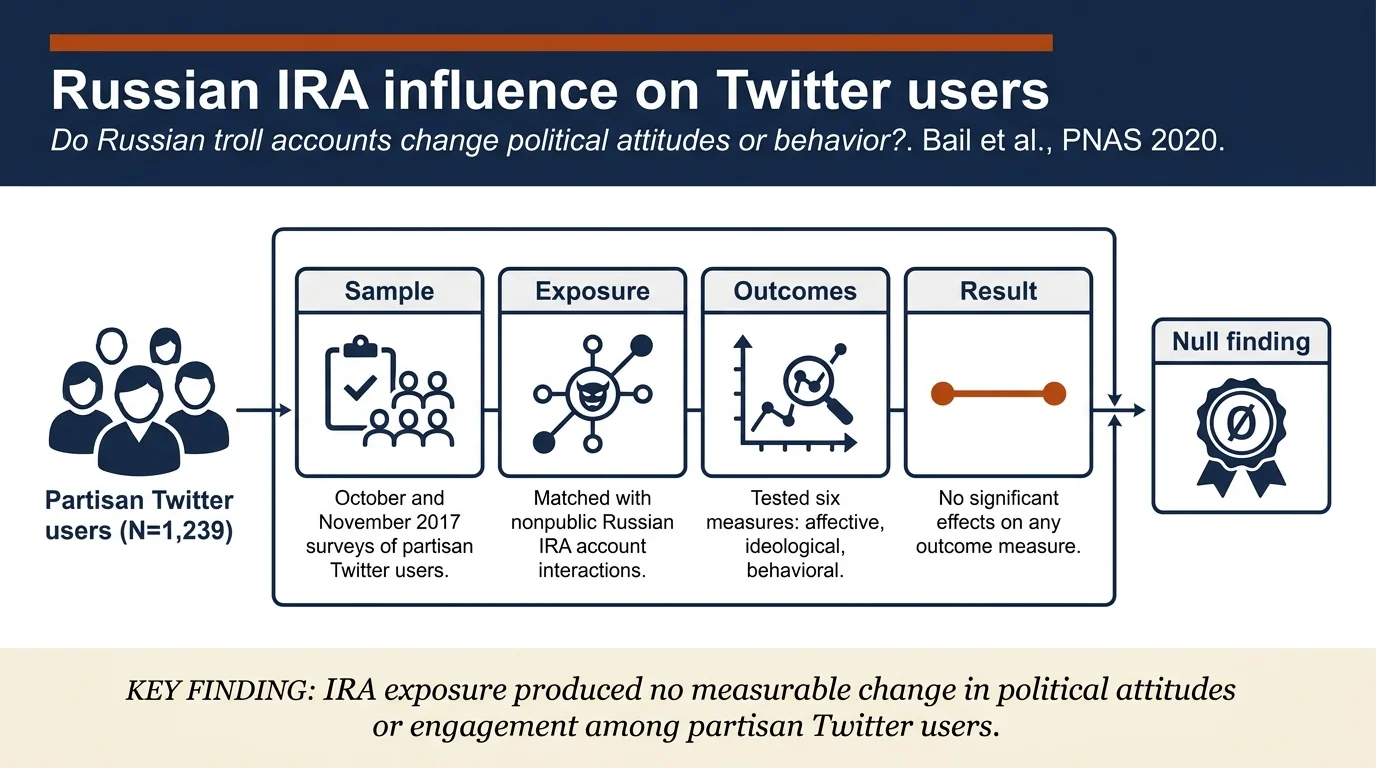
Assessing the Russian Internet Research Agency's impact on the political attitudes and behaviors of American Twitter users in late 2017Combining longitudinal survey data from 1,239 partisan Twitter users with nonpublic IRA account data, Bail et al. find no evidence that interaction with Russian Internet Research Agency accounts substantially impacted six measures of political attitudes (affective/ideological polarization) or behaviors (political engagement, network…
 Bots & coordinated campaignsSpread & networks
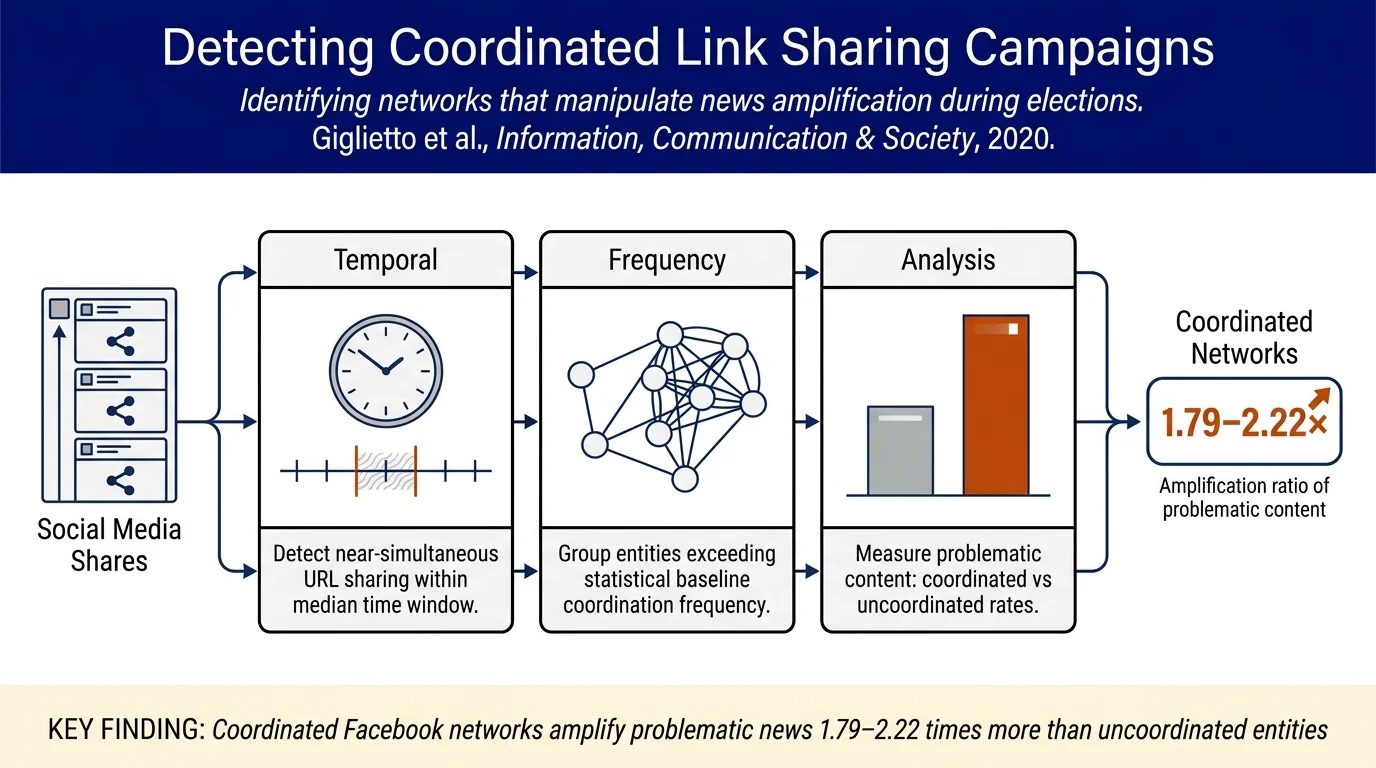
It takes a village to manipulate the media: coordinated link sharing behavior during 2018 and 2019 Italian electionsCoordinated networks of Facebook pages and groups substantially amplified problematic news during Italian elections: coordinated entities shared problematic domains 1.79×–2.22× more frequently than uncoordinated ones. The paper introduces a method to detect "coordinated inauthentic behavior" by identifying entities that…
 Bots & coordinated campaignsPlatforms, policy & society
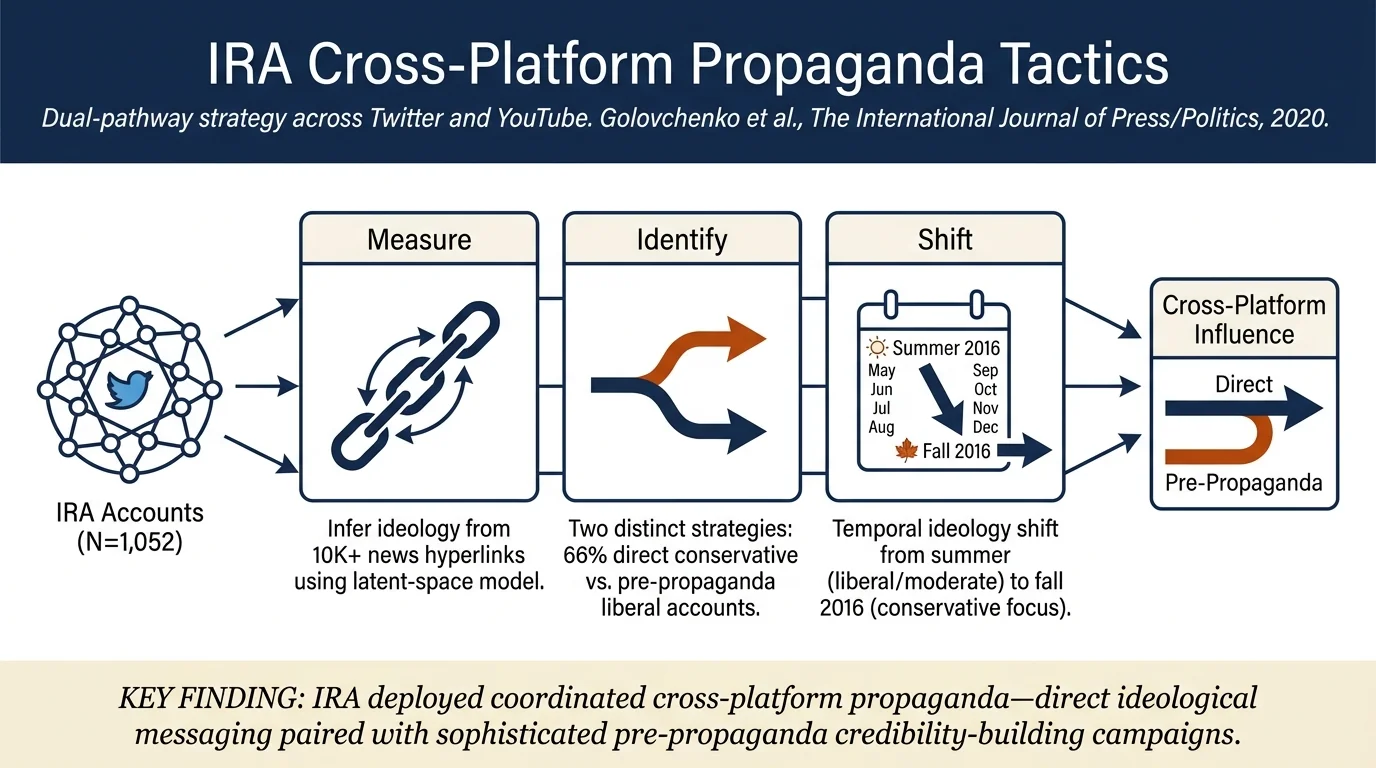
Cross-Platform State Propaganda: Russian Trolls on Twitter and YouTube during the 2016 U.S. Presidential ElectionThis paper analyzes 1,052 Russian IRA Twitter accounts to understand their propaganda strategy during the 2016 U.S. presidential election. By examining hyperlinks to news stories and YouTube videos, the authors find IRA accounts linked to conservative sources more frequently than liberal ones, consistent with supporting Trump.
 Bots & coordinated campaignsPlatforms, policy & society
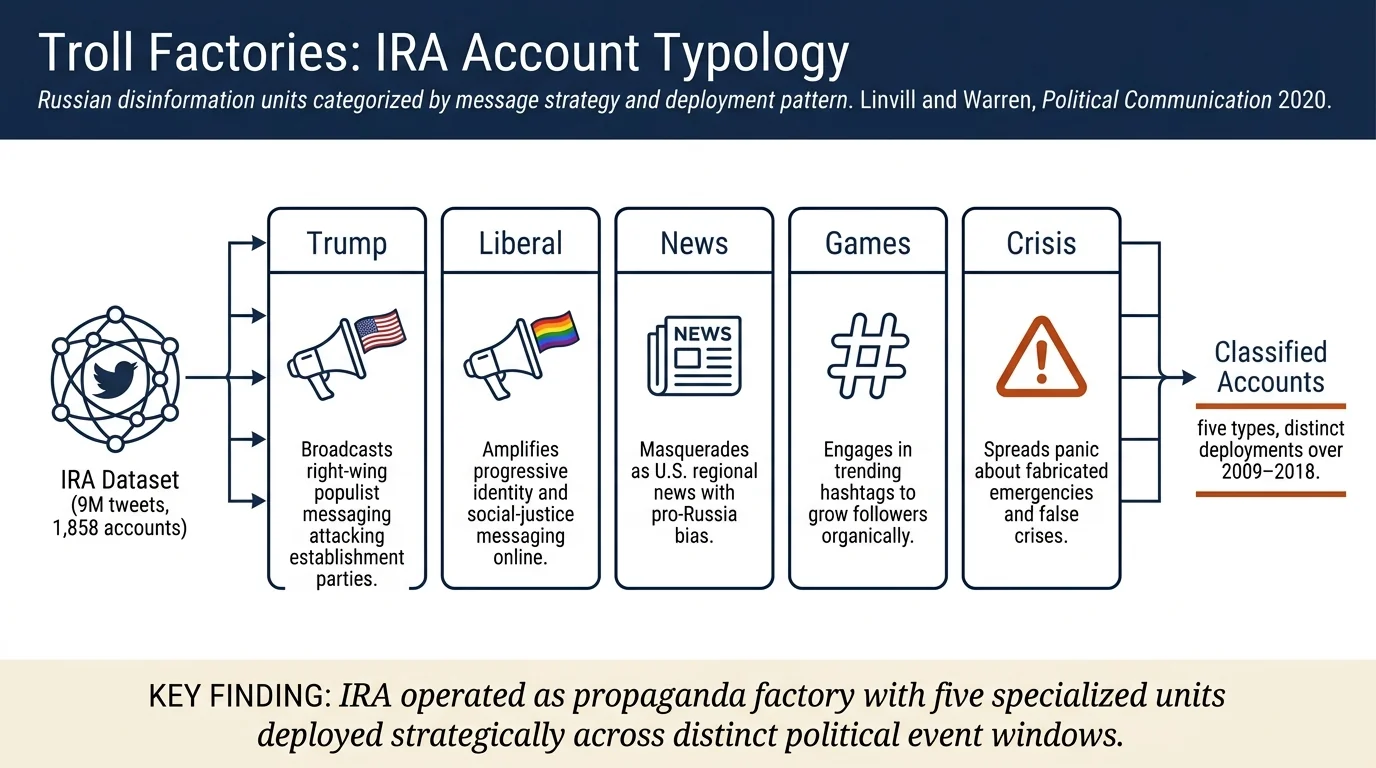
Troll Factories: Manufacturing Specialized Disinformation on TwitterLinvill and Warren analyze 9.04 million tweets from Russia's Internet Research Agency (IRA) spanning 2009–2018, identifying five specialized account categories—Right Troll, Left Troll, News Feed, Hashtag Gamer, and Fearmonger—each with distinct behavioral patterns, temporal deployment strategies, and communication styles. The authors…
 Spread & networksBots & coordinated campaigns
5 Reasons Why Social Networks Make Us Vulnerable to MisinformationMenczer presents five fundamental factors that make social networks inherently vulnerable to misinformation spread. Information and misinformation propagate through networks at equivalent rates due to structural properties of scale-free networks combined with human cognitive limitations.
 Spread & networksPlatforms, policy & society
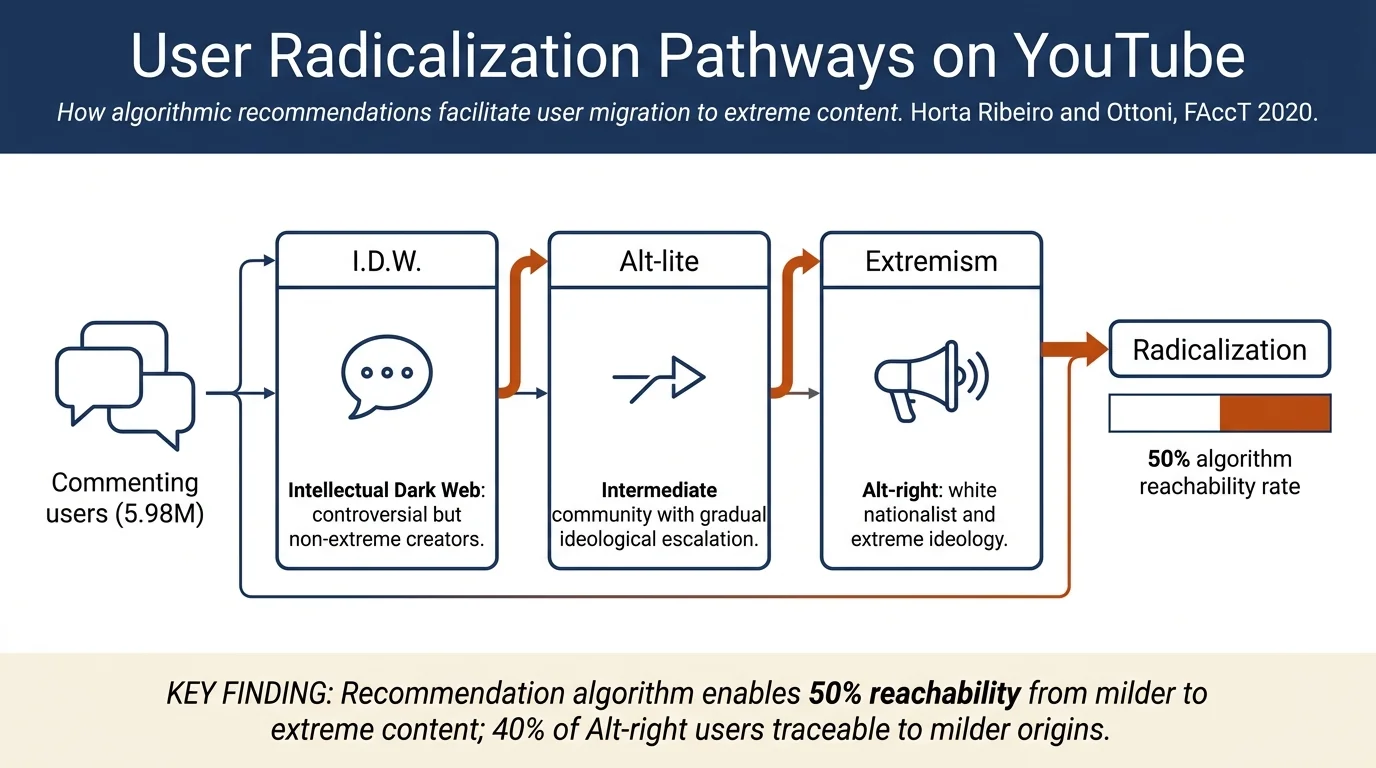
Auditing Radicalization Pathways on YouTubeFirst large-scale quantitative audit of user radicalization on YouTube. The authors tracked 349 channels across three ideological communities (Intellectual Dark Web, Alt-lite, Alt-right) and found strong evidence that users systematically migrate toward more extreme content.
 Bots & coordinated campaignsDetection methods
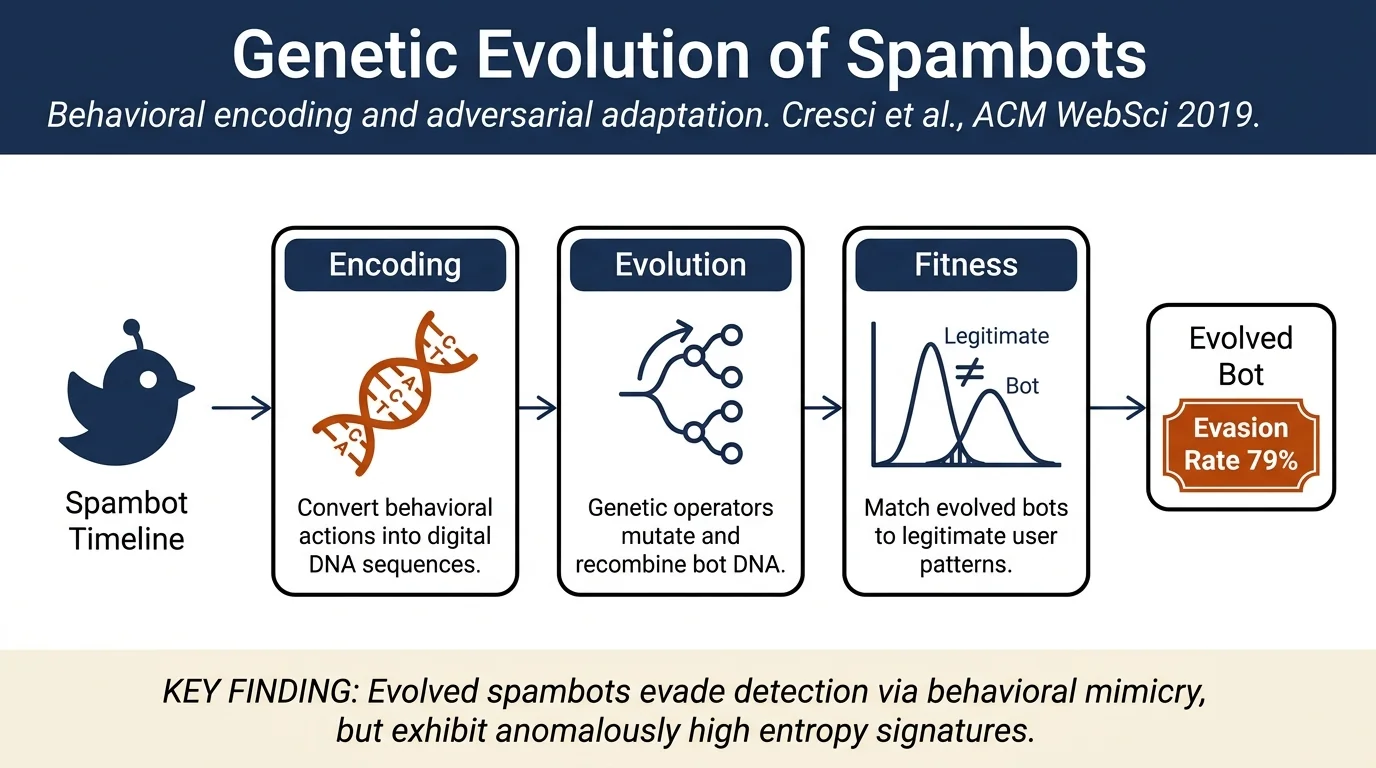
Better Safe Than Sorry: an Adversarial Approach to improve Social Bot DetectionProposes GenBot, a novel genetic algorithm that synthesizes evolved versions of existing spambots by encoding behavioral timelines as "digital DNA" sequences and iteratively evolving them to resemble legitimate user behavior. Tests the evolved bots against three state-of-the-art detection systems and finds they largely evade detection…
 Bots & coordinated campaignsDeepfakes & multimodal
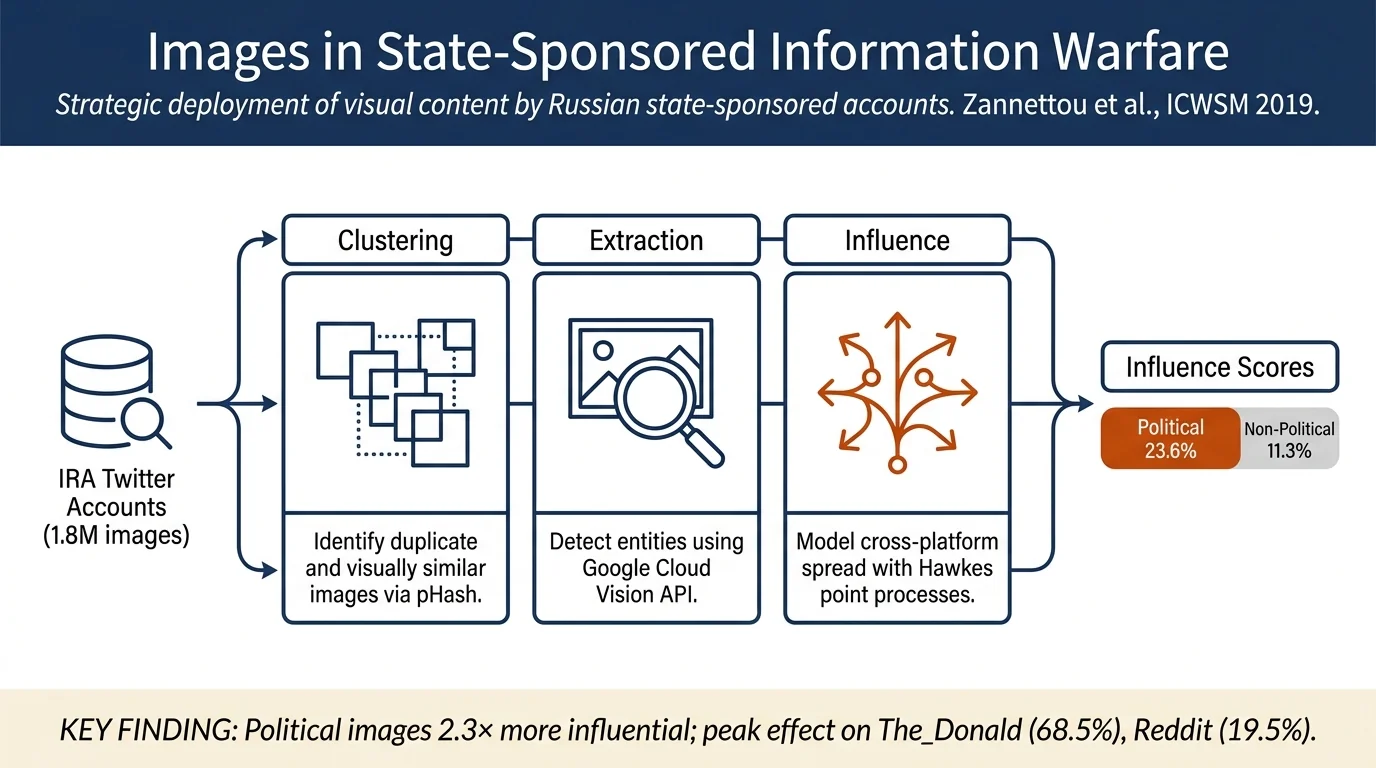
Characterizing the Use of Images in State-Sponsored Information Warfare Operations by Russian Trolls on TwitterLarge-scale analysis of 1.8M images posted by ~3.6K Russian state-sponsored Twitter accounts (IRA-controlled). Russian trolls strategically deployed images and memes to maximize political influence, with political imagery 2+ times more effective than general content.
 Bots & coordinated campaignsPlatforms, policy & society
Coordinating a Multi-Platform Disinformation Campaign: Internet Research Agency Activity on Three U.S. Social Media Platforms, 2015 to 2017This paper analyzes Russian Internet Research Agency activity across Facebook, Twitter, and Reddit from 2015–2017 using vector autoregression models on 3,126 Facebook ads, 1.9M tweets, and 12,603 Reddit posts. Key finding: Reddit activity influenced subsequent Twitter activity (a "trial balloon" effect), but the IRA's Twitter engagement…
 Spread & networksBots & coordinated campaigns
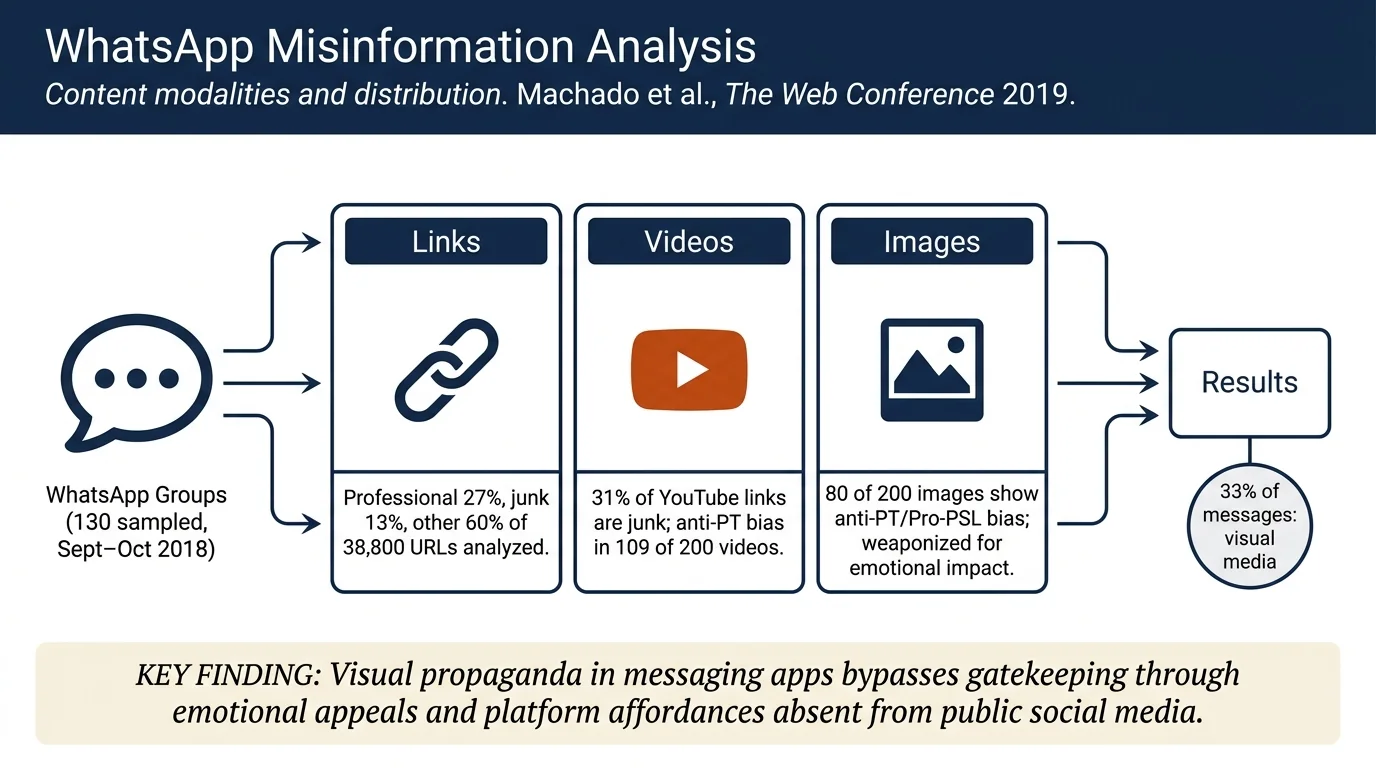
A Study of Misinformation in WhatsApp groups with a focus on the Brazilian Presidential ElectionsStudy of 130 public WhatsApp groups during the 2018 Brazilian presidential election found that 13.1% of shared links pointed to junk news sources, with 40% of links directing to YouTube—a platform used strategically to bypass platform moderation. Videos and images dominated message content (33% of all messages) and were heavily…
 Spread & networksBots & coordinated campaigns
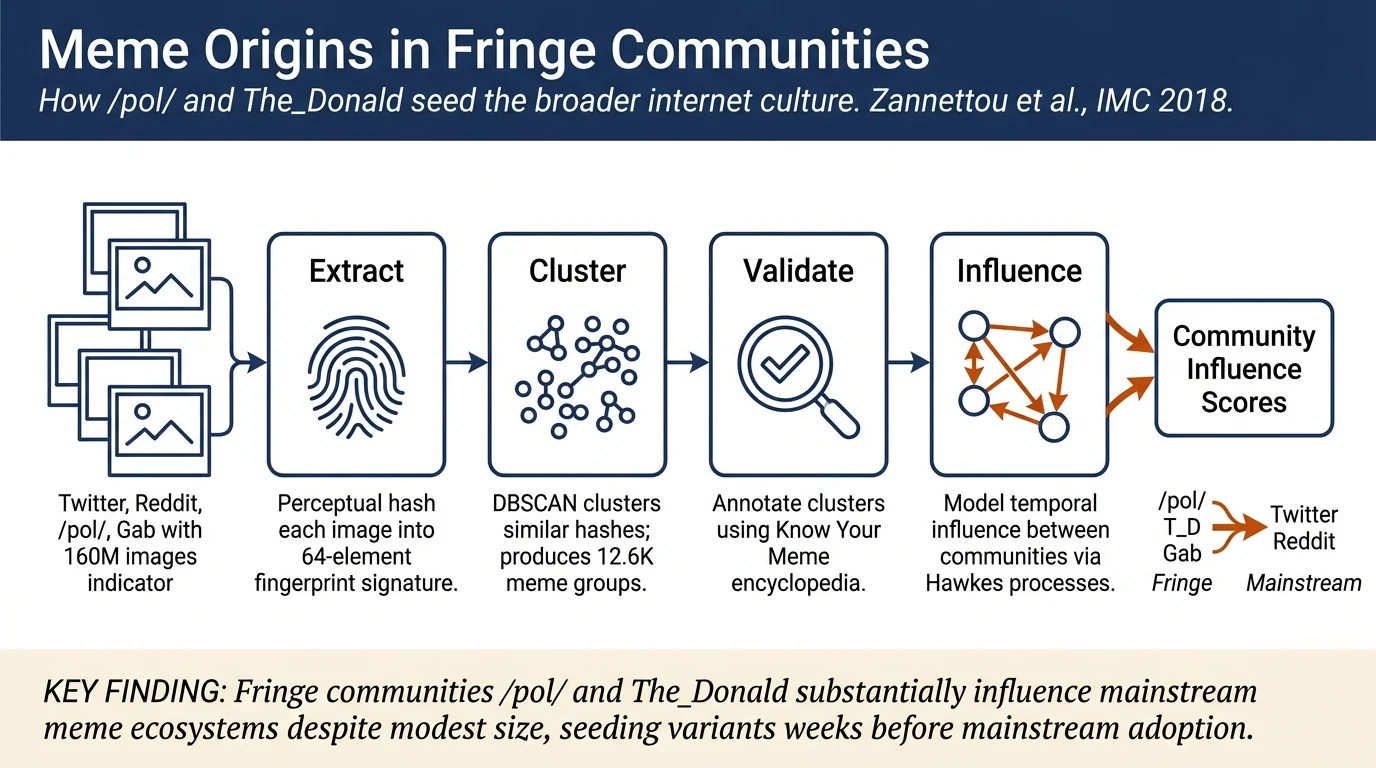
On the Origins of Memes by Means of Fringe Web CommunitiesLarge-scale empirical study of how image memes originate and propagate across fringe and mainstream Web communities. Analyzes 160M images posted to Twitter, Reddit, /pol/, and Gab (2016–2017) using perceptual hashing, clustering, and custom distance metrics.
 Spread & networksBots & coordinated campaigns
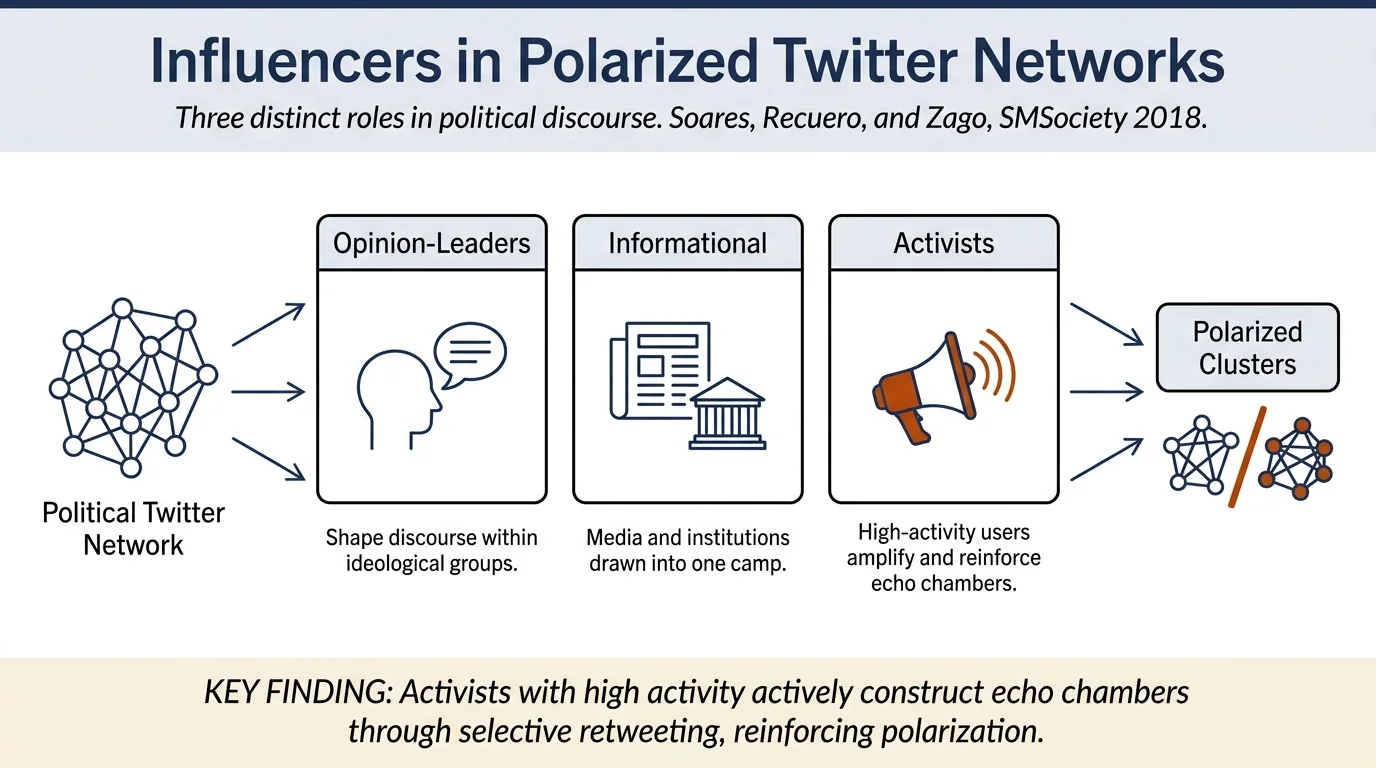
Influencers in Polarized Political Networks on TwitterThis paper identifies three types of influencers in polarized political Twitter conversations during Brazil's 2016 Dilma Rousseff impeachment: "opinion leaders" who shape discourse within ideological groups, "informational influencers" (media/institutions) drawn into one camp, and "activists" who amplify like-minded messages. The…
 Bots & coordinated campaignsSpread & networks
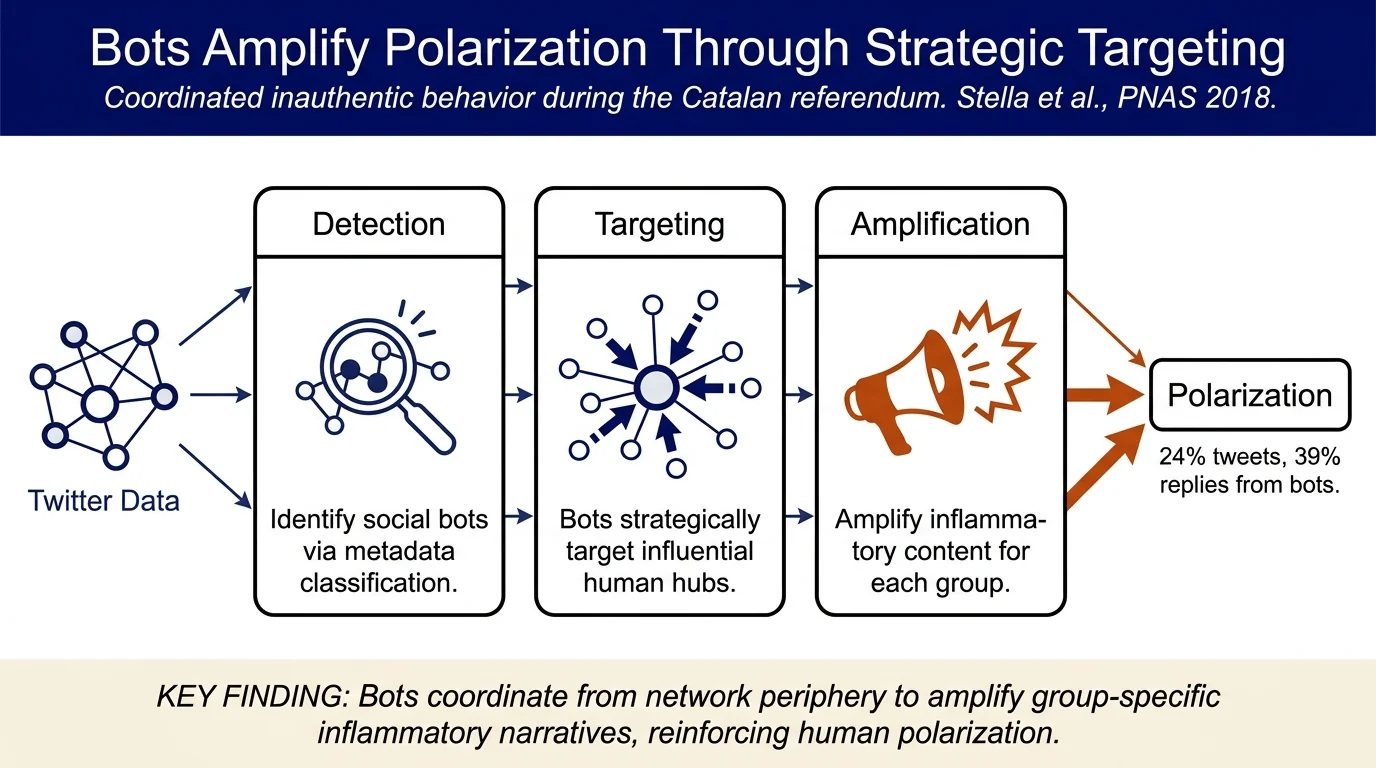
Bots increase exposure to negative and inflammatory content in online social systemsSocial bots during the 2017 Catalan independence referendum strategically targeted influential humans to amplify negative and inflammatory content. Operating from network peripheries, bots coordinated sentiment-driven amplification that exacerbated polarization, with approximately one in three referendum-related tweets generated by bots.
 Bots & coordinated campaignsDetection methods
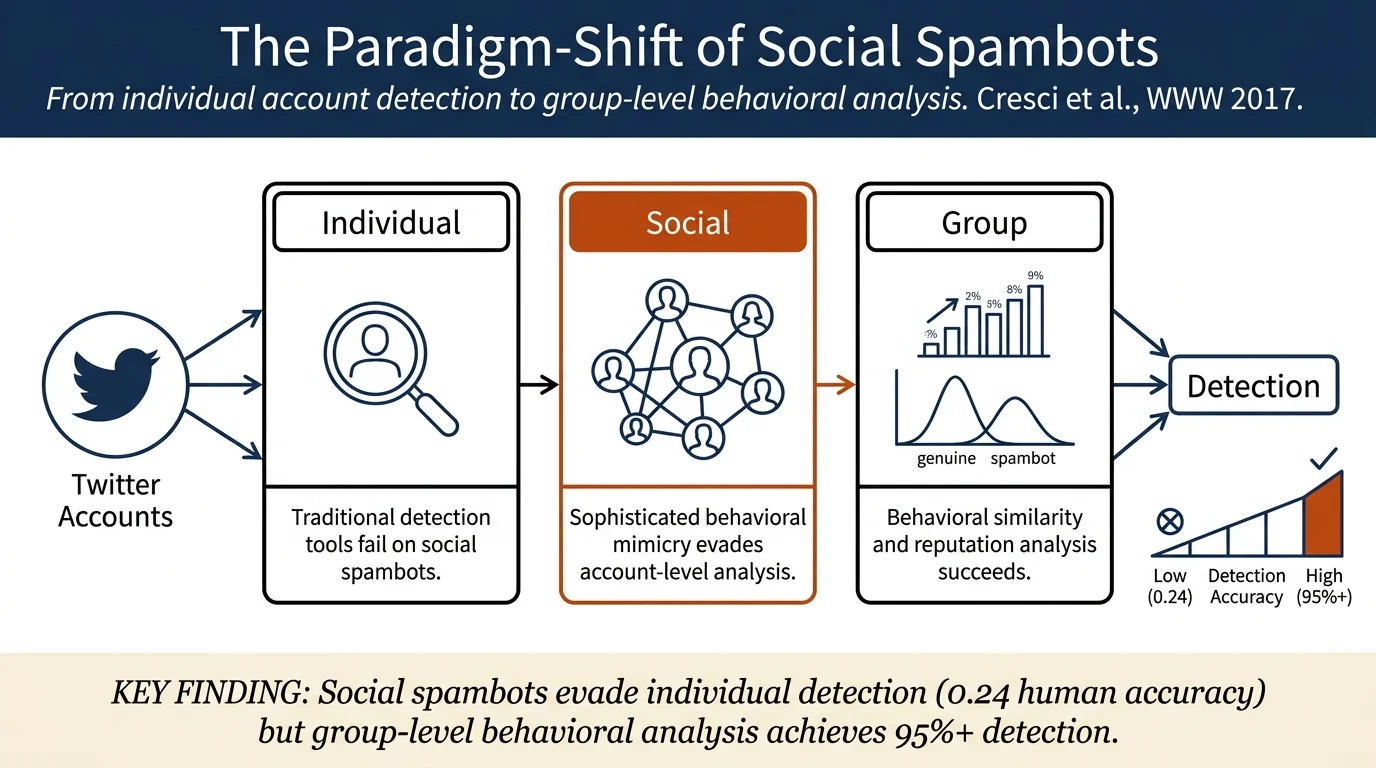
The Paradigm-Shift of Social Spambots: Evidence, Theories, and Tools for the Arms RaceThis paper provides empirical evidence of a paradigm shift in spambot design on Twitter, where new "social spambots" closely mimic genuine user behavior and successfully evade detection. Neither Twitter's automated systems, human annotators, nor established academic detection tools can effectively identify these accounts; however,…
 Bots & coordinated campaignsPlatforms, policy & society
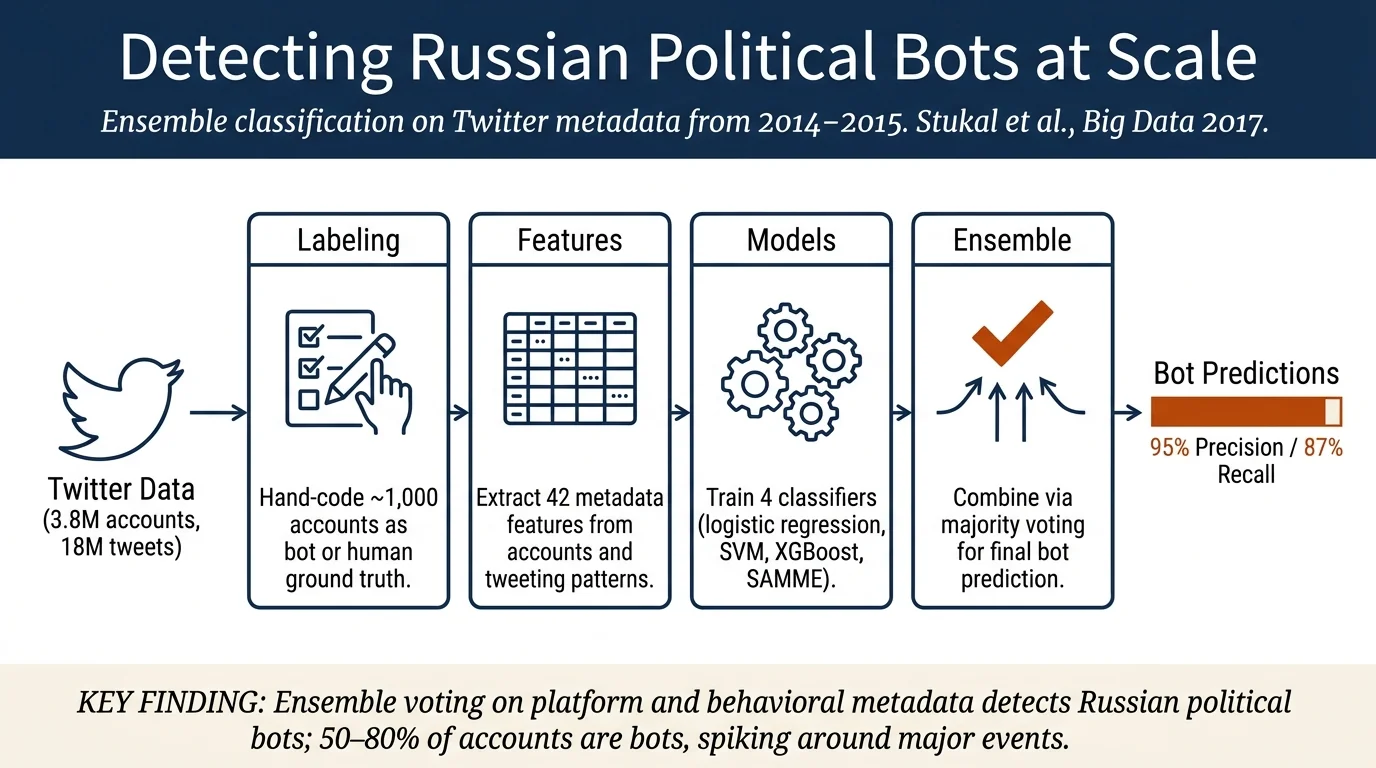
Detecting Bots on Russian Political TwitterAutomated Twitter accounts (bots) represent 50% of activity in Russian political discourse. Using supervised ensemble classifiers on 3.8M accounts and 18M tweets from 2014–2015, the authors achieve 95% precision in detecting bots while maintaining 75% recall.
 Spread & networksBots & coordinated campaigns
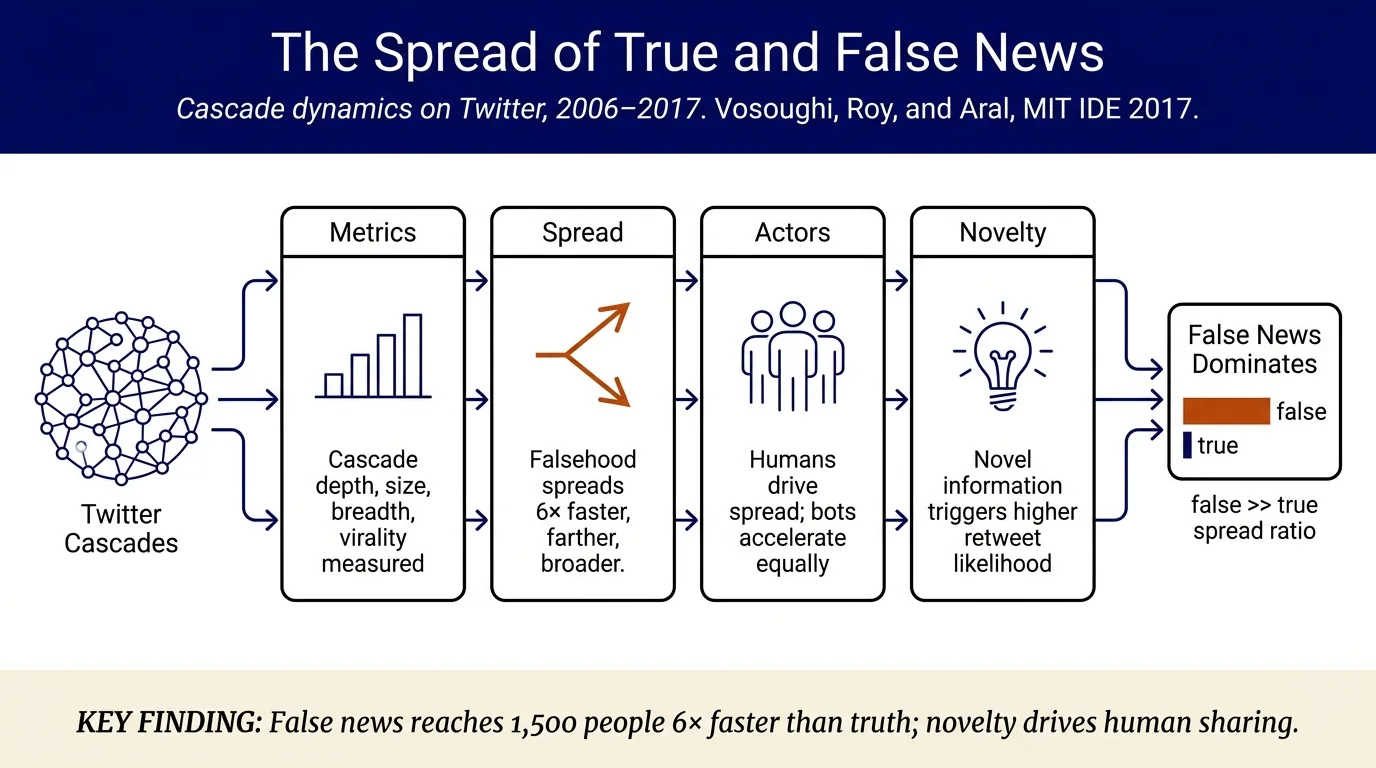
The Spread of True and False News OnlineAnalyzes 126,000 verified true and false news cascades from Twitter (2006–2017) covering 3 million users and 4.5 million shares. False news diffuses significantly farther, faster, deeper, and more broadly than truth across all categories, with false political news spreading fastest.