Setting the clock: Evaluating temporal window parameters for coordinated behavior detection
Authors: Georgios Panayiotou, Lorenzo Mannoccci, Maurizio Tesconi
Venue: AIDEM Workshop, ECML-PKDD 2026 — arXiv 2609.21959
TL;DR
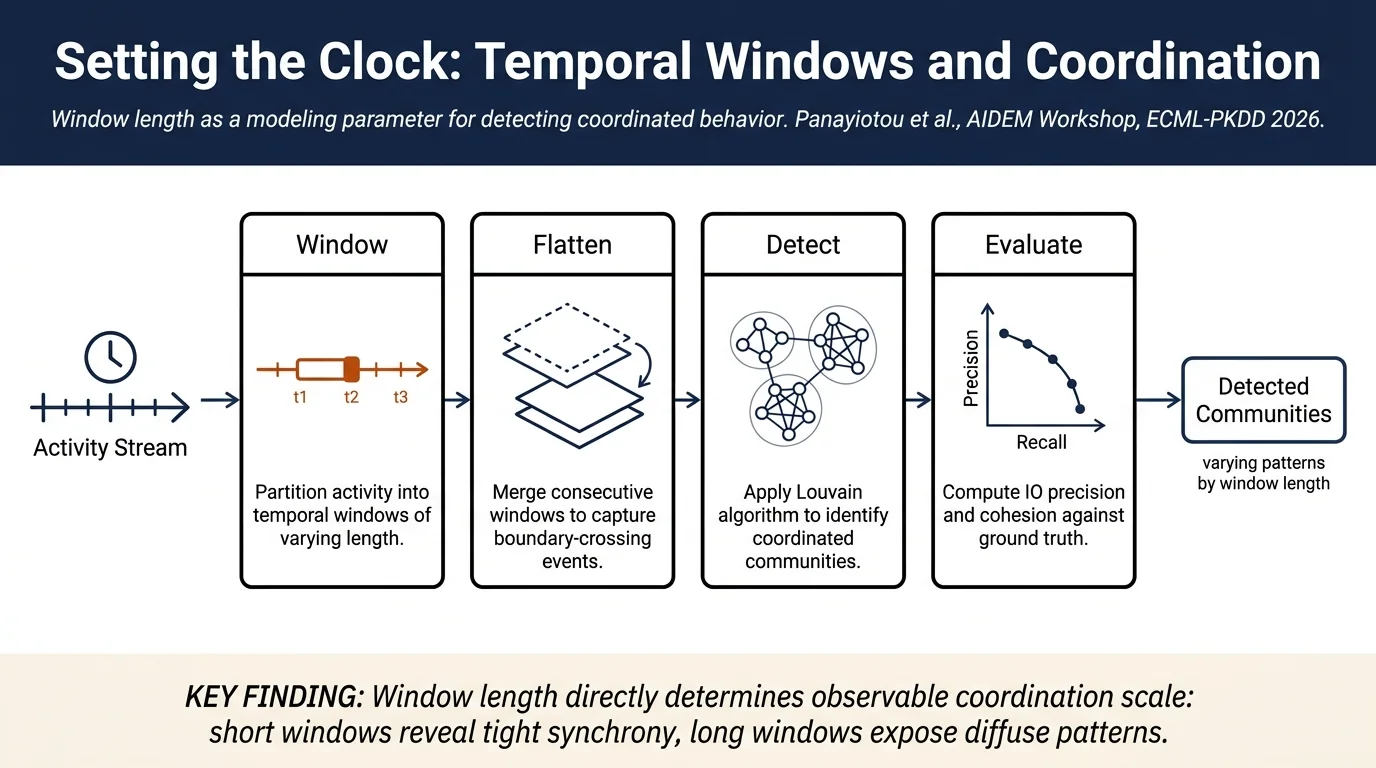
The paper systematically evaluates how temporal window parameters (length and stride) affect detection of coordinated communities in co-repost networks. Using 14 labeled information operation datasets, the authors find that window length is a central modeling parameter: short windows (seconds to minutes) detect tight, highly synchronized coordination; longer windows (hours to days) reveal slower, diffuse coordination patterns; window overlap has negligible effect on detection quality. These findings suggest temporal windowing choices directly determine which coordination scales become observable.
Contributions
-
First empirical analysis of temporal window parameters in coordinated behavior detection: systematically tests window lengths from 1 second to 1 day and stride overlaps (0%, 20%, 50%) across 14 real information operation campaigns.
-
Quantitative evidence that window length is a key modeling choice: demonstrates that window length substantially affects both community structure and the precision/recall tradeoff for recovering known coordinated actors.
-
Window stride has minimal impact: shows that overlapping windows (50% overlap) do not consistently improve detection over adjacent non-overlapping windows, despite higher computational cost.
-
Complementary metrics capture different coordination signals: IO precision (fraction of community members that are known coordinated actors) and community cohesion (frequency of repeated co-actions within detected groups) are largely decoupled, revealing that a high-precision group may exhibit low behavioral intensity and vice versa.
Method
The paper models coordinated behavior through co-actions: two accounts are connected when they perform the same action (e.g., retweet) on the same content within a shared temporal window. The method:
-
Constructs temporal co-repost networks by partitioning activity into consecutive temporal windows of length \(t_c\) and stride \(t_s\). Each window \(i\) produces a graph \(G_i\) where accounts are nodes and edges represent co-reposts within that window.
-
Flattens consecutive temporal layers: for each pair of consecutive layers \((G_i, G_{i+1})\), creates a merged graph \(G_{i,i+1}\) that captures co-posting spanning window boundaries—important for tightly-timed coordination that might otherwise be split across windows.
-
Applies community detection (Louvain algorithm) to each flattened graph to identify coordinated communities.
-
Evaluates against labeled information operation data: computes structural metrics (number of communities, relative community size, intra-community cohesion) and agreement metrics (IO precision, IO recall) relative to known coordinated actors in 14 ground-truth IO datasets.
Results
Effect of window length on community structure (Table 1): - Number of detected communities increases with window length (longer windows capture more repost actions, creating more coordination links). - Relative community size remains stable as windows grow, suggesting window length changes the granularity of detected coordination without collapsing all communities into a single giant component. - Cohesion (intra-community co-repost weight) increases with window length, as longer periods provide more opportunities for repeated co-actions.
Effect of window length on IO precision (Figure 1):
- Short windows (1–15 minutes) achieve high precision (0.6–1.0) on campaigns with frequent, synchronous coordination (e.g., egypt_use, ghana_nigeria), but low activity rates when few accounts co-post rapidly.
- Longer windows (1–6 hours) show more moderate and stable precision (0.2–0.8), capturing slower coordination but at cost of mixing in non-coordinated accounts sharing popular content.
- Precision-recall tradeoff: small windows isolate tight, known-coordinated groups; large windows broaden membership but dilute signal with organic users.
Effect of window stride on detection performance (Figure 2): - Varying stride from 0% to 50% overlap produces only small variations in IO precision and recall (typically <0.05 difference). - No consistent improvement from overlapping windows. The paper concludes that window overlap does not substantially reduce boundary effects between adjacent windows.
IO precision and cohesion capture different signals (Figure 3):
- For egypt_use (1-minute window): very high IO precision (~0.95) but low cohesion (~0.2), indicating known coordinated actors appear in the same detected community but rarely co-repost the same content repeatedly.
- For china-1 (1-hour window): low precision (~0.2) but cohesion peaks mid-window, suggesting high behavioral synchrony among non-known actors.
- Interpretation: precision measures whether coordinated actors cluster together; cohesion measures behavioral intensity. These are complementary rather than redundant.
Connections
- A Decade of Social Bot Detection — Decade-long review of bot and coordination detection evolution; emphasizes shift from individual to group-level detection.
- A Survey on Computational Propaganda Detection — Survey of propaganda and coordinated campaign detection using network and temporal methods.
- It takes a village to manipulate the media: coordinated link sharing behavior — Foundational work detecting coordinated link-sharing on Facebook; establishes temporal proximity as a core coordination signal.
- Disinformation Warfare: Understanding State-Sponsored Trolls on Twitter and — Empirical study of state-sponsored information operations; demonstrates temporal clustering of coordinated accounts.
- Rumor Detection Temporal — Related work on temporal dynamics in rumor propagation and verification.
- Network Dynamics — Broader topic on how networks evolve and reveal patterns over time.
Notes
Strengths: - Addresses a practical and long-overlooked methodological question: the choice of temporal window is usually treated as an implementation detail, but this work demonstrates it is a substantive modeling choice that changes the observable coordination patterns. - Ground-truth evaluation against labeled IO datasets is rare and valuable; provides empirical evidence rather than pure theory. - Clear presentation of complementary metrics (precision vs. cohesion) that can be misinterpreted as contradicting signals.
Limitations and open questions: - Single co-action modality: analysis focuses only on retweets. Real coordinated campaigns exploit multiple modalities (shared URLs, hashtags, mentions, comments). Generalization to multimodal co-actions is an important next step. - Community detection method fixed: uses Louvain algorithm; unclear whether findings generalize to other community detection approaches (e.g., Leiden, spectral clustering, flow-based methods). - Flattening of temporal layers: the paper flattens consecutive layer pairs to reduce boundary effects, but this design choice is not systematically ablated. Other temporal aggregation strategies might yield different results. - Computational cost of overlapping windows: while overlap does not improve quality, computational cost grows linearly; the paper mentions this but does not explore adaptive windowing or efficient approximations. - Platform-specific behavior: evaluation focuses on Twitter/X retweet networks. Social media-specific properties (e.g., timeline decay, retweet cascades) may make findings less portable to other platforms (Facebook, TikTok) or offline coordination.
Future work: - Test findings on multimodal coordination networks (URLs, hashtags, mentions). - Compare alternative community detection algorithms to determine whether temporal window effects generalize. - Explore adaptive window lengths that respond to observed activity rates or known event timing. - Investigate whether temporal window length affects robustness to adversarial obfuscation (e.g., deliberate desynchronization of coordinated accounts).