Cognitive heuristics are mental shortcuts that allow people to make judgments and decisions quickly with limited information and cognitive effort. While heuristics enable efficient decision-making in complex environments, they can also lead to systematic errors and biases. In the context of information evaluation, heuristics include reputation-based judgments, consistency checks, source popularity signals, and detection of commercial intent.
Key papers
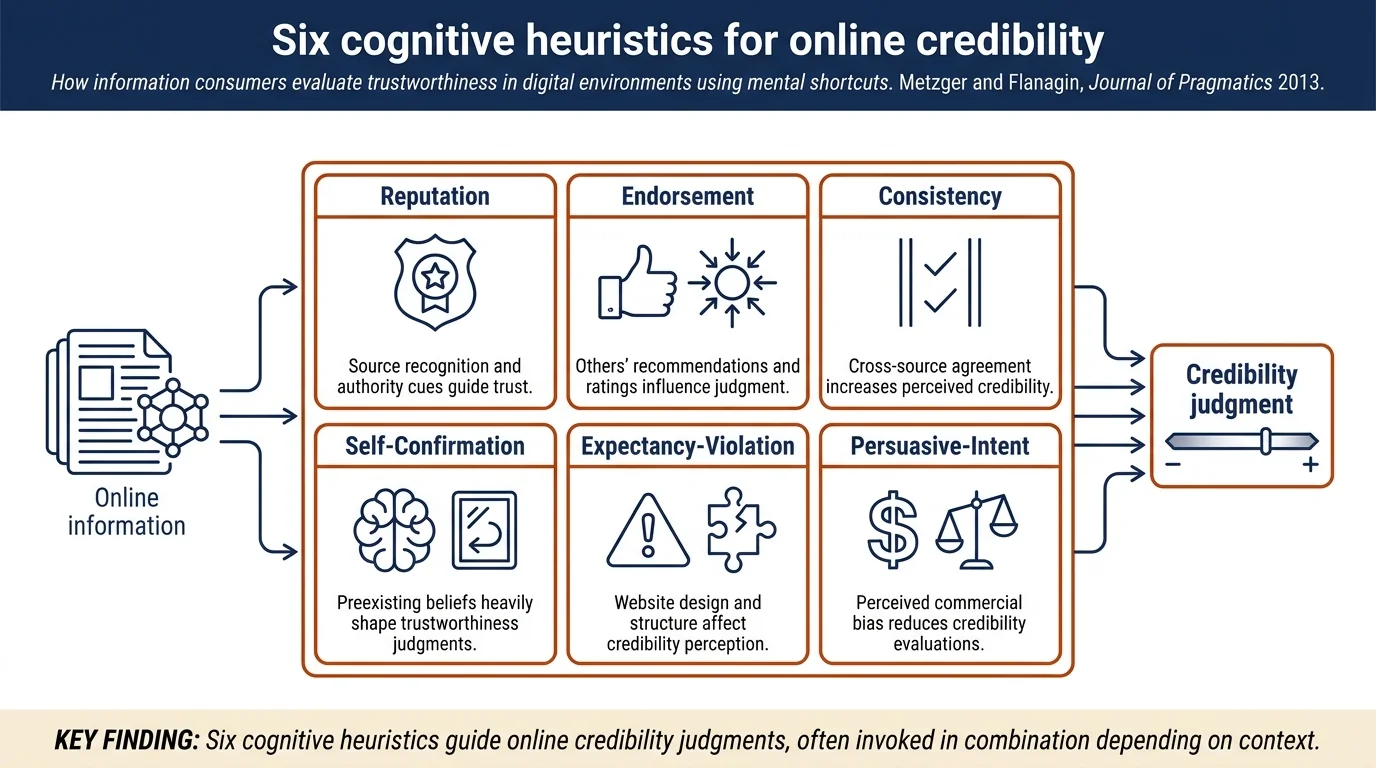
- Metzger & Flanagin (2013) — Comprehensive survey of cognitive heuristics in credibility evaluation; catalogs six primary heuristics (reputation, endorsement, consistency, self-confirmation, expectancy violation, persuasive intent); examines how heuristics are combined and prioritized in information-evaluation tasks; proposes research agenda for understanding heuristic-based credibility assessment in networked environments.
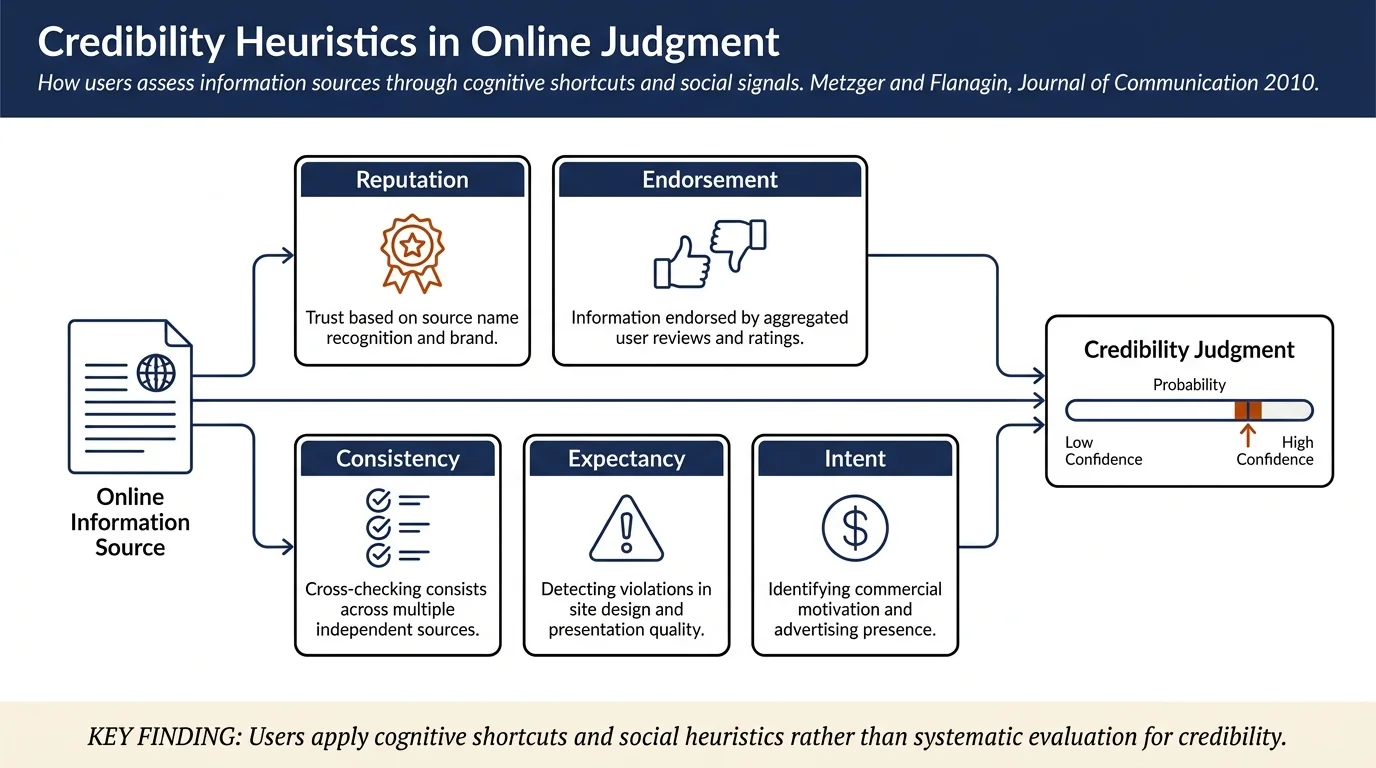
- 2010-metzger-social-heuristic-credibility — Identifies five heuristics in online credibility assessment: reputation (name recognition), endorsement (social proof), consistency (cross-source alignment), expectancy violation (design/format expectations), and persuasive intent (commercial motivation detection)
Related topics
- information-processing (cognitive mechanisms underlying heuristics)
- credibility (heuristics as tools for credibility judgment)
- misinformation (how heuristics can lead to false-belief acceptance)
- cognitive-biases (related systematic errors in judgment)
Notes
In the misinformation domain, heuristics can be both protective and problematic. On one hand, they allow rapid discrimination of obviously false content (e.g., poor design as a credibility signal). On the other hand, they can be exploited: bad actors can signal false expertise, fake social proof, or manufactured consensus to fool heuristic judgments. Understanding which heuristics people actually use—and under what conditions—is important for both designing interventions and predicting vulnerability to manipulation.