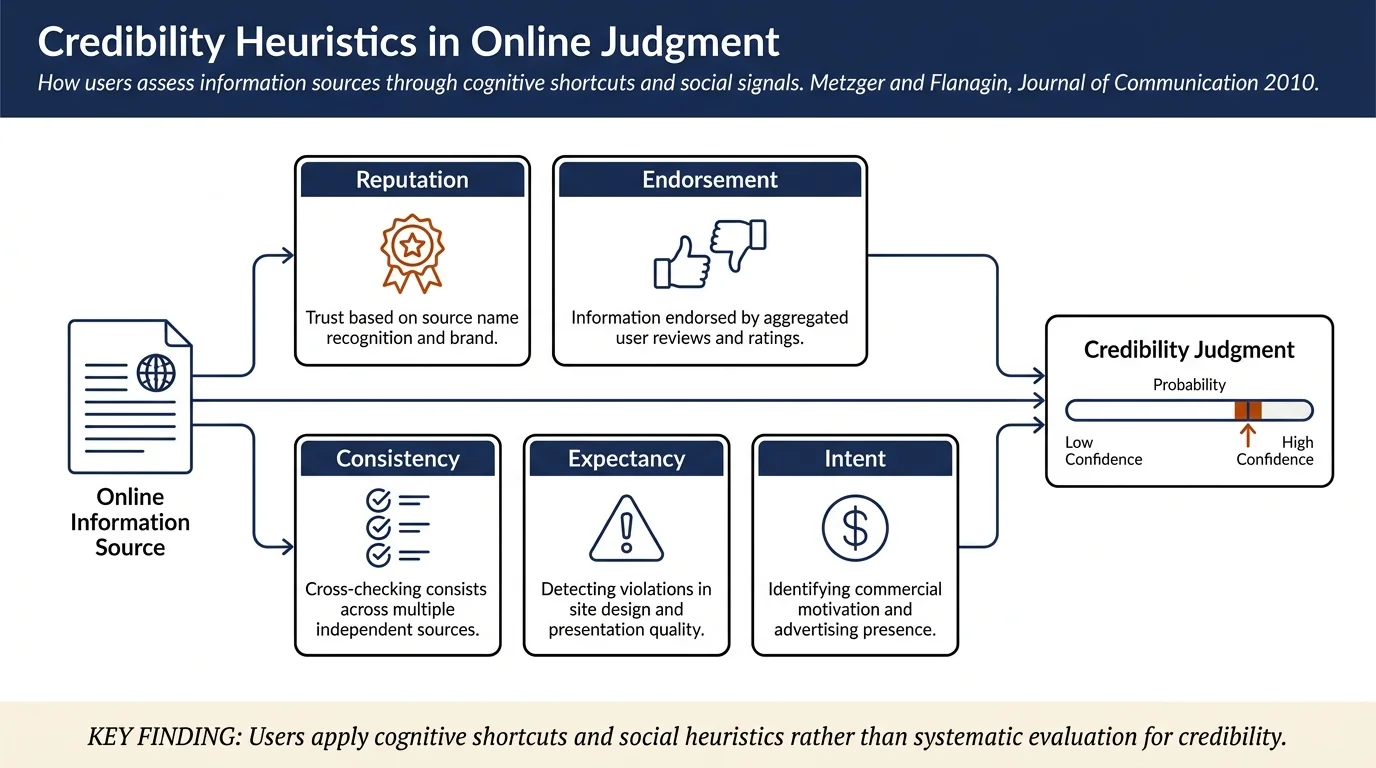
Source evaluation refers to the cognitive and social processes through which people assess whether to trust and believe information from a given source. This includes examining source expertise, reputation, potential biases, institutional affiliation, and supporting evidence. Research shows that source evaluation involves both deliberate systematic scrutiny and rapid heuristic judgments, with the balance depending on motivation, ability, and context.
Key papers
- 2010-metzger-social-heuristic-credibility — Identifies heuristics and social strategies used in online source evaluation, showing reliance on reputation, social confirmation, consistency checks, and detection of commercial intent
- 2007-metzger-credibility-on-web — Experimental evidence that website design and perceived source expertise shape source credibility judgments
Related topics
- credibility (broader concept of trustworthiness)
- cognitive-heuristics (mental shortcuts in evaluation)
- fact-checking (formal source evaluation process)
Notes
Source evaluation is critical in the misinformation pipeline: if people accurately evaluate sources, they can distinguish reliable reporting from false claims. However, research shows that source evaluation is often cursory, biased toward confirming existing beliefs, and vulnerable to manipulation through fake expertise signals and social proof.