 Miriam Metzger
 Andrew J. Flanagin
Contributions
- Two-study design examining college students' Web usage patterns and information evaluation behavior
- Quantitative comparison of college students vs. nonstudents on credibility perceptions and verification strategies
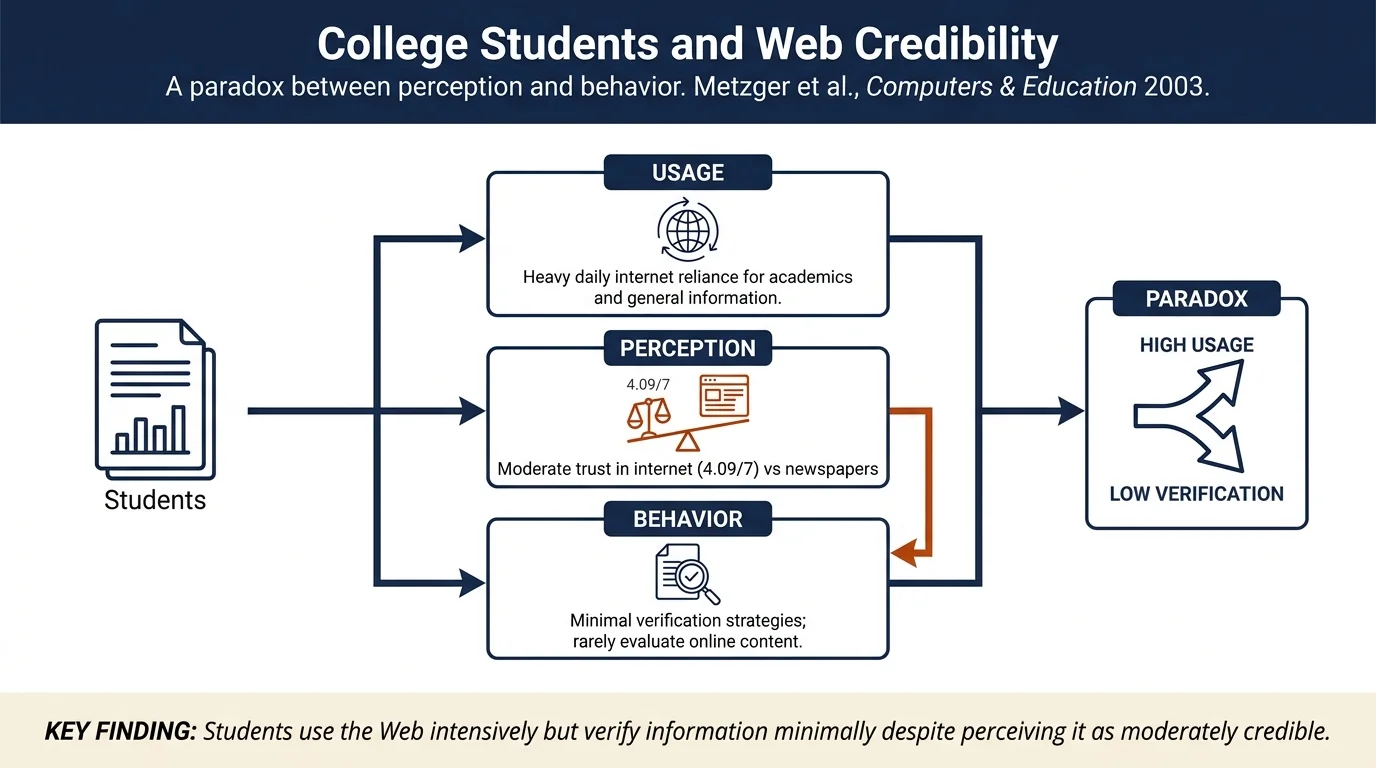
- Empirical documentation of a credibility paradox: students find Web information trustworthy despite infrequent verification
- Identification of specific verification strategies employed by college users (currenciness, completeness, fact-vs-opinion assessment)
- Empirical evidence of generational differences in Internet reliance and credibility assessment patterns
Method
Study 1: Survey of 356 undergraduate students from a large public university on West Coast U.S., examining frequency of Web use for general and academic purposes, perceived helpfulness, and expected future reliance.
Study 2: Expanded sample of 436 college students vs. 307 nonstudents, using convenience and snowball sampling. Participants completed anonymous questionnaires measuring: (1) Internet credibility perceptions on seven-point scales across five information sources (newspapers, television, magazines, Internet, radio); (2) credibility of four information types (news, reference, entertainment, commercial) across media; (3) verification strategies used when assessing online information (nine items measuring specific tactics); (4) demographic and Internet experience variables.
Measures: Credibility assessed via seven-point bipolar scales anchored on dimensions of believability, accuracy, and trustworthiness. Verification strategies adapted from information evaluation literature (Alexander & Tate 1999; Harris 1996).
Results
Study 1 findings:
- 51.0% of students use Internet "every day"; 29.9% "several times a week"
- Primary academic uses: research (89%), emailing instructors (51%), accessing course materials (32%)
- Students perceived Internet as helpful for finding sources (3.97/5), saving time (3.77/5), and grades (3.42/5)
- 80% expected their Web use to increase in future; only 4% expected decrease
Study 2 findings — Credibility perceptions:
- Students find Internet moderately credible ($M = 4.09/7$), less than newspapers ($M = 4.74/7$), more than radio ($M = 4.07/7$)
- Significant main effect of information source $[F(3, 1160) = 136.01, P < 0.001, \eta^2 = 0.32]$
- Students find news ($M = 4.54$) and reference ($M = 4.43$) information most credible; commercial ($M = 3.77$) least credible
- Students rate all channels as more credible than nonstudents ($P < 0.05$), with largest difference for Internet ($M_{\text{students}} = 4.09$ vs. $M_{\text{nonstudents}} = 4.06$, $t = 0.49$, n.s.)
Study 2 findings — Verification behavior:
- Statistically significant difference in verification between students ($M = 2.49, SD = 0.68$) and nonstudents ($M = 2.69, SD = 0.86$), $t(475.82) = -3.18, P < 0.01$
- Students verify online information "rarely" to "occasionally" (between 2–3 on 5-point scale)
- Top five verification strategies used (in order of frequency): 1. Check if information is current ($M = 3.32$) 2. Check if information is complete/comprehensive ($M = 3.13$) 3. Consider whether views represent facts or opinions ($M = 2.99$) 4. Seek out other sources to validate information ($M = 2.75$) 5. Consider author's goals/objectives ($M = 2.75$)
- Least-used strategies: verify author qualifications ($M = 2.03$), check author contact information ($M = 2.13$)
Notes
This paper documents a critical finding for misinformation research: college students—the population most intensively using the Web—rely on it heavily but verify information minimally and employ unsophisticated evaluation strategies. The credibility paradox (high perceived credibility despite low verification effort) persists even among educated users, suggesting that Internet literacy curricula must teach not just how to verify but why verification matters. The empirical pattern of minimal verification effort combined with perceived trustworthiness aligns with decades of research on heuristic-based decision-making and suggests users adopt mental shortcuts over systematic evaluation—a cognitive pattern exploitable by misinformation campaigns. The gap between students' and nonstudents' verification behavior remains modest despite vastly different age and experience cohorts, suggesting institutional exposure to research methodology in higher education has limited spillover effects on everyday information evaluation. This work remains timely: despite 20+ years of Internet literacy initiatives, the core finding—that high-usage populations verify minimally—continues to characterize contemporary college cohorts and young digital-native populations.