Information-seeking behavior encompasses the processes by which people identify information needs, search for relevant sources and content, evaluate what they find, and decide whether and how to use the information. The field studies how information-seeking goals, motivations, contexts, and information-seeking strategies interact to shape which sources people consult and how they assess credibility and relevance.
For the fake news and misinformation literature, understanding information-seeking is critical because misinformation spreads and takes hold not in a vacuum but within actual information-seeking episodes—people looking for news, health information, educational material, or answers to everyday questions. The strategies people use to find information (which search engine, which trusted source, whether they cross-reference multiple sources) and the contextual constraints they face (time pressure, prior beliefs, relevant expertise) directly influence their exposure to and belief in false information.
Key dimensions
Information-seeking goals and contexts: People's information needs vary widely—academic research, health information, entertainment, work-related problems, personal decisions. The perceived stakes of an information-seeking task (whether the decision matters and might affect important outcomes) shapes how much effort people invest in credibility assessment. High-stakes tasks (choosing medical treatments, academic research) typically invoke more careful evaluation; low-stakes tasks (finding entertainment recommendations) may rely on heuristics or convenience.
Search strategies and resource choice: Information seekers choose which resources to consult (search engines, specific websites, friends, experts, libraries). These choices often reflect prior experience and trust in a source. Early research found that young people tend to start with the most accessible resource (often a web search engine) rather than systematically comparing options. Subsequent work shows that college students and adults often begin at "trusted places" (familiar, historically reliable sources) before broadening their search.
Multi-sourcing and cross-referencing: When facing uncertainty or high-stakes decisions, people consult multiple sources and check for consistency. If multiple independent sources agree, information is judged more credible. This strategy is effective against some misinformation (if one source contradicts others, it may signal false content) but can fail if misinformation propagates across multiple sources or if people consult sources that reinforce one another.
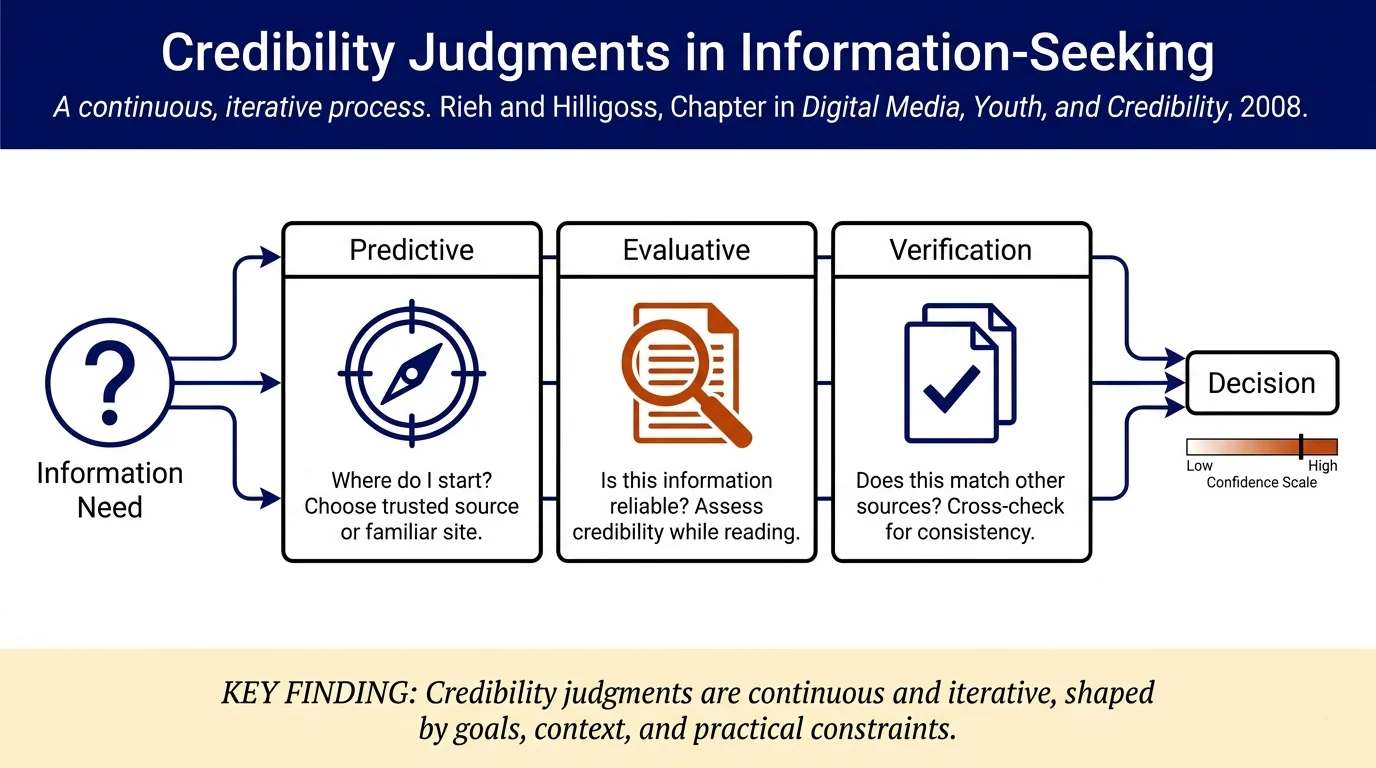
Credibility judgment within information-seeking: Credibility assessment is not a separate task but embedded within information-seeking episodes. People make predictive judgments about where to search (which sources seem most likely to have good information), evaluative judgments while reading (is this relevant and accurate?), and verification judgments when encountering contradictions (should I believe this or seek more sources?). The same person may apply different credibility standards depending on the information-seeking goal.
Key papers
- College Students' Credibility Judgments in the Information-Seeking Process — Qualitative study of college students' credibility judgments during everyday information seeking; identifies predictive, evaluative, and verification judgment types; shows credibility concerns vary with stakes and contextual goals; reveals three credibility-related seeking strategies
- Digital Media, Youth, and Credibility — Foundational edited volume on how young people assess credibility and seek information in digital media
- Flanagin & Metzger (2008) — Conceptual synthesis tracing credibility and information-seeking research from classical rhetoric through digital media
Connections
- Credibility assessment for fake news detection — how credibility evaluation fits into and shapes information-seeking behavior
- Information evaluation — strategies for assessing information quality during and after search
- Source Credibility — how people judge trustworthiness of information sources
- Media literacy — educational approaches to improving information-seeking and credibility evaluation skills