Internet literacy refers to the competencies required to access, evaluate, create, and communicate information effectively in online environments. It extends traditional media literacy to address the unique characteristics of the Web: the absence of institutional gatekeeping, the ease of creating professional-looking but unverified content, the blending of advertising and editorial content, and the speed at which information propagates through networks.
Core competencies
Source evaluation: Identifying author credentials, institutional affiliation, potential biases, and track record for accuracy.
Information evaluation: Assessing whether claims are supported by evidence; distinguishing opinion from fact; recognizing emotional manipulation or propaganda techniques.
Media literacy: Understanding how platforms shape what content is visible; recognizing algorithmic personalization; understanding business models of digital platforms.
Verification skills: Knowing how to cross-reference claims across sources; using lateral reading to investigate sources; consulting primary evidence rather than relying on summaries.
Information production: Understanding citation practices; using credible evidence when creating content; respecting intellectual property; communicating transparently about sources and limitations.
Internet literacy gap
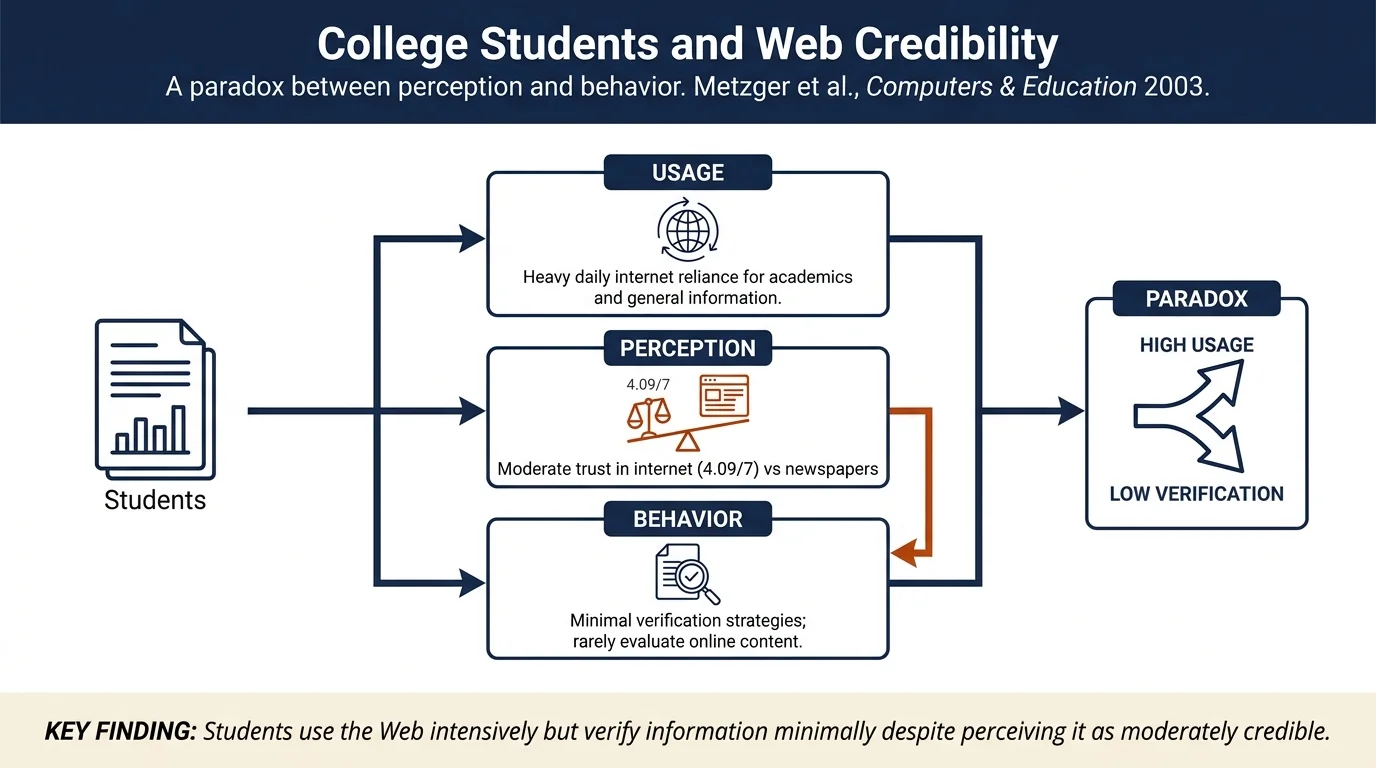
Despite decades of educational efforts, research shows substantial gaps between Internet literacy as taught and Internet literacy as practiced. College students—the population most intensively using Web-based information—often lack systematic evaluation strategies and rely instead on rapid heuristic judgments (design quality, source reputation, peer endorsement). This gap represents a vulnerability to misinformation: users who feel confident in their ability to identify trustworthy information ("I'm good at the Web, I know what to trust") may verify least thoroughly.
Role in misinformation defense
Internet literacy education is frequently positioned as a primary defense against misinformation. Research shows that instruction in verification strategies, source evaluation, and lateral reading can improve accuracy discernment and reduce susceptibility to falsehoods. However, effects are often modest and training effects decay; interventions in formal educational settings (university courses on media literacy) show stronger and longer-lasting effects than brief online interventions. Crucially, effective Internet literacy requires not just knowledge of evaluation techniques but also motivation to apply them—the willingness to invest effort in verification rather than relying on quick judgments.
Key papers
- Metzger, Flanagin & Zwarun (2003) — Empirical evidence that formal education and Internet exposure do not automatically produce Internet literacy; college students use Web extensively but verify minimally; suggests Internet literacy must be taught explicitly and practiced deliberately.
- Metzger (2007) — Comprehensive review of Internet literacy frameworks; discusses tension between teaching systematic evaluation strategies vs. accounting for how users actually (heuristically) evaluate information; proposes pedagogical approaches for fostering critical evaluation.
- Metzger et al. (2003) — Historical and theoretical perspective on how Internet literacy differs from traditional media literacy; identifies unique challenges posed by Web's lack of gatekeeping, genre convergence, and ease of forgery; discusses implications for education policy and user empowerment.
- Lateral Reading and the Nature of Expertise: Reading Less and Learning More When Evaluating Digital Information — Expert study on what effective Internet literacy looks like in practice; demonstrates that professional fact-checkers employ specific strategies (lateral reading, leaving-the-site investigation) that differ markedly from student approaches; suggests these expert strategies are learnable.
Related topics
- Information Verification — Core skill within Internet literacy
- Source Credibility — Understanding credibility dimensions
- Education — Pedagogical contexts for teaching literacy skills
- Information literacy — Broader set of competencies including traditional and online contexts