Trust in online contexts refers to the willingness to rely on information or interact with others despite risk and uncertainty in environments where traditional markers of trustworthiness (institutional gatekeeping, face-to-face verification, professional credentials) are often absent or unverifiable. Online trust operates across multiple targets: sources and publishers, individual authors, platform operators, and other users.
Key dimensions
Source-based trust: Extends from institutions (traditional media outlets, academic publishers) to individuals (bloggers, social media users). Key signals include author credentials, publication history, organizational affiliation, and consistency of past behavior. Critically, research shows that prior experience and familiarity predict trust judgments, independent of actual reliability.
User-to-user trust in social environments: In social media platforms, trust is informed by network proximity (knowing the account holder), observed expertise (past contributions and skill), and social feedback (community endorsement). Users rely heavily on endorsements from their networks, sometimes substituting network trust for independent verification.
Platform trust: Users must trust that platforms (Facebook, Wikipedia, YouTube) will curate and moderate content responsibly, protect privacy, and handle misinformation. Platform trust correlates with willingness to both consume and share information through that platform.
Risk asymmetry: The potential harm from trusting false information varies by domain. Health misinformation carries concrete, personal harm; product information may carry economic risk; news/political information affects collective outcomes. Users are generally more skeptical and demand higher evidence thresholds when harm is perceived as greater.
Key empirical findings
- Familiarity increases trust: Repeated exposure to and positive prior experience with a source or medium increases trust judgments, even if actual reliability is unchanged (Gefen, 2000; Kim et al., 2008).
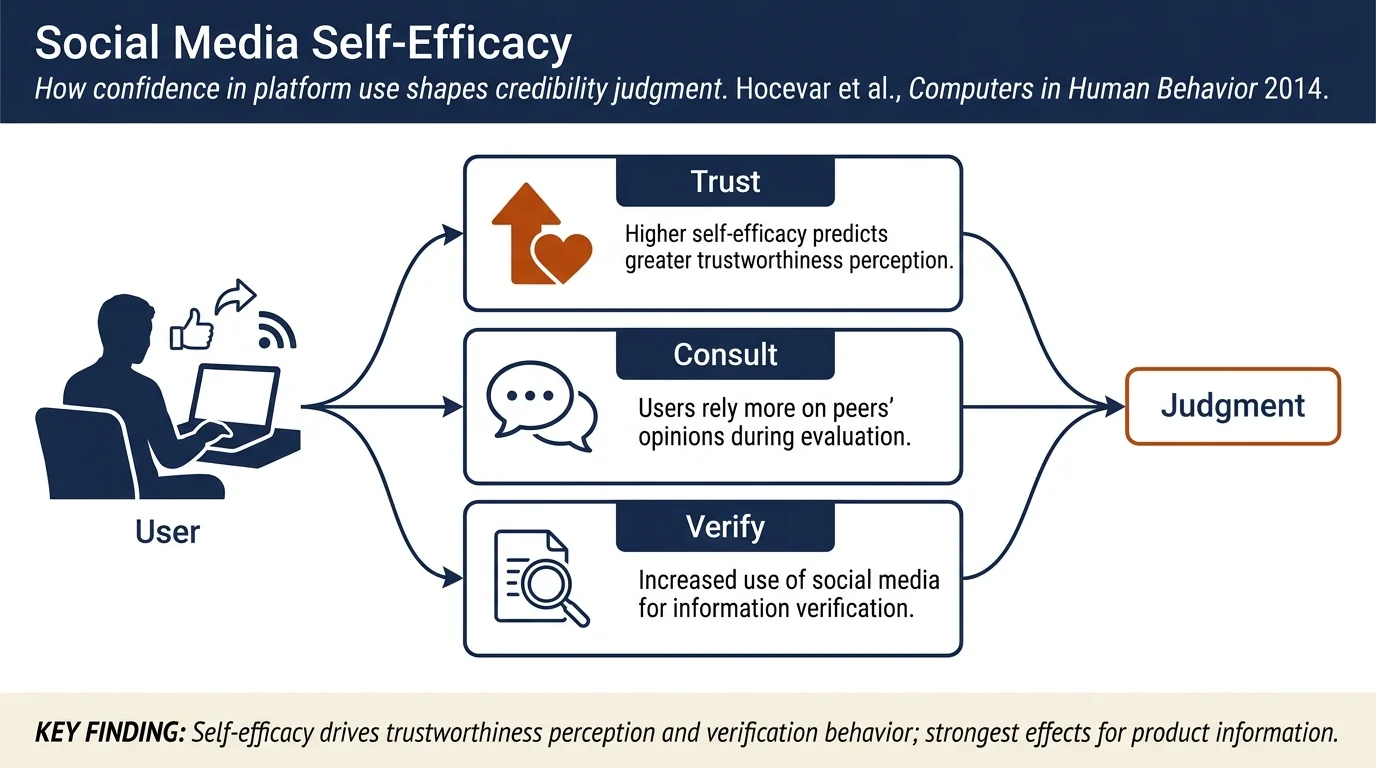
- Social media information trusted relative to offline sources: Users with high self-efficacy in social media environments rate social media information as more trustworthy than offline sources, particularly for product information (Hocevar et al., 2014).
- Consistency drives judgment: Information consistent with prior beliefs is judged as more credible; this consistency heuristic can amplify misinformation in ideologically segregated environments.
- Institutional markers matter: Bylines, author affiliation, organizational logos, and design quality all serve as trust signals, though they can be forged (mimicry of institutional form).
Key papers
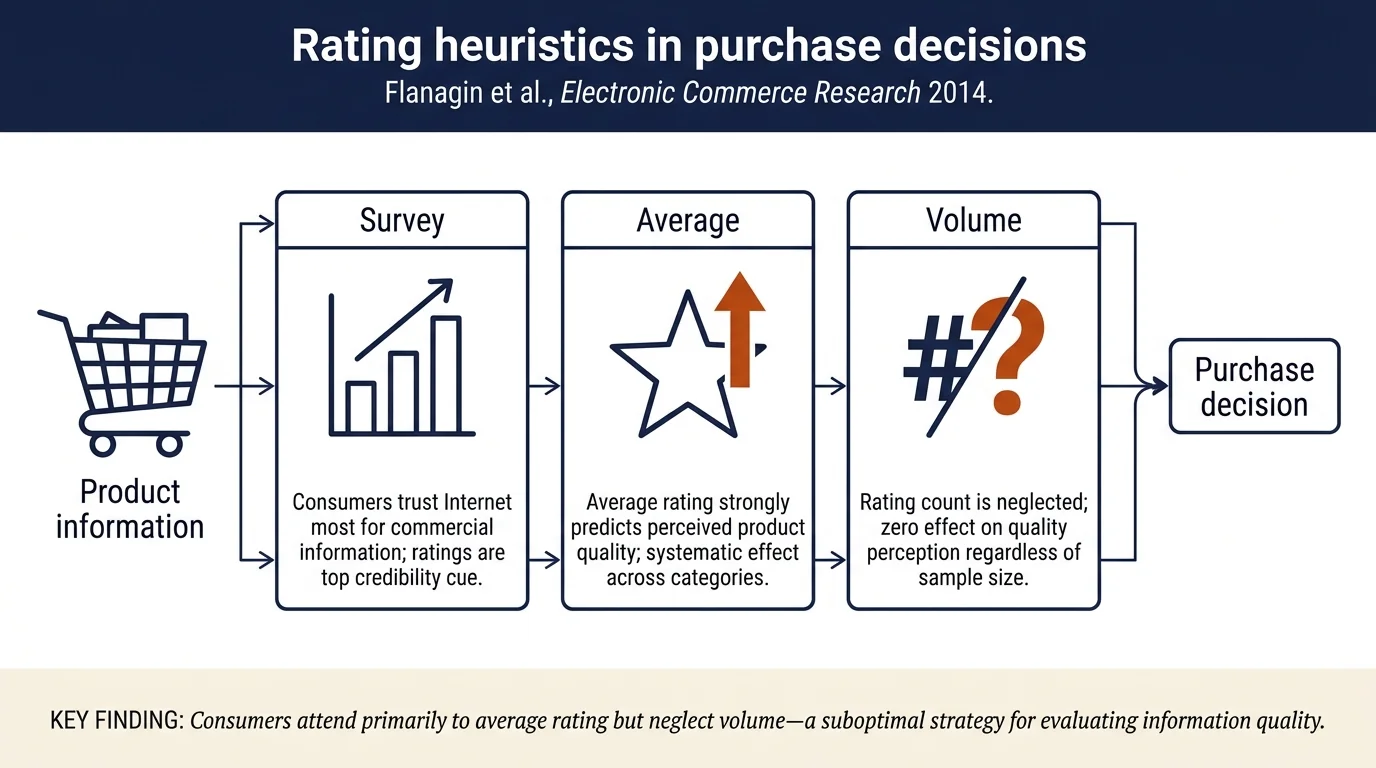
- Flanagin, Metzger, Pure, Markov & Hartsell (2014) — Nationally representative survey and experiment demonstrating that consumers develop strong trust in web-based commercial information and rely on user-generated product ratings for purchase decisions; product quality judgments mediate the relationship between ratings and trust-based behavior.
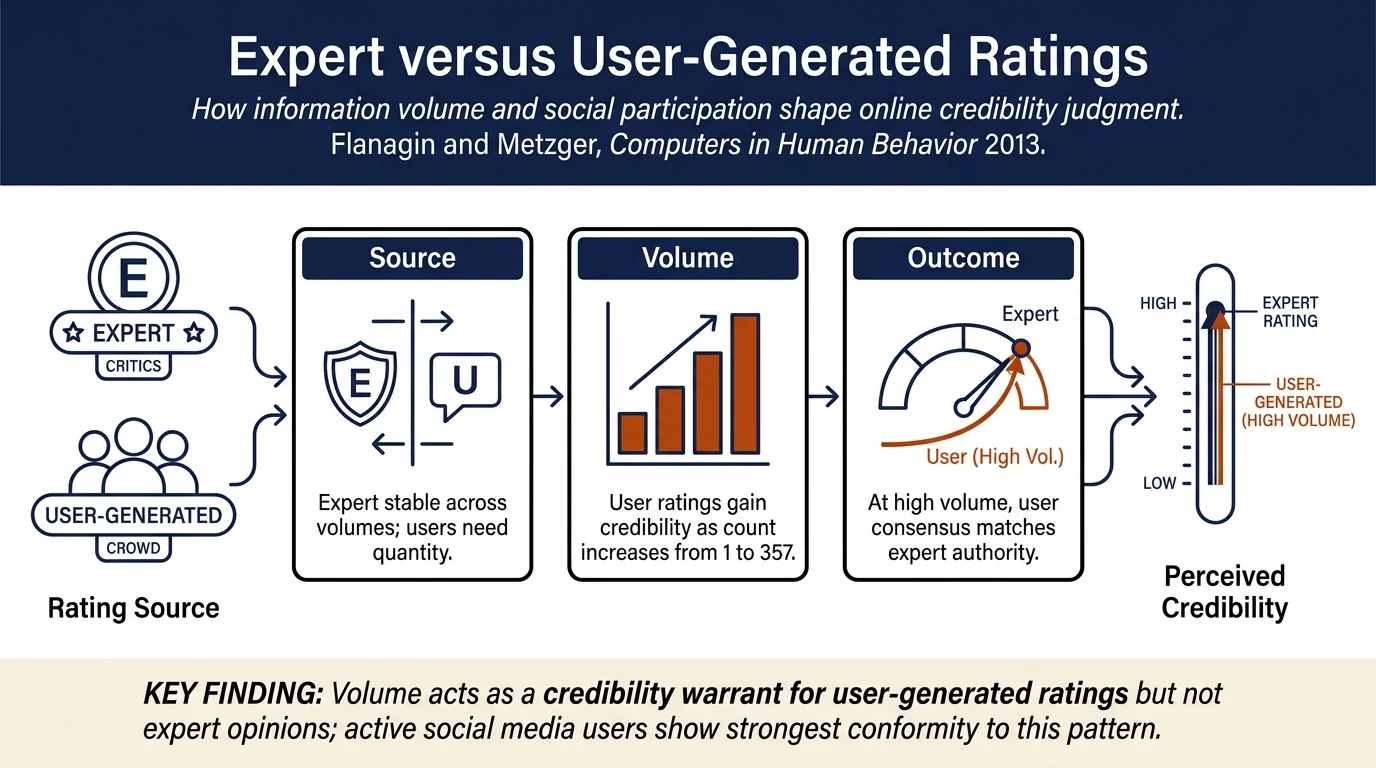
- Flanagin & Metzger (2013) — Empirical study demonstrating how information volume, source type (expert vs. user-generated), and user characteristics affect trust and reliance on online ratings; shows aggregated user-generated information can equal or exceed expert information when volume is high.
- Hocevar, Flanagin & Metzger (2014) — Empirical demonstration that self-efficacy and familiarity with social media predict trustworthiness perceptions.
- Metzger et al. (2003) — Foundational analysis of how online environments change trust dynamics: removal of gatekeepers, ease of professional-looking forgery, and genre convergence create novel trust challenges.
Related topics
- Information evaluation — broader process of assessing information quality
- Credibility assessment for fake news detection — systematic evaluation of source signals
- Source Credibility — author and institutional trustworthiness
- Social media and misinformation — platforms as mediators of trust
Open questions
- How do bots, deepfakes, and other synthetic media undermine trust signals that rely on observable markers?
- What role does transparency (algorithmic explainability, data ownership) play in platform trust?
- Can trust be rebuilt after violations, or does it degrade permanently?
- How do trust asymmetries (e.g., greater skepticism of unfamiliar sources) contribute to polarization and misinformation spread?
Papers on this topic
 Detection methods
Mitigating risk in ecommerce transactions: perceptions of information credibility and the role of user-generated ratings in product quality and purchase intention
 Detection methods
Social media self-efficacy and information evaluation online
 Detection methods
Trusting expert- versus user-generated ratings online: The role of information volume, valence, and consumer characteristics