 Miriam Metzger
Contributions
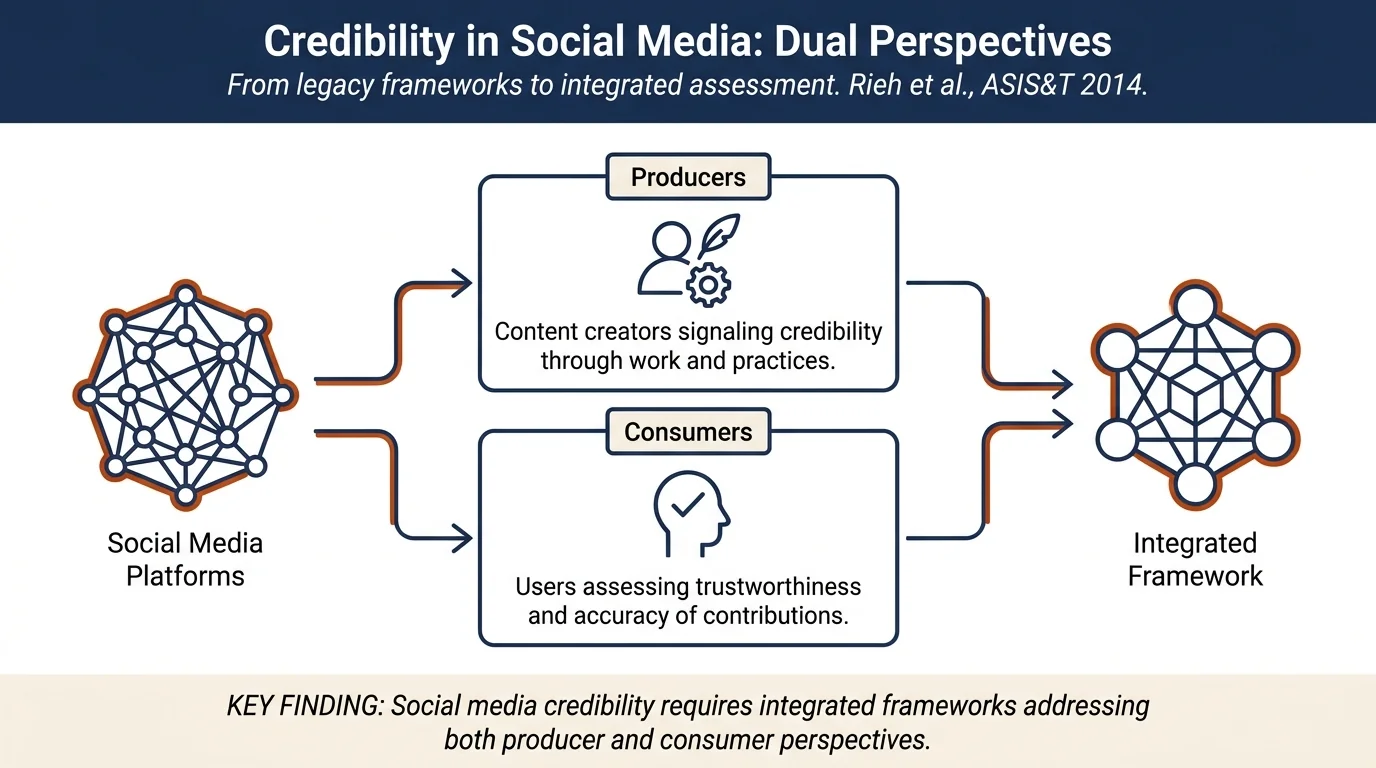
- Multi-perspective framework: Addresses credibility from both producer (content contributor) and consumer (reader/user) viewpoints, recognizing the dual roles users play in social media
- Cross-platform analysis: Examines credibility issues across diverse social media including Twitter, Wikipedia, blogs, and social Q&A services, identifying platform-specific challenges
- Audience-aware credibility construct: Introduces audience-aware credibility as a theoretical framework showing how bloggers signal credibility based on perceived audience needs
- Methodological review: Surveys existing credibility assessment frameworks (media-based, website-based, content-based) and their limitations in the social media context
- Research agenda: Identifies gaps in credibility scholarship and proposes directions for integrated conceptual frameworks
Context
Credibility research has historically focused on comparing credibility across different media channels. When social media emerged as a dominant information ecosystem, researchers initially applied legacy frameworks from print and broadcast media. The panel argues these frameworks inadequately capture the unique credibility challenges of user-generated content and the blurred boundary between producer and consumer roles.
Key Issues Identified
Three significant problems in social media credibility research:
-
Lack of consensus: Different studies use inconsistent terminology and measures, making it difficult to build on prior work. Trustworthiness and expertise—the canonical dimensions from prior media credibility research—may not be the most relevant dimensions for social media contexts.
-
Framework mismatch: Credibility constructs developed for traditional media (television, newspapers) don't transfer directly. Social media users prioritize trustworthiness, reliability, accuracy, and completeness but downplay authoritativeness and expertise compared to other media contexts.
-
Producer-consumer asymmetry: Most credibility research examines information consumers, missing how content creators themselves establish and maintain credibility. Social media users simultaneously consume and produce information.
Panelist Perspectives
Soo Young Rieh (moderator): Introduces audience-aware credibility—how independent bloggers signal credibility based on perceived audience identity and by providing value to that audience. Bloggers employ specific practices and strategies to establish credibility with their readers.
Meredith Ringel Morris: Explores how interface design of search engines and social platforms impacts users' credibility perceptions. Studies cross-cultural differences in credibility assessments of microblog posts (US vs. China).
Miriam J. Metzger: Examines Wikipedia as a case study of user-generated information credibility, investigating the tension between "wisdom of crowds" and traditional credentialed expertise. Discusses tools and interface features designed to support credibility evaluation.
Helena Francke: Analyzes Wikipedia content creation and maintenance from a producer perspective, conceptualizing it within tensions between freedom-to-contribute ideology and rules enforcing traditional authoritative standards. Shows how these tensions shape Wikipedia's perceived credibility.
Grace YoungJoo Jeon: Investigates credibility assessment in social Q&A environments (Yahoo! Answers), examining how users judge credibility of unknown answerers and how online interactions with strangers influence information-seeking behavior.
Notes
This panel paper is a position piece and research agenda rather than an empirical study. Its value lies in synthesizing credibility research across multiple platforms and articulating the need for integrated frameworks that account for social media's unique characteristics. The emphasis on producer perspectives (Rieh, Francke) alongside consumer perspectives is particularly important for understanding information integrity in participatory media systems. The work establishes conceptual foundations that have influenced subsequent research on credibility assessment in user-generated contexts.