 Miriam Metzger
 Andrew J. Flanagin
Contributions
- Reconceptualizes expertise beyond traditional credentialed models to include experiential authority grounded in personal experience, addressing how social media enables non-credentialed experts to gain credibility
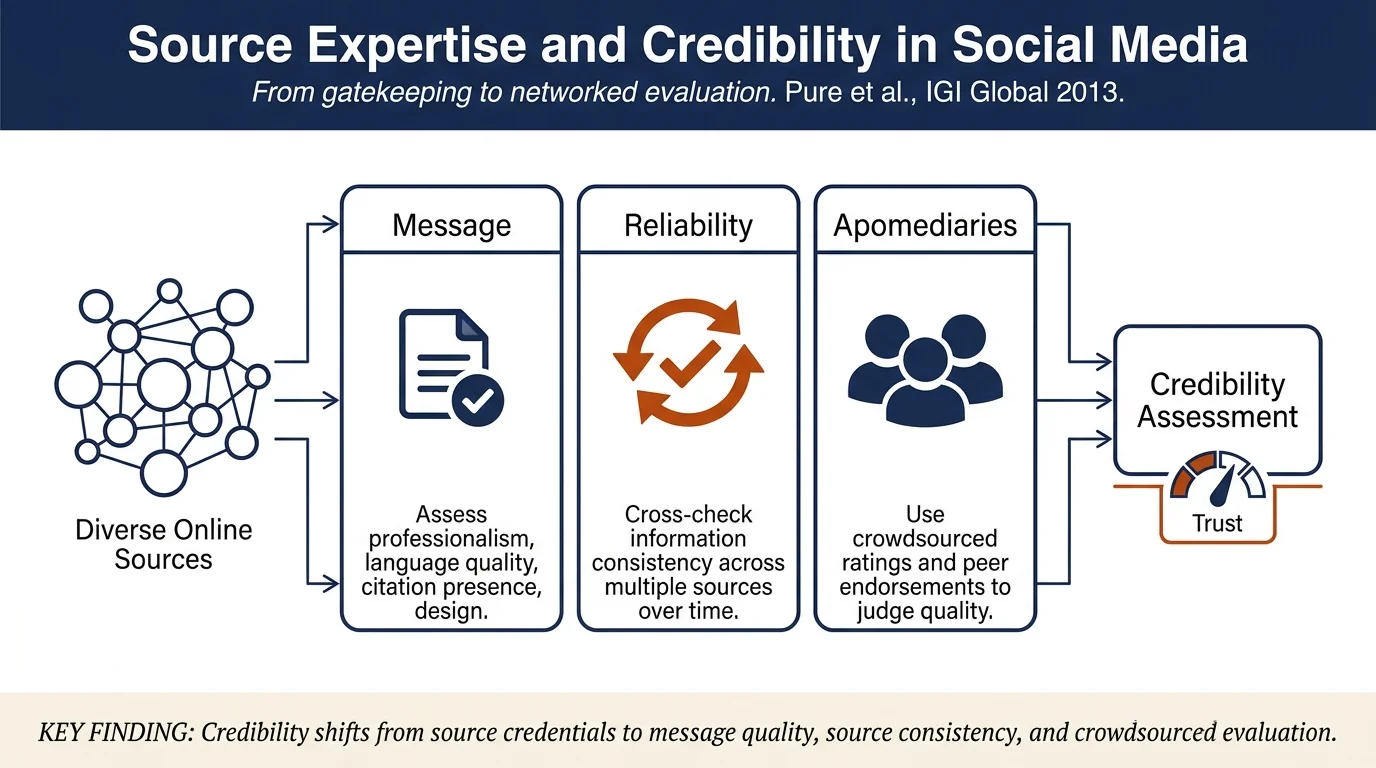
- Identifies key credibility mechanisms in digital environments: message characteristics (design, language, citation), reliability consistency across time and sources, and community-based heuristics—replacing traditional source authority cues in contexts where source identity is ambiguous or absent
- Introduces the apomediaries framework: describes how non-expert intermediaries (Amazon reviewers, Wikipedia editors, user ratings) stand beside consumers to help them navigate information rather than filtering for them, complicating credibility assessment as users must evaluate both the intermediaries and the underlying sources
- Catalogs credibility cues specific to online environments: website design and professionalism, information aggregation across multiple sources, longevity of contributions, and community features that signal reliability rather than authority
- Addresses credibility deficits unique to networked information: hyperlinked environments obscure authorship and intent; source anonymity and pseudonymity undermine traditional source-based evaluation; information aggregation and repurposing blur authorial boundaries and original intent
Method
The chapter synthesizes decades of credibility research across communication, psychology, and information science, extending classical credibility models (source, message, and media credibility) to account for Web-specific realities. The authors analyze how four technological shifts fundamentally alter expertise evaluation:
- Low-cost information production — dramatically lowers barriers for who can publish, increasing information abundance and the number of potential sources
- Loss of professional gatekeeping — traditional intermediaries (journalists, editors, subject-matter gatekeepers) control less of the information flow; users access information directly from creators or through user-generated intermediaries
- Hyperlinked information architecture — makes it psychologically difficult for users to track information source and authorial intent, particularly when sites aggregate or repurpose content across multiple origins
- Source anonymity and pseudonymity — common in online contexts, preventing traditional credibility assessment based on author reputation or credentials
They then propose new mechanisms users employ to evaluate credibility when traditional source cues are unavailable: message characteristics (professionalism, language quality, appropriate terminology), reliability heuristics (information consistency across multiple sources, longevity and edit history of contributions), and apomediaries (using community ratings, peer endorsements, and crowdsourced knowledge as proxies for quality).
Results and Key Findings
The paper does not report quantitative results but rather develops a conceptual and empirical framework. Key findings and proposals:
- Credentialed expertise is insufficient: While formally credentialed experts can provide high-quality information, social software tools and collaborative platforms enable non-credentialed individuals with direct experience to become trusted expertise sources; examples include Wikipedia contributors, medical Q&A communities (Yahoo Answers, Yedda), and product reviewers
- Message cues replace source cues in ambiguous contexts: When authorship is unclear or absent, users evaluate credibility through message characteristics—professionalism, language use, citation presence, design quality—rather than author identity or credentials
- Reliability trumps authority: In conditions where knowledge is collectively generated online and updated continuously (Wikipedia, collaborative wikis, social media), information reliability (consistency over time, convergence with other sources, sustained community maintenance) becomes the credibility indicator, replacing traditional authority-based models
- Apomediaries introduce new credibility layers: Intermediaries like Amazon reviewers, Yelp raters, and Wikipedia's editorial community help users navigate information abundance, but their credibility depends on the quality and trustworthiness of the aggregation mechanism itself—creating a credibility meta-problem: users must evaluate the evaluators
- Expertise is increasingly experiential and crowd-sourced: Social software facilitates collective expertise where non-experts with specific personal experience (e.g., parents discussing child-rearing, patients discussing medications) pool knowledge in ways that can rival or exceed credentialed expert consensus, particularly in domains where experience-based knowledge is salient
Notes
A foundational work that explicitly theorizes the shift from traditional gatekeeping to networked information production. Its distinction between credentialed expertise and experiential authority remains highly relevant for understanding how misinformation spreads—traditional credibility markers (institutional affiliation, credentials, professional training) lose force when anyone can publish with professional appearance (via website builders, social media), and when collective knowledge can be more reliable than any single expert.
The paper's treatment of apomediaries is particularly prescient: it identifies that outsourcing credibility judgment to intermediaries (whether Amazon's rating algorithm or Wikipedia's community voting) doesn't eliminate credibility assessment challenges—it moves them one level up. This directly applies to modern concerns about algorithmic mediation, platform-endorsed misinformation, and the credibility of crowdsourced fact-checking.
The work also highlights the credibility vulnerability of message-cue-dependent evaluation: if users rely on professionalism of design, language quality, and citation presence, then misinformation that is well-designed and professionally presented becomes harder to distinguish from reliable information—a problem that has only intensified with AI-generated content and deepfakes.