 Ullrich K. H. Ecker
 Stephan Lewandowsky
Contributions
- First systematic study of whether explicit warnings can reduce or eliminate the CIE, moving beyond prior unsuccessful attempts
- Identifies two key factors for reducing CIE: inducing alertness (via warnings) and providing plausible alternatives to the misinformation
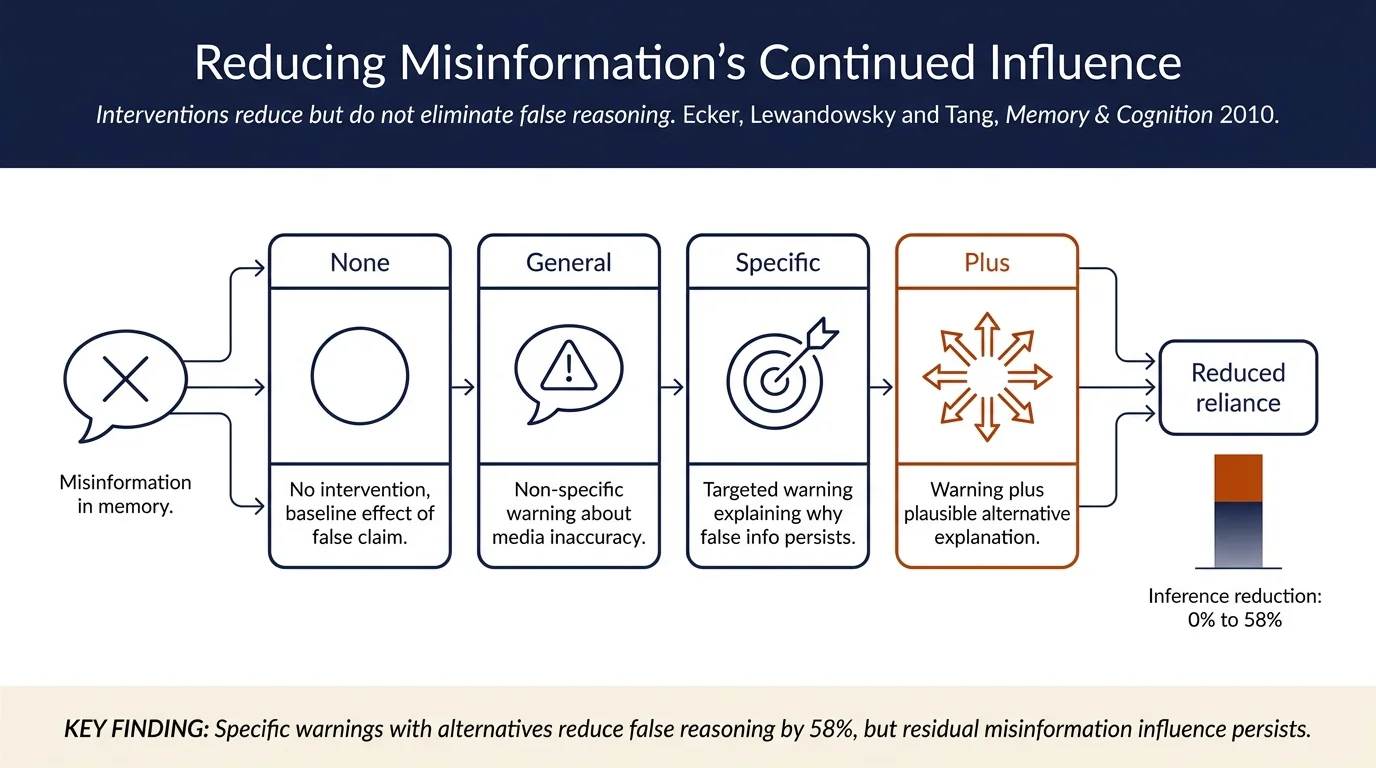
- Demonstrates that general warnings alone are insufficient; specific, targeted warnings with alternatives are more effective
- Shows that even optimal interventions cannot completely eliminate the continued influence effect
Method
Two experiments using a fictitious minibus accident scenario with false information about passenger demographics:
Experiment 1: 125 participants read an account containing a false claim (elderly passengers) followed by a retraction. The study crossed two factors: (1) whether a retraction was presented, and (2) warning type — no warning, general warning (media often publishes inaccurate information), or specific warning (explaining why outdated information continues to influence reasoning). A within-subjects design tested whether providing a plausible alternative explanation reduced the CIE.
Experiment 2: 92 participants in a between-subjects design tested the combined effect of specific warnings with alternative explanations. Measured dependent variables: inference scores (about aspects of the incident directly or indirectly linked to the false information), fact-recall accuracy, and manipulation-check questions to verify understanding and retention.
Results
- General warning effect: Mere retraction reduced false inferences from 5.06 to 4.04 references, but a general warning reduced this only to 3.36 — a modest effect.
- Specific warning + alternative: The combined condition produced the largest reduction, to 2.12 references — a ~58% reduction compared to no retraction.
- Incomplete elimination: Even in the best-performing condition, participants still made 2.12 average inferences to misinformation, compared to 4.64 in the no-retraction baseline. Residual influence persisted.
- Fact recall unaffected: Warnings did not improve recall of correct factual details or the retraction itself.
- Alertness and alternatives: The benefit of providing an alternative explanation appears to operate through strategic monitoring of retrieval processes, making participants more cautious about what information to trust.
Notes
This is a canonical early study of how to reduce misinformation effects, not just documenting that they persist. The key finding — that warnings work but incompletely — has shaped subsequent intervention research. The paper's strength lies in the manipulation of plausibility-driven alternatives: people don't abandon false information entirely, but can be nudged toward more critical retrieval monitoring. A limitation is the controlled laboratory setting with a fictional scenario; real-world persistence of politically charged misinformation may involve stronger defensive processing. The mechanism explanation (untagging vs. suppression of misinformation in memory) remains speculative and was tested only indirectly via behavioral measures.