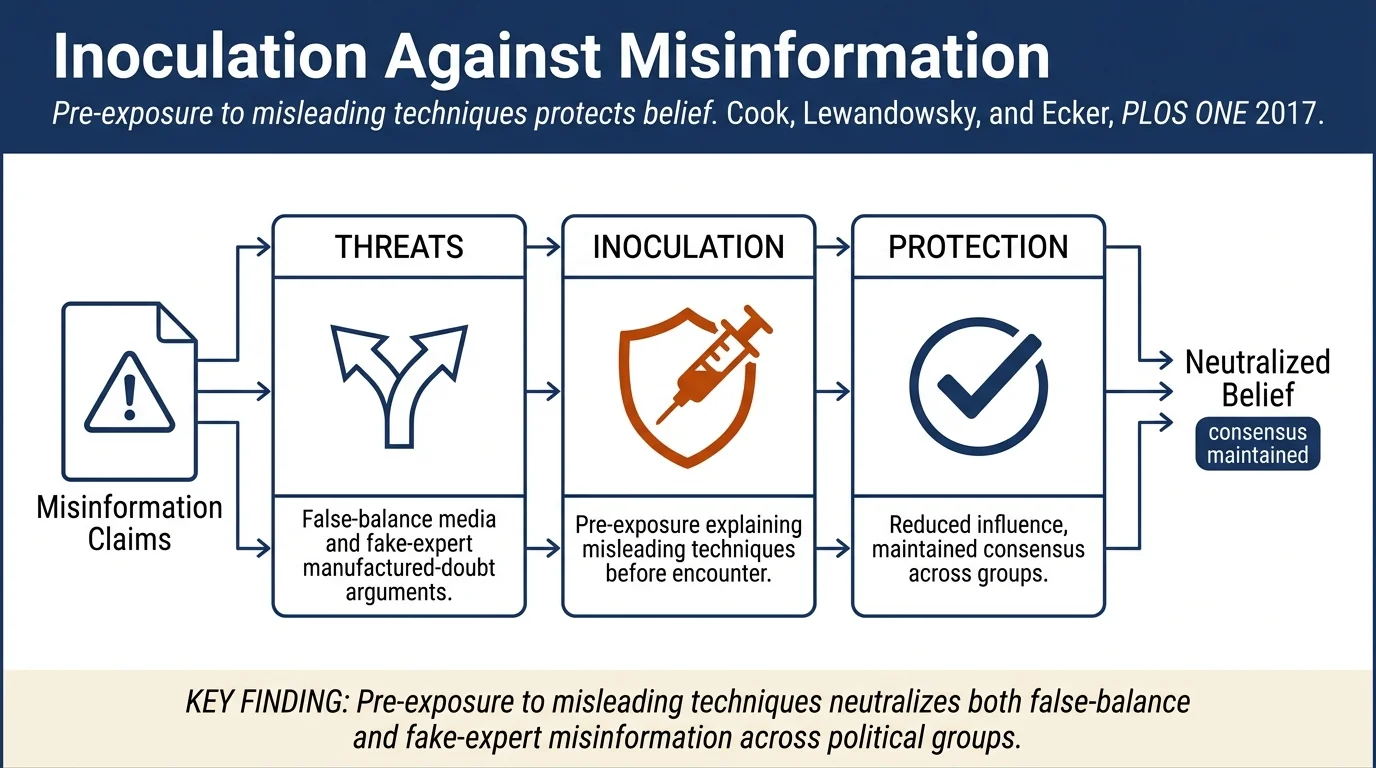
Neutralizing misinformation through inoculation: Exposing misleading argumentation techniques reduces their influence
Authors: John Cook, Stephan Lewandowsky, Ullrich K. H. Ecker Venue: PLOS ONE, May 5, 2017 — DOI
TL;DR
Pre-emptively exposing people to flawed arguments before they encounter misinformation (inoculation) reduces that misinformation's influence. Two experiments tested this on climate change: false-balance media coverage (equal weight to consensus vs. contrarian scientists) and fake-expert arguments (using unqualified scientists to manufacture doubt). Inoculation messages explaining the misleading techniques were effective at neutralizing both types of misinformation and reducing politically motivated polarization.
Contributions
- Empirically validates inoculation theory in the climate change misinformation context
- Demonstrates effectiveness of explaining misleading techniques (e.g., false balance, appeal to fake experts) before exposure
- Shows inoculation can work across political worldviews; particularly effective for free-market conservatives
- Reveals that consensus information alone may not protect against misinformation if it conflicts with prior beliefs
- Identifies inoculation as superior to corrective information when pre-exposure is possible
Method
Experiment 1: False-balance media coverage - Misinformation: Mock news article presenting climate scientists alongside contrarian scientists in equal weight (false balance) - Consensus information: Description of 97% scientific agreement on human-caused global warming - Inoculation: Explanation of the "false balance" strategy and why it's misleading - Design: 714 U.S. participants randomly assigned to control, misinformation only, consensus information (before misinformation), inoculation (before misinformation), or both consensus and inoculation - Measured: perceived consensus, acceptance of anthropogenic global warming (AGW), attribution of climate trends to humans, trust in climate scientists, policy support
Experiment 2: Fake-expert arguments - Misinformation: Text from the Oregon Petition Project (fake experts: scientists with unrelated expertise claiming to reject the consensus) - Inoculation: Explanation of the "fake experts" technique using analogy to tobacco industry's use of fake-credentialed spokespersons - Design: 2×2 between-subjects design; 392 U.S. participants in four conditions: control, inoculation-only, misinformation-only, inoculation + misinformation - Same dependent measures as Experiment 1
Results
Experiment 1: - False-balance misinformation significantly decreased perceived consensus (M=63.5% vs. control M=68.9%) - Consensus information alone partially recovered perceived consensus (M=86.1%) - Inoculation alone neutralized the misinformation with no change in perceived consensus (M=70.0%, relative to consensus-only's M=83.9%) - Combined consensus + inoculation was most effective (M=83.9%), particularly for free-market supporters - Consensus information reduced trust in contrarian scientists; inoculation had direct neutralizing effect on misinformation
Experiment 2: - Fake-expert misinformation polarized attitudes by political ideology: free-market supporters decreased AGW acceptance; liberals increased it - Inoculation successfully neutralized misinformation across both groups, showing no overall change (M=50.4% vs. control M=54.5%) - Consensus information alone was ineffective in this experiment (M=44.5% vs. control); misinformation's polarizing effect persisted - Three-way interaction (free-market support × inoculation × misinformation) was significant: inoculation reduced the polarizing effect
Connections
- Related to Roozenbeek & van der Linden (2019) via shared inoculation-theory framework and empirical validation at larger scale
- Complements Ecker et al. (2022) which synthesizes prebunking and debunking evidence
- Connected to Wardle & Derakhshan (2017) on information disorder mechanisms; this paper tests interventions against false-balance and manufactured-doubt tactics
- Extends psychological research on belief formation and continued influence effects
Notes
Strengths: - Strong empirical design with randomized assignment and adequate sample sizes (714 and 392 participants) - Two complementary experiments addressing different misinformation strategies (false balance vs. fake experts) - Tests inoculation across political worldviews; demonstrates that inoculation can work when simple correction fails due to ideological resistance - Practical implication: pre-exposure to misleading techniques is feasible for science communicators and educators - Measures multiple outcomes (consensus perception, policy support, trust); shows effects generalize beyond one measure
Limitations: - Laboratory design with self-selected, online participants; generalization to in-the-wild exposure unclear - Single exposure to inoculation; durability over time and with repeated exposure not tested - Climate change as domain; unclear how well inoculation transfers to other misinformation topics (health, politics, etc.) - Inoculation explained the technique but did not mention the Oregon Petition or false-balance examples explicitly in Exp 1; potential ceiling effects - No measurement of belief revision after exposure to misinformation and inoculation together; primarily measured prevention
Follow-ups: - Longitudinal follow-up to assess durability of inoculation effects weeks or months later - Cross-domain generalization: do inoculations against climate false-balance transfer to vaccine or election misinformation? - Dose-response: does repeated inoculation training increase effectiveness? - Mechanistic studies: does inoculation work by increasing skepticism generally, or by specific detection of the flagged technique? - Integration with other interventions (media literacy, fact-checking infrastructure)