Contributions
- Empirically challenges the assumption that knowledge constrains the illusory truth effect
- Demonstrates that illusory truth effects occur for contradictions of well-known facts, not just unfamiliar statements
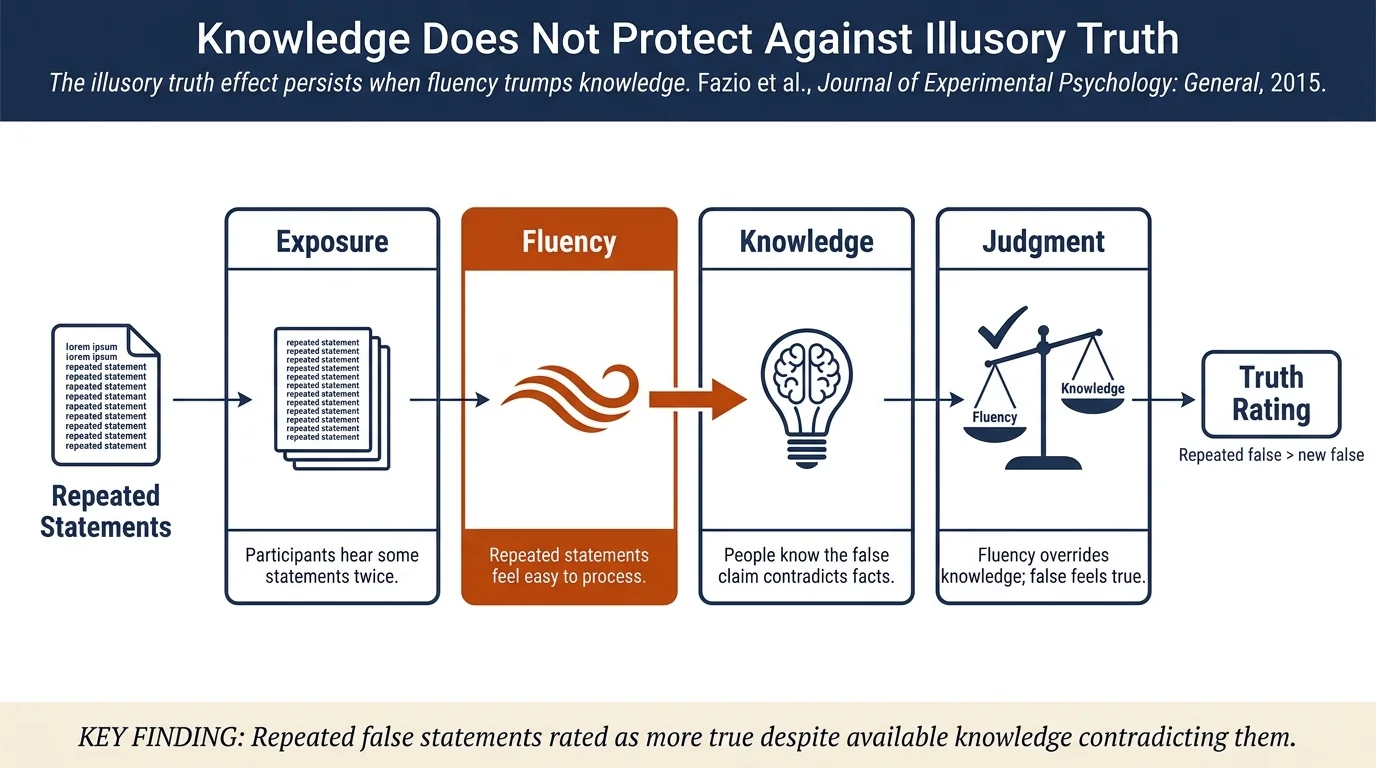
- Introduces the concept of "knowledge neglect"—failure to deploy available knowledge when evaluating fluent statements
- Uses multinomial process modeling to distinguish two cognitive models: fluency-conditional (people rely on fluency even when knowledge is available) versus knowledge-conditional (people only use fluency if knowledge retrieval fails)
Method
Experiment 1 tested whether knowledge protects against illusory truth. Forty Duke University undergraduates evaluated 176 statements (created from Nelson & Narens 1980 norms) across three phases:
- Exposure phase: Participants rated 88 statements for interest using a 6-point scale; half the statements were repeated.
- Truth rating phase: Participants rated all 176 statements for truthfulness on a 6-point scale, with half marked as "repeated" from exposure.
- Knowledge check: A post-experimental multiple-choice test measured participants' actual knowledge on the same facts tested during exposure.
Statements were categorized as known truths, known falsehoods (contradictions of well-known facts), unknown truths, or unknown falsehoods. The design was 2 (repetition: repeated, new) × 2 (estimated knowledge: known, unknown) within-subjects.
Experiment 2 replicated Experiment 1 with binary truth judgments and compared two competing multinomial process models to explain how repetition and knowledge interact.
Results
Experiment 1:
- Knowledge check confirmed estimates: 67% correct on questions estimated as known; 20% on unknown questions.
- Illusory truth effect occurred regardless of knowledge: Repeated known falsehoods (M = 2.93) received higher truth ratings than new ones (M = 2.59; t(39) = 2.93, p = .006). The effect was larger for known statements than unknown ones—counter to predictions that knowledge would inhibit the effect.
- Repeated unknown falsehoods (M = 4.13) also received higher ratings than new ones (M = 3.92; t(39) = 2.79, p = .008).
Experiment 2:
- Replicated the illusory truth effect with binary judgments (repeated M = 0.62 vs. new M = 0.56; F(1,39) = 13.18, p < .001).
- Multinomial modeling showed the fluency-conditional model fit better than the knowledge-conditional model, suggesting participants rely on fluency even when knowledge is accessible.
Notes
Methodologically rigorous and directly addresses prior assumptions in the literature. The knowledge check phase and use of normed stimuli provide strong evidence that observed effects reflect genuine knowledge neglect rather than mere lack of knowledge. The multinomial modeling framework offers a replicable approach to dissociating fluency-driven and knowledge-driven judgment processes. This work has become canonical in misinformation research and is frequently cited as evidence that repetition makes false information feel true even when corrected or when the audience knows the truth.