Explore everything
Filter by research area, year and venue. Every filter is in the address bar, so you can share a view as a link.
 Bots & coordinated campaignsDetection methods
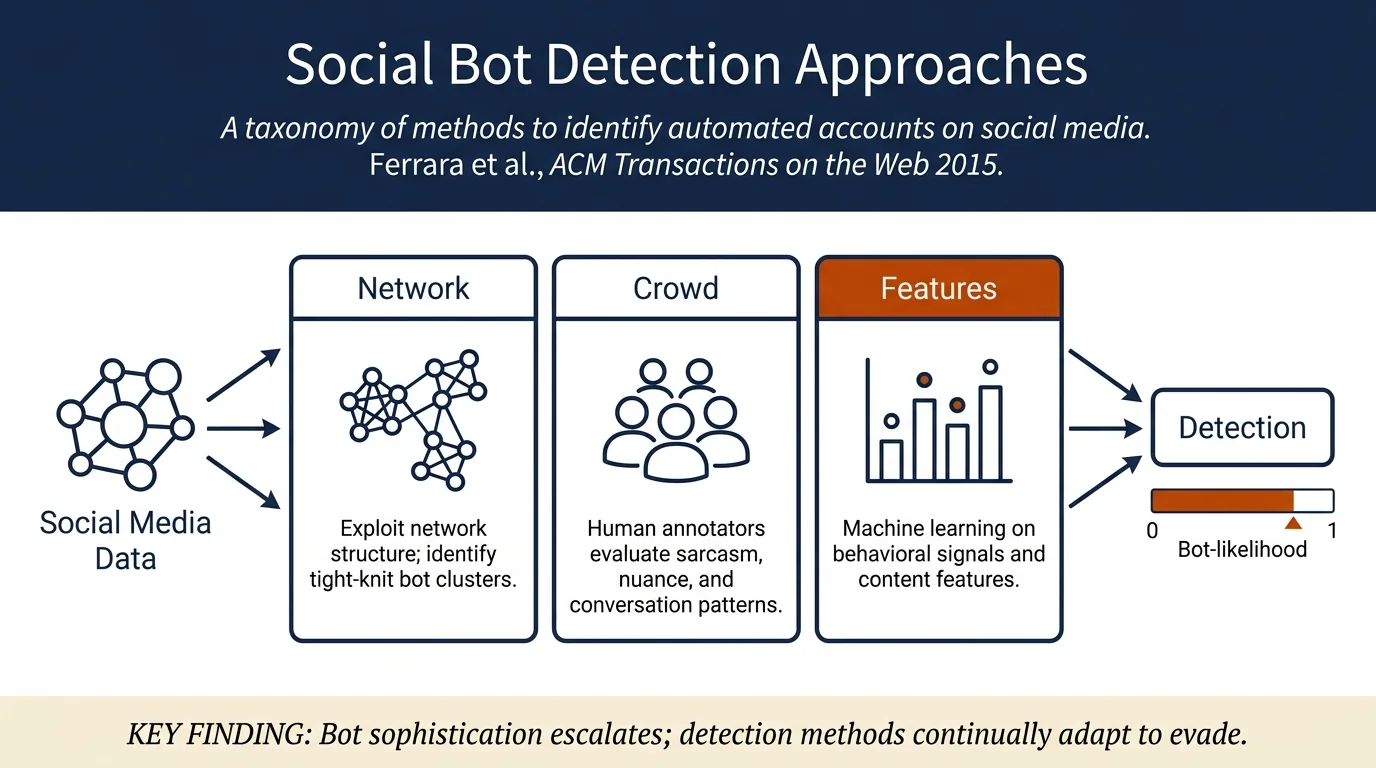
The Rise of Social BotsSocial bots—automated software agents in social media—are increasingly sophisticated and pose real threats including misinformation spread, trend manipulation, and election interference. This paper characterizes modern bot behavior, surveys detection challenges, and proposes a taxonomy of detection approaches: graph-based methods…
 Platforms, policy & societyPsychology & interventions
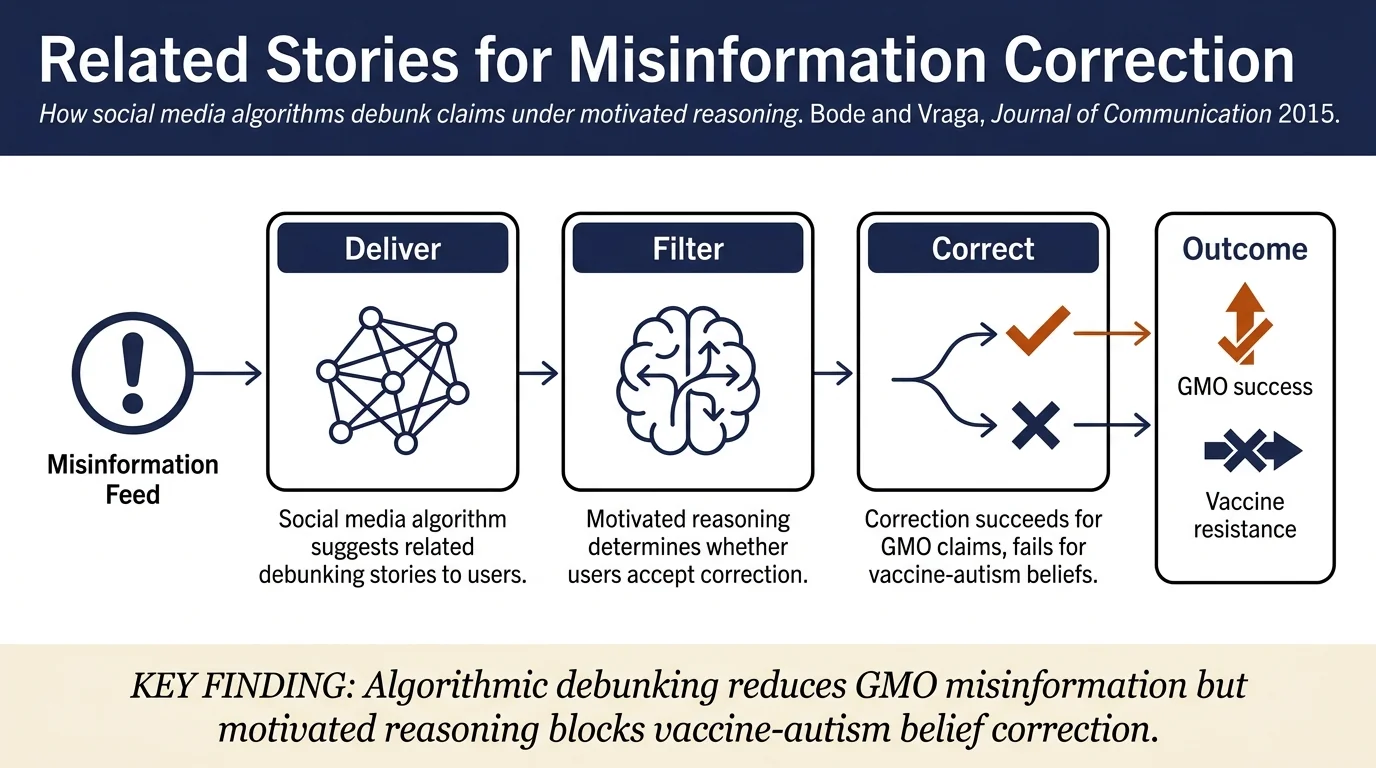
In Related News, That Was Wrong: The Correction of Misinformation Through Related Stories Functionality in Social MediaThis study tests whether Facebook's "related stories" feature can correct misinformation by exposing users to debunking information. Two experiments (students and Mechanical Turk workers) examined vaccine-autism and GMO-illness misperceptions.
 Fact-checking & verificationPsychology & interventions
How to separate fact and fiction onlineMarkham Nolan, editor of Storyful, explains how journalists use open-source intelligence tools to verify content in the age of information overload. Through real-world case studies—including fake Hurricane Sandy photos and identifying locations in Syrian conflict videos—he demonstrates that truth-seeking requires human judgment combined…
 Psychology & interventionsFact-checking & verification
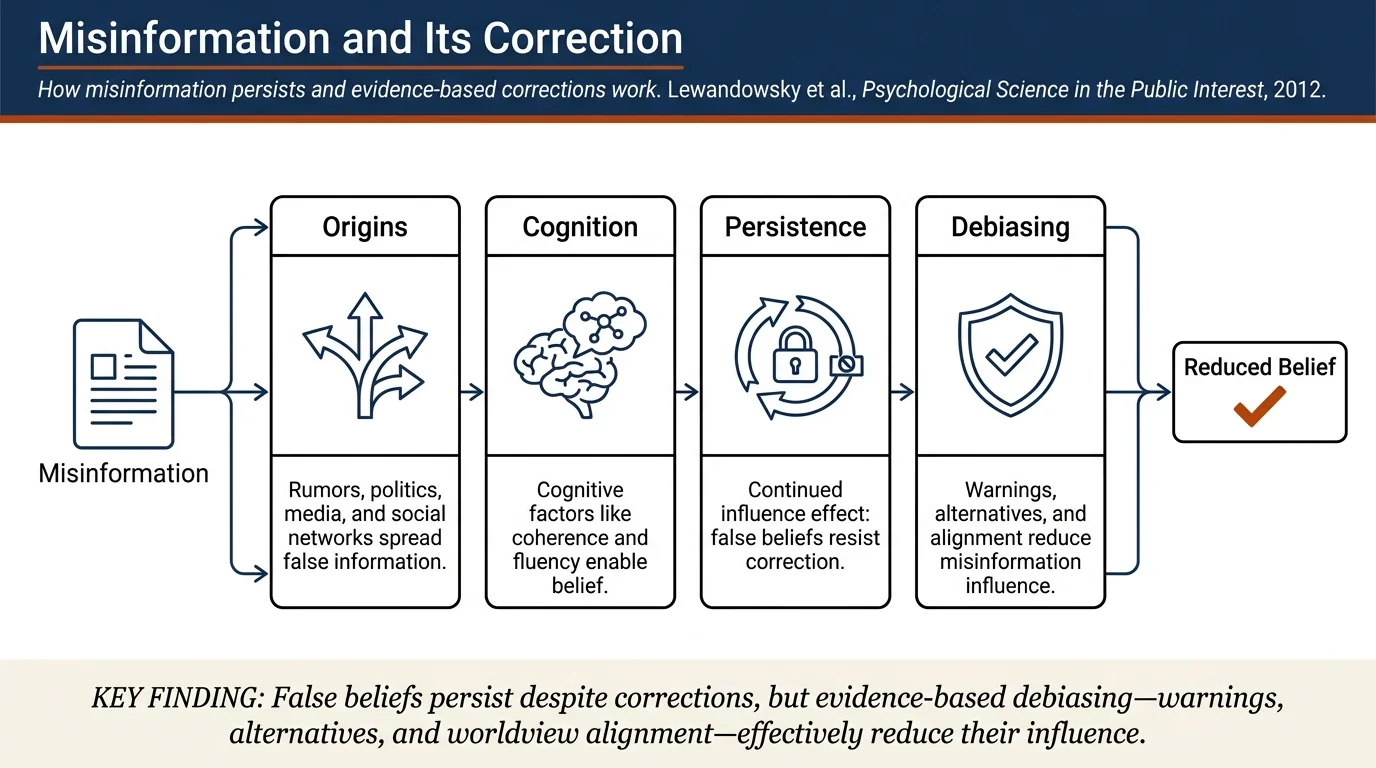
Misinformation and Its Correction: Continued Influence and Successful DebiasingThis comprehensive review synthesizes literature on why false beliefs persist despite corrections, examining cognitive mechanisms (coherence, credibility, source confusion, fluency) that render misinformation resistant to change. The authors propose evidence-based debiasing strategies—warnings, alternative explanations, repeated…
 Spread & networksPlatforms, policy & society
Beware online filter bubblesAlgorithmic personalization on major platforms like Facebook and Google has created "filter bubbles" — personalized information universes that show us what we're predicted to like rather than what we need to see. This invisible algorithmic gatekeeping threatens democracy and information diversity by isolating us in narrow perspectives,…
 Spread & networksBots & coordinated campaigns
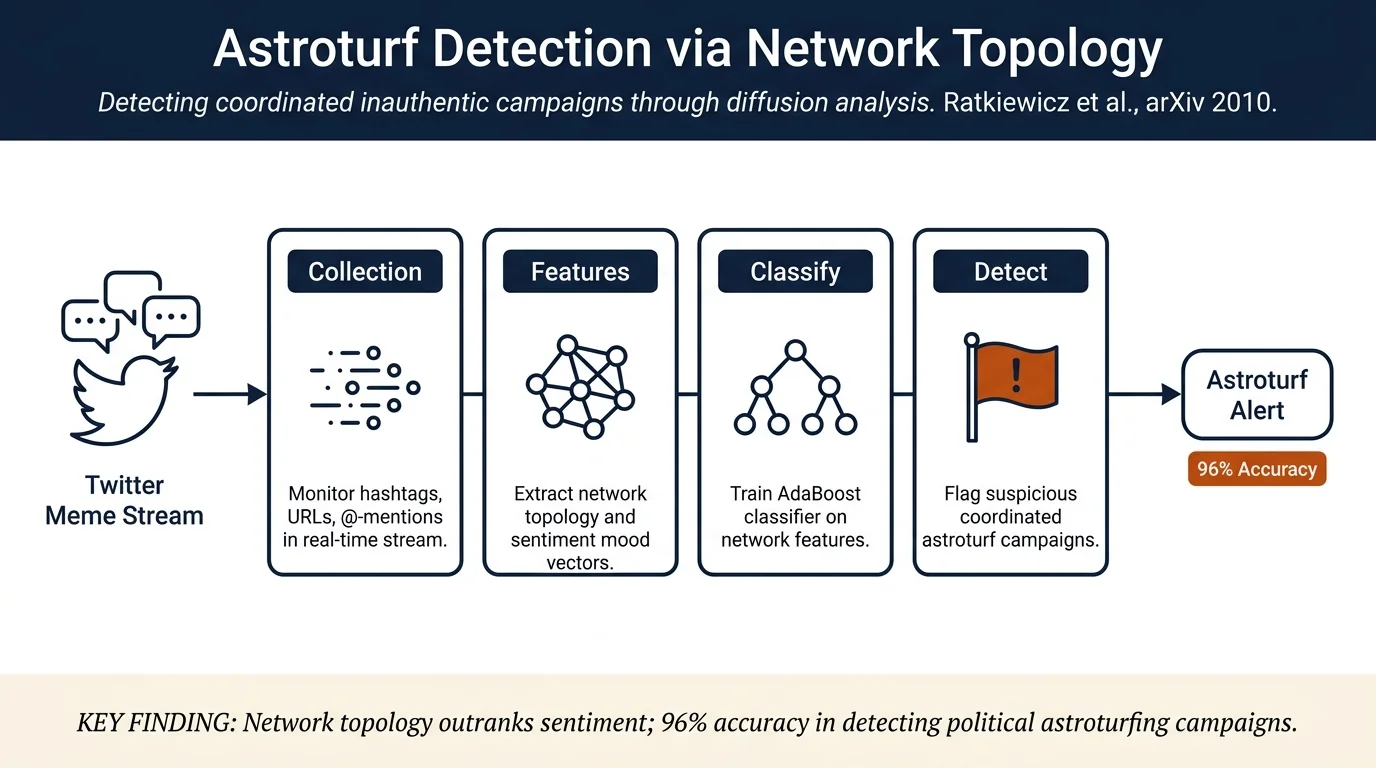
Detecting and Tracking the Spread of Astroturf Memes in Microblog StreamsPolitical campaigns increasingly use social media to amplify deceptive memes that mimic organic grassroots behavior—termed "astroturfing." This paper introduces the Truthy system, which analyzes meme diffusion networks on Twitter to detect orchestrated campaigns through network topology and sentiment analysis, achieving ~90%…
 Spread & networksDatasets & evaluation
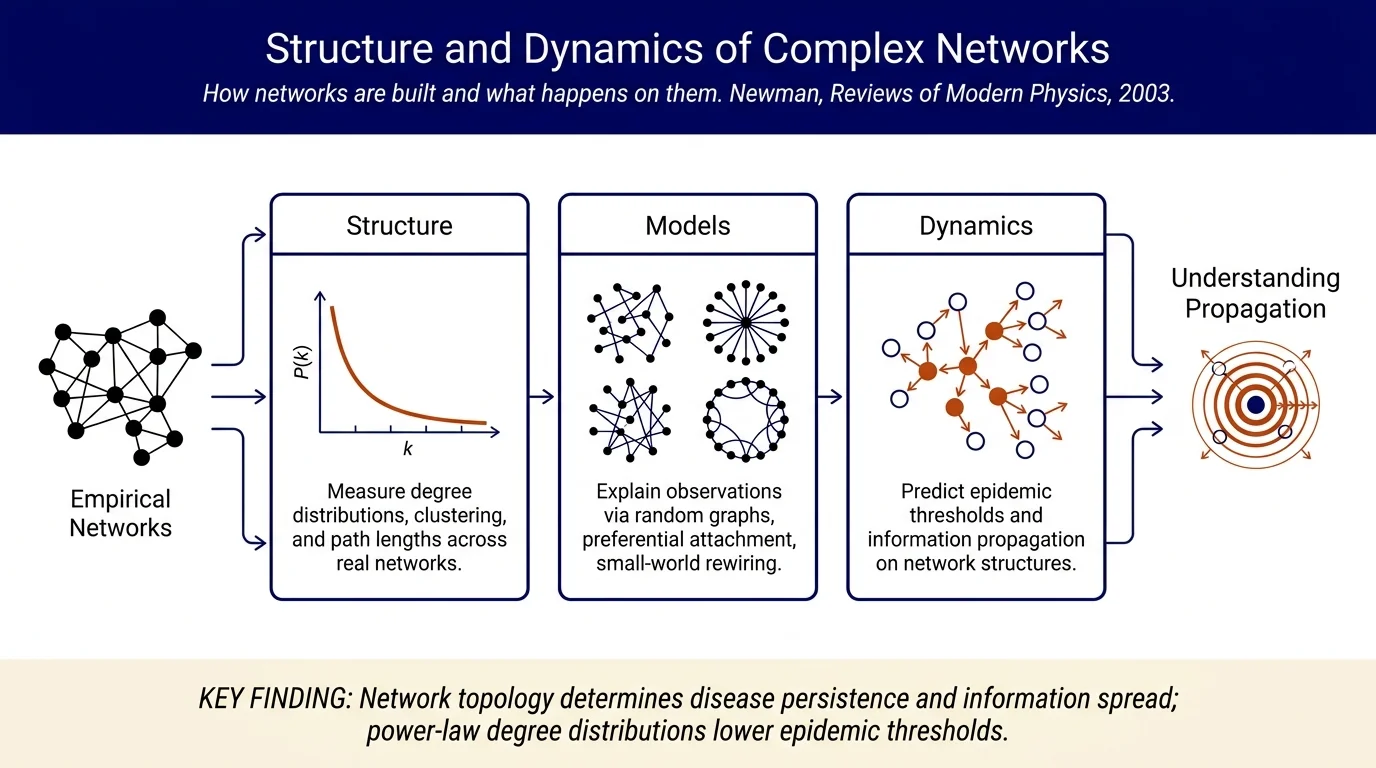
The structure and function of complex networksThis comprehensive review surveys the properties and mathematical models of complex networks across diverse domains: social networks, the Internet, biological networks, and collaboration networks. Newman covers observed structural properties (degree distributions, clustering, small-world effects), foundational models (random graphs,…
 Psychology & interventionsPlatforms, policy & society
How We Create Our Own Fake NewsBobby Duffy's "Perils of Perception" research (100,000+ interviews across 40 countries) reveals that people systematically misestimate social realities by factors of 2–3×. Using concrete examples (teenage pregnancy, murder rates, immigration, social media adoption), Duffy traces these perception gaps to four psychological mechanisms: (1)…
Platforms, policy & society
Don't blame the election on fake news. Blame it on the media.A critical analysis arguing that while fake news received disproportionate blame for Trump's 2016 victory, the mainstream media's coverage patterns—emphasizing scandals over policy—played a more significant role in shaping voter knowledge and behavior. Examining New York Times coverage, the authors demonstrate that scandal-focused…
Platforms, policy & societyBots & coordinated campaigns
Partisanship, Propaganda, and Disinformation: Online Media and the 2016 U.S. Presidential ElectionThis large-scale analysis of mainstream and social media coverage during the 2016 U.S. presidential election documents asymmetric partisan structures: conservative media formed an insulated, hyperpartisan ecosystem centered on far-right outlets like Breitbart, while liberal media remained anchored in traditional journalistic practices.…
Spread & networksPsychology & interventions
Avoiding the Echo Chamber About Echo Chambers: Why selective exposure to like-minded political news is less prevalent than you thinkThis Knight Foundation white paper reviews the academic literature on echo chambers and filter bubbles and argues that the narrative of pervasive ideological self-segregation in media consumption is significantly overstated. While people do prefer congenial political information, most Americans consume diverse media diets; most partisan…
Spread & networksPlatforms, policy & society
Social Media, Political Polarization, and Political Disinformation: A Review of the Scientific LiteratureThis comprehensive literature review examines the relationships among social media usage, political polarization, and political disinformation, synthesizing research across six topic areas: online political conversations, consequences of disinformation exposure, producers of disinformation, spreading strategies, content and polarization…
Bots & coordinated campaignsPlatforms, policy & society
The Global Disinformation Order: 2019 Global Inventory of Organised Social Media ManipulationA comprehensive inventory of government and political-party organized social media manipulation campaigns (cyber troops) across 70 countries. The report catalogs organizational structures, strategies, platforms, and resources deployed for computational propaganda; finds organized manipulation in 70 countries (up from 28 in 2017), with…
Spread & networksPlatforms, policy & society
WhatsApp vigilantes: an exploration of citizen reception and circulation of WhatsApp misinformation linked to mob violence in IndiaThis LSE report examines how WhatsApp misinformation circulation in India relates to lynchings and mob violence since 2015. The study investigates citizen reception, technological affordances, motivations for sharing, and the broader socio-political context shaping how false information spreads through messaging platforms and triggers…
Detection methodsPlatforms, policy & society
Facts and Myths about MisperceptionsBrendan Nyhan surveys misperceptions in politics, science, and health, analyzing why false beliefs persist and how to counter them. While cognitive limits play a role, the strongest driver of misperceptions is group identity and directional motivation (partisanship) in low-incentive domains.
 Spread & networksDetection methods
Climate Change Misinformation: Supply, Demand, and the Challenges to ScienceLewandowsky examines climate denial through supply and demand lenses: well-funded disinformation campaigns (billions annually from fossil fuel interests and conservative think tanks) deploy cherry-picked data to infiltrate mainstream media and political rhetoric, while political ideology (conservatism, libertarianism) predisposes people…
 Psychology & interventionsPlatforms, policy & society
How to Pre-Bunk Misinformation and DisinformationJon Roozenbeek discusses psychological inoculation as a scalable defense against misinformation. Rather than focusing on veracity (which becomes politically contested), he proposes teaching people to recognize predictable manipulation techniques before encountering false content.
 Detection methodsPlatforms, policy & society
Truth DecayTruth Decay—the erosion of reliance on facts and data in policy-making and civil discourse—is not new but cyclically emerges during periods of technological disruption in media. Kavanagh traces this through yellow journalism, radio demagoguery, cable news, and now social media.
 Spread & networksPlatforms, policy & society
Network PropagandaBenkler presents research on media asymmetry during the 2016 U.S. election, revealing that the right-wing media ecosystem operates under a fundamentally different structure than the center and center-left press. Rather than technological systems (Facebook algorithms, Russian interference) or individual-level factors, the key driver of…
 Deepfakes & multimodalDetection methods
The Erosion of Shared Reality in the Age of DeepfakesGenerative AI has moved from nascent to commodity in just 18 months; text-to-image, text-to-video, and real-time interactive deepfakes are now trivial to create. Humans are bad at detecting them (performing ~60% accuracy on trained tasks vs. 50% chance).
 LLMs & generative AIFact-checking & verification
Factuality Challenges in the Era of Large Language ModelsNakov surveys the twin challenges posed by large language models (LLMs) to misinformation detection and fact-checking: (1) LLMs generate coherent, persuasive, and factually-unreliable text—hallucinations are pervasive and often hidden; (2) LLMs can be weaponized to automate misinformation production at scale through paraphrasing, persona…
 Psychology & interventionsPlatforms, policy & society
The Misinformation AgeFalse beliefs persist and spread through social factors—conformity, institutional curation of evidence, and network structure—rather than individual cognitive biases alone. O'Connor examines historical cases (variolation in 18th-century England, tobacco industry strategy) and mathematical models to show how unbiased actors (journalists,…
 Platforms, policy & societyFact-checking & verification
How Polarization Can Help Solve the Misinformation ProblemDavid Rand presents a counter-intuitive argument: while polarization is widely viewed as exacerbating misinformation, it may actually improve crowd-sourced fact-checking systems like Twitter's Birdwatch/Community Notes. Rather than a traditional technology approach (machine learning classifiers), platforms can scale fact-checking by…
 Psychology & interventionsFact-checking & verification
How You Can Help Combat Fake NewsA researcher presents empirical findings challenging the "motivated reasoning" account of why people believe false headlines. Instead, a multi-study investigation with 25,000+ participants shows that critical thinking and cognitive reasoning—not willful bias—are the primary determinants of misinformation susceptibility.