Explore everything
Filter by research area, year and venue. Every filter is in the address bar, so you can share a view as a link.
 Bots & coordinated campaignsDatasets & evaluation
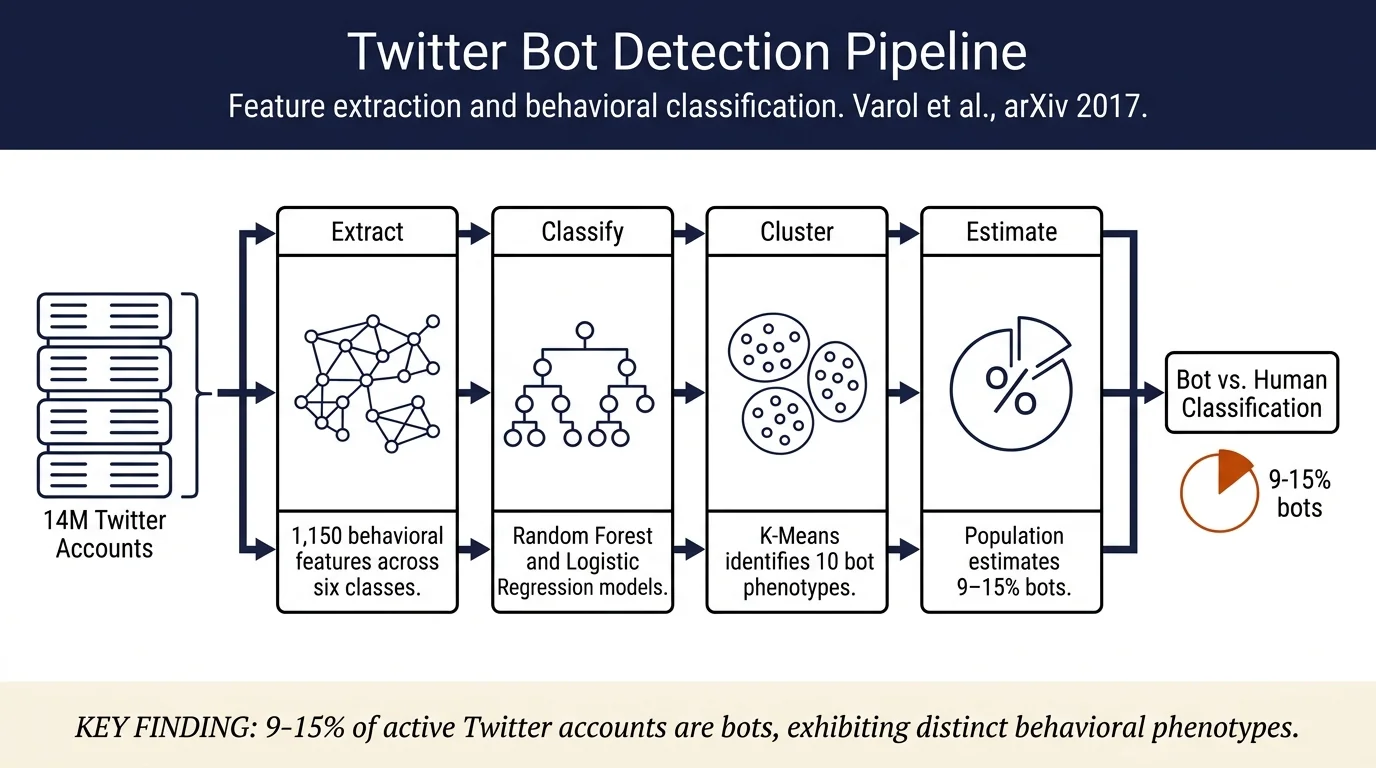
Online Human-Bot Interactions: Detection, Estimation, and CharacterizationSocial media accounts controlled by software can mimic human behavior while executing coordinated campaigns. This paper develops a machine-learning framework extracting 1,150 behavioral features from Twitter account metadata, posting patterns, and social networks to classify bots with 95% accuracy on honeypot data.
 Bots & coordinated campaignsDetection methods
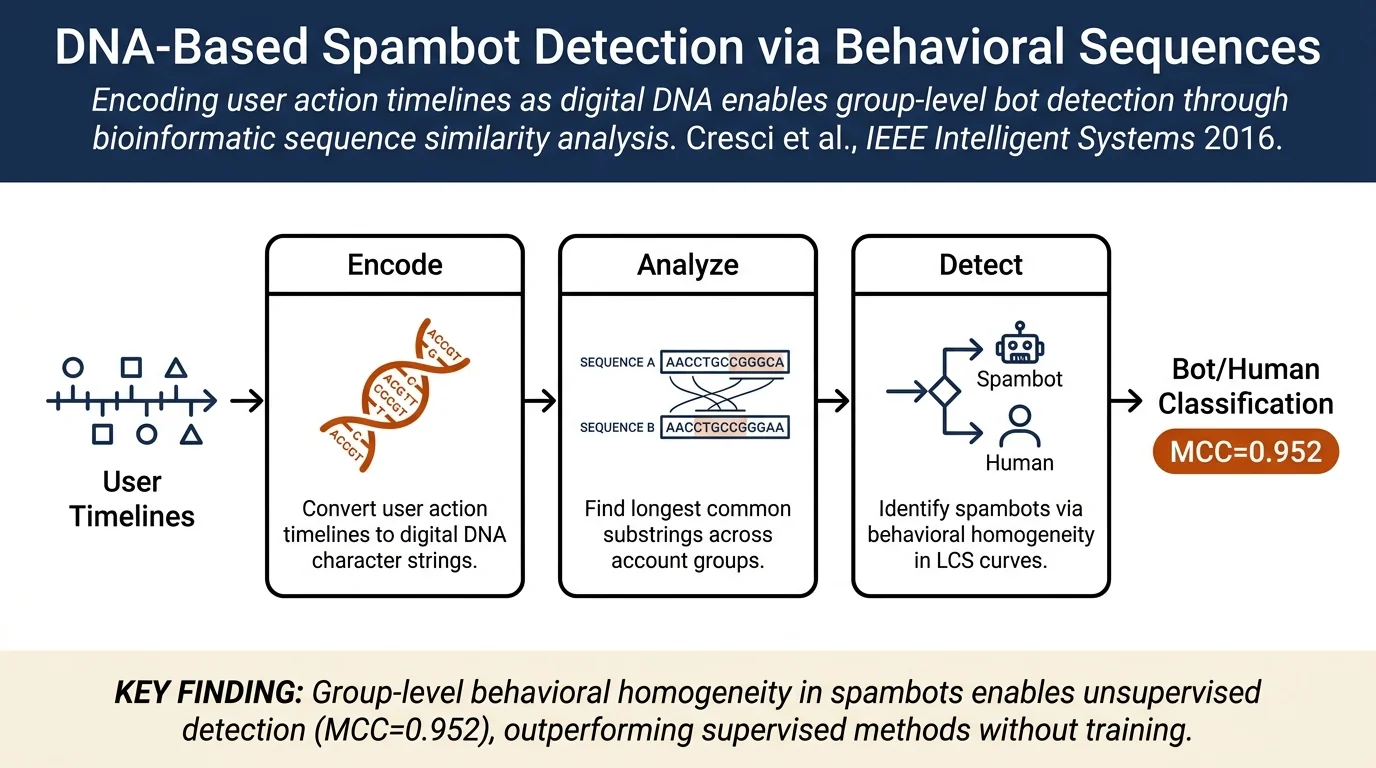
DNA-Inspired Online Behavioral Modeling and Its Application to Spambot DetectionProposes a novel methodology to characterize online user behavior using DNA-inspired digital sequences, where each user action (tweet type, content features) is encoded as a character in a string. Applies standard bioinformatic DNA analysis techniques—specifically longest common substring (LCS) analysis—to detect spambots on Twitter by…
 Spread & networksDetection methods
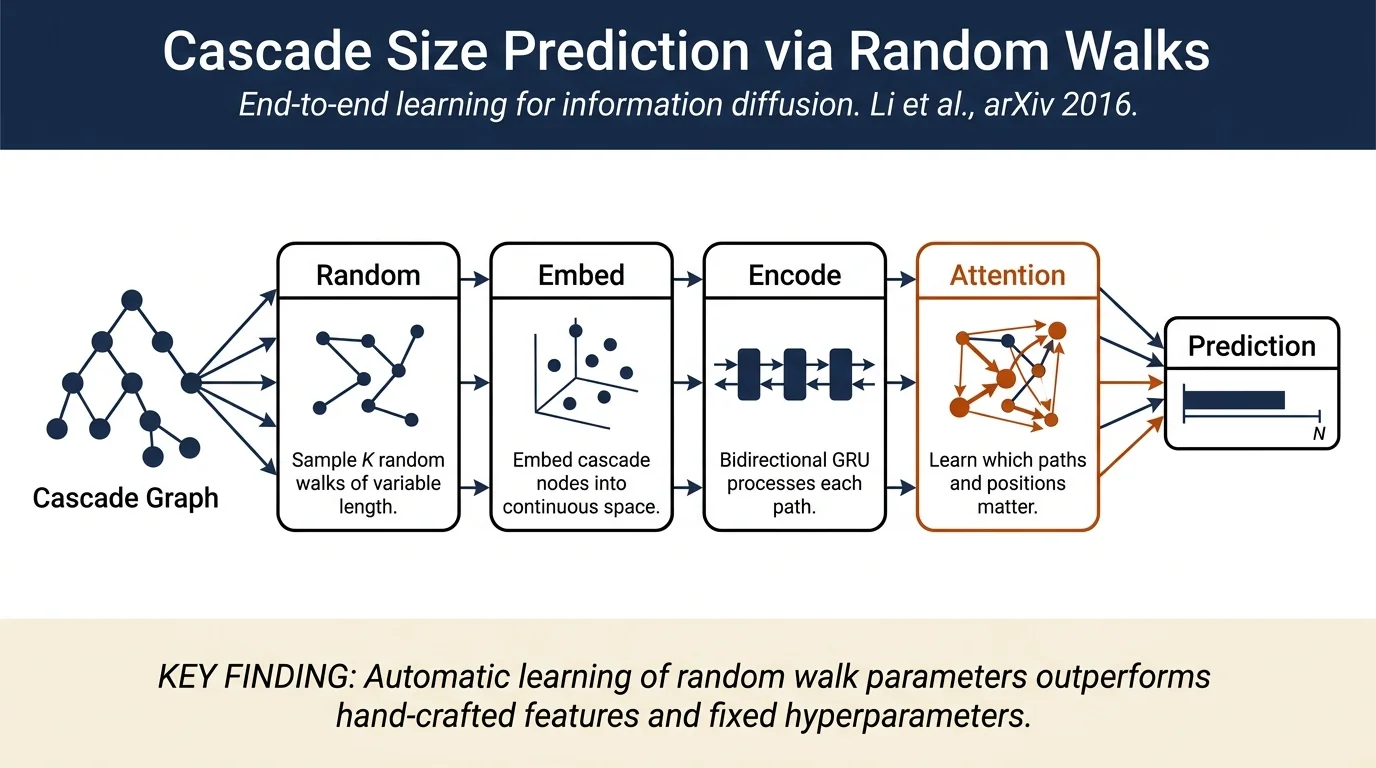
DeepCas: an End-to-end Predictor of Information CascadesDeepCas predicts the future size of information cascades (e.g., how many people will eventually retweet a post or cite a paper) using an end-to-end deep learning model that represents cascade graphs as sets of random walk paths. Instead of relying on hand-crafted network features, the model learns cascade representations automatically…
 Spread & networksDetection methods
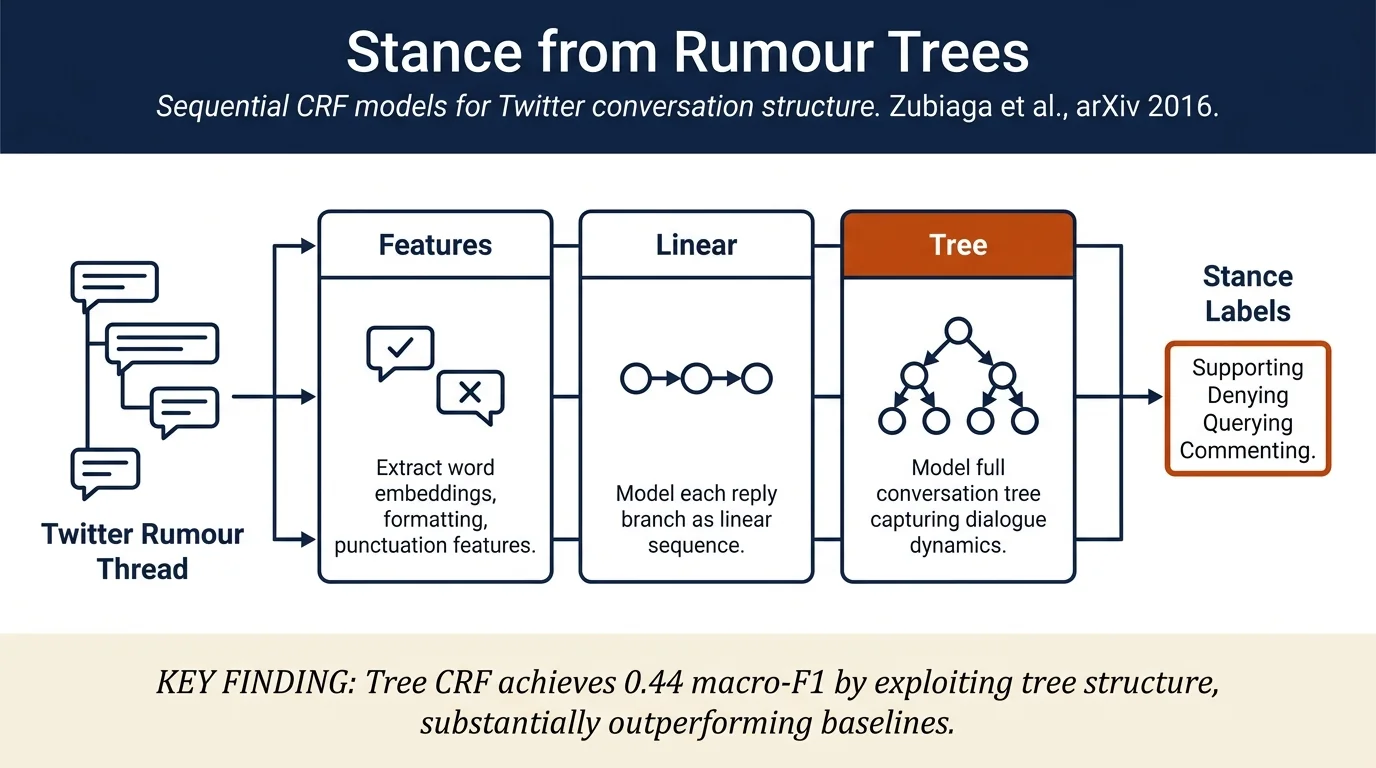
Stance Classification in Rumours as a Sequential Task Exploiting the Tree Structure of Social Media ConversationsProposes that modelling Twitter conversations as tree-structured sequences improves rumour stance classification. Introduces Linear and Tree Conditional Random Fields (CRF) to exploit the sequential structure of replies within rumour threads, showing that Tree CRF significantly outperforms non-sequential baselines on 4,519 annotated…
 Bots & coordinated campaignsDetection methods
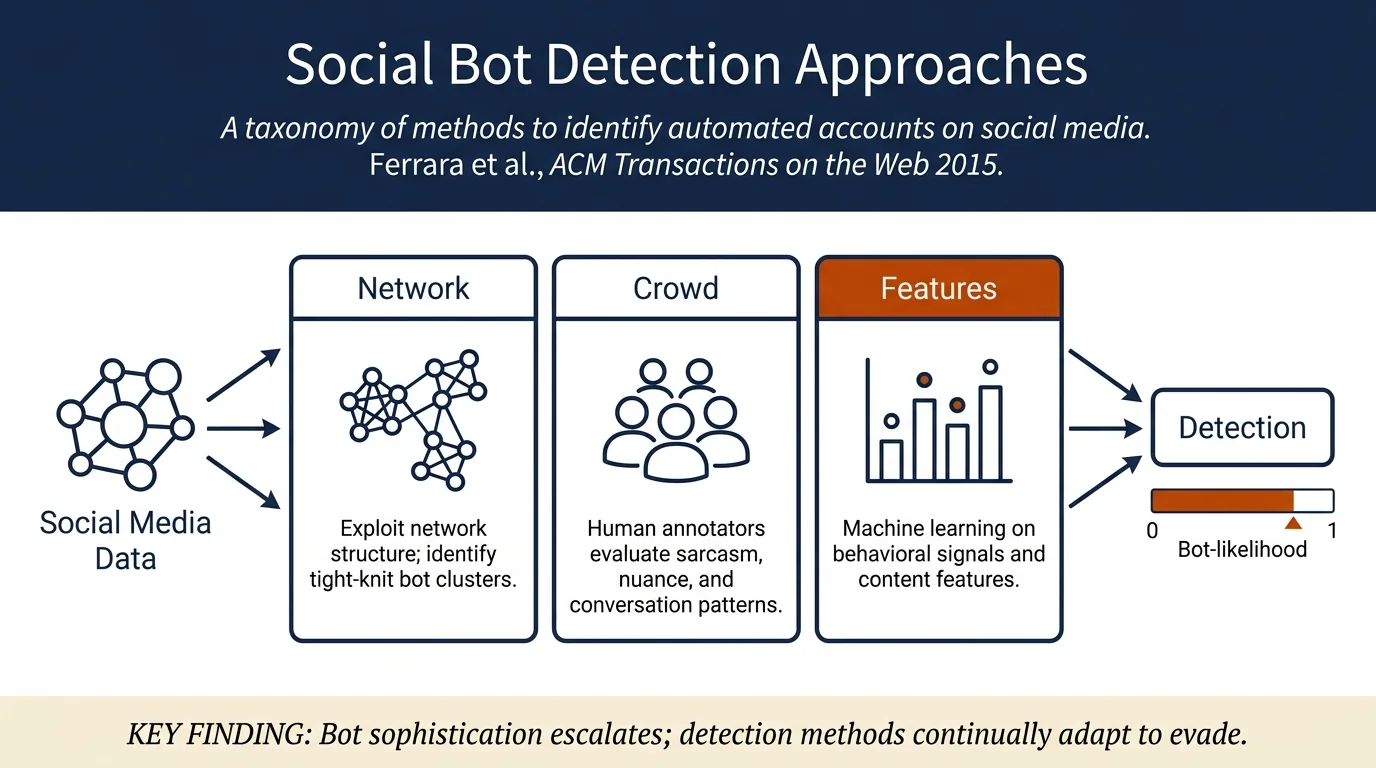
The Rise of Social BotsSocial bots—automated software agents in social media—are increasingly sophisticated and pose real threats including misinformation spread, trend manipulation, and election interference. This paper characterizes modern bot behavior, surveys detection challenges, and proposes a taxonomy of detection approaches: graph-based methods…
 Detection methodsFact-checking & verification
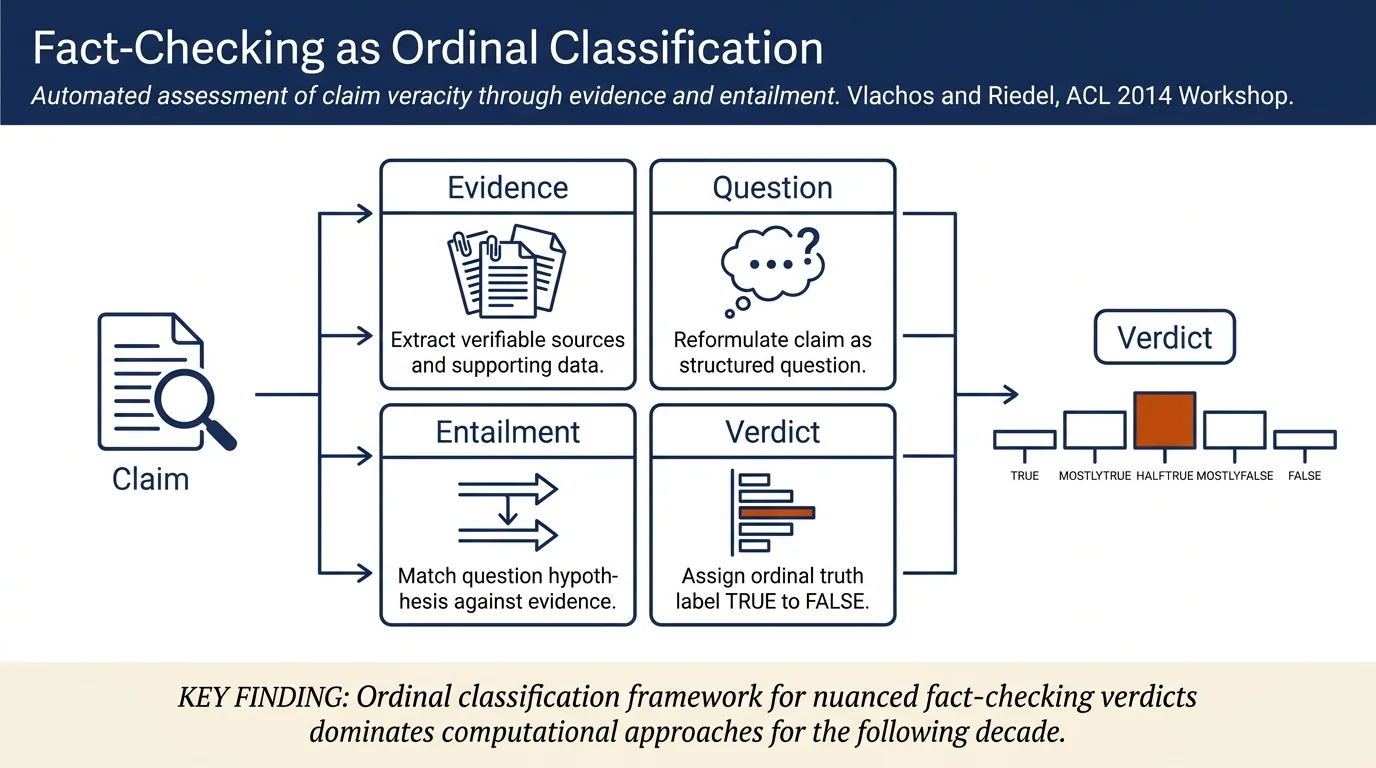
Fact Checking: Task definition and dataset constructionThis paper introduces fact-checking as a formal computational task: assessing the truthfulness of political claims as an ordinal classification problem with five labels (TRUE, MOSTLYTRUE, HALFTRUE, MOSTLYFALSE, FALSE). The authors construct a dataset of 106 objectively-verifiable fact-checked statements from PolitiFact and Channel 4 (out…
 Spread & networksDetection methods
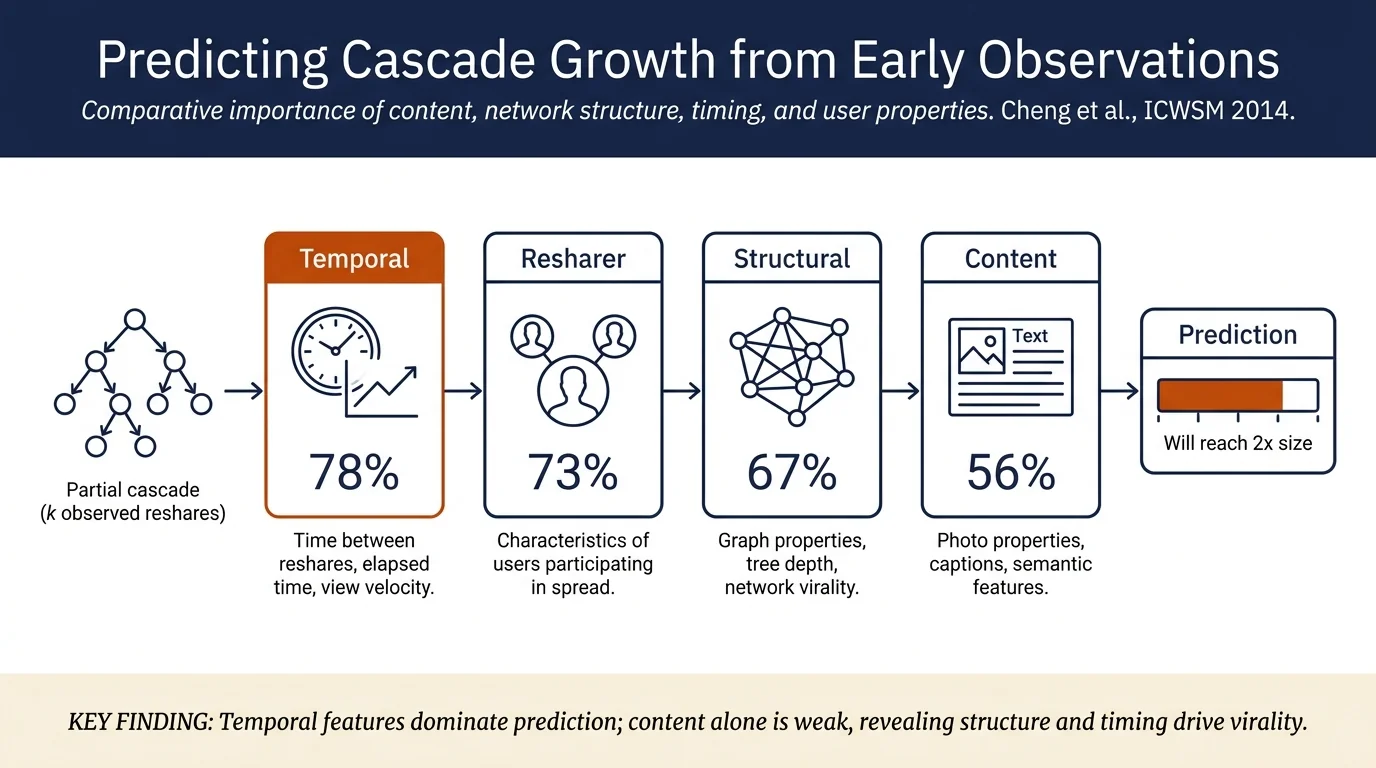
Can Cascades be Predicted?Information cascades on social networks can be predicted with reasonable accuracy (~80%) using temporal and structural features extracted from early observations. Performance improves substantially as more cascade stages are observed.
 Detection methodsSpread & networks
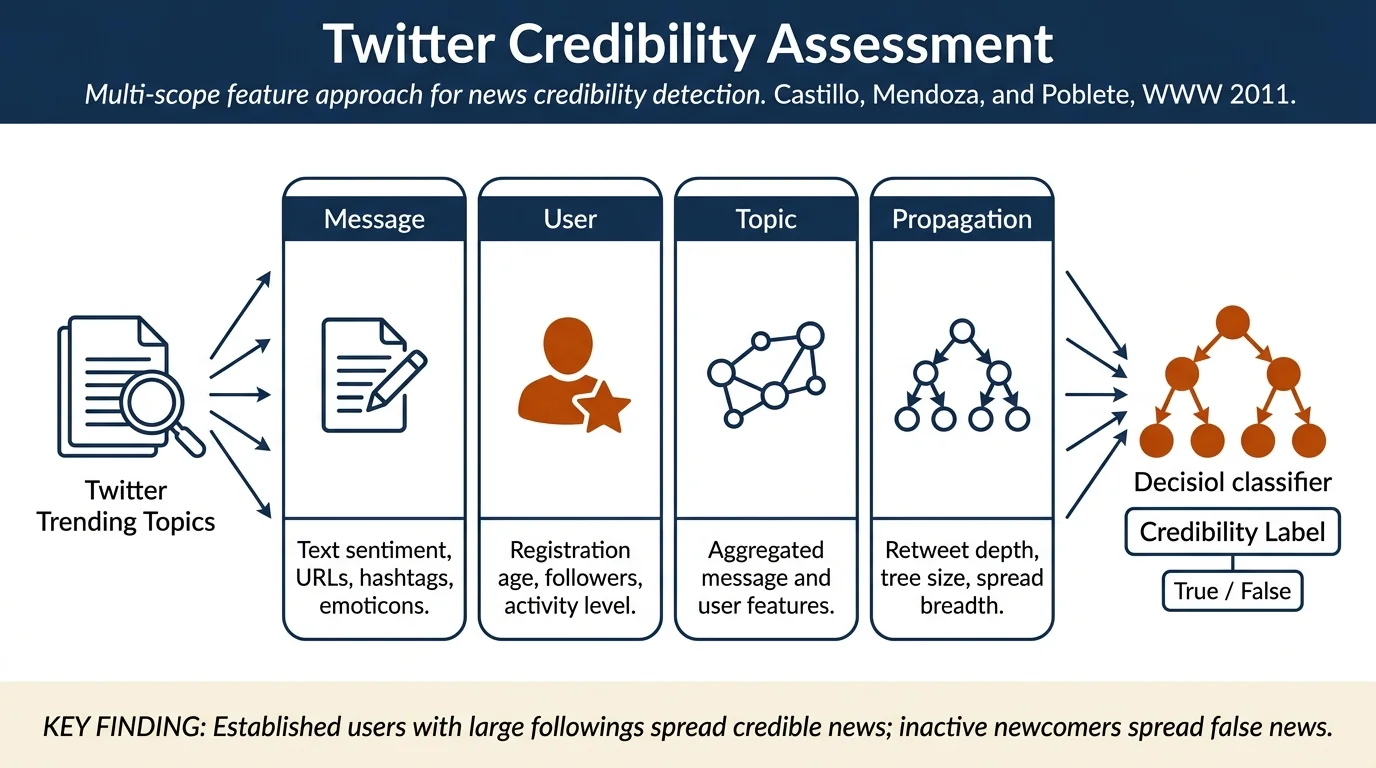
Information Credibility on TwitterThis paper proposes supervised learning classifiers to automatically assess the credibility of news discussed on Twitter. Using human-labeled topics from trending discussions, the authors extract message-level, user-level, topic-level, and propagation-level features to build classifiers that distinguish newsworthy from conversational…
 Psychology & interventionsDetection methods
Why People Fall for MisinformationJoseph Isaac traces how misconceptions persist using the tongue map myth as exemplar: David Hänig's 1901 research found modest taste-sensitivity variations across tongue regions, but through translation barriers, visual simplification, and our preference for clean narratives, it became the false claim that sweetness is imperceptible at…
Detection methodsPlatforms, policy & society
Facts and Myths about MisperceptionsBrendan Nyhan surveys misperceptions in politics, science, and health, analyzing why false beliefs persist and how to counter them. While cognitive limits play a role, the strongest driver of misperceptions is group identity and directional motivation (partisanship) in low-incentive domains.
 Spread & networksDetection methods
Climate Change Misinformation: Supply, Demand, and the Challenges to ScienceLewandowsky examines climate denial through supply and demand lenses: well-funded disinformation campaigns (billions annually from fossil fuel interests and conservative think tanks) deploy cherry-picked data to infiltrate mainstream media and political rhetoric, while political ideology (conservatism, libertarianism) predisposes people…
 Psychology & interventionsPlatforms, policy & society
How to Pre-Bunk Misinformation and DisinformationJon Roozenbeek discusses psychological inoculation as a scalable defense against misinformation. Rather than focusing on veracity (which becomes politically contested), he proposes teaching people to recognize predictable manipulation techniques before encountering false content.
 Psychology & interventionsDetection methods
The Psychology of MisinformationEcker presents evidence that misinformation continues to influence reasoning even after people receive, believe, and remember corrections. Drawing on cognitive psychology, he demonstrates that corrections are only partially effective—typically halving (not eliminating) reliance on misinformation.
 Detection methodsPlatforms, policy & society
Truth DecayTruth Decay—the erosion of reliance on facts and data in policy-making and civil discourse—is not new but cyclically emerges during periods of technological disruption in media. Kavanagh traces this through yellow journalism, radio demagoguery, cable news, and now social media.
 Spread & networksBots & coordinated campaigns
The Spread of Misinformation in Social MediaMenczer presents a framework for understanding misinformation spread through social networks as an inevitable consequence of network structure and human cognitive limitations rather than platform design failures. He discusses how structural properties—scale-free topology, finite attention, information overload—create vulnerabilities…
 Detection methodsPsychology & interventions
From WMDs to the vaccine-autism myth: Understanding misperceptions in politics and health careNyhan presents research on why people hold and resist correcting false beliefs, spanning political misperceptions (Iraq WMDs, Obama birth certificate, death panels) and health misinformation (vaccine-autism link). His core finding is that simple fact-based corrections often fail and sometimes backfire—especially among politically…
 Spread & networksDetection methods
Computational Propaganda and the Lie MachinesPhilip Howard discusses his book The Lie Machines and describes computational propaganda as an industrialized system combining organized disinformation campaigns (social component) with social media algorithms (technical component). He outlines three production stages — creation, dissemination, and long-term marketing — and argues that…
 Psychology & interventionsDetection methods
Towards psychological herd immunity: Cross-cultural prebunking against COVID-19 misinformationJon Roozenbeek presents a cross-cultural randomized controlled trial testing two psychological interventions against COVID-19 misinformation. Comparing the "Go Viral" game (technique-based inoculation) against UNESCO infographics and a Tetris control condition across 1,777 participants in the UK, Germany, and France, he demonstrates that…
 Deepfakes & multimodalDetection methods
The Erosion of Shared Reality in the Age of DeepfakesGenerative AI has moved from nascent to commodity in just 18 months; text-to-image, text-to-video, and real-time interactive deepfakes are now trivial to create. Humans are bad at detecting them (performing ~60% accuracy on trained tasks vs. 50% chance).