 Stephan Lewandowsky
 Sander van der Linden
Contributions
- Revival of inoculation for the digital age. Applies mid-20th-century psychological theory to modern misinformation environments, arguing that the spread of false information online resembles viral transmission and inoculation offers a scalable "vaccine" approach.
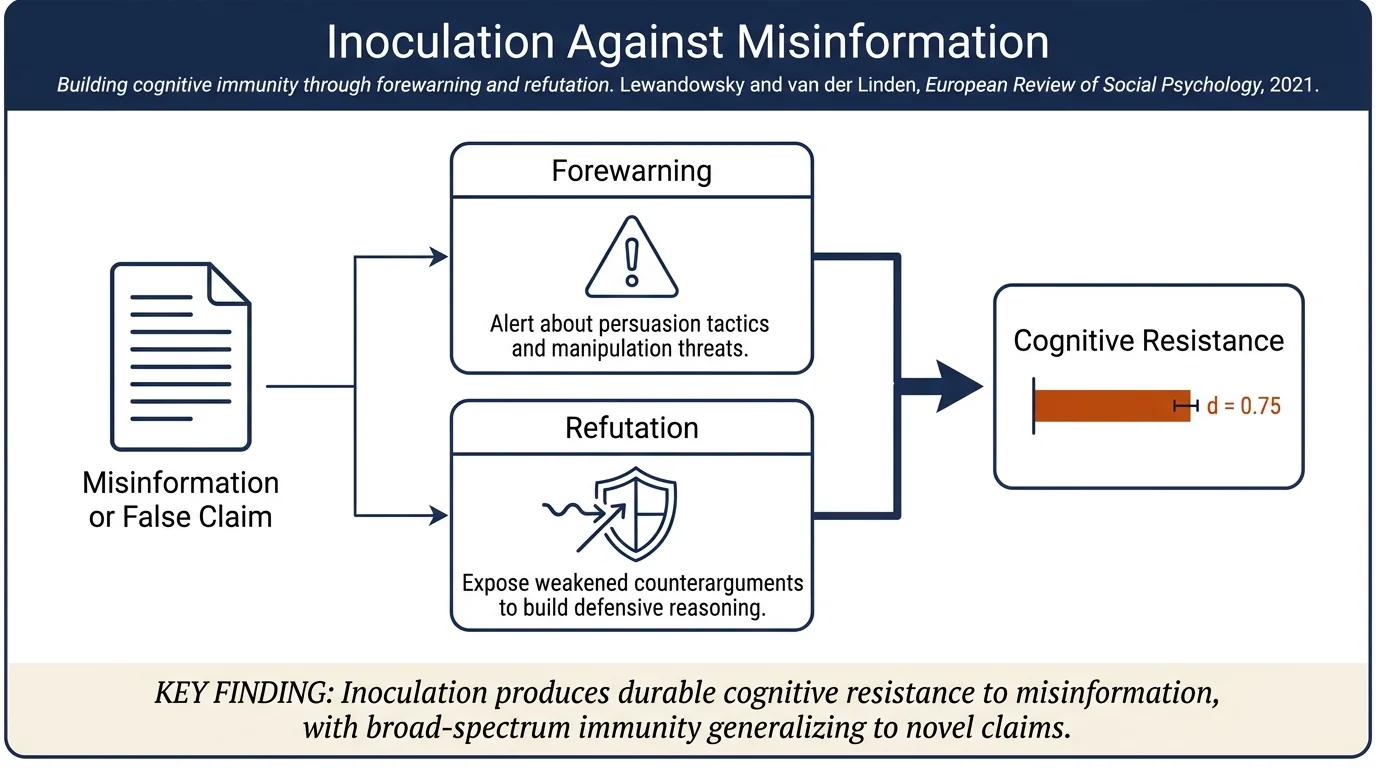
- Distinction of two core mechanisms. Inoculation consists of a forewarning (activating threat and motivating resistance) plus refutational preemption (providing weakened counterarguments and defensive reasoning).
- Meta-analytic evidence. Synthesizes over 50 years of research showing inoculation produces effect sizes of d ≈ 0.43 across domains, with full inoculation (d ≈ 0.75) more effective than warnings alone (d ≈ 0.33).
- From narrow to broad-spectrum immunity. Demonstrates that inoculation against specific arguments (e.g., the "fake experts" tobacco industry tactic) can generalize to other false claims on the same issue, and that teaching about manipulation techniques (rather than content) produces resistance to novel misinformation.
- Application to contested issues. Shows inoculation works not only on low-salience topics (tooth brushing) but on polarized, high-stakes issues: climate change, vaccines, COVID-19, political claims, and conspiracy theories — with effects robust across political ideologies.
- Limitations and open questions. Identifies three challenges in scaling inoculation: (1) causal alternatives may not exist or may carry ideological baggage, (2) skepticism of the correction source itself may undermine acceptance, (3) inoculation framing can inadvertently redirect attention to the false claim itself.
Method
The paper reviews existing experimental literature on inoculation theory and presents new data from an online study on climate misinformation. In the climate experiment (N=2,167), participants were randomly assigned to one of five conditions: scientific consensus information alone, misinformation alone, misinformation followed by scientific consensus (false-balance condition), brief inoculation (warning that politically motivated groups use misleading tactics), or full inoculation (warning + explanation of the "fake experts" tactic with evidence that the 97% consensus petition comprised many non-experts). Participants reported attitudinal beliefs pre- and post-exposure.
The paper also reviews case studies of inoculation applied to: the "Global Warming Petition Project" (fake-expert attack on climate consensus), astroturfing and coordinated disinformation (e.g., pro-Russian comments on social media), radicalization and extremist rhetoric, and political misinformation during elections.
Results
Climate experiment: Both inoculation conditions were effective. Forewarning alone (d = 0.33) and full inoculation (d = 0.75) both reduced the persuasiveness of the misinformation attack. Strikingly, inoculation was nearly equally effective regardless of participants' prior attitudes (positive, neutral, or negative toward climate change), showing political ideology did not eliminate the protective effect.
Generalization: Teaching about the "fake experts" tactic reduced receptivity not only to the specific petition attack but also to other climate misinformation, suggesting cross-protection or "broad-spectrum" immunity.
Conspiracy theories: Jolleys & Douglas (2017) and subsequent work showed inoculation reduced belief in anti-vaccination conspiracies and 9/11 conspiracy narratives. A 2021 study showed inoculation against extremist rhetoric (using weakened versions of radicalization arguments) reduced endorsement of violent extremism compared to a no-treatment control.
Persistence: Inoculation effects persisted for up to two weeks post-exposure in at least one study, though the exact durability remains an open question for real-world deployment.
Notes
Strengths:
- Timely synthesis bridging decades of psychological theory to contemporary information challenges.
- Meta-analytic backing over a large literature gives the effect-size claims credibility.
- Honest about limitations: the paper does not claim inoculation is a panacea. It acknowledges three genuine barriers to scaling inoculation in the wild (lack of causal alternatives, source credibility, and attention-to-the-falsehood).
- Demonstrates robustness across multiple contested domains and political ideologies, strengthening generalizability.
- Clear distinction between specific-issue inoculation and broad-spectrum techniques (e.g., teaching about rhetorical tricks) is actionable.
Weaknesses:
- Durability in real-world settings remains understudied. Laboratory inoculation effects persist weeks; real-world effectiveness and decay rates are unknown.
- Most studies are online experiments with self-selected samples, which may not generalize to vulnerable populations (elderly, low-literacy, highly partisan echo chambers).
- The paper does not deeply explore the mechanics of when inoculation fails — e.g., when are causal alternatives too plausible or too politically loaded to dismiss?
- Limited discussion of the interaction between inoculation and repeated exposure to misinformation. Does a single inoculation withstand bombardment?
Open questions:
- How can inoculation be deployed at scale without triggering the "don't think about the elephant" paradox — where mentioning a false claim increases its spread?
- What is the optimal timing for inoculation (before, shortly before, or weeks before exposure to misinformation)?
- Does inoculation against one class of manipulation (e.g., emotional framing) confer immunity to unrelated misinformation tactics?