 Briony Swire-Thompson
 David Lazer
Contributions
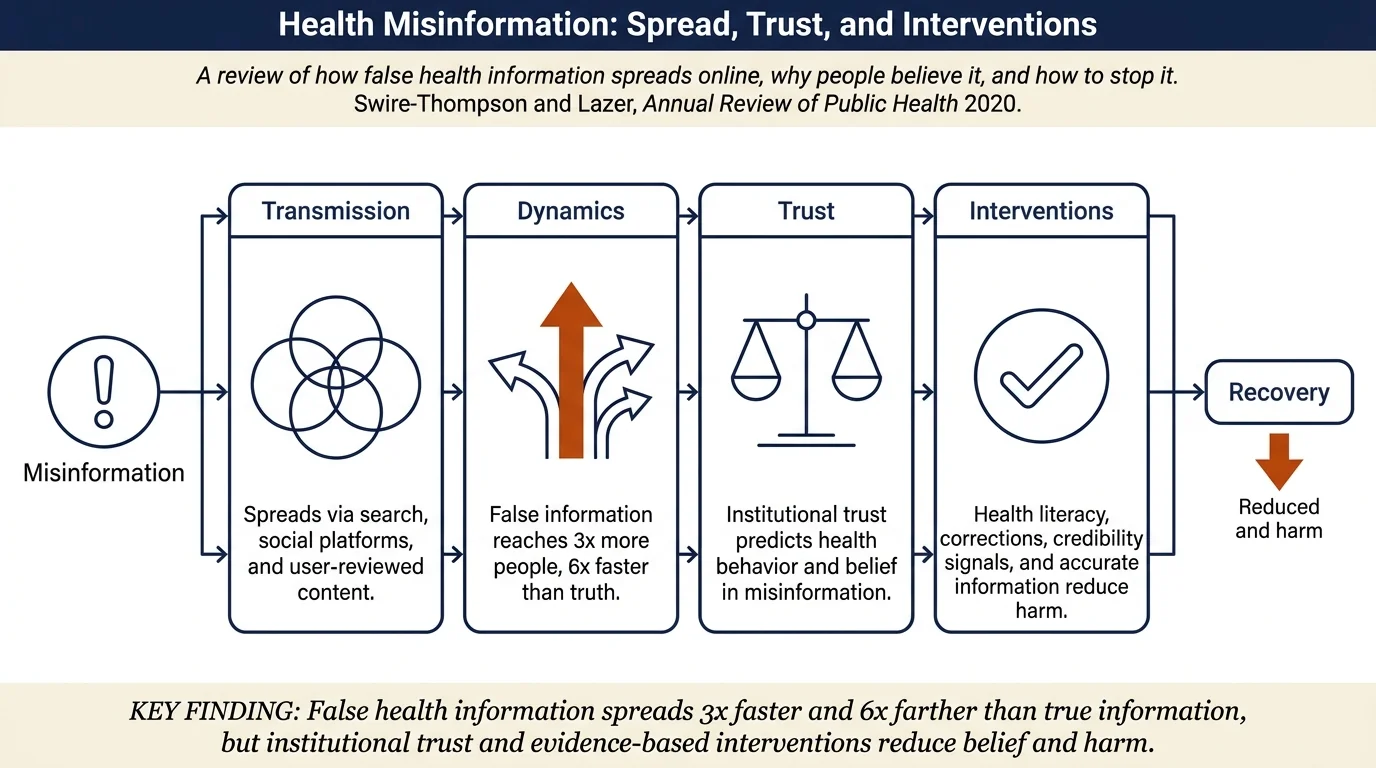
The review synthesizes knowledge across five core dimensions:
-
How individuals engage with health misinformation online — via search engines (with confirmation bias), user-generated content platforms (Wikipedia, WebMD, Amazon reviews), mobile apps with limited regulation, and social media.
-
Epidemiology of misinformation spread on social networks — false health information diffuses faster, deeper, and farther than true information on Twitter; echo chambers amplify vaccine hesitancy; major social media platforms remain understudied for misinformation pathology.
-
Who spreads health misinformation — political polarization correlates with health misinformation sharing; demographics (age, education, income) predict engagement; corporations and vested interests amplify misinformation; a small fraction of accounts and influencers drive large cascades.
-
Institutional trust as a mediator — trust in science, government, media, and health professionals predicts health behavior (vaccination, medication adherence, disease precautions); trust in institutions has declined, with partisan divides; trustworthiness (perception of honest intent) often outweighs expertise in persuasion.
-
Evidence-based interventions — improved health literacy, physician-patient collaboration, stronger source credibility signals, creation of accurate information, technological tools, and repeated corrective messaging. Most interventions remain understudied for long-term effect.
Method
Literature review synthesizing published research on health-seeking behavior, misinformation epidemiology, institutional trust, and intervention efficacy. The authors identify gaps and propose research priorities across multiple disciplines (epidemiology, psychology, communication, network science).
Key Claims and Evidence
Quality of online health information is often poor. Eysenbach et al. (2002) meta-analysis of 79 studies found 70% concluded quality was a problem. WebMD user reviews of apricot kernels for cancer averaged 4.6/5 effectiveness despite no scientific support. Mobile health apps rarely align with clinical guidelines; only 32% of cancer information apps contained scientifically valid content.
False information spreads faster and farther. Vosoughi et al. (2015) tracked 126,000 rumors on Twitter and found false rumors spread to 3x more individuals and reached those individuals 6x faster than true rumors. False information evoked more disgust, fear, and surprise — emotions that increase sharing.
Institutional trust predicts health behavior. In 2015, only 19% of Americans trusted the federal government's CDC; in 2016, 35% trust in media dropped to a 40-year low. High trust in science correlates with vaccine acceptance and medication adherence; trust in physicians remains high (84% of respondents report confidence in medical scientists), yet anti-vaccine echo chambers on Facebook are highly interconnected and separate from mainstream communities.
Health misinformation causes measurable harm. Croce et al. (2015) systematic review of 1,512 abstracts found only 3 articles reporting actual harm; however, Johnson et al. found a hazard ratio of 2.50 for colorectal cancer patients using alternative medicine alone versus conventional treatment. The MMR-autism link, refuted decades ago, continues to reduce vaccination rates and has triggered measles outbreaks (Albania, Czech Republic, Greece, United Kingdom in 2018–19).
People are resilient to correction. When presented with factual corrections, belief in misinformation decreases; backfire effects are rare. The problem is frequency — people do not remember where information came from, so misinformation continues to influence reasoning even after correction.
Recommendations for Interventions
-
Improved eHealth literacy — teach critical thinking about online health sources; mixed evidence for school-based programs but promising for targeted adult populations.
-
Physician-patient collaboration — online resources can help patients prepare for doctor visits and improve decision-making when framed collaboratively, not paternalistically.
-
Stronger source credibility signals — tools like NewsGuard (green-red ratings) and verified credentials on platforms; health mobile apps should require and display author credentials and supporting evidence.
-
Creation and dissemination of accurate information — scientists publishing in open access, collaborating with media and journalists, editing Wikipedia articles on health topics, contributing to social media platforms directly.
-
Increased frequency of corrections — repetition of corrective messaging reduces the influence effect of misinformation; particularly effective during breaking news and crises.
-
Technological advances — tools that help sort reputable from disreputable sources; real-time health advice from professionals; rapid detection and labeling of vaccine misinformation.
Notes
This review is comprehensive and covers both the breadth of health misinformation (search, social media, apps, user-generated content) and depth of institutional mechanisms (trust, echo chambers, demographics). A key strength is the explicit harm framing — the authors ground their argument in mortality data (MMR vaccination declines, alternative cancer therapies) rather than treating misinformation as an abstract information problem.
The intervention section is somewhat limited by sparse evidence: most proposed strategies (health literacy programs, physician collaboration) lack rigorous long-term evaluation. The authors correctly note that most research has focused on political rather than health misinformation, and many findings may not transfer. The review predates the COVID-19 pandemic and rapid rise of visual misinformation; it remains highly relevant but would benefit from updates on TikTok, visual deepfakes, and vaccine disinformation dynamics post-2020.
The framing of trust — distinguishing between trustworthiness (perceived benevolence) and expertise — is underexplored in misinformation research and merits deeper treatment.