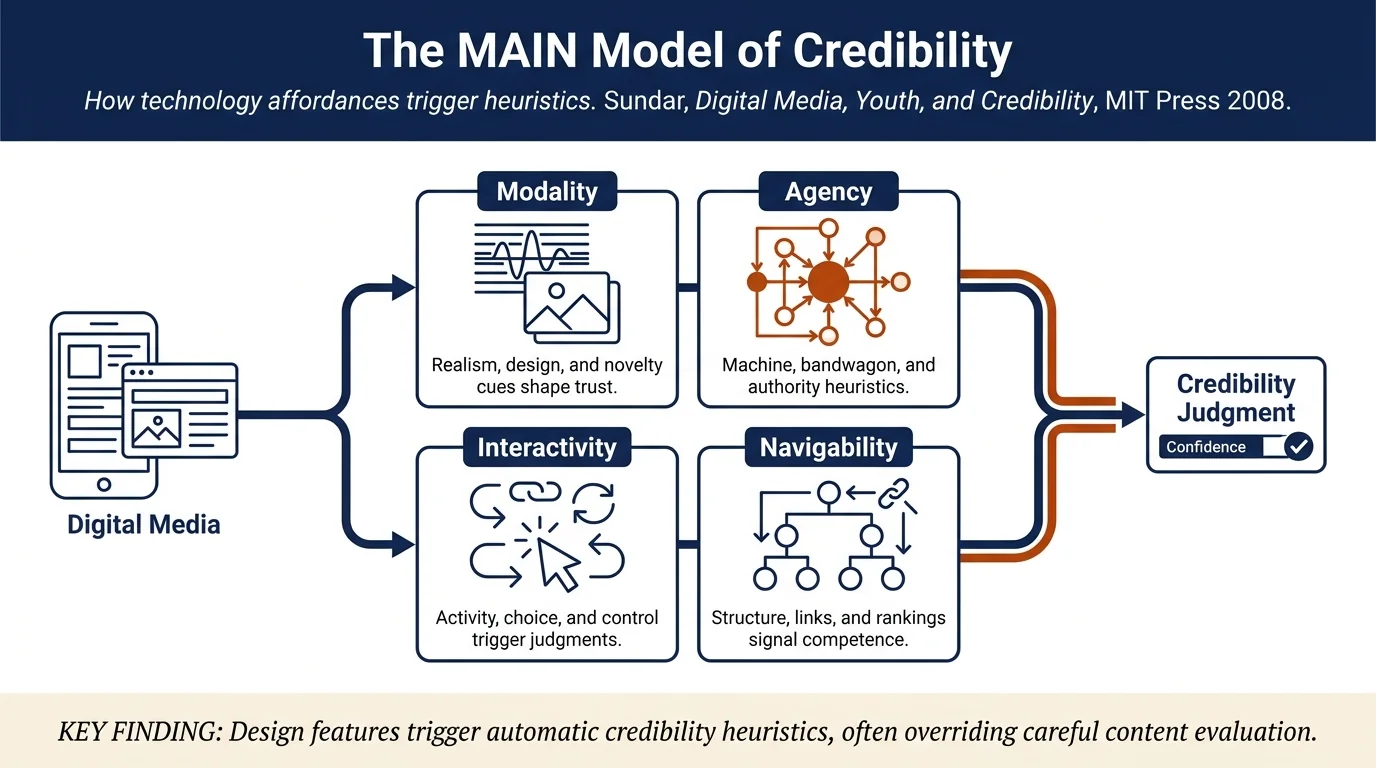
Heuristics are mental shortcuts—judgment rules that people apply rapidly and often unconsciously to evaluate the credibility and trustworthiness of information and sources. Rather than systematically analyzing all available evidence, people rely on heuristics to make efficient decisions under time pressure, cognitive load, and information abundance. In credibility assessment, heuristics are triggered by salient cues in the information environment (e.g., source identity, design features, social endorsements) and lead to quick judgments.
Role in misinformation vulnerability
Heuristics are both adaptive and risky. They enable rapid decision-making in complex environments but are exploited by misinformation and disinformation: false claims succeed by triggering credibility heuristics (impersonating trusted sources, gaining social endorsement, achieving professional-looking presentation) rather than through superior content quality. Understanding which heuristics people activate, when, and why is essential to designing interventions that promote accurate information evaluation.
Common credibility heuristics
Source-based heuristics:
- Authority heuristic: "If an expert or official source said it, it must be true." Triggered by credentials, titles, organizational affiliation.
- Expertise heuristic: "If the source has specialized knowledge, their claims are credible." Triggered by credentials, prior track record, field alignment.
- Machine heuristic: "If a machine (algorithm, automation) selected or endorsed it, it must be objective." Triggered by algorithmic recommendations, automated curation.
- Bandwagon heuristic: "If many others like or endorse it, it must be good." Triggered by popularity metrics, collaborative filtering, social proof.
- Social presence heuristic: "If the source exhibits human or social qualities, it is trustworthy." Triggered by anthropomorphic design, conversational tone, perceived benevolence.
- Helper heuristic: "If a system is designed to assist me, it must be benevolent." Triggered by customization, support features, user-centered design.
- Identity heuristic: "If I see myself reflected in the system or content, I trust it more." Triggered by personalization, identity signals, in-group markers.
Message-based heuristics:
- Realism heuristic: "If the message is presented in an audiovisual (more lifelike) modality, it is more credible." Triggered by multimodal content, high production quality, perceptual bandwidth.
- Bells and whistles heuristic: "If the presentation includes aesthetic features and advanced design, it is more credible." Triggered by animations, visual polish, technological sophistication.
- Novelty heuristic: "If the technology or presentation is novel or cutting-edge, it is more credible." Triggered by new modalities, innovative interfaces, immersive experiences.
- Distraction heuristic: "If I am cognitively overloaded by the presentation, I am less likely to scrutinize the content." Triggered by multimodal overload, rapid scene changes, intrusive elements.
- Intrusiveness heuristic: "If the presentation feels intrusive or disruptive, I judge it as less credible." Triggered by pop-ups, autoplay, aggressive advertising.
Navigation and interaction-based heuristics:
- Interaction heuristic: "If a system allows me to interact with it and specify my needs, it is more responsive and credible." Triggered by customization options, choice, control mechanisms.
- Activity heuristic: "If a site shows dynamism and frequent updates, it is actively maintained and trustworthy." Triggered by animation, change, freshness cues.
- Choice heuristic: "If I have options to refine content, the resulting specificity indicates credibility." Triggered by menus, search results, filtering options.
- Flow heuristic: "If interaction is smooth and seamless, the system is well-designed and credible." Triggered by responsive interfaces, lack of lag, coherent navigation.
- Contingency heuristic: "If messages reflect mutual exchange and dialogue, the interaction is genuine and credible." Triggered by threading, conversational turn-taking, responsive chat.
- Own-ness heuristic: "If I have customized or personalized something, I attribute credibility to that system or content." Triggered by personalization, user-generated contributions, ownership signals.
- Scaffolding heuristic: "If the interface structure reduces cognitive load and guides me through information, it is credible." Triggered by hierarchical organization, clear pathways, reduced complexity.
- Play heuristic: "If engaging with content feels playful or enjoyable, I transfer that positive affect to credibility judgments." Triggered by game-like elements, levity, low-stress interaction.
- Browsing heuristic: "If a site's navigation is well-organized and easy to browse, the information is credible." Triggered by navigation quality, information architecture, link density.
- Elaboration heuristic: "If a site offers detailed, layered information, it signals expertise." Triggered by depth of content, multi-level detail, comprehensive coverage.
- Prominence heuristic: "If a result or link appears first in a search or at the top of a list, it is relevant and credible." Triggered by ranking, prominence placement, priority signals.
- Similarity heuristic: "If a search result or recommendation matches my interests or values, I trust it." Triggered by relevance ranking, personalized recommendations, alignment.
Modulation by context and individual differences
The strength and direction of heuristic effects depend on:
- Cognitive load: Under time pressure or information overload, people rely more on heuristics. With ample time and motivation, they may engage in more systematic evaluation.
- Domain expertise: Experts may ignore surface heuristics and rely on content knowledge. Novices rely more heavily on design and source cues.
- Motivation and goals: People seeking entertainment may prioritize flow and novelty; those seeking health information may prioritize expertise and authority.
- Age and cognitive development: Youth and those with lower cognitive sophistication are more susceptible to heuristic processing; adolescents and adults with strong media literacy may consciously override heuristics.
- Digital literacy: Media-savvy users may be aware of heuristic triggers and discount design-based cues; naive users may be unaware of which cues should matter.
- Individual differences: Need for cognition (tendency to engage in thinking), openness to experience, and trust disposition all predict which heuristics people activate.
Key papers
- The MAIN Model: A Heuristic Approach to Understanding Technology Effects on Credibility — Canonical framework (MAIN model) cataloging four classes of technological affordances and the specific heuristics each class triggers in credibility assessment
- Digital Media, Youth, and Credibility — Foundational volume integrating cognitive and communication perspectives on credibility heuristics in youth; identifies how heuristics evolve with development
- Metzger & Flanagin (2013) — Systematic survey of heuristics people employ during online credibility evaluation; catalogs reputation, endorsement, consistency, self-confirmation, expectancy-violation, and persuasive-intent heuristics
- College Students' Credibility Judgments in the Information-Seeking Process — Empirical study showing college students employ heuristic evaluation strategies (trust in familiar sources, verification via cross-referencing) under real-world information-seeking constraints
- The Special Case of Youth and Digital Information Credibility — Detailed empirical study identifying three credibility evaluation strategies (analytic, heuristic, social) among 2,747 youth; shows heuristic processing increases under time pressure and cognitive load
Connections
- Credibility assessment for fake news detection — credibility heuristics are central mechanisms by which people evaluate information
- Source Credibility — many heuristics are triggered by source identity and reputation signals
- Media literacy — teaching people to recognize and consciously override problematic heuristics
- Psychological susceptibility to misinformation — individual and developmental factors that modulate heuristic reliance
- Misinformation spread and diffusion — false claims exploit credibility heuristics to gain acceptance
- Fact-checking and corrections — fact-checkers must understand which heuristics lay audiences activate in order to design effective corrections