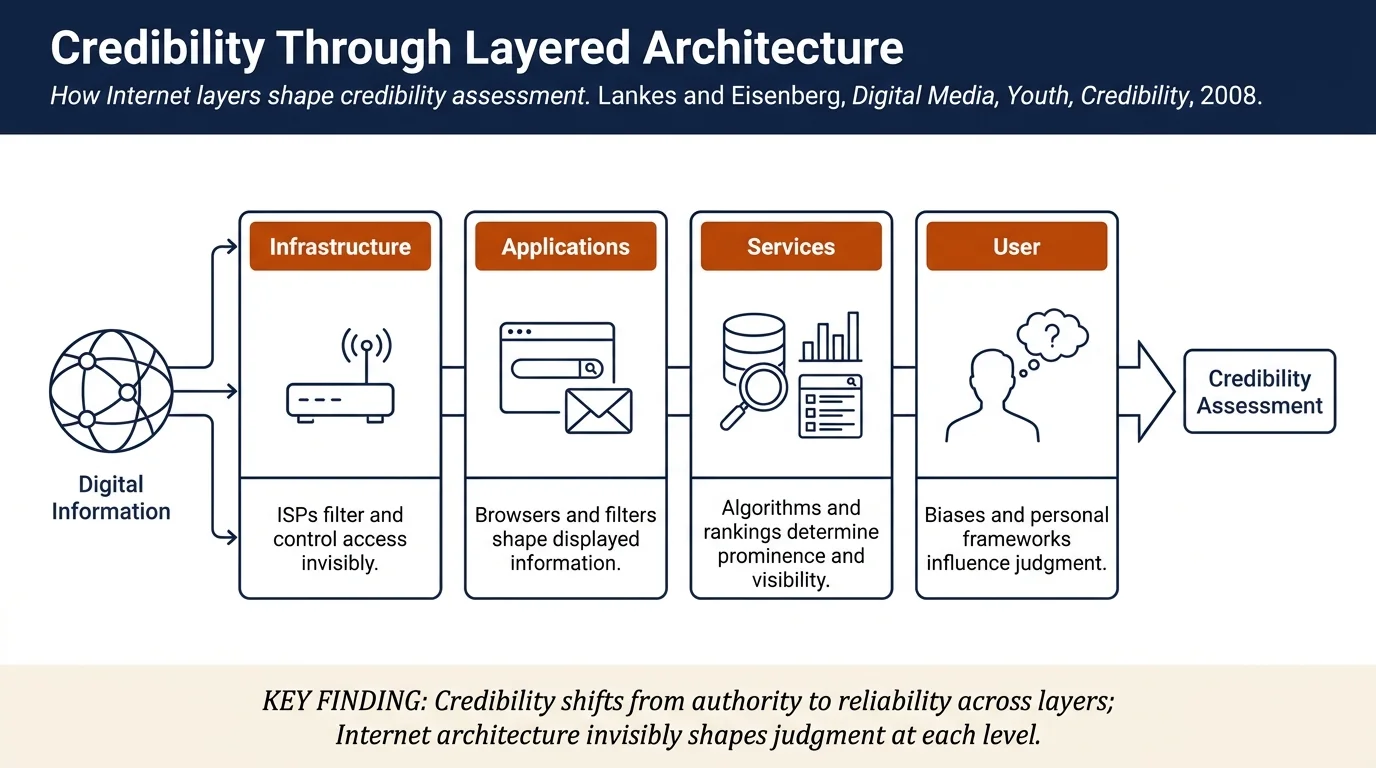
Information self-sufficiency refers to the growing trend where individuals—particularly youth—are expected to independently determine the credibility and usefulness of information they encounter, without relying on traditional institutional gatekeepers (libraries, publishers, editors, trusted authorities). This shift accompanies an increasing reliance on digital tools, search engines, and information services that mediate what information is accessible and how it is presented.
The paradox
The core insight is a fundamental paradox: as users are simultaneously more independent in their information decision-making and more dependent on the tools and other people's information that enable those decisions.
Increased independence: Users can now:
- Access information directly without institutional intermediaries (books from publishers, articles from journals, advice from professionals)
- Book travel, assess medical information, determine weather, and make financial decisions entirely through self-service online platforms
- Become their own authorities by synthesizing information from multiple sources and deciding credibility individually
Increased dependence: Yet users are dependent on:
- Digital tools that mediate access (browsers, algorithms, search engines)
- Information services and platforms that determine visibility (Google ranking, social media recommendation systems)
- Other people's information and judgments (crowdsourced ratings, social media shares, Wikipedia edits)
- Invisible infrastructure choices (ISP filtering, application design, platform policies)
This creates a tension: users are told they are responsible for their own information decisions, yet the tools and systems that enable those decisions often operate invisibly, constraining what can be evaluated and how.
Implications for credibility assessment
The information self-sufficiency paradox has profound implications for how people assess credibility:
-
Loss of institutional trust signals: When users no longer rely on libraries, editorial gatekeeping, or publisher vetting, they lose traditional credibility cues (institutional affiliation, editorial review, publishing standards). Instead, credibility must be assessed through new mechanisms: consistency across sources, track record, design signals, social proof.
-
Invisible infrastructure shapes judgment: Because much of the information mediation happens invisibly (at the infrastructure or algorithmic layer), users cannot evaluate the systems shaping what they see. For example, they may not realize that search results are ranked by popularity-based metrics rather than accuracy, leading to credibility judgment errors.
-
Conversion from authority to reliability: As institutional authority weakens, credibility assessment must shift toward reliability — assessing whether sources are consistent, dependable, and transparent—rather than simply trusting an authority.
-
Demand for tools and transparency: To genuinely assess credibility when institutions no longer pre-filter information, users need tools that make the information architecture transparent (showing how information is ranked, filtered, recommended) and enable participation (Wikipedia editing, crowdsourced rating, collaborative fact-checking).
In education and policy
The self-sufficiency paradox creates challenges for educators and policymakers:
- Digital literacy paradox: Teaching users to identify misinformation by restricting their access to that information is counterproductive—they need to engage with and scrutinize information to develop true evaluation skills.
- Responsibility without power: Users are told they are responsible for credibility judgment, yet they often lack the technical knowledge and infrastructure access to understand and influence the systems shaping what information is available to them.
- Participation vs. protection: Approaches that protect users by filtering information (content filters in schools, platform content moderation) may paradoxically reduce their long-term ability to evaluate information independently.
Related concepts
- Authority vs. reliability: The shift from trusting a single authority to synthesizing information from multiple sources and assessing consistency.
- Information literacy: The skills and knowledge required to find, evaluate, and use information effectively.
- Platform dependency: The reliance on algorithmic systems and commercial platforms for information access, with attendant risks of manipulation and invisibility.
Key papers
- Trusting the Internet: New Approaches to Credibility Tools — Introduces and elaborates the information self-sufficiency paradox; discusses how the layered architecture of the Internet (infrastructure, applications, services, users) shapes credibility at each layer, often invisibly; proposes transparency and participation as solutions
- Digital Media, Youth, and Credibility — Foundational volume documenting empirical evidence of how youth struggle with the increased responsibility for credibility judgment in digital environments
- Flanagin & Metzger (2008) — Situates the self-sufficiency paradox historically, tracing the evolution from gatekeeping-dependent credibility assessment to user-dependent assessment
Open questions
- How much technical understanding of platform architecture is necessary for users to effectively assess credibility?
- Can platform transparency alone resolve the information self-sufficiency paradox, or is structural change (algorithmic accountability, user control) also necessary?
- What is the developmental trajectory of information self-sufficiency? At what age are youth capable of handling the responsibility and dependency it entails?