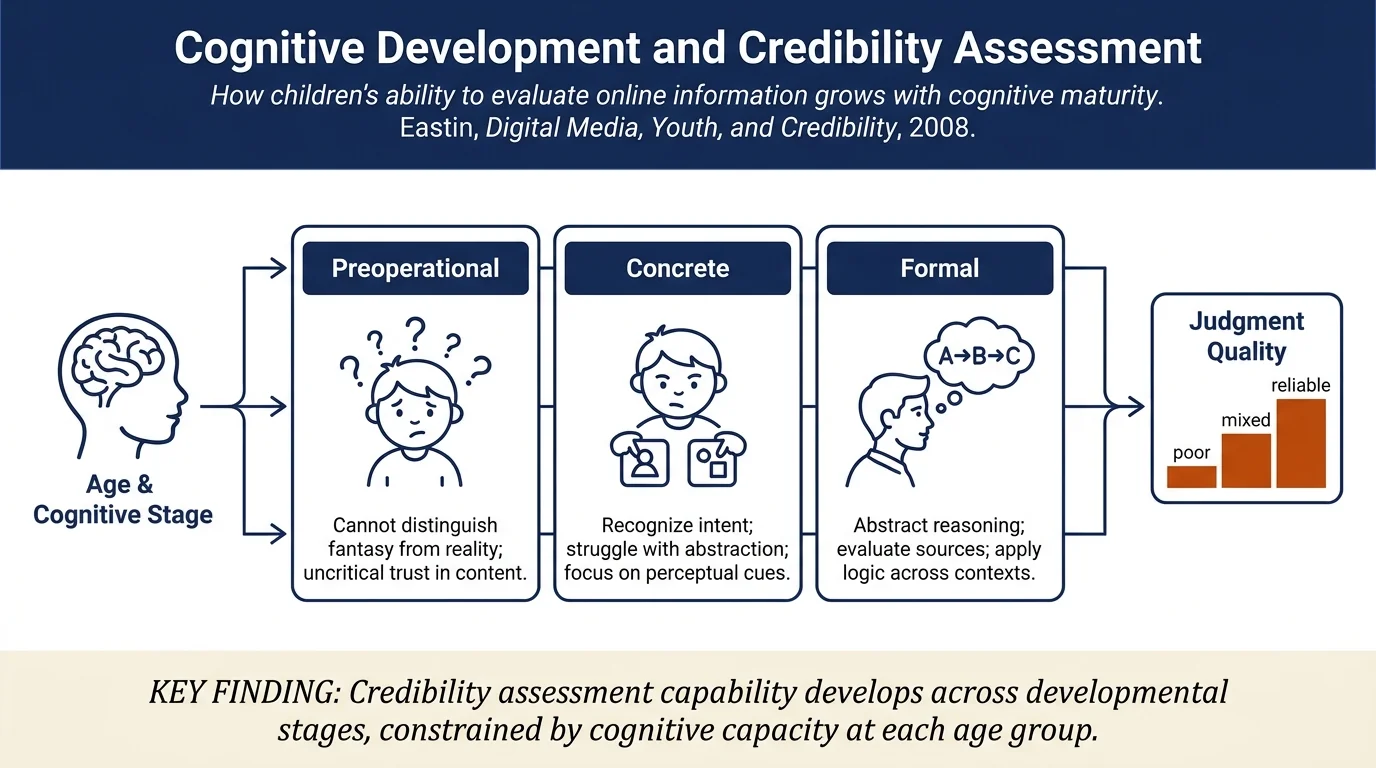
Psychological susceptibility to misinformation refers to individual differences in vulnerability to false claims, driven by cognitive abilities, developmental stage, psychological traits, and contextual factors. Rather than a fixed trait, susceptibility is understood as an interaction between information-processing capacity, prior knowledge and beliefs, motivation to evaluate information critically, and the characteristics of the information environment.
Key dimensions
Cognitive development: Age and cognitive maturity strongly predict the ability to evaluate information critically. Children in earlier cognitive stages (preoperational, concrete operational) have systematic limitations in abstracting inference, distinguishing appearance from reality, and organizing multiple information cues simultaneously. These limitations are not deficits but normal developmental constraints that resolve with cognitive maturation.
Information-processing capacity: The Limited Capacity Model identifies finite cognitive resources for encoding, storing, and retrieving information. Younger children and individuals under cognitive load rely on quick heuristics—perceptually salient cues, familiar sources, emotionally resonant messages—rather than systematic evaluation. Online environments often exceed available capacity through information density, multimedia, and advertising.
Prior knowledge and belief structures: People assimilate new information into existing mental schemas. Strong prior beliefs can protect against contradictory information or amplify susceptibility depending on how new information is framed. Belief perseverance and the backfire effect describe how corrections can fail or even strengthen false beliefs when individuals lack adequate prior knowledge to evaluate evidence quality.
Motivation and cognitive style: Cognitive traits like need for cognition (motivation to engage in effortful thinking), cognitive flexibility, and openness to experience predict analytical evaluation strategies. Individuals with higher analytic thinking are more resistant to misinformation, though this relationship is moderated by domain knowledge. Motivated reasoning—the tendency to rationalize information consistent with preferred conclusions—can undermine even motivated thinkers when stakes are high.
Comparative optimism bias: People typically overestimate their own ability relative to others when evaluating information. Comparative optimism about media literacy and credibility evaluation skill is associated with fewer analytical evaluation strategies and greater reliance on heuristics, suggesting that overconfidence about one's own media literacy can paradoxically increase vulnerability.
Role in misinformation spread
Psychological susceptibility is not "gullibility" or stupidity. Rather, susceptibility emerges from normal cognitive processes operating under constraints. Misinformation campaigns succeed by:
- Targeting developmental stages: Young children's inability to distinguish fantasy from advertising reality; preoperational children's egocentrism and difficulty with perspective-taking; concrete-operational children's struggle with abstraction and multimodal reasoning.
- Exploiting cognitive load: Complex environments with dynamic content, advertising, and multimedia overwhelm working memory, forcing reliance on surface heuristics (bright colors, familiarity, emotional arousal).
- Leveraging prior beliefs: Misinformation that aligns with existing beliefs encounters less scrutiny; corrections threaten identity and can trigger defensive responding.
- Using affective triggers: Outrage, fear, and moral emotion impair deliberative evaluation and promote rapid sharing.
Understanding susceptibility is essential for designing interventions. Blanket "media literacy" instruction that ignores developmental stage and cognitive constraints will fail or backfire; interventions must match cognitive capacity and address actual decision-making contexts.
Key papers
- Eastin (2008) — Toward a Cognitive Developmental Approach to Youth Perceptions of Credibility — Foundational application of Piaget's theory to online credibility judgment; demonstrates age-graded cognitive limitations in evaluating source expertise, distinguishing advertising from content, and organizing multiple information cues; proposes developmentally-appropriate interventions
- Digital Media, Youth, and Credibility — Edited volume integrating cognitive science, communication theory, and educational perspectives on youth vulnerability to misinformation; chapters cover how cognitive development, technology design, and information-processing limitations shape credibility assessment
- Metzger, Flanagin & Nekmat (2015) — Empirical survey documenting comparative optimism bias in children's self-assessment of credibility evaluation skill; reveals that overconfidence about media literacy predicts fewer analytical strategies, suggesting overconfidence increases vulnerability
- Metzger et al. (2015) — Large survey revealing that credibility training paradoxically increases both correct strategies and hoax susceptibility, suggesting that instruction without metacognitive grounding increases vulnerability to surface-level manipulation
Related topics
- Credibility assessment for fake news detection — how individuals evaluate information
- Media literacy — educational interventions to reduce susceptibility
- psychological factors — personality and cognitive traits
- Belief formation and epistemology — how false beliefs form and persist
Open questions
- How do developmental stages interact with cultural and educational background to shape misinformation susceptibility?
- Can comparative optimism bias be reduced through targeted interventions without fostering disengagement?
- What is the minimal viable cognitive capacity required to evaluate information at scale (e.g., rapid social media feeds)?
- How do emotional arousal and moral outrage interact with developmental stage to impair evaluation?