Explore papers
Filter by research area, year and venue. Every filter is in the address bar, so you can share a view as a link.
 Detection methodsDatasets & evaluation
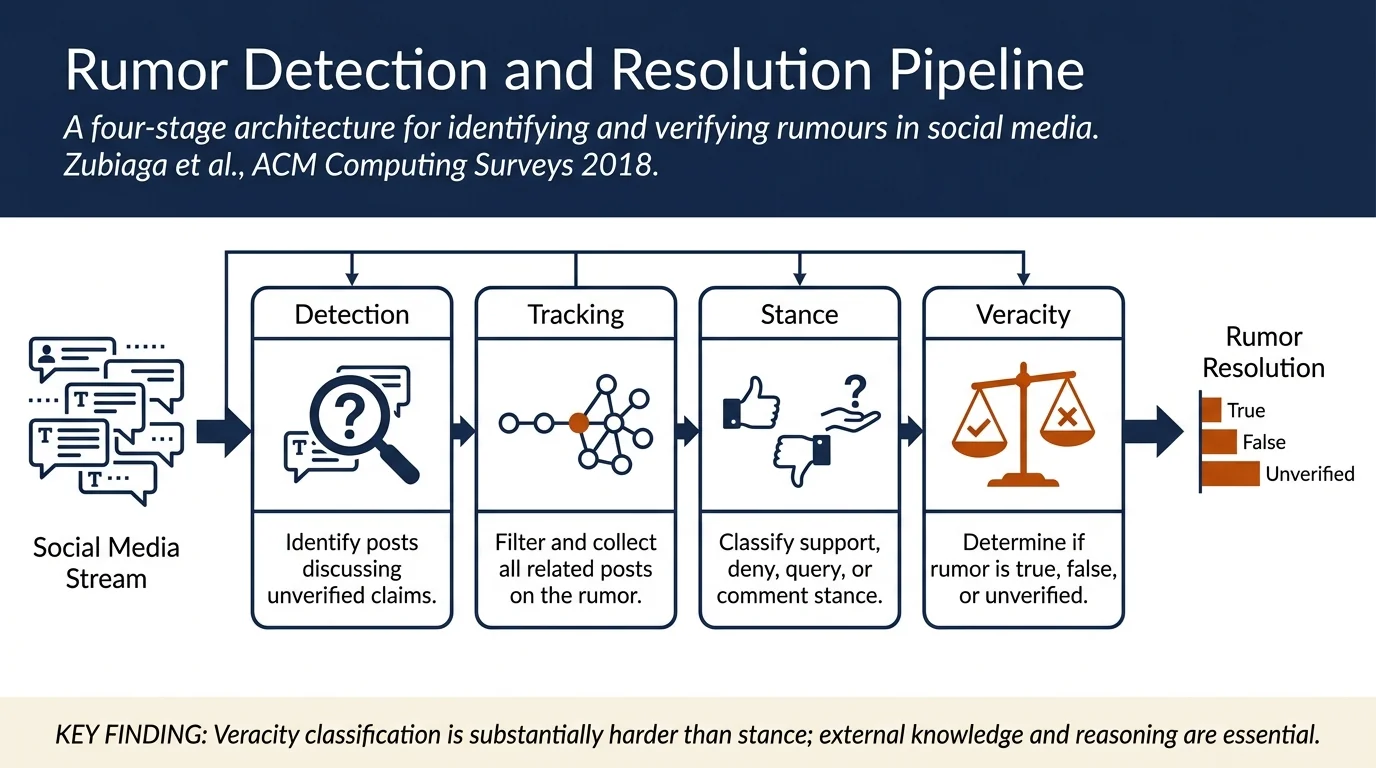
Detection and Resolution of Rumours in Social Media: A SurveyComprehensive survey of rumour detection and resolution in social media covering the entire pipeline: rumour definition and characterization, data collection strategies, annotation schemes, detection approaches for both emerging and long-standing rumours, tracking of rumour propagation, stance classification (support/deny/query/comment),…
 Fact-checking & verificationDatasets & evaluation
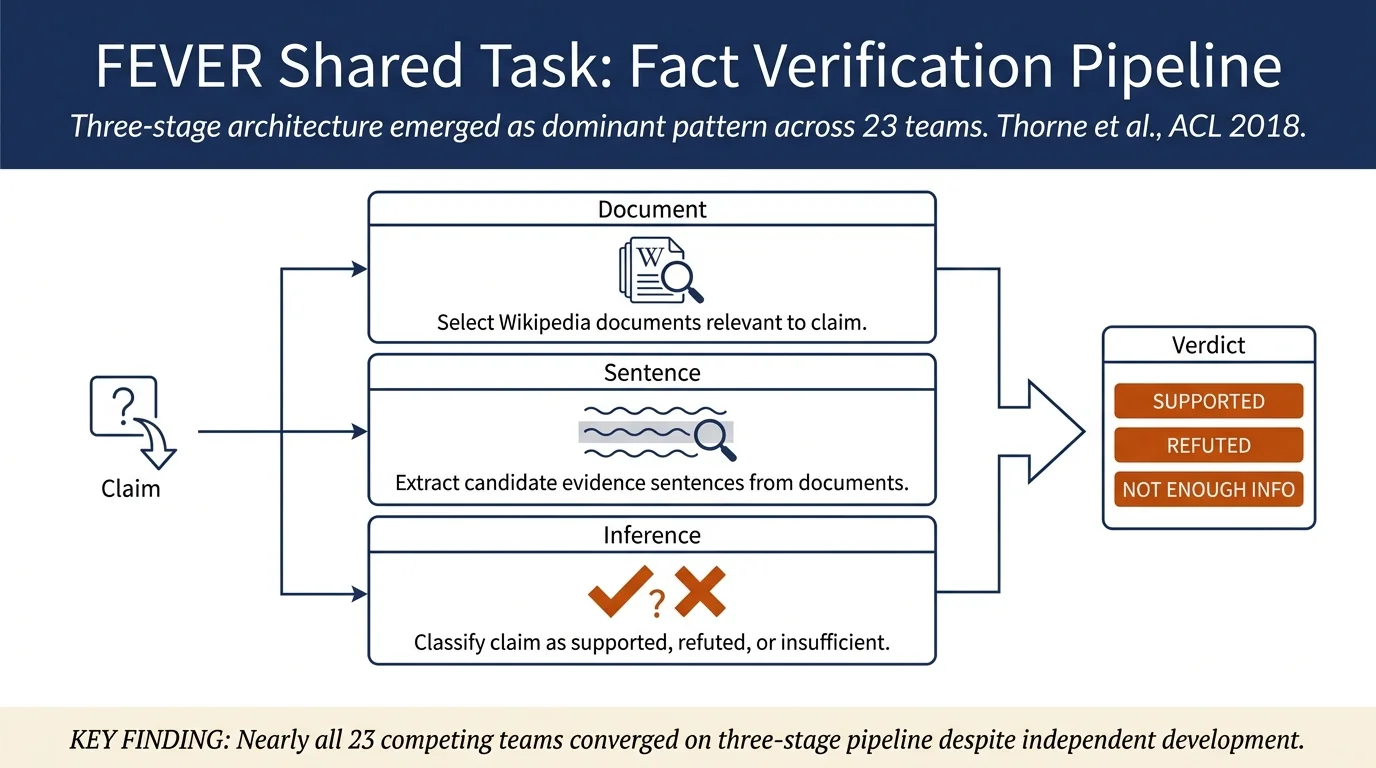
The Fact Extraction and VERification (FEVER) Shared TaskThis paper presents results of the first FEVER shared task competition, which challenged 23 teams to classify whether human-written factoid claims could be SUPPORTED or REFUTED using evidence retrieved from Wikipedia. The best system achieved 64.21% FEVER score, demonstrating the difficulty of joint evidence retrieval and natural…
 Fact-checking & verificationDatasets & evaluation
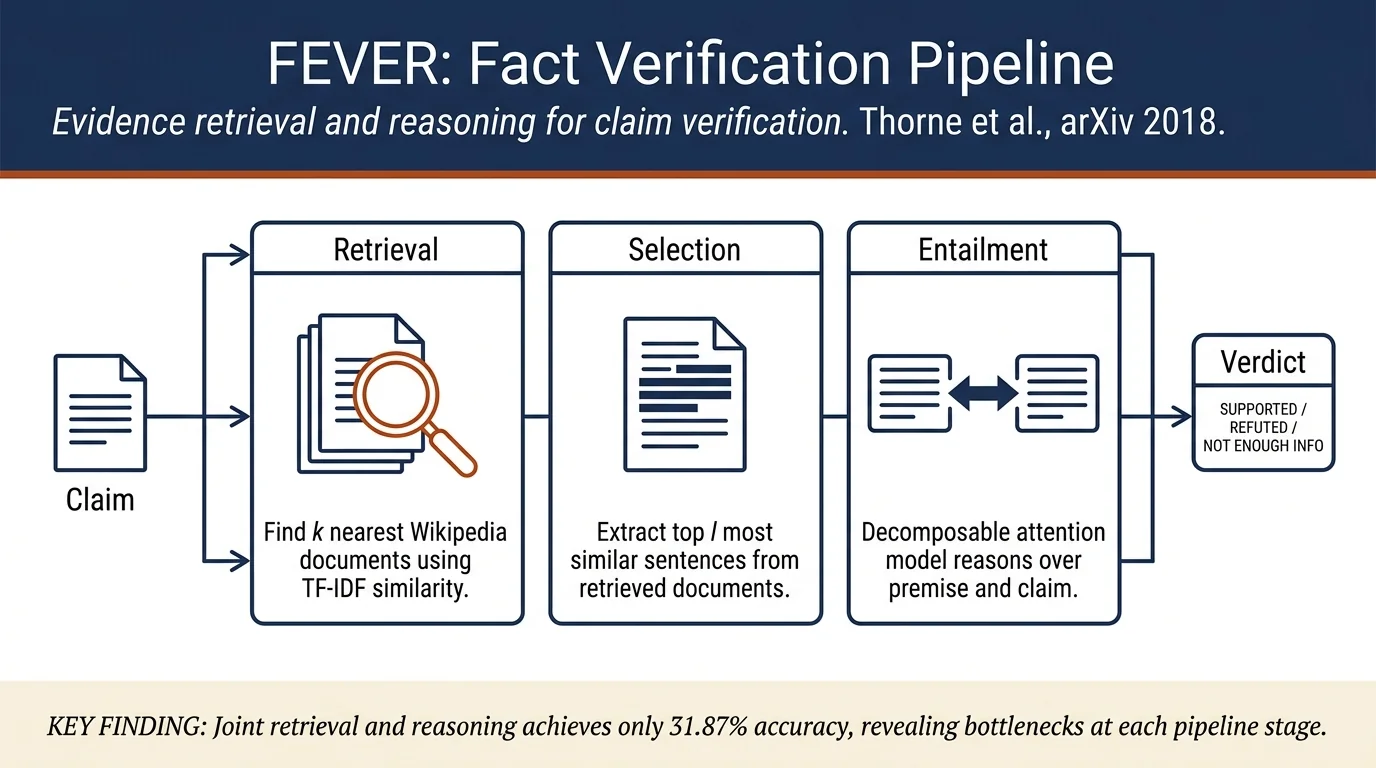
FEVER: A Large-Scale Dataset for Fact Extraction and VERificationThis paper introduces FEVER, a large-scale dataset of 185,445 human-verified claims with Wikipedia evidence for training fact verification systems. Claims are generated from Wikipedia and labeled as SUPPORTED, REFUTED, or NOT ENOUGH INFO; the paper presents a three-stage baseline pipeline (document retrieval, sentence selection, textual…
 Fact-checking & verificationDetection methods
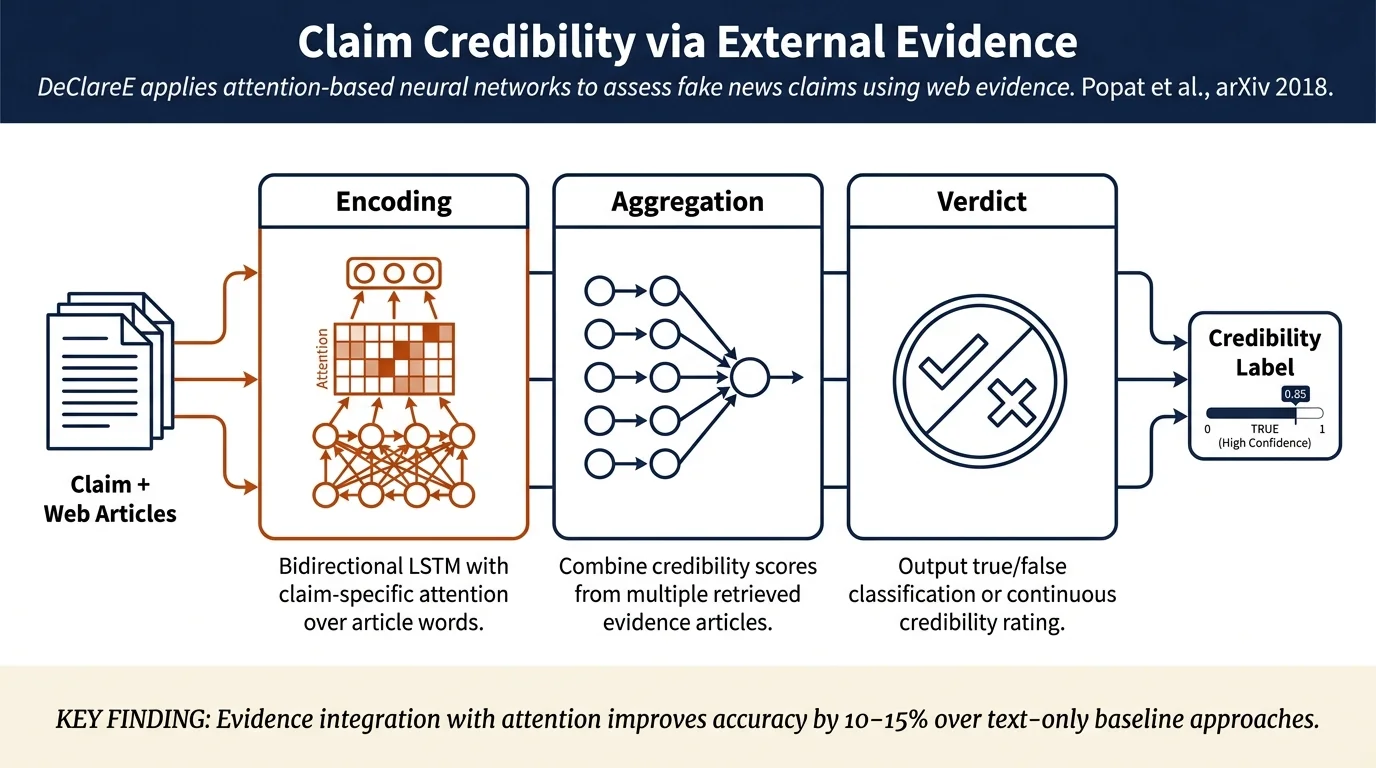
DeClareE: Debunking Fake News and False Claims using Evidence-Aware Deep LearningDeClareE is an end-to-end neural network for evidence-aware credibility assessment of arbitrary natural-language claims. The model combines claim and evidence article representations using bidirectional LSTMs with claim-specific attention, automatically discovering which web articles support or refute a claim without hand-crafted…
 Detection methodsFact-checking & verification
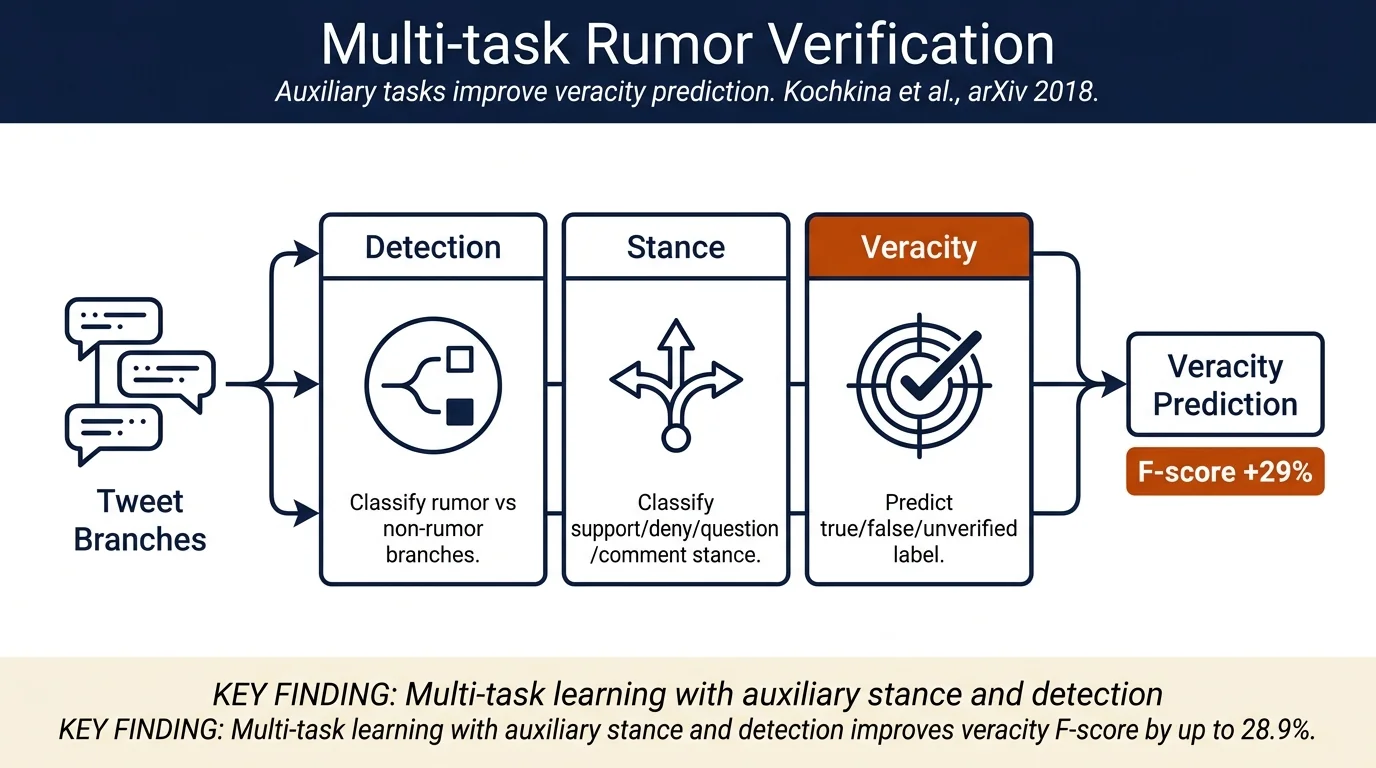
All-in-one: Multi-task Learning for Rumour VerificationThis paper proposes a multi-task learning framework for rumor verification that jointly trains veracity classification (the main task) with auxiliary tasks—rumor detection and stance classification. The approach outperforms single-task baselines on both RumourEval and PHEME datasets, demonstrating that sharing representations across…
 Datasets & evaluationSpread & networks
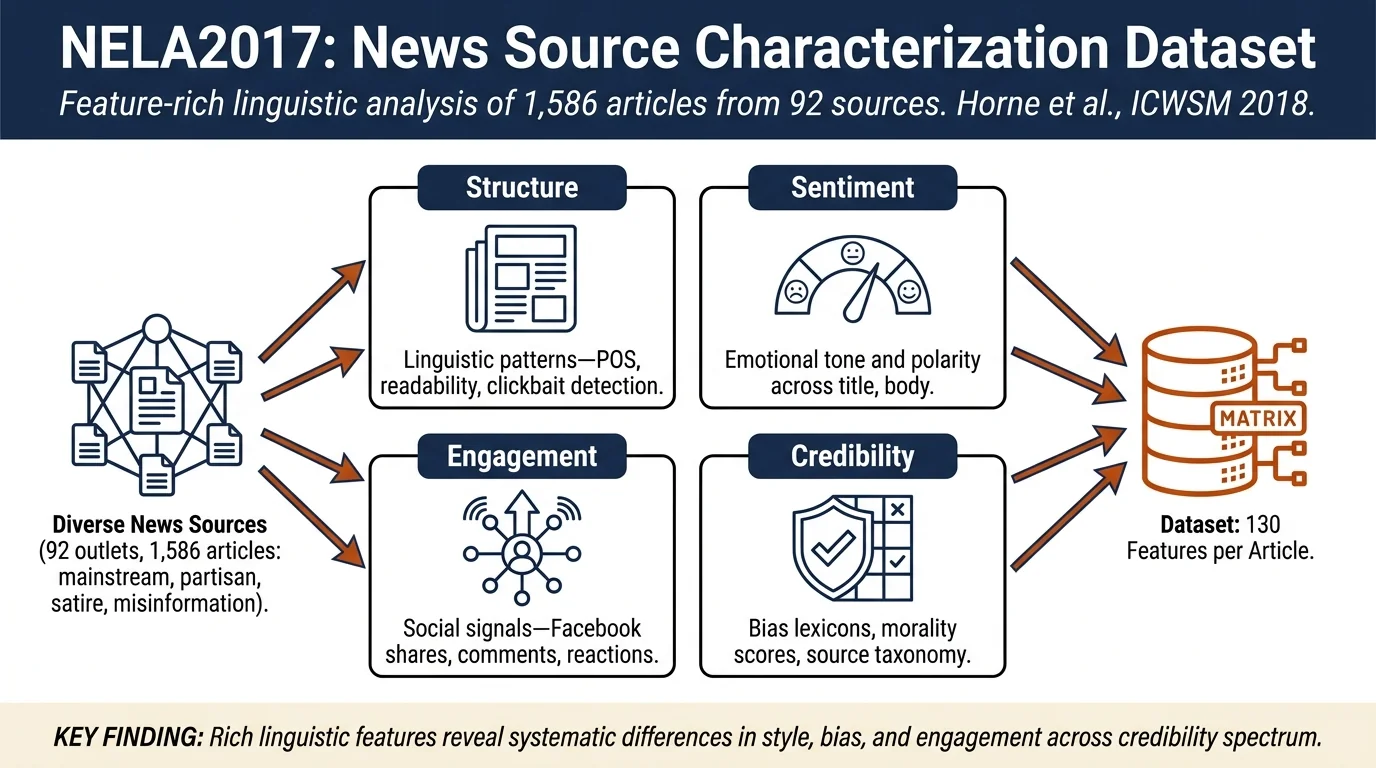
Sampling the News Producers: A Large News and Feature Data Set for the Study of the Complex Media LandscapeIntroduces NELA2017, a dataset of 1,586 news articles from 92 diverse news sources over 7 months (April–October 2017), including mainstream outlets, hyper-partisan sources, satire, and deliberately false news sites. Computes 130 content-based linguistic and engagement features on each article, enabling large-scale comparative analysis of…
 Fact-checking & verificationDatasets & evaluation
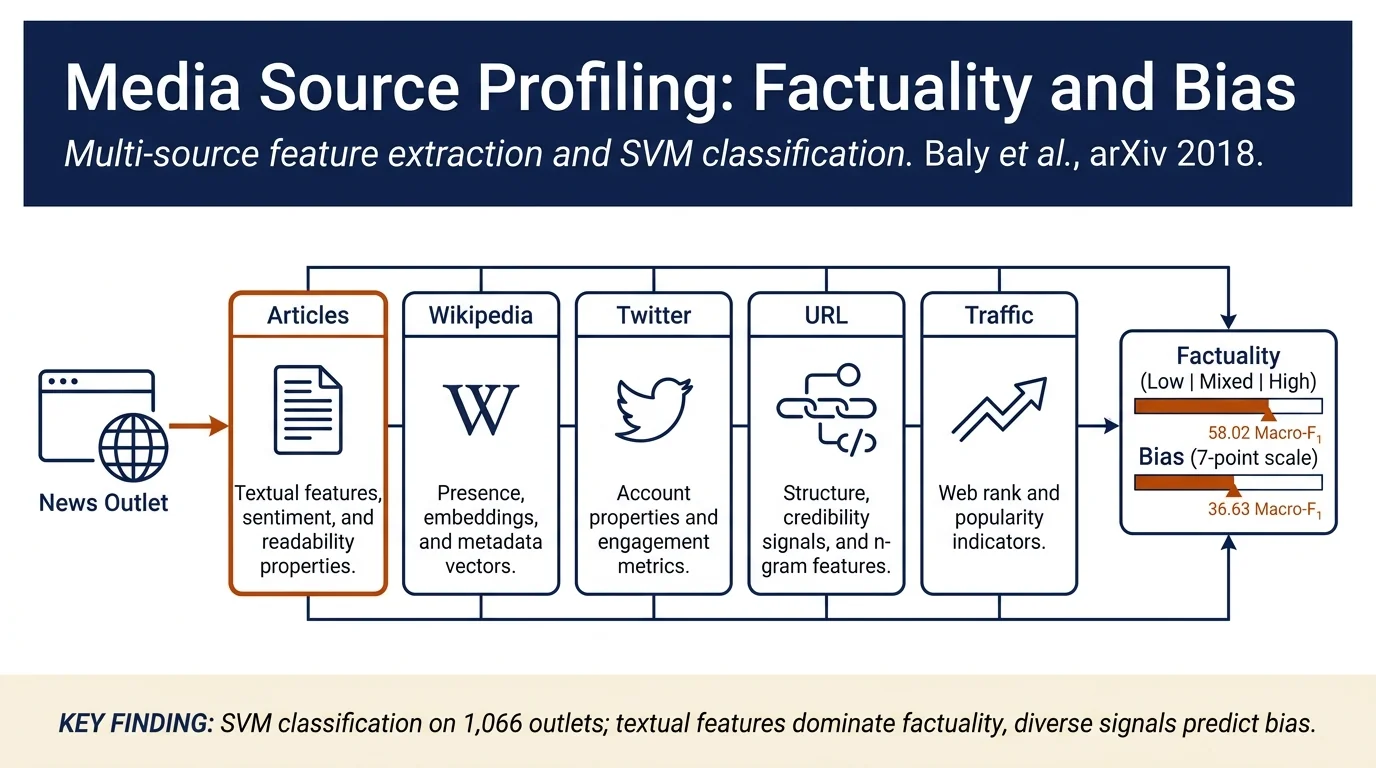
Predicting Factuality of Reporting and Bias of News Media SourcesThis paper frames predicting news media factuality and bias as classification tasks at the news outlet level rather than at the claim or article level. The authors extract 141 features from multiple sources (articles, Wikipedia, Twitter, URL structure, web traffic) and train SVM classifiers, creating a dataset of 1,066 websites manually…
 Platforms, policy & societyFact-checking & verification
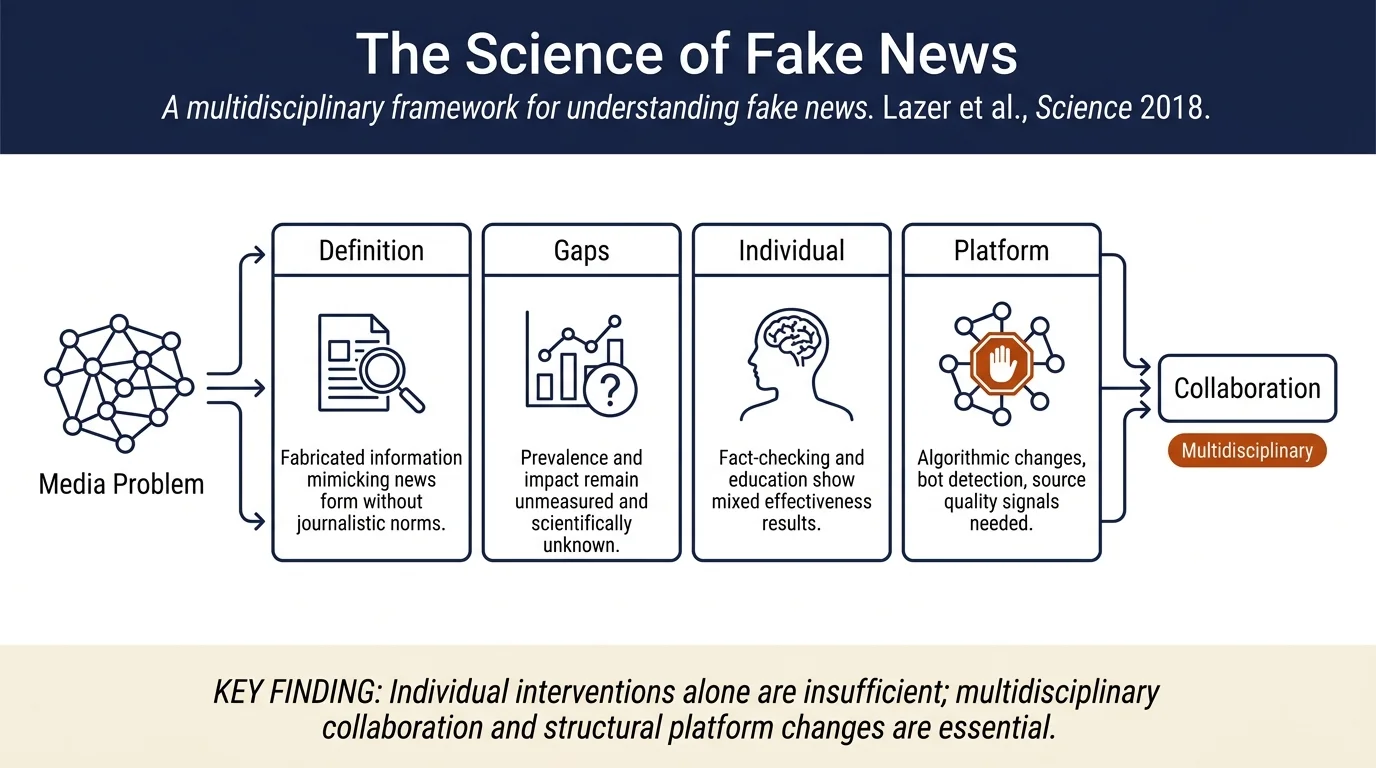
The Science of Fake NewsThis multidisciplinary review establishes a scientific framework for studying fake news, defining it as fabricated information that mimics news media form but lacks editorial norms. The paper identifies two mitigation strategies—empowering individuals through fact-checking and education, and structural platform interventions—while…