Explore everything
Filter by research area, year and venue. Every filter is in the address bar, so you can share a view as a link.
 Bots & coordinated campaignsDetection methods
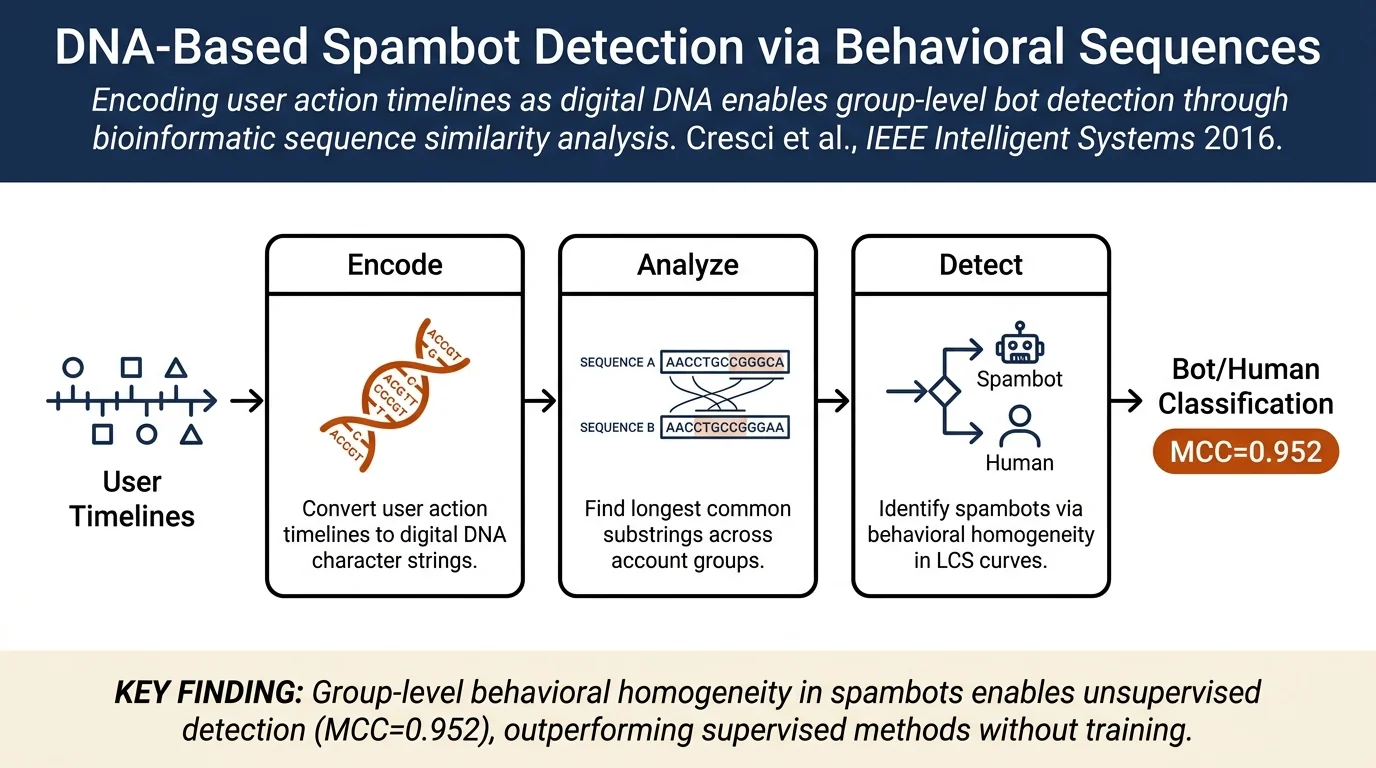
DNA-Inspired Online Behavioral Modeling and Its Application to Spambot DetectionProposes a novel methodology to characterize online user behavior using DNA-inspired digital sequences, where each user action (tweet type, content features) is encoded as a character in a string. Applies standard bioinformatic DNA analysis techniques—specifically longest common substring (LCS) analysis—to detect spambots on Twitter by…
 Bots & coordinated campaignsDatasets & evaluation
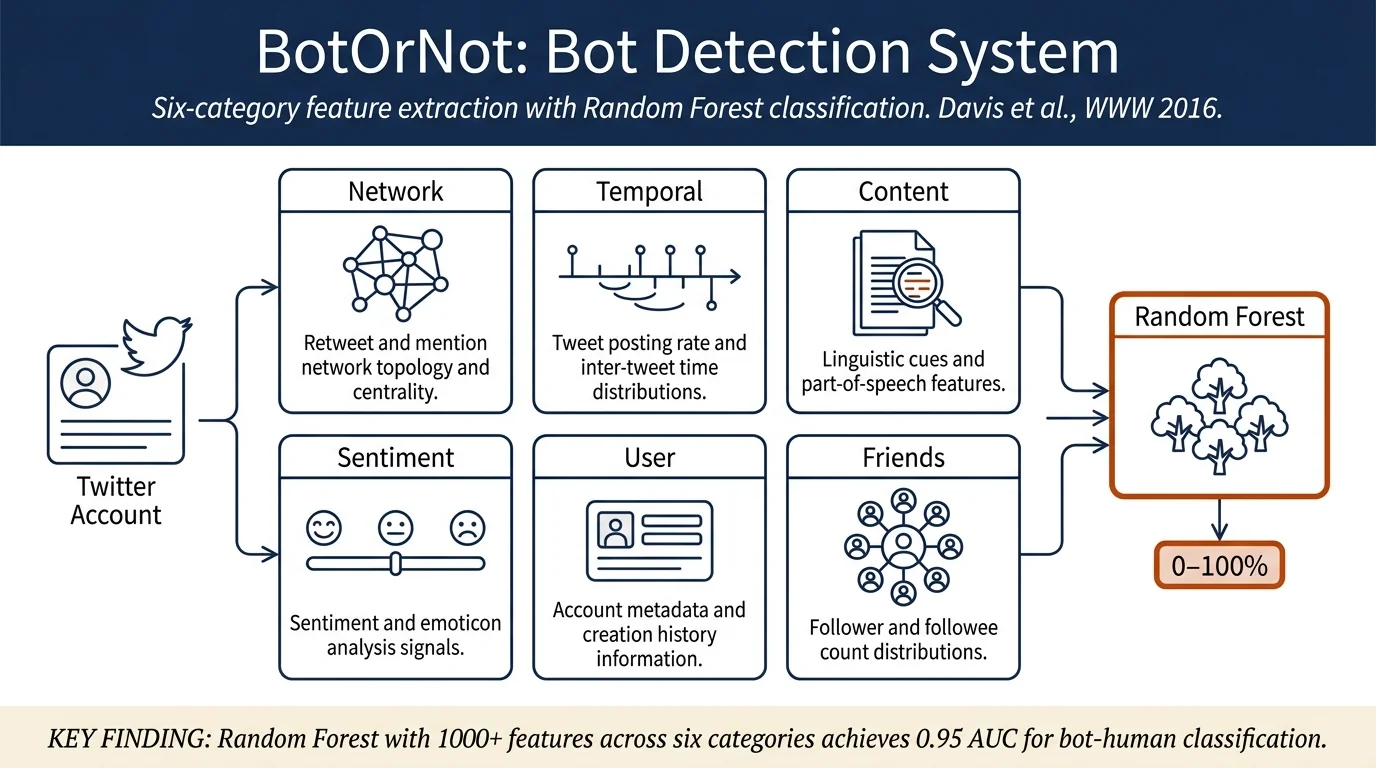
BotOrNot: A System to Evaluate Social BotsBotOrNot is a publicly available service and API that evaluates whether a Twitter account is controlled by a human or automated bot. Using 1,000+ features across six categories (network, user, friends, temporal, content, sentiment), the system applies Random Forest classification to achieve 0.95 AUC on a labeled dataset of 15k bots and…
 Spread & networksDetection methods
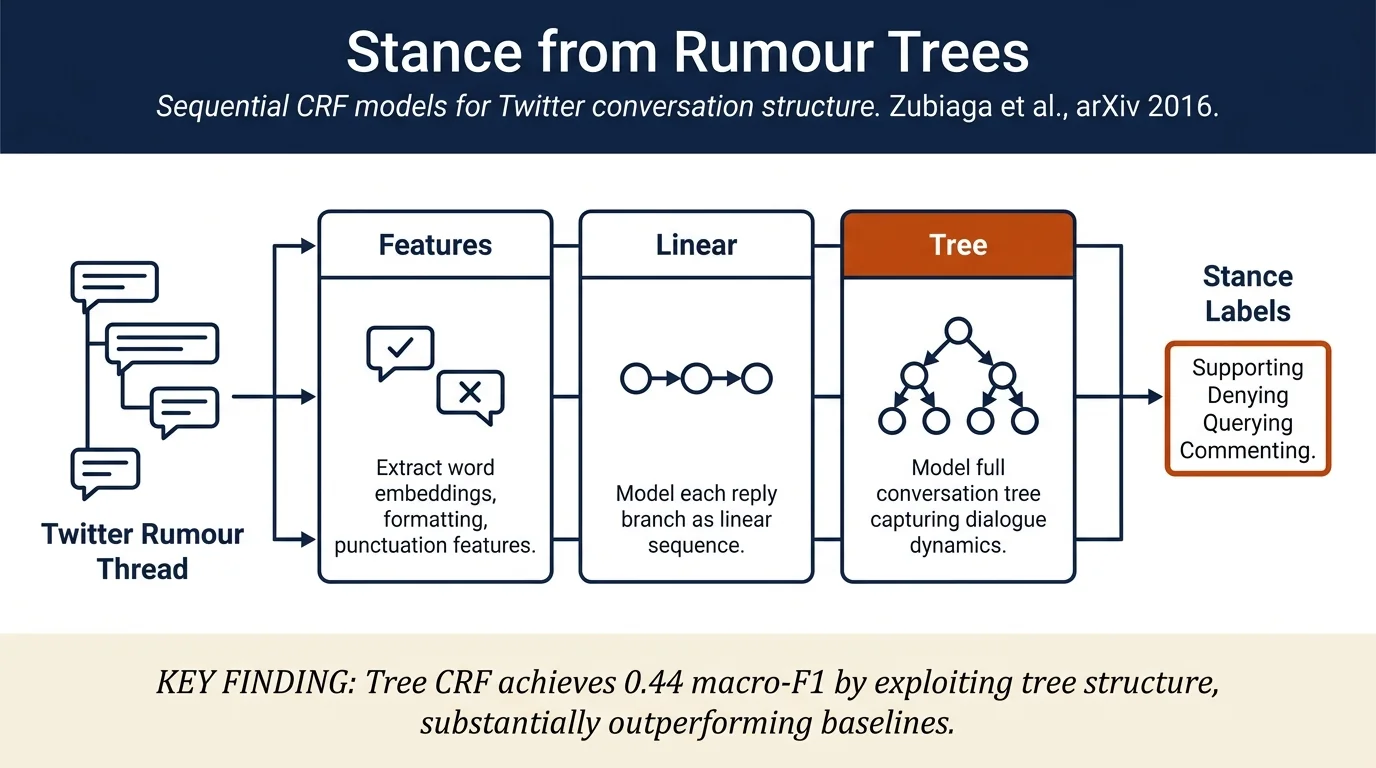
Stance Classification in Rumours as a Sequential Task Exploiting the Tree Structure of Social Media ConversationsProposes that modelling Twitter conversations as tree-structured sequences improves rumour stance classification. Introduces Linear and Tree Conditional Random Fields (CRF) to exploit the sequential structure of replies within rumour threads, showing that Tree CRF significantly outperforms non-sequential baselines on 4,519 annotated…
 Fact-checking & verificationDatasets & evaluation
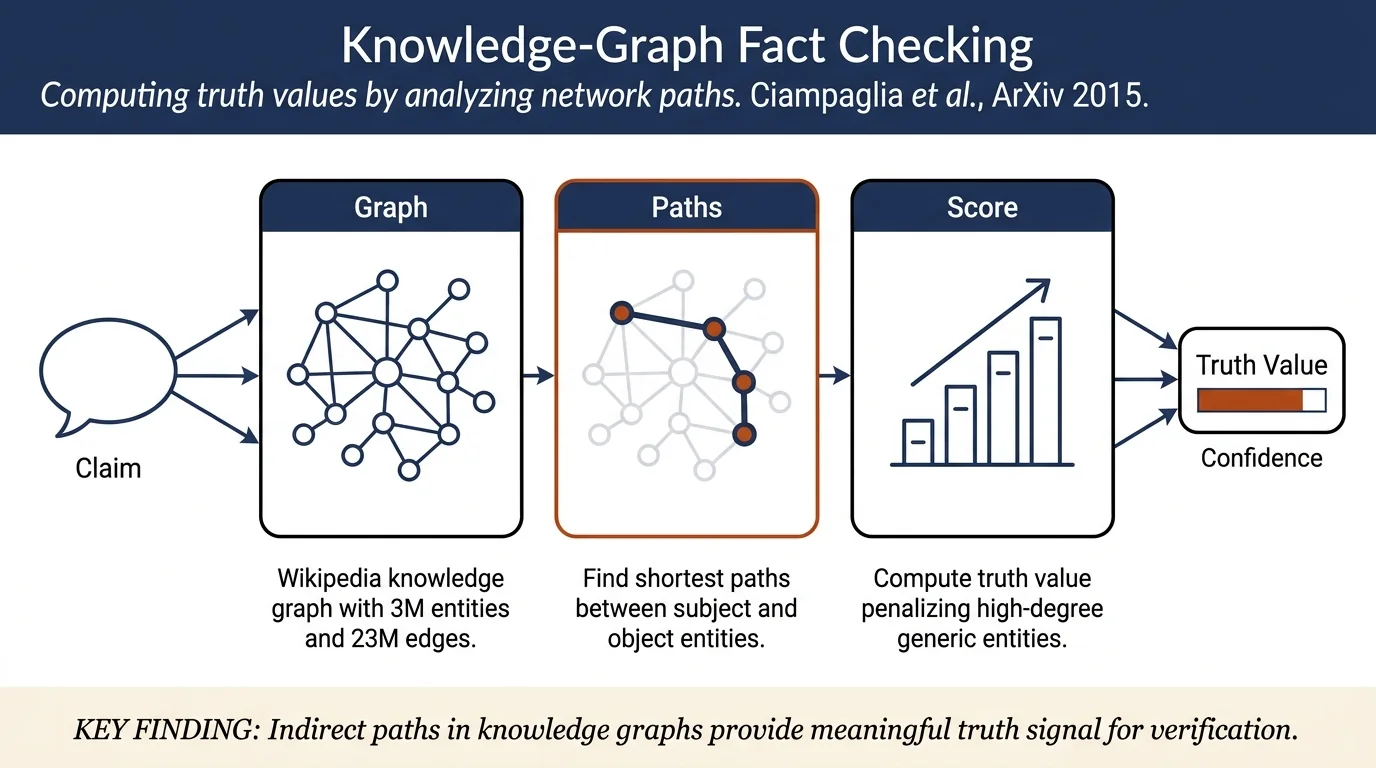
Computational fact checking from knowledge networksThis paper proposes a computational approach to fact checking by framing it as a network problem on knowledge graphs. The method finds the shortest path between entities in Wikipedia's knowledge graph using semantic proximity metrics that account for entity generality.
 Spread & networksDatasets & evaluation
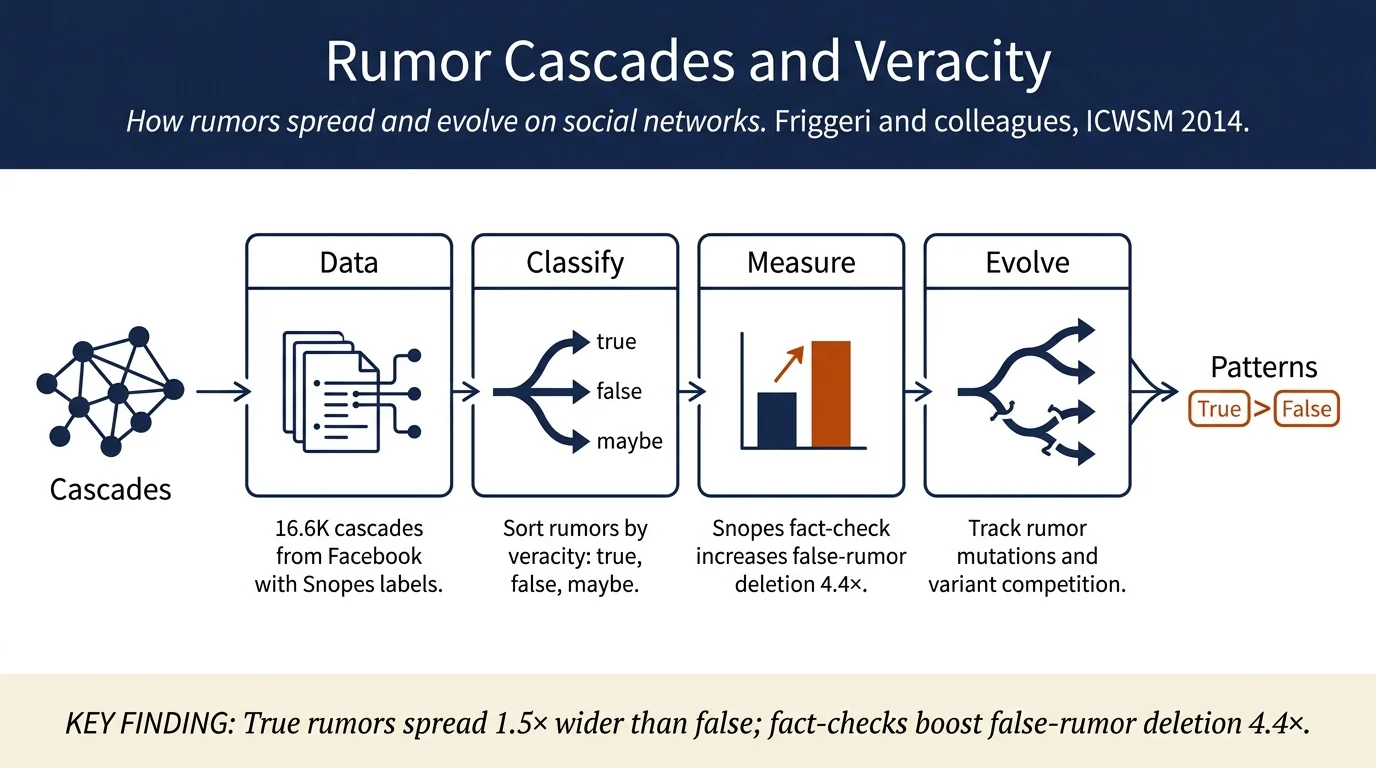
Rumor CascadesFriggeri et al. tracked thousands of rumors on Facebook using Snopes.com as ground truth, finding that rumor cascades run deeper in the social network than typical content. True rumors spread more virally than false ones despite false rumors being more frequently uploaded; Snopes fact-checks increase deletion likelihood for false rumors…
 Detection methodsSpread & networks
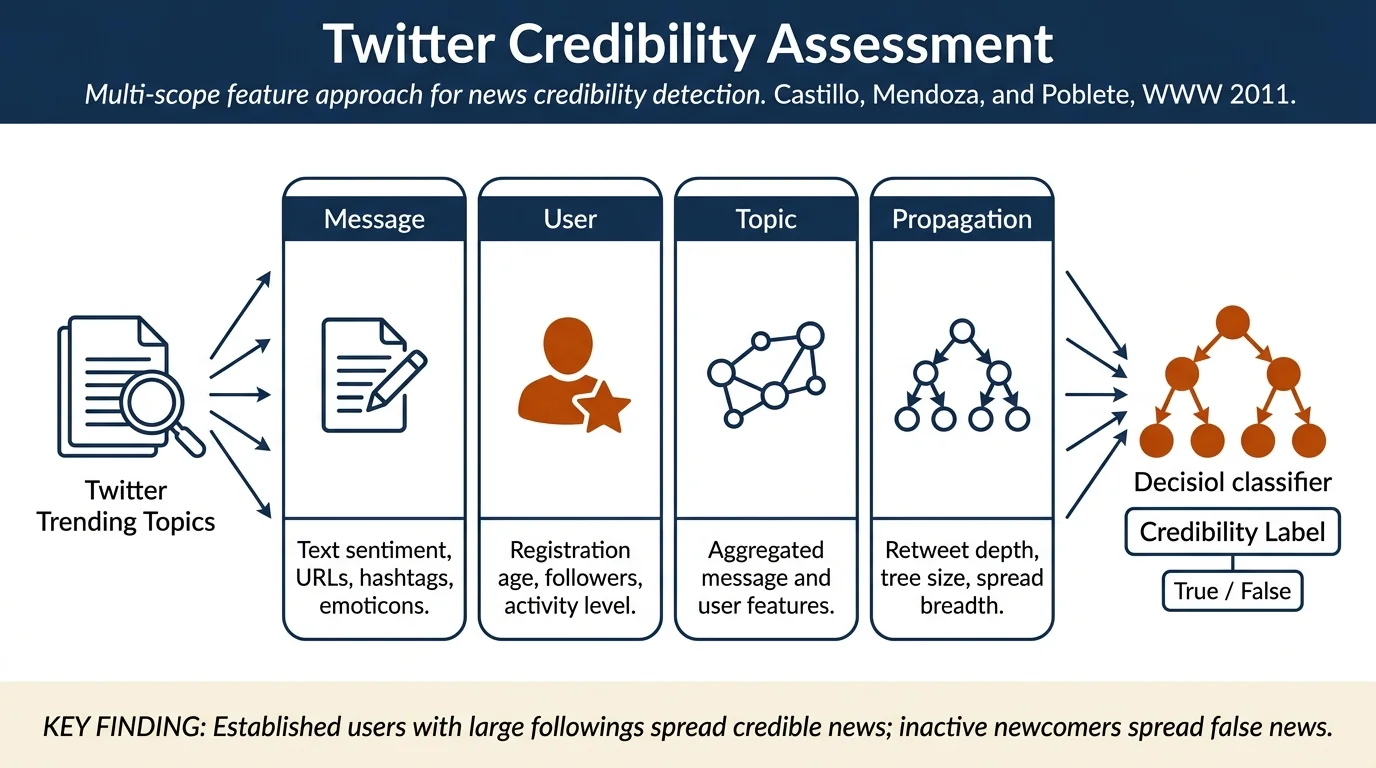
Information Credibility on TwitterThis paper proposes supervised learning classifiers to automatically assess the credibility of news discussed on Twitter. Using human-labeled topics from trending discussions, the authors extract message-level, user-level, topic-level, and propagation-level features to build classifiers that distinguish newsworthy from conversational…
 Spread & networksDatasets & evaluation
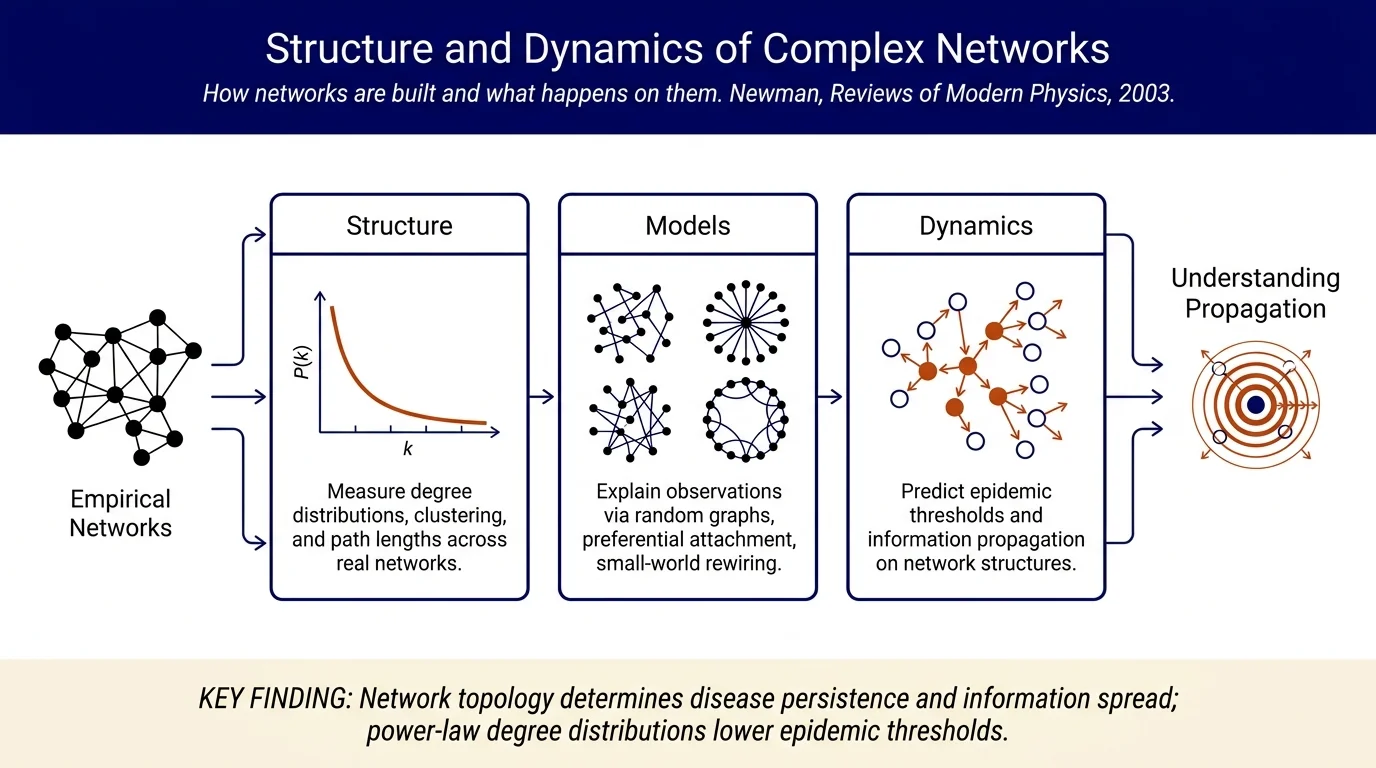
The structure and function of complex networksThis comprehensive review surveys the properties and mathematical models of complex networks across diverse domains: social networks, the Internet, biological networks, and collaboration networks. Newman covers observed structural properties (degree distributions, clustering, small-world effects), foundational models (random graphs,…