Explore papers
Filter by research area, year and venue. Every filter is in the address bar, so you can share a view as a link.
 Datasets & evaluationLLMs & generative AI
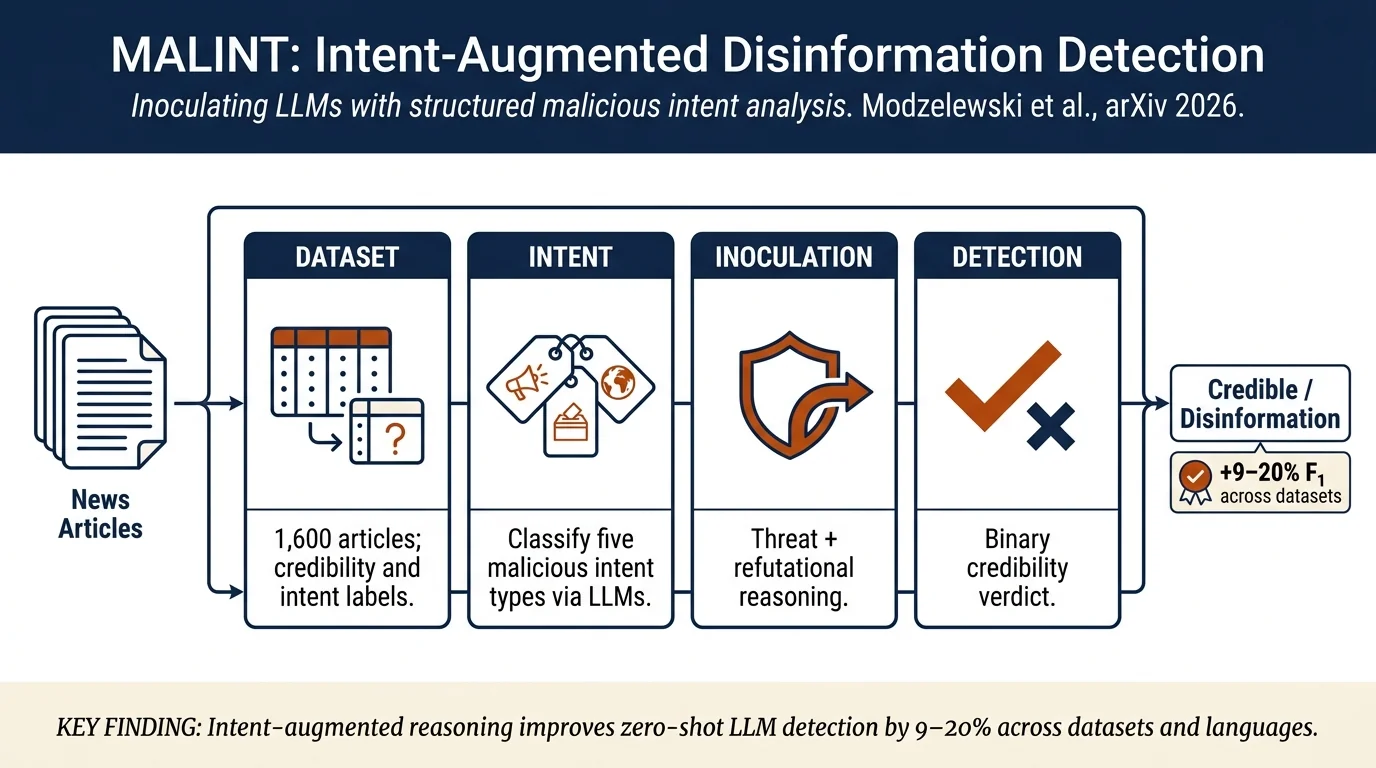
MALicious INTent Dataset and Inoculating LLMs for Enhanced Disinformation DetectionMALINT is the first human-annotated English corpus pairing 1,600 news articles with annotations of both credibility and the malicious intentions behind disinformation. The paper evaluates 12 language models on intent classification and proposes Intent-Based Inoculation (IBI), an intent-augmented reasoning approach that improves zero-shot…
 LLMs & generative AIDatasets & evaluation
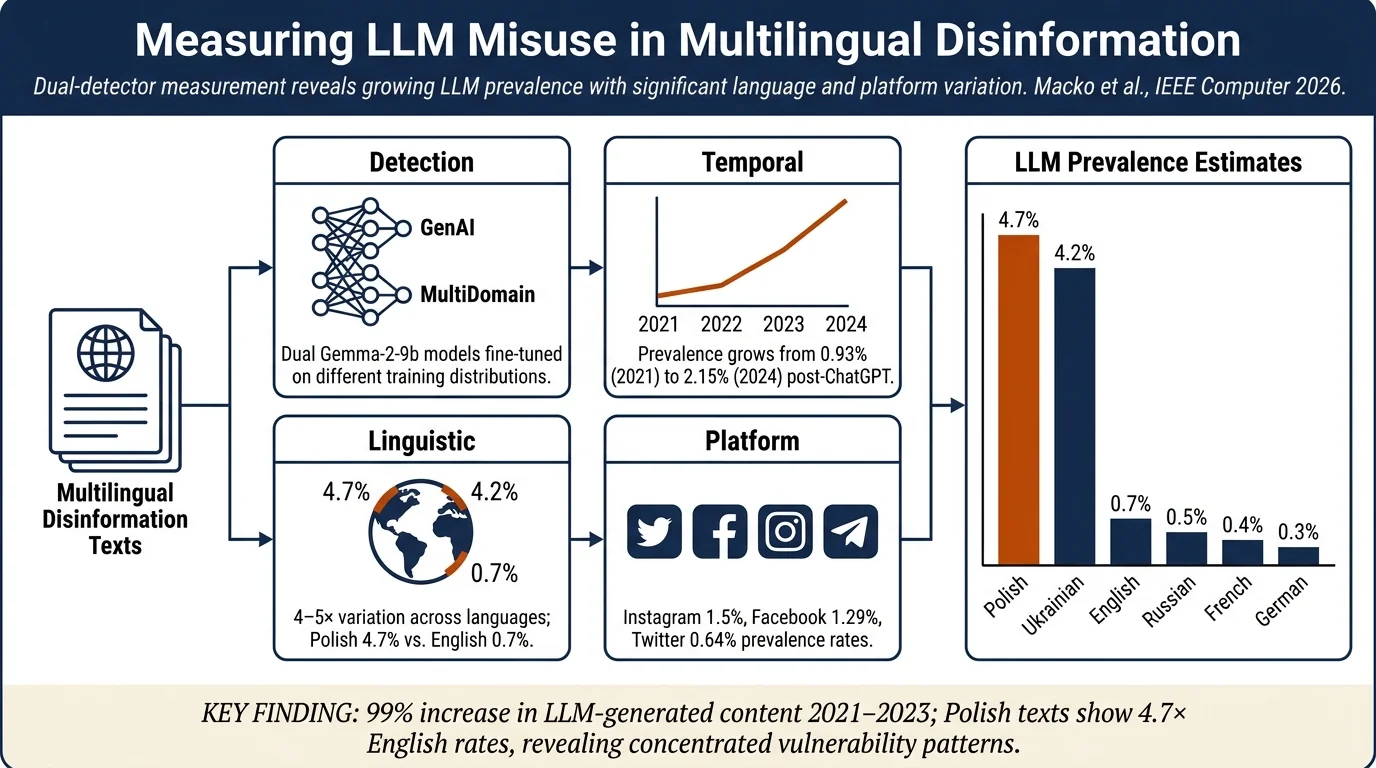
Beyond Speculation: Measuring the Growing Presence of LLM-Generated Texts in Multilingual DisinformationThis empirical study provides the first measurement of LLM-generated content in real-world disinformation datasets. Analyzing the MultiClaim dataset (fact-checked social media posts), the authors document a 99% increase in machine-generated content from 2021 to 2023 (0.93% to 1.85%), correlating with ChatGPT's November 2022 release.
 LLMs & generative AIDatasets & evaluation
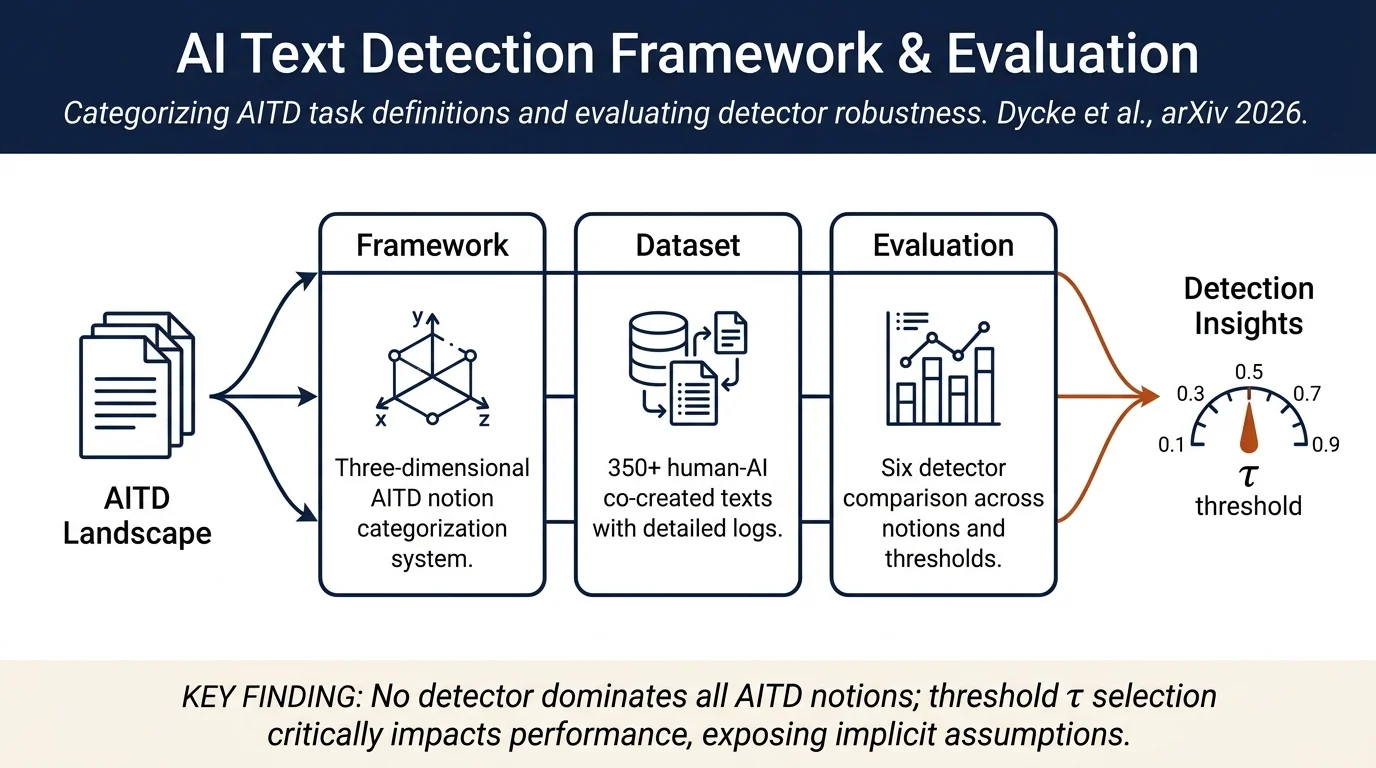
'Your AI Text is not Mine': Redefining and Evaluating AI-generated Text Detection under Realistic AssumptionsThe paper systematically analyzes the fragmented landscape of AI-generated text detection (AITD) task definitions in the literature and proposes a unified framework distinguishing five core notions with implicit assumptions about what constitutes "AI text." The authors introduce AITDNA, a novel dataset of 350+ texts from real human-AI…
 Spread & networksDetection methods
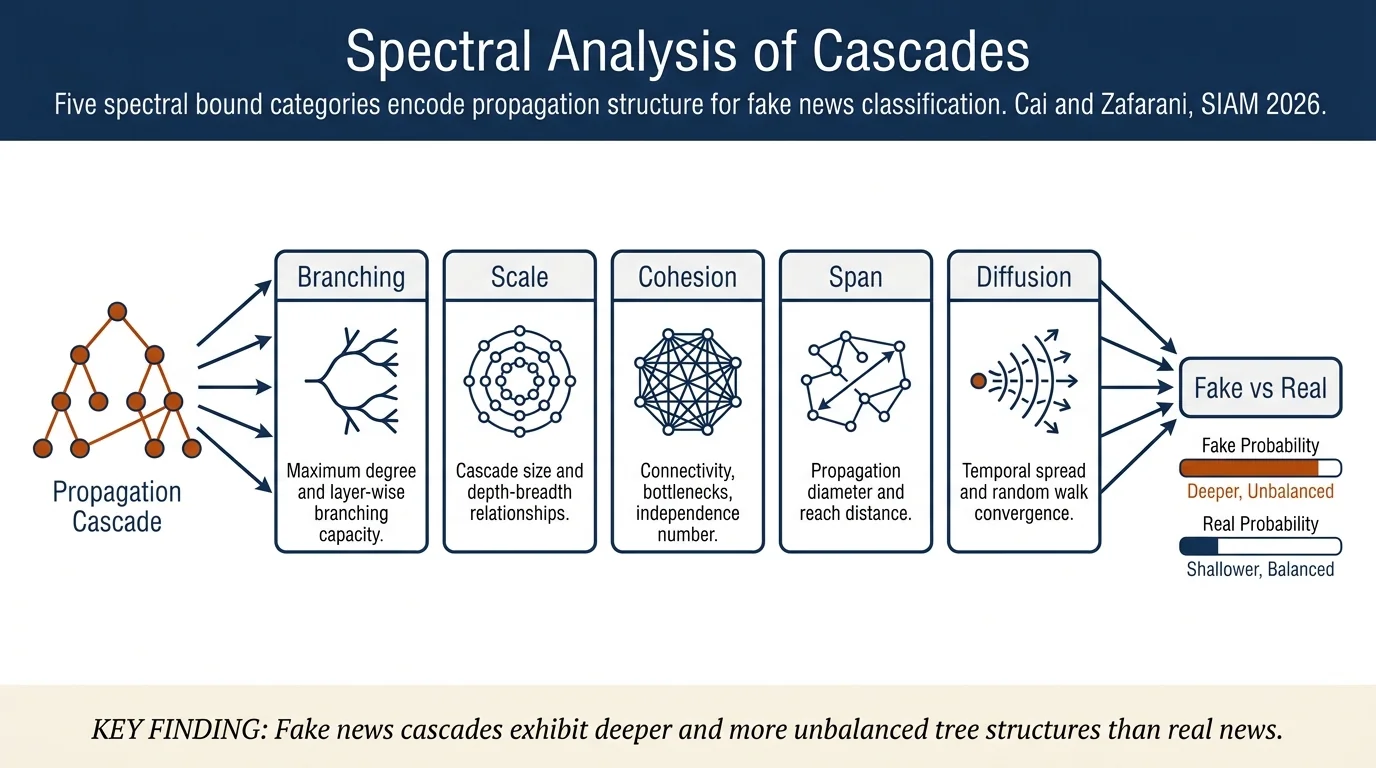
Spectral Analysis of Fake News PropagationThe paper develops a spectral view of fake news propagation by connecting graph spectra with structural properties of propagation trees. The authors derive spectral bounds capturing five key aspects of cascade structure—branching capacity, cascade scale, structural cohesion, propagation span, and diffusion dynamics—and use them as graph…
 Detection methodsLLMs & generative AI
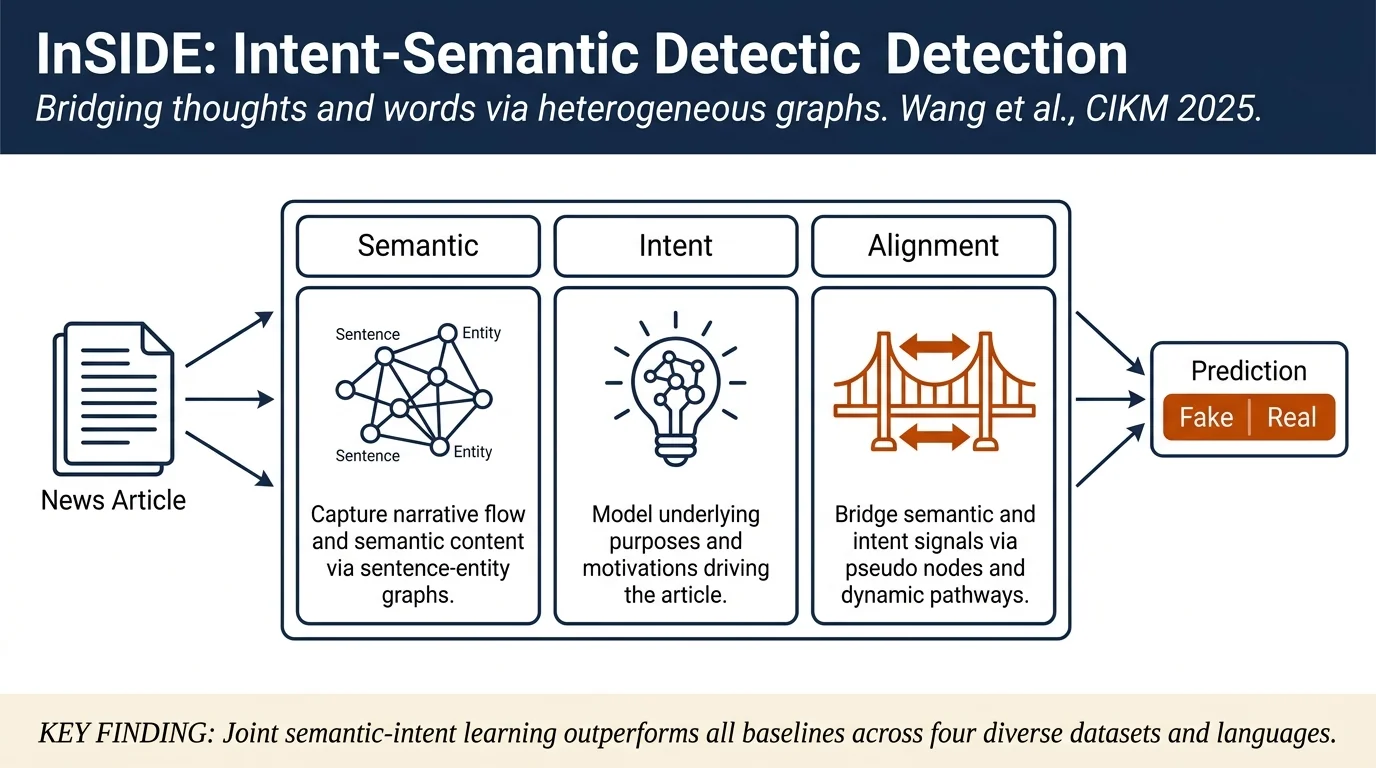
Bridging Thoughts and Words: Graph-Based Intent-Semantic Joint Learning for Fake News DetectionExisting fake news detectors rely on surface-level semantic patterns (emotional language, stylistic cues) and fail when writing styles shift. This paper proposes InSIDE, which combines semantic and intent signals via heterogeneous graphs: intent models the purpose behind an article (e.g., promoting a product), while semantics capture…
 Datasets & evaluationDetection methods
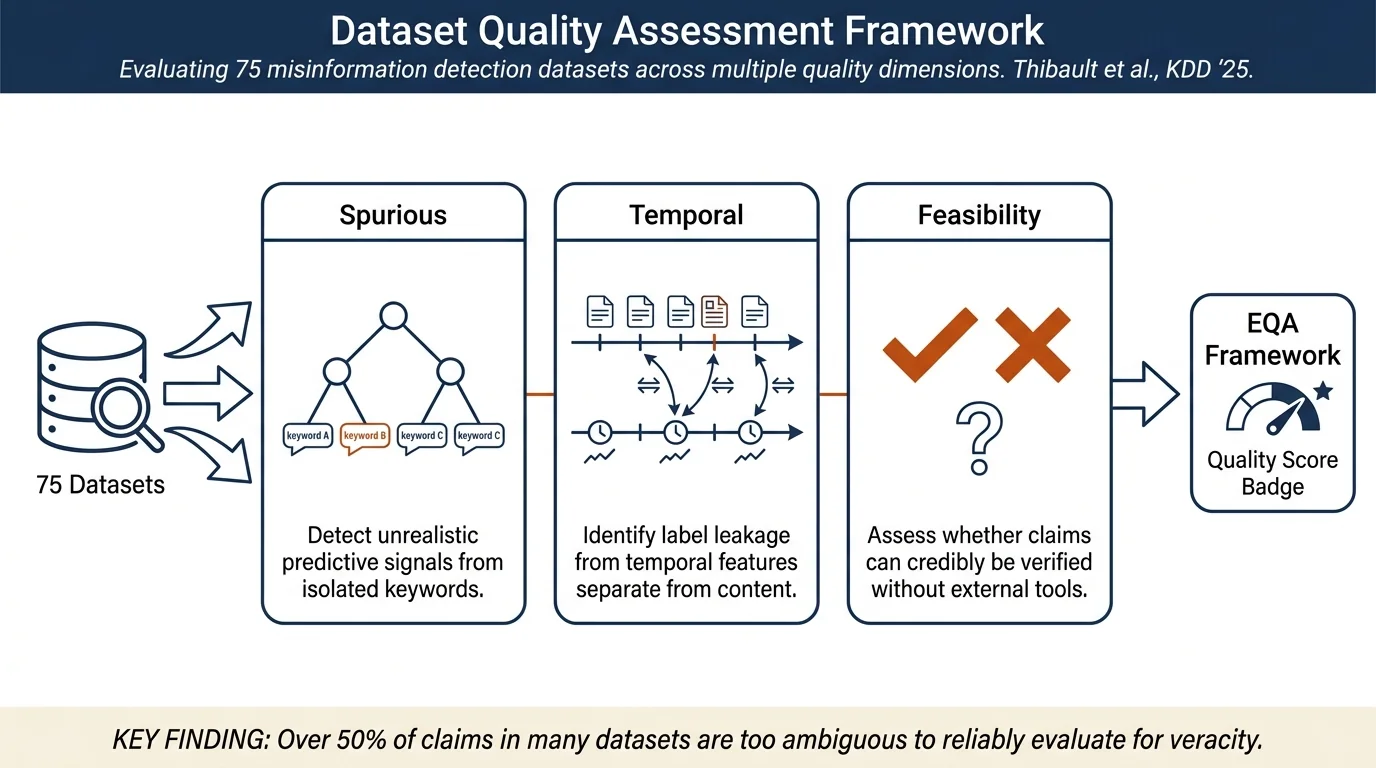
A Guide to Misinformation Detection Data and EvaluationThis work surveys the largest collection of misinformation detection datasets to date (75 datasets from prior literature) and evaluates dataset quality across multiple dimensions. The authors assess whether datasets enable reliable veracity evaluation by analyzing keyword correlations, temporal correlations, and feasibility of claim…
 Deepfakes & multimodalDatasets & evaluation
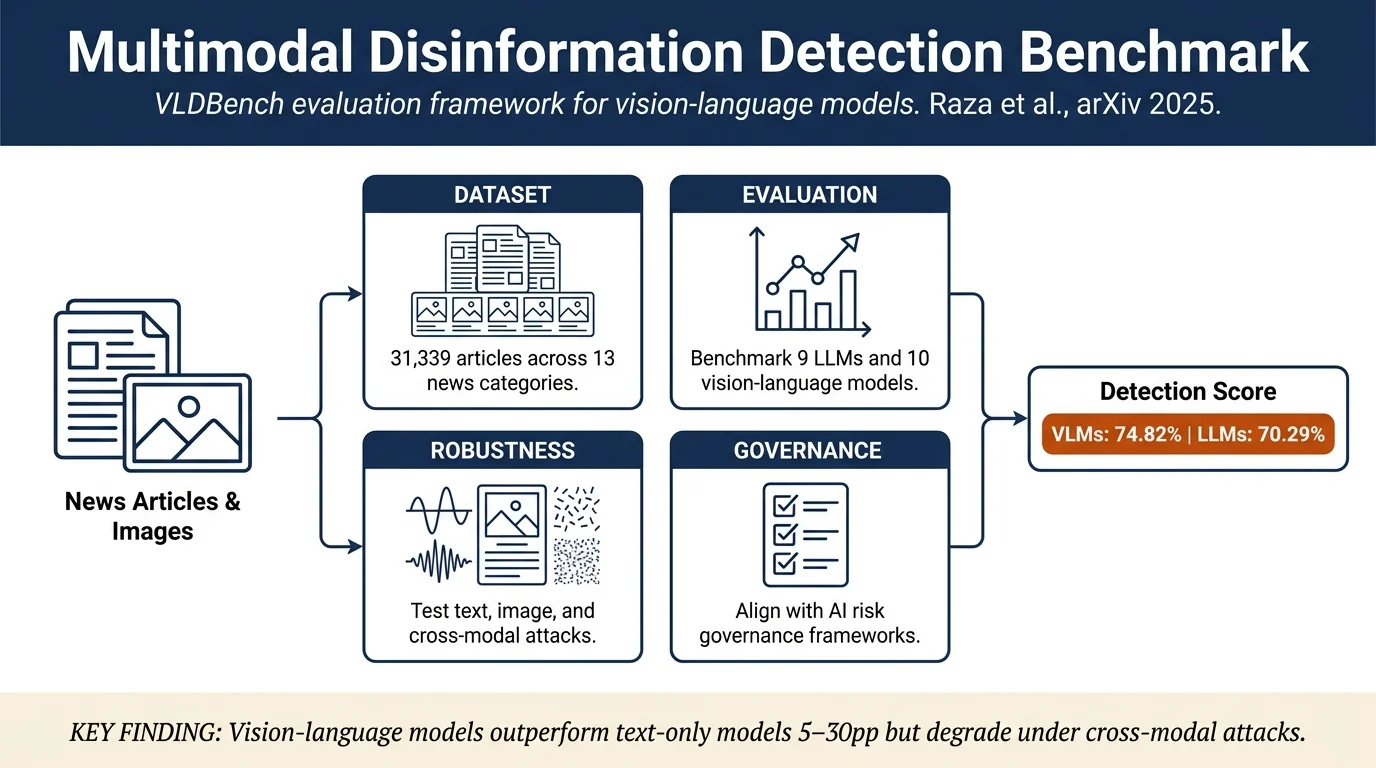
VLDBench: Evaluating Multimodal Disinformation with Regulatory AlignmentVLDBench is the first large-scale human-verified benchmark for multimodal disinformation detection, comprising 31,339 news articles paired with images across 13 topical categories. Evaluation of 9 LLMs and 10 VLMs shows vision-language models substantially outperform text-only baselines (e.g., LLaMA-3.2-11B-Vision: 74.82% accuracy), but…
 Detection methodsDatasets & evaluation
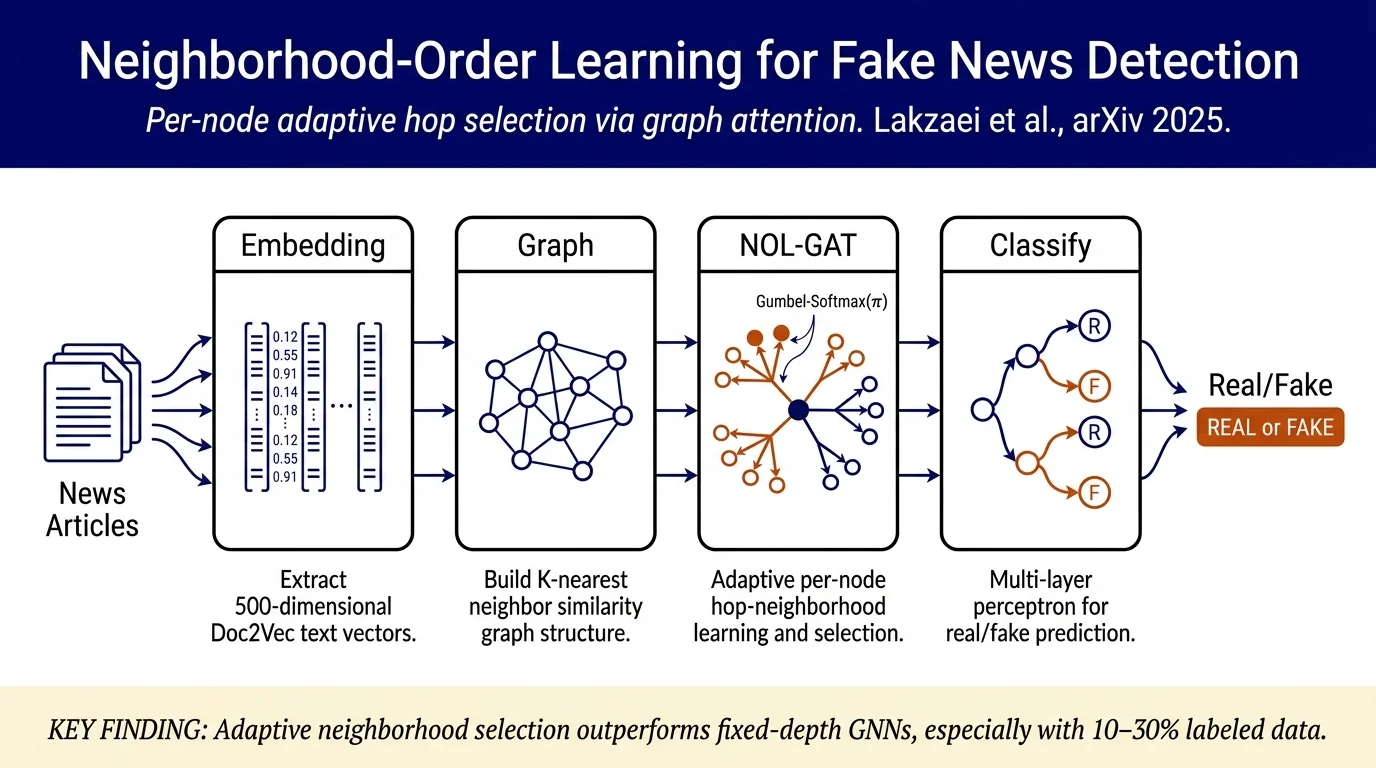
Neighborhood-Order Learning Graph Attention Network for Fake News DetectionProposes NOL-GAT (Neighborhood-Order Learning Graph Attention Network), a GNN architecture that allows each node to adaptively select its optimal hop-neighborhood at each layer, bypassing the fixed L-hop limitation of conventional message-passing GNNs. Evaluated on five fake news datasets, NOL-GAT outperforms baseline GNN methods,…
 Detection methodsDatasets & evaluation
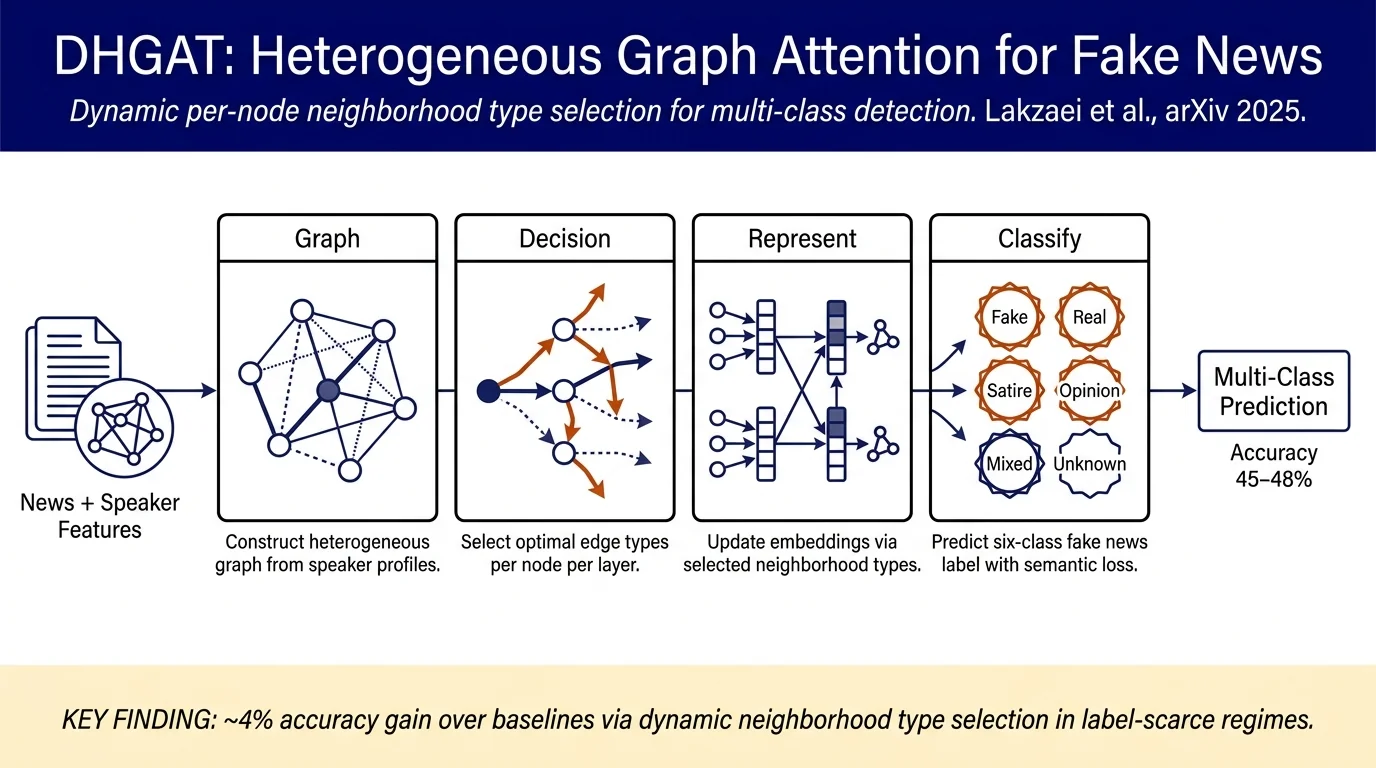
A Decision-Based Heterogeneous Graph Attention Network for Multi-Class Fake News DetectionProposes DHGAT (Decision-based Heterogeneous Graph Attention Network), a semi-supervised method for six-class fake news classification on the LIAR dataset. Unlike standard GNNs that apply uniform neighborhood aggregation, DHGAT models news as heterogeneous graphs with multiple edge types derived from speaker profiles and enables each…
 Detection methodsLLMs & generative AI
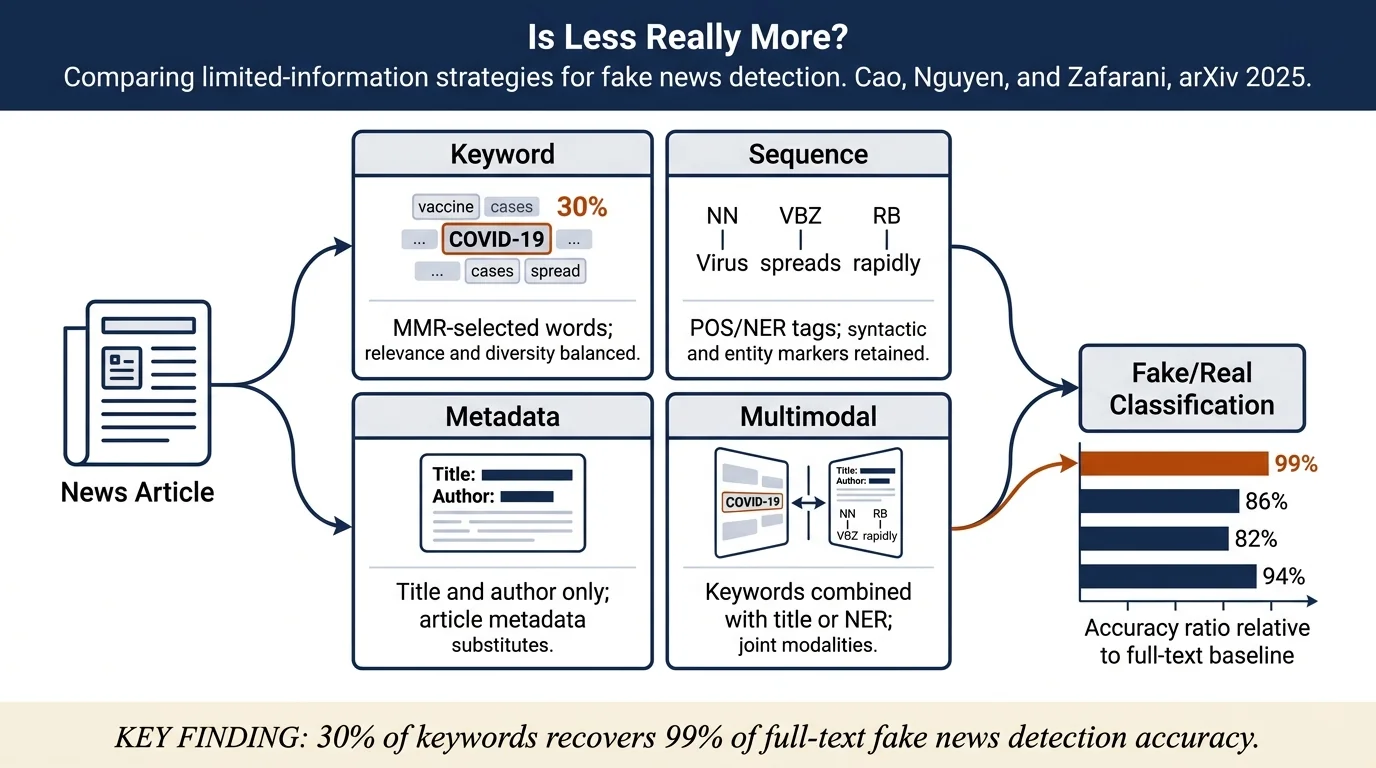
Is Less Really More? Fake News Detection with Limited InformationSLIM (Systematically-selected Limited Information) replaces full news article text with strategically chosen subsets — extracted keywords, POS/NER sequence tags, or textual metadata — to address the computational cost and data-sparsity limitations of full-text fake news detection. Information-theoretic measures (normalized Shannon…