Beyond Speculation: Measuring the Growing Presence of LLM-Generated Texts in Multilingual Disinformation
Authors: Dominik Macko, Aashish Anantha Ramakrishnan, Jason S. Lucas, Robert Moro, Ivan Srba, Adaku Uchendu, Dongwon Lee
Venue: IEEE Computer, February 2026 — DOI
TL;DR
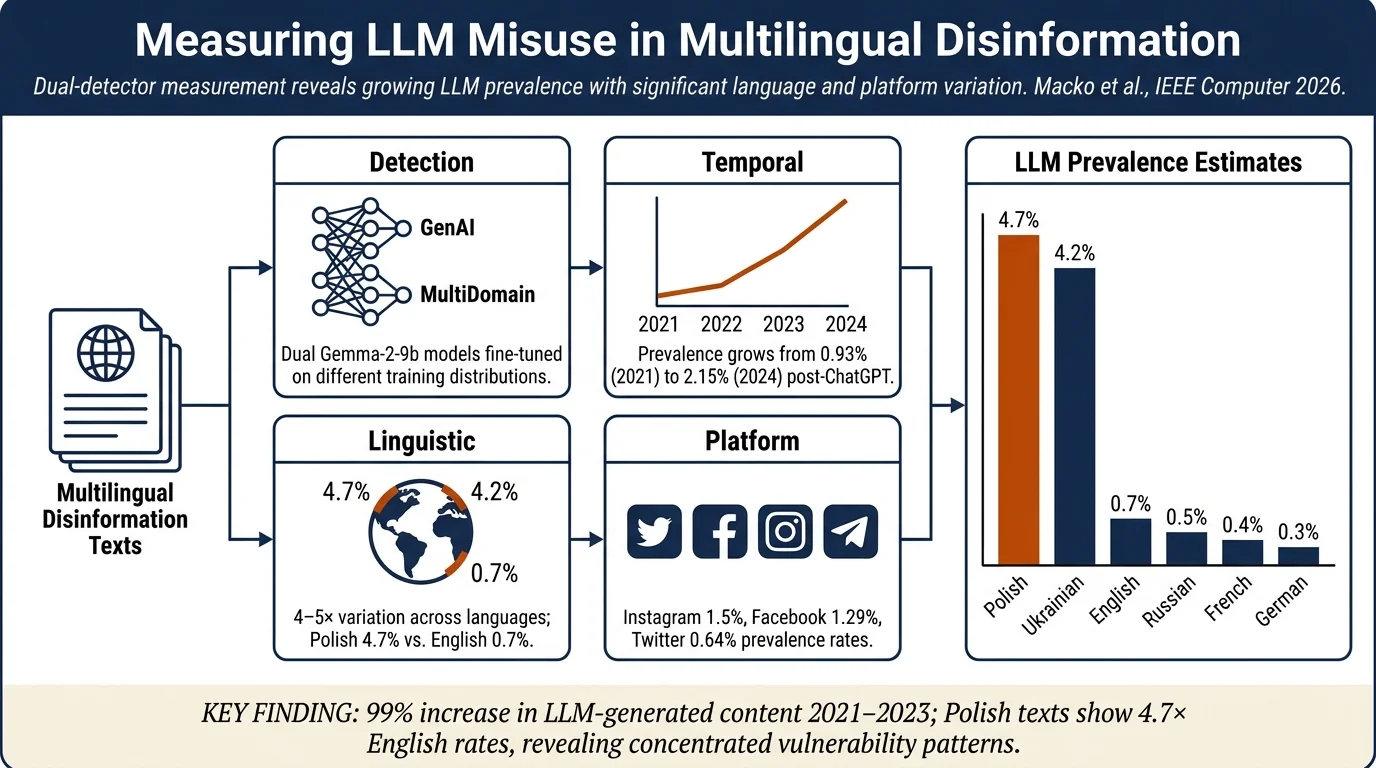
This empirical study provides the first measurement of LLM-generated content in real-world disinformation datasets. Analyzing the MultiClaim dataset (fact-checked social media posts), the authors document a 99% increase in machine-generated content from 2021 to 2023 (0.93% to 1.85%), correlating with ChatGPT's November 2022 release. Detection patterns vary dramatically across languages (Polish 4.7%, French 4.2%, English 0.7%) and platforms (Instagram 1.5%, Twitter 0.64%), indicating targeted rather than uniform misuse.
Contributions
- First empirical evidence of LLM-generated content prevalence in real-world disinformation datasets (MultiClaim, FakeNews, USC-X, FIGNEWS), moving beyond speculation to concrete measurements.
- Temporal analysis showing clear trajectory: prevalence increases from 0.93% (2021) to 1.85% (2023) to 2.15% (2024) in MultiClaim, with steepest rise post-ChatGPT.
- Cross-linguistic and cross-platform patterns revealing vulnerability heterogeneity: Polish and French texts show 4–5× higher rates of LLM generation than English; Instagram and Telegram exceed Twitter/X by 2–3×.
- Robust detection methodology using two multilingual Gemma-2-9b-it detectors fine-tuned on different datasets (GenAI and MULTITuDE+MultiSocial), achieving 93–99% precision across 5 benchmark datasets.
- Policy implications identifying "longtail" contexts (specific languages, platforms, temporal windows) where LLM misuse is concentrated, enabling targeted interventions.
Method
The study employs a dual-detector strategy to measure LLM-generated text prevalence. Two Gemma-2-9b-it models (base: instruction-tuned variant) are fine-tuned using QLoRA on different training distributions:
- Gemma_GenAI: trained on GenAI dataset (multilingual, diverse domains)
- Gemma_MultiDomain: trained on MULTITuDE + MultiSocial (news articles + social media, 22 languages, 5 platforms)
Detection uses two complementary metrics:
- Mean Score — the average probability (0–1) that texts are machine-generated, measuring temporal and population trends even when individual predictions are uncertain.
- Combined confident detection — predicts positive (LLM-generated) only when one detector is fully confident (p=1.0) and the other is not fully confident negative (p>0.0), with language-specific filtering to control false positives in Arabic, German, Italian, Russian (FPR > 0.1).
Evaluation on 5 multilingual benchmark test sets (MULTITuDE, MultiSocial, SemEval, GenAI, MIX) demonstrates 0.94–0.99 precision, validating out-of-distribution robustness.
Real-world prevalence is analyzed across: - Time periods: pre- vs. post-ChatGPT (Nov 2022 cutoff), yearly granularity - Languages: aggregated for datasets with ≥1,000 samples - Platforms: Twitter/X, Facebook, Instagram, Telegram - Labels: fact-check verdicts (True, False, Misleading, Not Categorized)
Results
MultiClaim evolution (main finding): - Mean Score increases from 0.04–0.27 (2021) to 0.05–0.36 (2023), a 30% rise for one detector. - High-confidence LLM-generated proportion: 0.93% (2021) → 1.85% (2023) — a 99% relative increase. - 2024 reaches 2.15%, continuing the upward trend. - Minimum estimate: at least 1.7% of 2023 texts are LLM-generated or LLM-modified (using worst-case 93% precision).
Language variation (Figure 3): - Polish: 4.7% LLM-generated (highest) - French: 4.2% - Spanish: 1.9% - English: 0.7% (despite largest absolute volume) - Arabic, Hebrew, Hindi: <0.5%
Platform differences: - Instagram: 1.5% - Facebook: 1.29% - Telegram: >1.7% (small sample, n<1,000) - Twitter/X: 0.64% (lowest)
Label distribution (MultiClaim): - False: 1.36% LLM-generated (highest) - Misleading / Not Categorized: ~1% - True: 0.76% (only 786 samples)
Other datasets: - FIGNEWS (Gaza propaganda, 5 languages): 3.16% overall, with French texts at >10% vs. Arabic/Hebrew/Hindi <0.5% - FakeNews (US elections 2023): 2.61% (real) vs. 3.27% (fake) - USC-X (2024 US election Twitter): 0.9% overall, but increases 4.5× over the election year (0.44% Jan → 2.39% Nov)
Connections
- Related to Tang et al.'s work on detecting LLM-generated texts via shared fine-tuning strategies and benchmark datasets.
- Extends Su et al.'s framework for adapting fake news detection by providing empirical validation of LLM prevalence in detection datasets.
- Complements Vykopal et al.'s survey of LLM disinformation capabilities with real-world evidence of deployment.
- Builds on Wu et al.'s survey of LLM-generated text detection methods with robust multilingual evaluation.
- Relates to Chen et al. on detectability of LLM-generated misinformation through shared question of real-world prevalence vs. detector capability.
- Cross-referenced by Loth et al.'s work on LLM-generated misinformation's collateral effects as empirical baseline for ecosystem-level analysis.
Notes
Strengths: - First large-scale empirical measurement of LLM-generated content in fact-checked real-world data, grounding the debate in measurement rather than speculation. - Robust dual-detector design with language-specific calibration addresses known overfitting risks in fine-tuned detection. - Clear temporal signal (ChatGPT release correlation) and identified vulnerability patterns (language/platform heterogeneity) are actionable for targeted defenses. - Multilingual scope (15 languages across datasets) avoids Anglophone bias.
Limitations: - Detectors may have different false-positive/false-negative profiles across languages; the 0.1 FPR threshold for disqualifying Gemma_GenAI predictions is data-driven but arbitrary. - MultiClaim is fact-checker curated (covers ~0.02% of daily information), biasing toward viral/contested claims; prevalence may differ in harder-to-moderate longtail contexts. - "Generated or modified" conflates purely LLM-written text with LLM-polished human text (translation, grammar); true generation rate may be lower. - 2023–2024 data are most recent; rapid LLM evolution may shift prevalence patterns further.
Open questions: - Which LLM variants (GPT-4, Claude, Llama, etc.) are actually being misused? Detection does not distinguish generator. - Do detected LLM texts correlate with lower credibility or higher virality than human-written false claims? - How do detection methods degrade as adversarial attacks (paraphrasing, insertion of typos, style-mixing) are applied?