Bridging Thoughts and Words: Graph-Based Intent-Semantic Joint Learning for Fake News Detection
Authors: Zhengjia Wang, Qiang Sheng, Danding Wang, Beizhe Hu, Juan Cao
Venue: CIKM 2025
ArXiv: 2509.01660
TL;DR
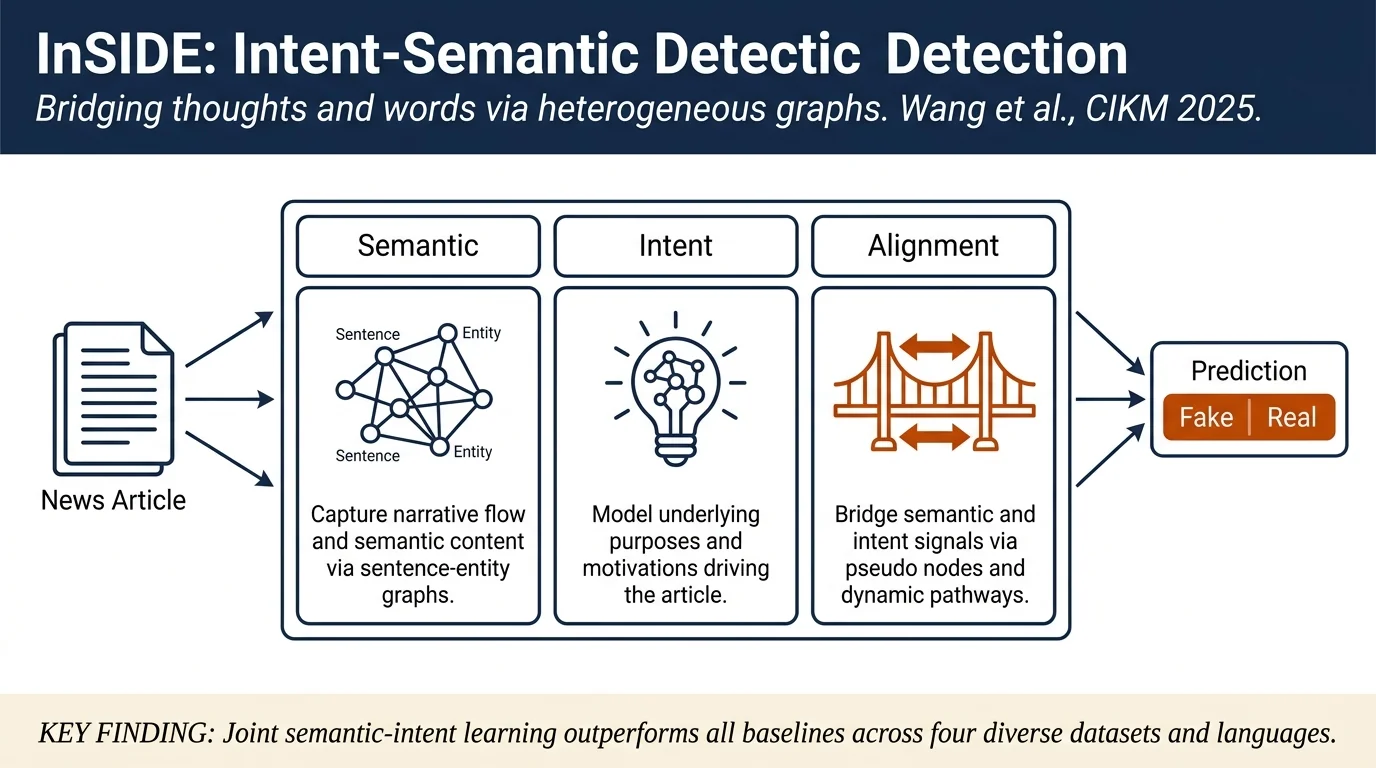
Existing fake news detectors rely on surface-level semantic patterns (emotional language, stylistic cues) and fail when writing styles shift. This paper proposes InSIDE, which combines semantic and intent signals via heterogeneous graphs: intent models the purpose behind an article (e.g., promoting a product), while semantics capture narrative flow. A dynamic alignment module bridges both signals, yielding consistent gains across four benchmarks, with up to 9.12% F1 improvement on GossipCop.
Contributions
- Proposes incorporating news intent — the underlying purpose or motivation of an article — as a complement to semantic signals for more robust fake news detection.
- Designs a coarse-to-fine intent modeling strategy that captures both high-level intent concepts (belief, desire, outcome) and fine-grained manifestations across news narratives.
- Introduces a dynamic pathway-based graph alignment module using pseudo nodes to bridge heterogeneous semantic and intent graph structures, enabling effective cross-signal integration without redundant direct connections.
- Demonstrates consistent improvements over state-of-the-art intent-agnostic and intent-aware baselines across diverse datasets (PolitiFact, GossipCop, Weibo, LLMFake) spanning multiple languages and news sources.
Method
InSIDE transforms a news article into two heterogeneous graphs that capture complementary signals:
Semantic Graph (G^sem): Represents narrative structure and semantic content. - Sentence and entity nodes extracted via NLP processing - Local edges (ℒ^local): sliding-window connections between adjacent sentences, capturing coherent narrative flow while maintaining computational efficiency - Global edges (ℒ^global): entity-mediated connections across distant sentences, enabling long-range context modeling
Intent Graph (G^int): Models the underlying motivations and purposes driving the article. - Coarse-grained intent nodes (C): high-level conceptual intents (e.g., belief, desire, outcome) initialized via frozen generative language models and prompting - Fine-grained intent nodes (ℐ^fine): learnable intent nodes initialized from coarse-grained embeddings, capturing specific intent manifestations in the article's narrative - Coarse-coarse edges (ℒ^coarse): logical dependencies among intent concepts - Coarse-fine edges (ℒ^fine): connections from high-level intents to their narrative realizations
Graph Updates: Dual-level message passing on both graphs. - Local message passing: each node gathers information from immediate neighbors via learnable edge weights - Global message passing: a super root node aggregates information across the entire graph to provide holistic context
Dynamic Pathway-based Alignment: Bridges semantic and intent signals without direct node-to-node connections. - Introduces pseudo nodes (V^p) that act as conceptual bridges between the two graph spaces - Pseudo nodes are fully connected to all semantic and intent nodes via pseudo edges - Dynamic message passing on pseudo nodes uses multi-layer perceptron-based edge features and attention weights to identify critical information pathways - Bidirectional information flow through pseudo nodes enables nuanced intent-semantic interactions while eliminating redundant and conflicting node connections
Prediction: Features from pseudo nodes are aggregated via mean pooling and fed to an MLP classifier with cross-entropy loss.
Results
InSIDE is evaluated on four benchmark datasets spanning English and Chinese news, with both real-time and chronological train-test splits (for temporal robustness):
| Dataset | Method | MacF1 | Accuracy |
|---|---|---|---|
| PolitiFact | InSIDE | 0.6823 | 0.6855 |
| BERT (baseline) | 0.6078 | 0.6083 | |
| GossipCop | InSIDE | 0.8653 | 0.9002 |
| BERT | 0.8078 | 0.8583 | |
| DMInt (intent-aware SOTA) | 0.7960 | 0.8845 | |
| InSIDE | 0.8807 | 0.9218 | |
| BERT | 0.7750 | 0.8895 | |
| LLMFake | InSIDE | 0.9247 | 0.9247 |
| BERT | 0.8588 | 0.9013 |
Key findings: - InSIDE consistently outperforms all baselines, including recent intent-aware methods (DMInt, DM-Inter), demonstrating the value of joint semantic-intent learning - Ablation studies confirm that entity nodes, sliding-window semantics, fine-grained intent nodes, and global message passing all contribute meaningfully - The dynamic pathway-based alignment significantly outperforms naive direct-connection approaches - Framework is adaptable across different intent conceptualizations (tested with four intent frameworks)
Connections
Related work cited in this paper: - Wang et al. (2025) — Interdisciplinary intent research framework; foundational for the coarse-to-fine intent modeling strategy - Sheng et al. (2021) — Semantic-only detection methods that this work extends with intent signals - Zhu et al. (2022) — Graph-based structure-aware detection; InSIDE uses similar graph foundations but adds intent modeling - Nan et al. (2024) — User-comment and external-signal approaches; InSIDE focuses on content-intrinsic signals for early detection without propagation - Chen and Shu (2023) — LLM-generated fake news dataset (LLMFake); InSIDE validation on this emerging challenge
Notes
Strengths: - Novel perspective: intent as a stable signal complementary to semantic patterns. While semantic cues shift across domains and time, underlying motivations (e.g., driving sales, spreading panic) remain consistent — this is a well-motivated asymmetry. - Coarse-to-fine intent design is elegant: conceptual intents are framework-agnostic (initialized via frozen LLMs and prompts), while fine-grained nodes capture implementation specificity. This flexibility is demonstrated empirically with four frameworks. - Dynamic alignment via pseudo nodes is cleaner than naive graph merging and avoids redundant inter-graph edges. - Comprehensive evaluation: four diverse datasets, multiple languages, temporal robustness splits, numerous baselines (intent-agnostic and intent-aware), ablations, and extensibility tests.
Limitations and open questions: - Intent annotation quality: Coarse-grained intent nodes are initialized via frozen LLMs and prompts (Wang et al. 2025). If that upstream framework misses or mischaracterizes intent, downstream performance suffers. The paper assumes the prompting strategy is robust but doesn't deeply analyze failure modes. - Scalability: Graph size grows with document length and entity count (max 32 entities, 3-layer GNNs). For very long documents or high-entity scenarios, computational cost may limit applicability. - Generalization to emerging tactics: Fake news tactics evolve (deepfakes, synthetic media). InSIDE assumes intent-semantic mismatch remains the key signal; if misinformation shifts to intent-aligned deceptive narratives (e.g., "I really do want to help but this product cures cancer"), intent alone may become unreliable. - Human interpretability: While the dynamic alignment identifies critical pathways via attention weights, the paper does not provide case studies showing practitioners what specific intent signals the model learned or how they manifest linguistically.
Future directions: - Compare against multimodal fake news (video, image, audio) where intent might be signaled differently - Investigate whether intent representations transfer across languages or news domains without retraining - Develop interactive explanations showing which intent manifestations influenced a prediction - Explore adversarial robustness: can adversaries craft intent-semantic mismatch that fools both signals?