Neighborhood-Order Learning Graph Attention Network for Fake News Detection
Authors: Batool Lakzaei, Mostafa Haghir Chehrghani, Alireza Bagheri Affiliation: Amirkabir University of Technology (Tehran Polytechnic), Iran Preprint: arXiv 2502.06927, February 2025
TL;DR
Proposes NOL-GAT (Neighborhood-Order Learning Graph Attention Network), a GNN architecture that allows each node to adaptively select its optimal hop-neighborhood at each layer, bypassing the fixed L-hop limitation of conventional message-passing GNNs. Evaluated on five fake news datasets, NOL-GAT outperforms baseline GNN methods, especially in low-data regimes (10%–30% labeled).
Contributions
- Introduces an adaptive GNN architecture where each node independently determines its neighborhood order at every layer via a differentiable Gumbel-Softmax mechanism.
- Proposes a two-component design: a Hop Network (Φ) that learns optimal neighborhood orders, and an Embedding Network (Ψ) that updates node representations using those neighborhoods.
- Addresses core GNN limitations: over-smoothing, over-squashing, and excessive computational cost by selective neighbor aggregation.
- Demonstrates consistent improvements over semi-supervised baselines (CO-GNN, L2Q, TGNcl, TextGCN, LSTM-CP-GCN, GATv2) across five datasets with varying label scarcity.
Method
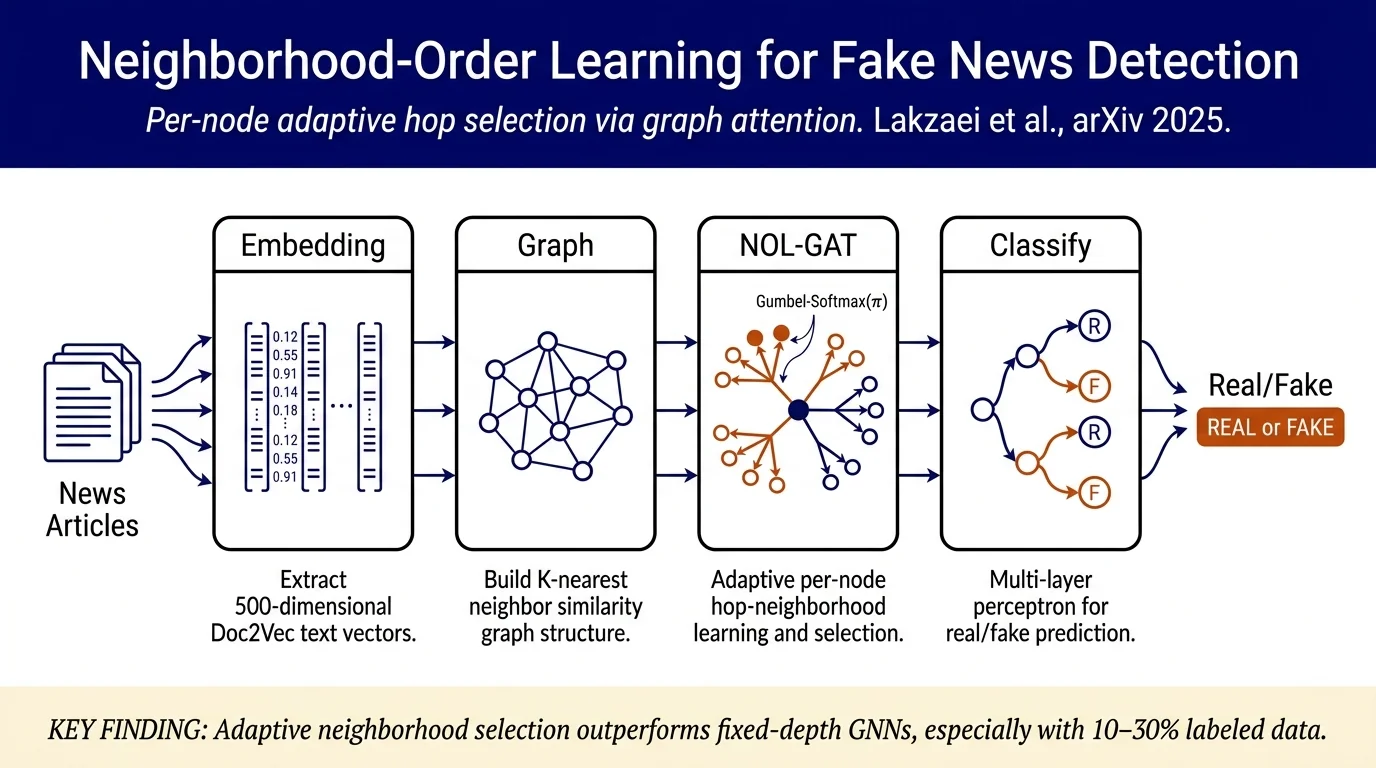
The NOL-GAT pipeline consists of four stages:
- Feature extraction: News text is embedded using Doc2Vec, generating 500-dimensional vectors.
- Graph construction: A K-nearest-neighbor similarity graph is built, connecting each news item to its K nearest neighbors by cosine similarity.
- NOL-GAT layers: For each node at each layer:
- The Hop Network predicts a probability distribution over possible neighborhood orders (1-hop, 2-hop, ..., d_g-hop, where d_g is graph diameter) using a GAT v2 backbone and Gumbel-Softmax sampling.
- The selected neighborhood (determined by the sampled hop count) is used to aggregate information via the Embedding Network (also GAT v2).
- This allows different nodes to use different neighborhood sizes without fixing the hop-distance globally.
- Classification: Final embeddings from layer L are fed to a Multi-Layer Perceptron for binary fake/real prediction.
The training uses binary cross-entropy loss on labeled examples; the Gumbel-Softmax estimator provides a differentiable approximation of discrete sampling.
Results
Evaluated on five fake news datasets with three label proportion scenarios (10%, 20%, 30% labeled):
Fake.Br (Portuguese, 7,200 articles): - 10% labeled: 0.8126 accuracy, 0.8139 macro-F1 - 30% labeled: 0.8287 accuracy, 0.8327 macro-F1 - Outperforms TextGCN (0.6235 / 0.6112) and Co-GNN (0.6391 / 0.6139)
Fact-checked News (Portuguese, 2,168 articles): - 10% labeled: 0.9358 accuracy, 0.9382 macro-F1 - 30% labeled: 0.9501 accuracy, 0.9513 macro-F1 - Next-best (Co-GNN): 0.9096 / 0.9282
FakeNewsNet (English, 7,003 articles): - 10% labeled: 0.8525 accuracy, 0.7772 macro-F1 - 30% labeled: 0.8589 accuracy, 0.7916 macro-F1 - Exceeds Co-GNN (0.8139 / 0.6662) and GATv2 (0.7986 / 0.6883)
FakeNewsDetection (English, 3,988 articles): - 10% labeled: 0.8892 accuracy, 0.8908 macro-F1 - 30% labeled: 0.9014 accuracy, 0.9044 macro-F1 - Competitive edge over Co-GNN (0.8210 / 0.7953)
FakeNewsData (English, 20,700 articles): - 10% labeled: 0.8837 accuracy, 0.8837 macro-F1 - 30% labeled: 0.8947 accuracy, 0.8957 macro-F1 - Outperforms Co-GNN (0.8703 / 0.8703) and GATv2 (0.8513 / 0.8513)
Connections
- Related to Propagation-based fake news detection through graph-structured modeling of news similarity.
- Extends Graph Neural Networks by enabling per-node adaptive aggregation depth, addressing over-squashing and over-smoothing identified in deep message-passing literature.
- Shares semi-supervised learning methodology with Semi Supervised Learning.
- Applies graph attention networks as backbone for both hop-order prediction and embedding updates.
- Addresses limitations of message-passing neural networks by enabling adaptive per-node neighborhood selection.
Notes
Strengths: - Novel approach to a concrete GNN limitation (fixed L-hop neighborhoods). The Gumbel-Softmax mechanism for differentiable discrete choice is well-motivated. - Strong empirical results across five datasets with multiple label regimes. Particularly impressive in low-data settings (10% labeled). - Clear problem motivation: explains why standard GNNs fail to leverage distant but important nodes, and why simply adding more layers doesn't work.
Limitations: - Still a preprint (February 2025); peer-review status unknown. - Computational complexity analysis sparse. The overhead of running the Hop Network at every node in every layer is not compared quantitatively to baselines. - Graph construction (K-NN with cosine similarity) is simplistic; other similarity measures or learned graph structures are not explored. - Content-only approach (text embeddings only); ignores user profiles, sharing patterns, or temporal dynamics that may carry signal in real-world deployment. - Evaluation limited to text-based fake news detection. Transferability to multimodal (image + text) disinformation unknown.