 Filippo Menczer
Contributions
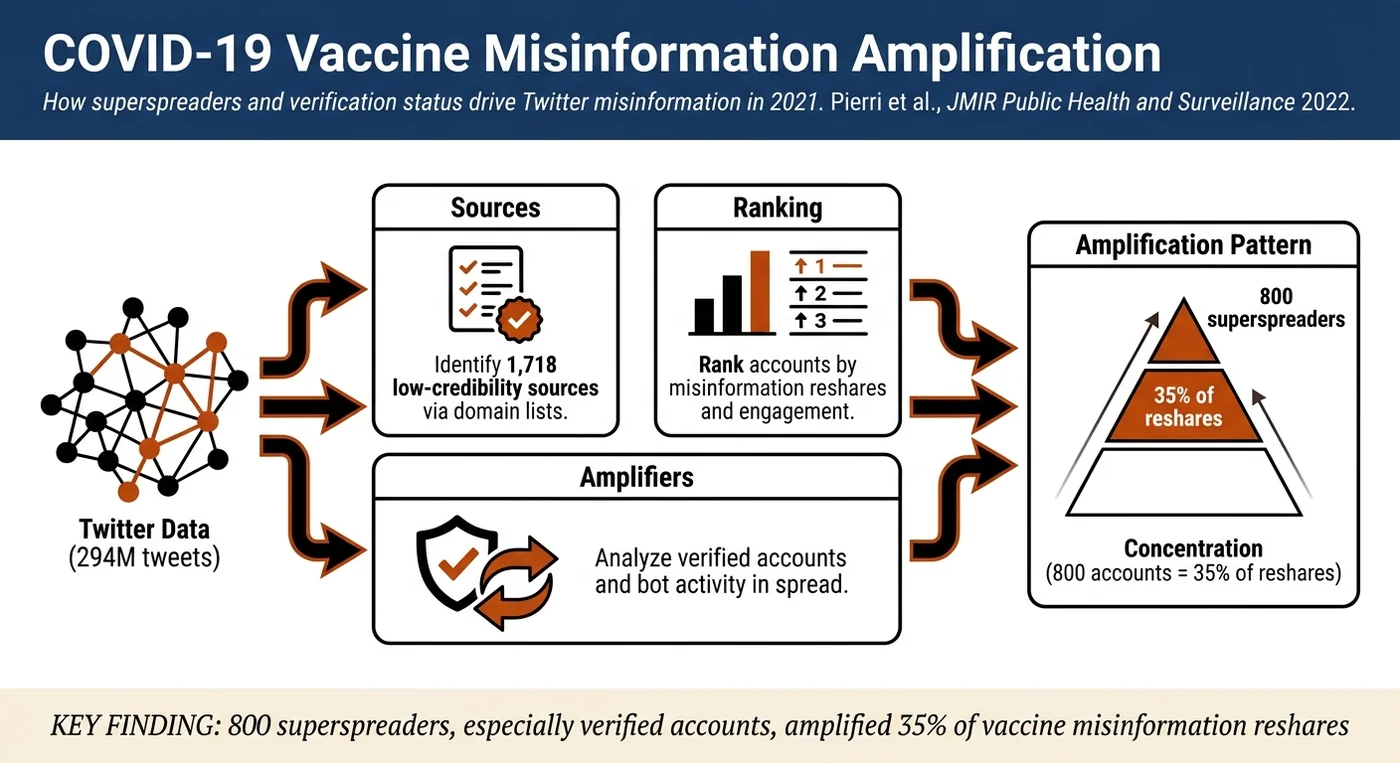
- Analyzed 294 million tweets about COVID-19 vaccines over 12 months (Jan–Dec 2021) from 19.5 million unique users
- Identified misinformation using domain-based approach combining Iffy+ and NewsGuard lists (1,718 low-credibility sources)
- Documented increasing trend in vaccine misinformation prevalence throughout 2021
- Identified and characterized "superspreaders" responsible for disproportionate share of misinformation amplification
- Demonstrated that verified Twitter accounts played outsized role in spreading low-credibility vaccine content
- Found automated accounts (bots) more active in sharing low-credibility news and inaccessible YouTube videos
- Identified Children's Health Defense as most shared low-credibility vaccine source, outperforming CDC and WHO
Method
Data collection: Real-time Twitter API data (January 4 – December 31, 2021) using keywords related to COVID-19 vaccines. Collected 294,081,599 tweets containing vaccine-related keywords from 19,581,249 unique users. Extracted URLs and analyzed link targets.
Misinformation identification: Two-pronged approach: (1) domain-based using Iffy+ Misinformation list (low-credibility websites compiled by journalists and fact-checkers) and NewsGuard reliability scores; (2) manual validation of link content by two independent coders. Combined approach yielded 1,718 low-credibility sources; also included mainstream baseline (CDC, WHO, major news outlets with NewsGuard scores >80).
Bot detection: Used BotometerLite to calculate bot scores for accounts (range 0–1; higher = more likely automated). Analyzed bot activity across different tweet categories.
Superspreader analysis: Ranked accounts by number of retweets to their posts linking to low-credibility sources. Investigated role of verified accounts vs. automated accounts. YouTube video analysis via YouTube API for accessibility and content.
Results
Prevalence and contagion:
- Low-credibility sources less prevalent overall (1.31% vs. 7.53% of vaccine tweets for mainstream) but showed increasing trend (p < 0.001)
- Mainstream news showed opposite decreasing trend (p < 0.001)
- Low-credibility content spread more through retweets than mainstream content (suggesting higher contagion potential through social networks)
- Peak in low-credibility prevalence in July 2021, coinciding with Children's Health Defense prominence
Misinformation sources:
- Children's Health Defense (CHD) was most shared low-credibility source, with 0.30% of all vaccine tweets and reshare volumes comparable to mainstream sources like Washington Post and Reuters
- Top 20 sources dominated; CHD alone accounted for ~20% of low-credibility tweets
Superspreaders:
- ~800 accounts ("superspreaders") accounted for ~35% of misinformation reshares on average daily basis
- 11 of top 25 superspreaders were Twitter-verified accounts
- Verified accounts represented only ~6% of low-credibility content posters but responsible for 43% of low-credibility vaccine content reshares
- Top superspreader: Robert Kennedy Jr. (@RobertKennedyJr), verified account responsible for 13.4% of low-credibility vaccine content reshares (~370,000 retweets)
- RobertKennedyJr account had 3.8× more followers than unverified @ChildrensHD account (416.2k vs. 109.8k as of April 2022)
Bot activity:
- Tweets sharing low-credibility sources had significantly higher bot-activity levels than vaccine tweets overall (median bot scores 0.25 vs. 0.22)
- Inaccessible YouTube videos had even higher bot scores (0.26)
- Automated accounts played amplification role but did not show temporal trend of increasing bot activity
Notes
Strengths: Large-scale longitudinal analysis across full year of pandemic; dual approach to misinformation identification (domain-based + manual validation); clear quantification of superspreader impact; demonstration that verified accounts play central role in misinformation spread; bot analysis at scale.
Limitations: English-language Twitter only (not globally representative); domain-based approach not perfect (some credible sources may be false negatives, some low-credibility sources may avoid explicit websites); BotometerLite imperfect at bot detection; YouTube video analysis limited to publicly accessible videos; Twitter users not representative of general population demographically.
Implications: Findings suggest targeting moderation efforts at a small number of verified superspreaders could significantly reduce misinformation spread. Financial incentives driving superspreaders merit investigation. Platforms should consider role of automation in amplification when designing interventions.