 Filippo Menczer
Contributions
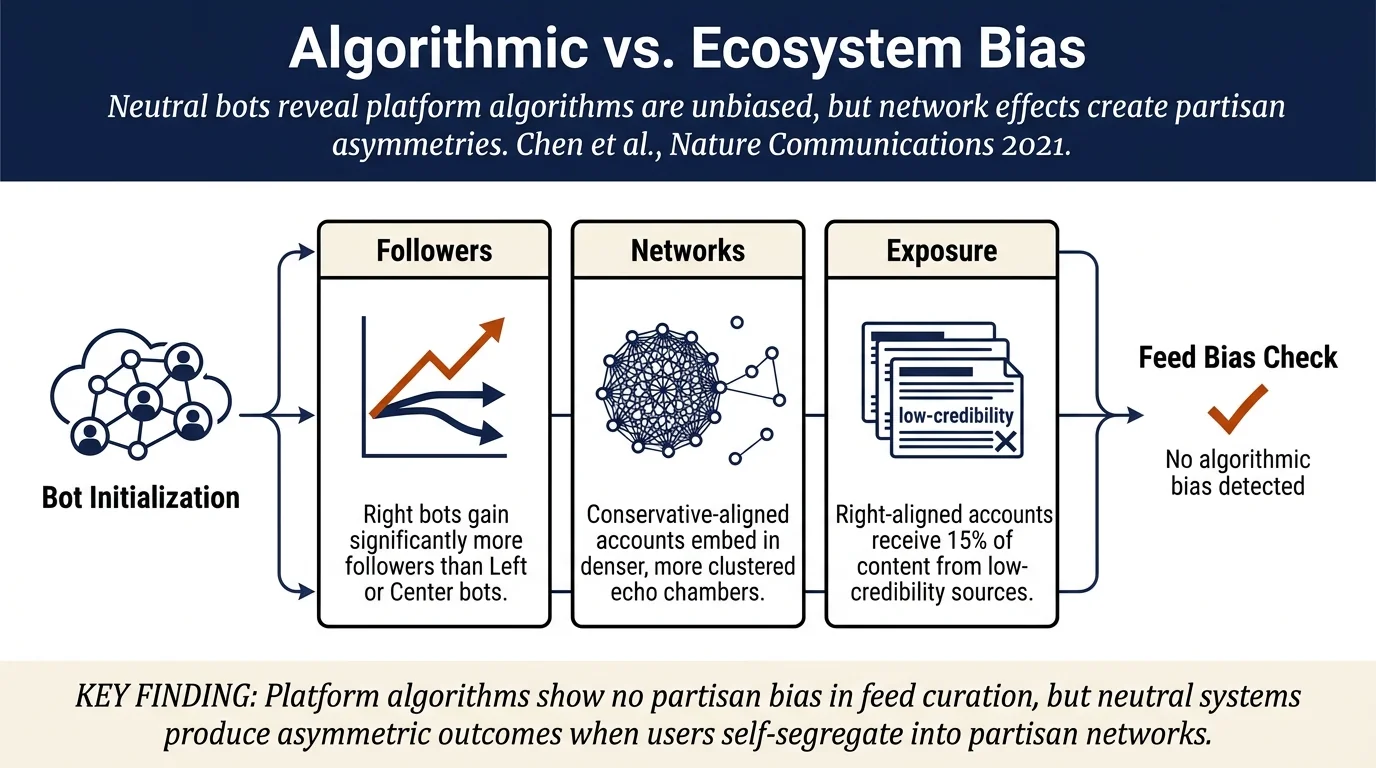
- Methodology: Introduces "drifter" bots with neutral behavior models as instruments to isolate platform effects from user-driven network effects in information exposure
- Empirical finding: No evidence of platform bias in news feed, contradicting claims of partisan algorithmic suppression
- Structural insight: Conservative-aligned accounts accumulate in denser social networks and are preferentially followed by bots, creating differential exposure to low-credibility content
- Mechanism: Demonstrates that asymmetric exposure depends on early network choices (initial following decisions), not platform ranking algorithms
- Policy implication: Neutral algorithms do not necessarily yield neutral outcomes when users form homophilic networks
Method
The study deployed 15 social bots (5 groups of 3) on Twitter, each initialized with a single initial following from news sources spanning the political spectrum: Left (The Nation), Center-Left (Washington Post), Center (USA Today), Center-Right (Wall Street Journal), Right (Breitbart). The bots followed a stochastic behavior model designed to be politically neutral—randomly selecting actions (tweets, retweets, likes, replies) from predefined probability distributions, without capability to discriminate content by political alignment. All actions were time-drawn from power-law distributions to replicate human bursty behavior. Between July and December 2019 (5 months), the researchers tracked: follower growth, echo-chamber density and clustering (transitivity), bot prevalence among bots' friends and followers, exposure to low-credibility sources, and political alignment of consumed and produced content (via word2vec embeddings on hashtags and domain analysis on shared links).
Results
Influence and follower growth:
- Right-aligned drifters gained followers significantly faster than Left-aligned drifters ($t=3.84, p<0.001$)
- Partisan drifters (Left/Right) gained more followers than Center drifters ($t=5.13$ for Right vs. Center, $p<0.001$)
- Effect correlates with popularity of initial friend among politically aligned accounts, suggesting homophilic preference reinforces partisan accounts' reach
Echo chamber structure:
- Right-aligned drifter networks show higher density and transitivity than Center networks ($p<0.001$)
- Left-aligned drifters' networks are more moderate in structure; several Left drifters shifted allegiance toward the Center after following diverse sources
- Right drifters embed in denser, more clustered communities despite comparable ideological homogeneity (normalized transitivity not significantly different)
Automated account prevalence:
- Partisan drifters follow more bot-like accounts than centrist drifters (Right vs. Center: $t=-6.14, p<0.001$)
- Right drifters follow accounts scoring higher on bot likelihood than Left drifters ($t=-2.33, p=0.020$)
Exposure to low-credibility content:
- Right drifters receive ~15% of links in home timelines from low-credibility sources, significantly more than all other groups ($t=5.06, p=0.007$ vs. Center-Right, $t=27.47$ vs. Center)
- Low-credibility exposure does not correlate with Breitbart News (intentionally excluded from list to prevent analysis bias), but drifter network structure and bot prevalence likely contribute
Political bias in news feed:
- Measuring $s_h$ (exposure in home timeline) vs. $s_f$ (friends' posts): For hashtag-based alignment, Right drifters show small but significant shift toward Center ($d=0.56, p<0.001$), while other groups show no significant feed bias
- Link-based alignment similarly shows weak/small effects for most groups (Center group shows Left bias: $d=0.76, p<0.001$)
- Conclusion: No strong or consistent evidence that Twitter's news-feed algorithm amplifies or suppresses partisan content
Asymmetric drift in content production:
- Left-aligned drifters produce increasingly moderate content as experiment progresses, shifting toward Center
- Right-aligned drifters maintain Right-leaning output with minimal centering trend
- Demonstrates user behavior and network pressure (not platform algorithm) drive partisan content production
Notes
Strengths:
- Novel methodology overcomes a persistent challenge in misinformation research: controlling for confounding factors (age, gender, ideology) of tracked human accounts
- Longitudinal 5-month study captures dynamics across multiple dimensions simultaneously
- Addresses a high-stakes policy question with rigorous experimental design
- Code and anonymized data publicly released for reproducibility
Limitations:
- Small sample (15 bots) limits generalization; ethical constraints on scale
- Findings specific to Twitter; may not generalize to Facebook, TikTok, or other platforms with different algorithmic curation
- Cannot directly measure algorithmic ranking effects (Twitter's recommendation engine not accessible via API)
- Initial-friend selection (while politically diverse) confounds with their popularity and partisan audiences' engagement levels
Key takeaway for GUIDE: This paper exemplifies the gap between algorithmic bias (what systems intend) and ecosystem bias (what systems produce through user interaction). It's widely cited in policy debates about platform regulation, but careful reading reveals the finding is narrower than claims: no evidence of feed-curation bias, but clear evidence that networks and inauthentic accounts create asymmetric exposure. The implied remedy—that "neutral algorithms are enough"—is contradicted by the paper's own findings: even neutral behavior produces politically skewed outcomes when users self-segregate.