COVID-19 misinformation encompasses false, misleading, and unsubstantiated claims about the coronavirus pandemic, its origins, prevention measures, treatments, and vaccines. During the pandemic, misinformation exploited widespread uncertainty and fear, was weaponized for political purposes, and contributed to preventable deaths and vaccine hesitancy. False narratives included origin conspiracy theories, unproven treatments (ivermectin, hydroxychloroquine), and claims that vaccines were dangerous or ineffective.
Key dimensions
Origins and causes: False narratives about COVID-19's origins (lab-leak, bioweapon, biological warfare) became politically polarized along partisan lines; scientific uncertainty was exploited to spread geopolitically motivated disinformation.
Treatments and interventions: Misinformation promoted unproven or harmful treatments (ivermectin for human use, hydroxychloroquine, bleach injections); vaccine hesitancy became intertwined with political identity and distrust of public health institutions.
Political exploitation: Right-wing politicians and media outlets leveraged pandemic uncertainty and health fears to undermine public health measures; false claims about COVID severity and vaccines' dangers became central to anti-lockdown and anti-vaccination movements.
Medical harm: Misinformation contributed to preventable deaths, vaccine hesitancy that prolonged the pandemic, and erosion of trust in public health institutions.
Platform role: Social media platforms amplified misinformation through algorithmic recommendation, engaged emotional response over accuracy, and resisted early transparency and content moderation.
Case studies
Lab-leak disinformation: A coordinated campaign (involving Steve Bannon, exiled billionaire Guo Wengui, and scientist Li-Meng Yan) weaponized preprint archives and right-wing media to promote the false narrative that COVID-19 was engineered in a laboratory. The campaign exploited academic infrastructure (Zenodo preprint archive) and political polarization.
Key talks and papers in this wiki
- Donovan — Investigating Media Manipulation and Disinformation — in-depth case study of the lab-leak disinformation campaign; documents how it exploited academic preprint archives, right-wing media amplification, and uncertainty to spread; shows connection between false narratives and anti-Asian hate crimes
Related topics
- misinformation-responses — interventions and debunking strategies
- media-manipulation — coordinated campaigns spreading COVID-related false claims
- vaccine-hesitancy — misinformation about vaccine safety and efficacy
- health-misinformation — broader category of false health claims
- political-polarization — how COVID misinformation became partisan
See also
Papers on this topic
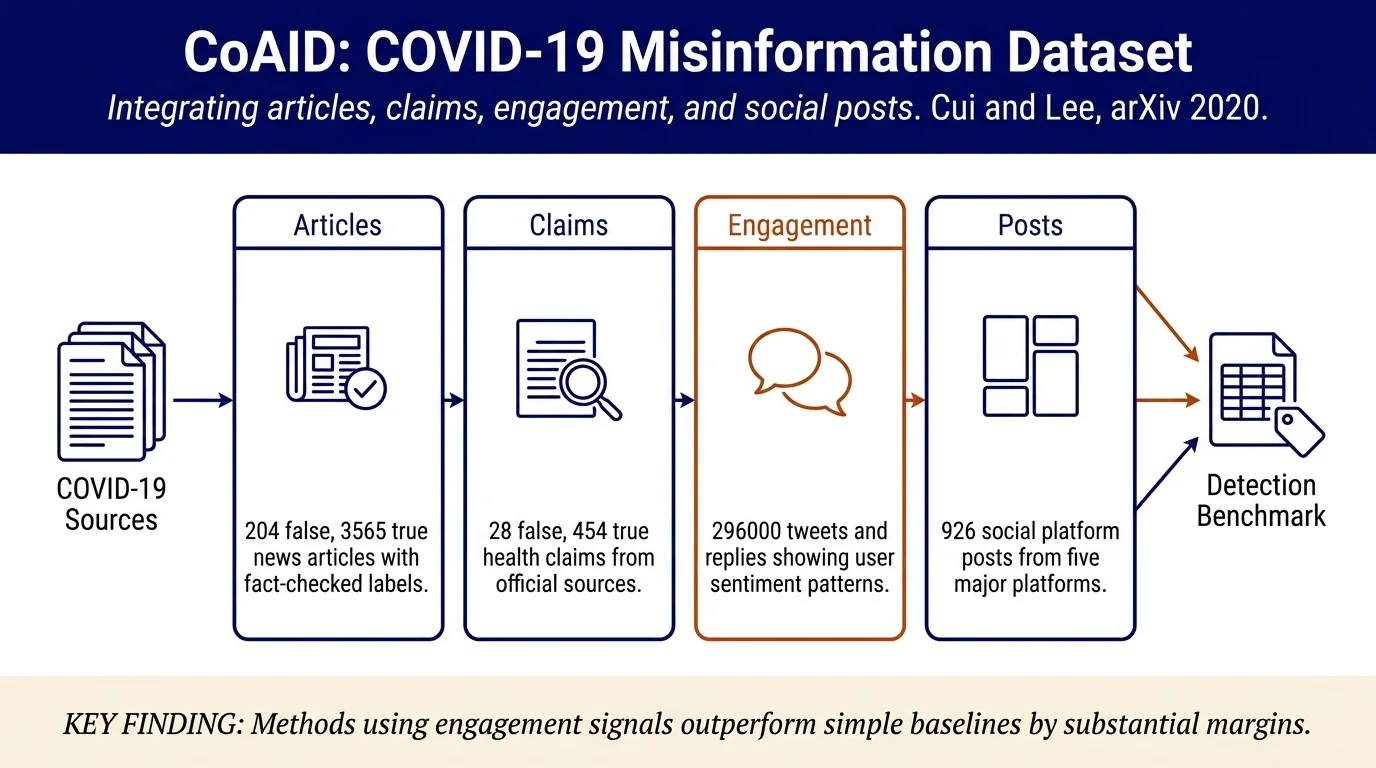 Datasets & evaluationSpread & networks
CoAID: COVID-19 Healthcare Misinformation Dataset
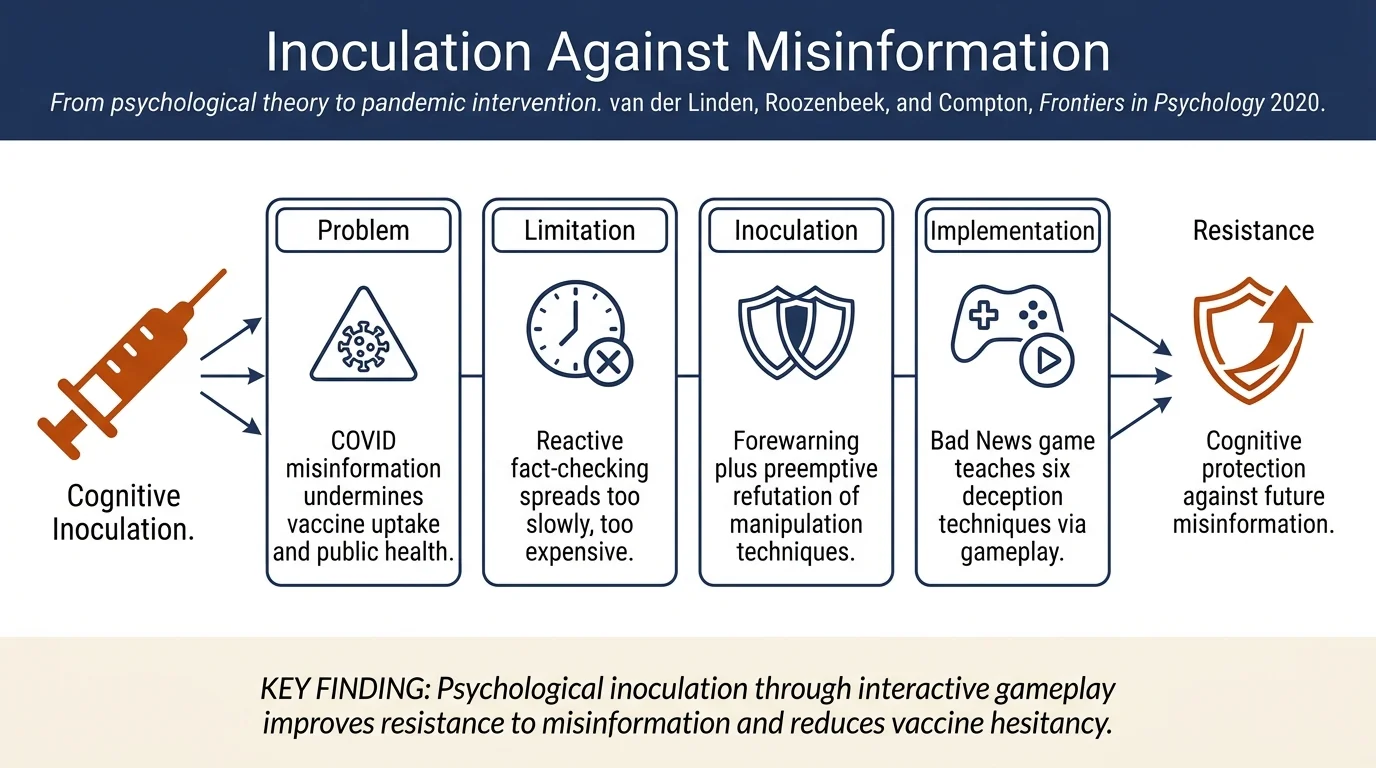 Psychology & interventionsPlatforms, policy & society
Inoculating Against Fake News About COVID-19
 Psychology & interventionsDetection methods
Towards psychological herd immunity: Cross-cultural prebunking against COVID-19 misinformation