Contributions
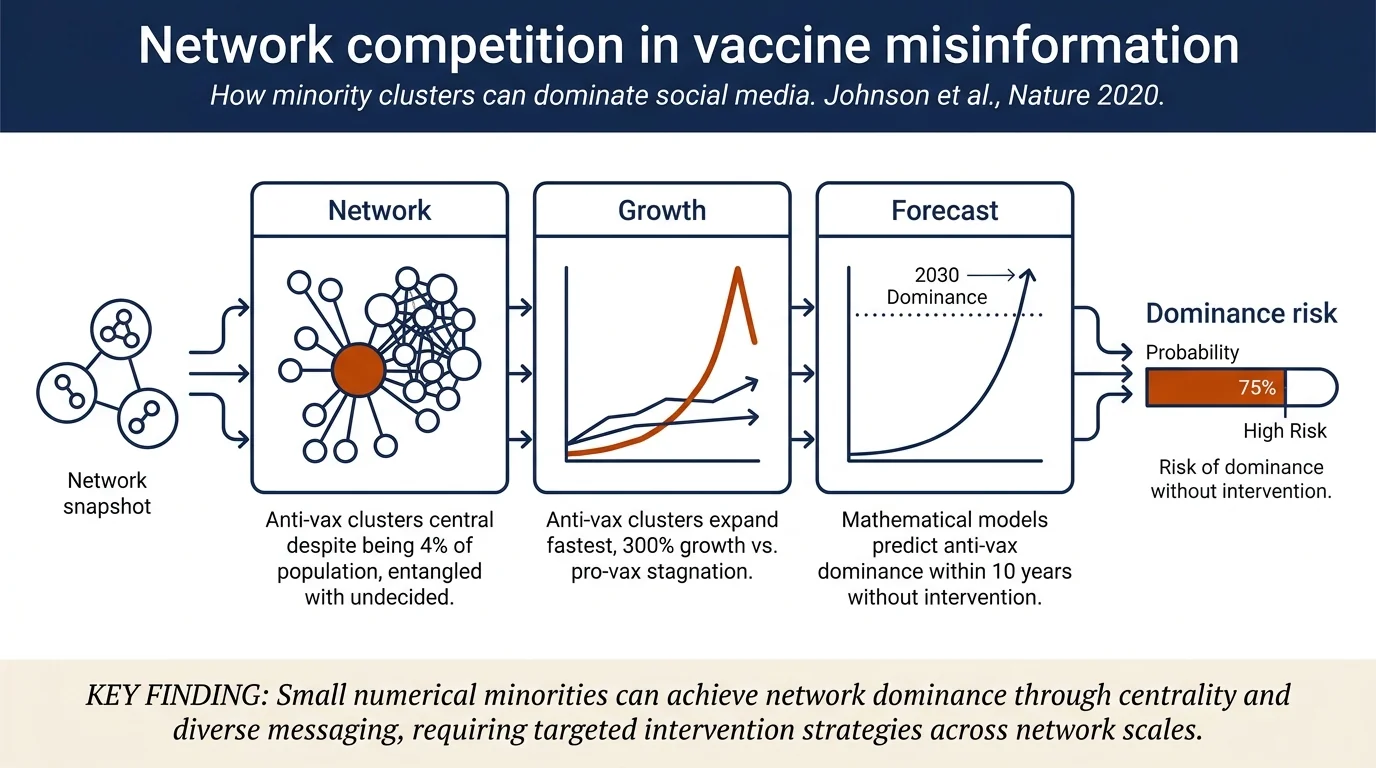
- Network mapping of the global vaccine debate ecosystem from Facebook's ~3 billion users, identifying three constituency groups (anti-vaccination, pro-vaccination, undecided) and their interconnection patterns.
- Seven structural features explaining anti-vaccination cluster resilience: centrality despite minority size, active (not passive) undecided clusters, diverse cluster formation strategy, diverse narratives vs. monothematic pro-vaccination messaging, growth during crisis (2019 measles outbreak), medium-sized cluster growth advantage, and geographic distribution.
- Theoretical framework predicting conditions for anti-vaccination dominance within ~10 years under current dynamics.
- Intervention strategies at three scales: individual cluster (increase heterogeneity in engagement), network patch (proactive cross-cluster engagement), and system-wide (manipulate link formation and inactivation rates).
Method
Facebook pages are the unit of analysis (clusters). The researchers used a snowballing methodology combining automated processes and human subject-matter expertise to identify vaccine-related clusters. Network visualization employs ForceAtlas2 (a force-directed layout in Gephi where nodes repel and links act as springs); color segregation emerges spontaneously. Mathematical models building on published results in collective behavior and population dynamics reproduce the empirical observations and predict future trajectories.
Results
Network structure (October 2019 snapshot):
- 4.2 million anti-vaccination individuals in 317 clusters (average ~13,000 per cluster)
- 6.9 million pro-vaccination individuals in 124 clusters (average ~56,000 per cluster)
- 74.1 million undecided individuals in 885 clusters (average ~84,000 per cluster)
Growth patterns (February–October 2019):
- Anti-vaccination clusters show strongest growth: some increase >300%, compared to <100% for pro-vaccination
- Medium-sized anti-vaccination clusters grow fastest (contrary to preferential-attachment theory)
- Undecided clusters show highest rate of new outgoing links, particularly those entangled with anti-vaccination clusters
Network topology:
- Anti-vaccination clusters dominate the largest connected component, central and heavily entangled with undecided clusters
- Pro-vaccination clusters confined to smaller network patches, peripheral to the main conflict
- Geography favors anti-vaccination groups: local clusters interconnect through global clusters, creating perception of both local and global campaigns
Notes
This paper was among the first to provide a system-level quantitative mapping of competing information ecosystems on social media at scale. The finding that numerical minorities can achieve network centrality through strategic fragmentation and diverse messaging has profound implications for platform policy and public health communication. The prediction of anti-vaccination dominance within a decade (made in 2020, before widespread COVID-19 vaccine rollout) proved to be a significant underestimate given subsequent events, but the structural insights remain valid. The framework's emphasis on cluster heterogeneity as an intervention lever is novel and supported by mathematical models. One limitation: the analysis depends on Facebook's public recommendations and declared locations, which are incomplete proxies for actual influence patterns.