 Alessandro Flammini
 Filippo Menczer
Contributions
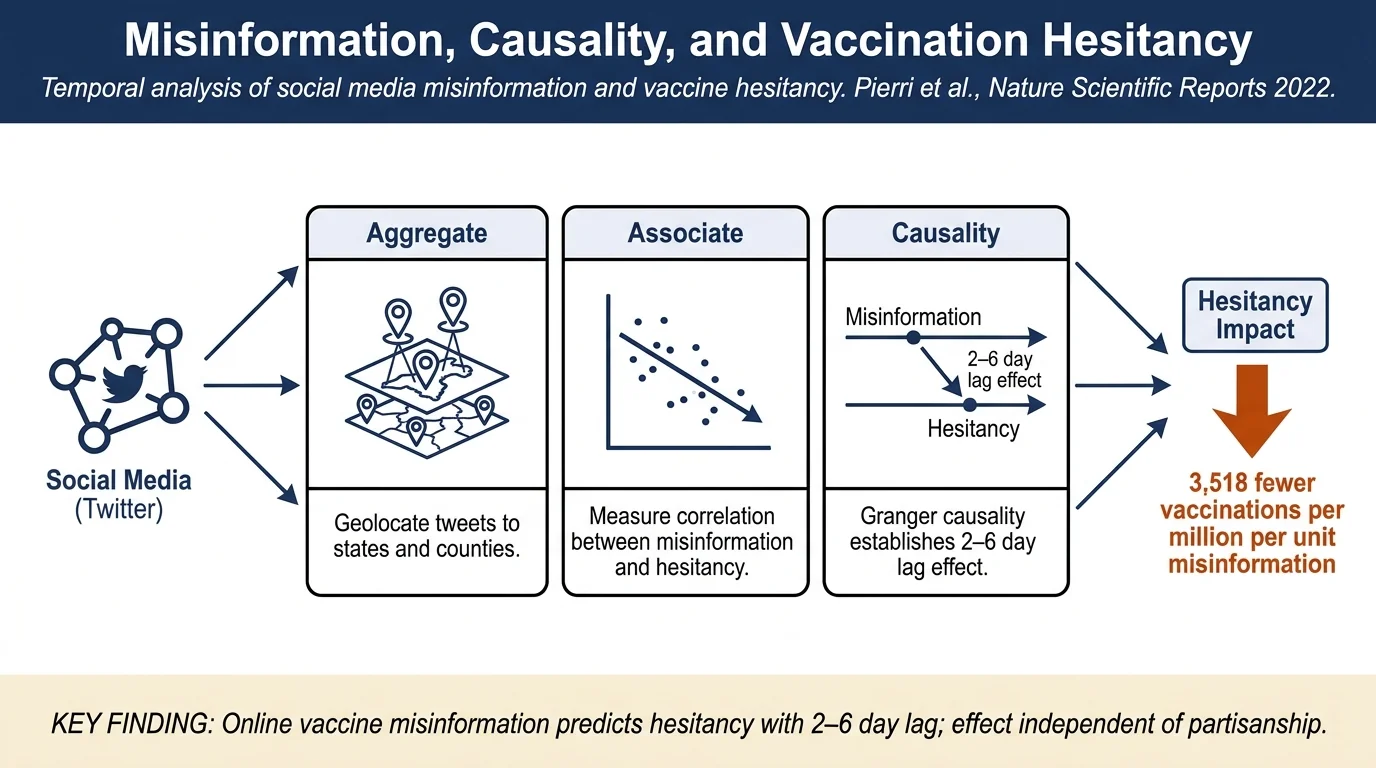
- Quantifies the correlation between online vaccine misinformation (via Twitter) and vaccination rates and hesitancy at state and county levels, controlling for socioeconomic, demographic, and political factors.
- Demonstrates that the effect of misinformation on hesitancy is strongest in Democratic counties, suggesting a ceiling effect in Republican-leaning regions.
- Employs Granger causality analysis to establish directionality: misinformation precedes hesitancy with a 2–6 day lag, particularly at county level.
- Identifies the most-shared low-credibility sources, with Children's Health Defense dominating the vaccine-related misinformation landscape.
Method
The authors analyzed 55 million tweets from the CoVaxxy dataset (January 4–March 25, 2021) using Twitter's filtered stream API and a comprehensive list of vaccine-related keywords. They geolocated ~1.67 million users to U.S. states and ~1.15 million to >1,300 counties using the Carmen library. Misinformation was identified by measuring the proportion of tweets containing links to news articles from low-credibility websites (compiled by a politically neutral third party).
Vaccination uptake was measured from CDC daily vaccination rates (week of March 19–25, 2021); vaccine hesitancy from Facebook Symptom Surveys administered by the Delphi Group at Carnegie Mellon University (January 4–March 25, 2021). Weighted multiple linear regression models controlled for poverty rate, age (65+), racial/ethnic composition, rural–urban continuum code (county level), COVID-19 death rate, and Republican vote share.
Granger causality analysis compared two autoregressive models: one predicting hesitancy from its own lagged values, and one that added misinformation as an exogenous variable. A bootstrap method with 10,000 permutations estimated p-values. Time window was optimized at $n = 6$ days.
Results
State-level findings: Online misinformation and vaccination uptake showed a negative correlation (Pearson $R = -0.49$, $p < 0.001$). In a weighted regression, a one-unit increase in misinformation was associated with 3,518 fewer daily vaccinations per million ($b = -3518.00$, $p = 0.009$). Misinformation was also significantly associated with vaccine hesitancy ($b = 6.88$, $p = 0.007$), independent of political partisanship.
County-level findings: Among 548 counties, misinformation and political partisanship both predicted hesitancy. Crucially, the interaction between political partisanship and misinformation was significant: as misinformation increased, Democratic and Republican counties converged toward the same hesitancy level (~30%), suggesting a ceiling effect in Republican counties.
Causality: Granger causality analysis showed misinformation helps forecast hesitancy weakly at state level ($p = 0.0519$) and strongly at county level ($p < 0.001$). Lagged coefficients indicate a 2–6 day lag from misinformation to hesitancy.
Top sources: Children's Health Defense dominated the low-credibility sources (~25% of misinformation links), followed by Breitbart, Bitchute, Zerohedge, and others.
Notes
Strengths: The paper uses strong ecological-scale evidence with multiple geographical levels (state and county), controls for confounders including political partisanship, and employs Granger causality to investigate directionality. The finding that misinformation effects are stronger in Democratic counties (counter to base-rate expectations) is striking and well-documented.
Limitations: Measures Twitter sharing activity rather than exposure or dose received. Analyses are aggregated by region, raising ecological inference concerns. Source-based misinformation detection may miss misleading content from credible outlets and cannot capture the full spectrum of harmful vaccine discourse. Data span only 2.5 months (Jan–Mar 2021). Reverse causality cannot be fully ruled out: vaccine-hesitant individuals may preferentially post misinformation.
Open questions: Does the county-level ceiling effect persist post-vaccination campaigns? How does misinformation spread offline after initial exposure online? Do individual-level interventions to counter misinformation scale to population effects?