Individuals, verified accounts, bots, and organizations that disproportionately disseminate and amplify misinformation on social media. Research demonstrates that misinformation spread is highly concentrated: a small number of "superspreaders" account for the majority of false information circulation, while most users share misinformation rarely or not at all.
Typology of spreaders
Verified human accounts: Journalists, celebrities, politicians, academics with large audiences. When these accounts share misinformation, they reach millions instantly. Some profit directly from engagement (advertising, sponsorship); others may spread false claims aligned with their ideological commitments.
Automated accounts (bots): Programmatically controlled accounts that amplify content through retweets, likes, and replies. Used by coordinated inauthentic actors for computational propaganda; may mimic human behavior to evade detection.
Organized networks: Coordinated teams (troll farms, state actors, political operatives) operating multiple accounts to amplify specific narratives; include both human-controlled and automated components.
Organic users: Most social media users share misinformation infrequently; a small fraction accounts for disproportionate share of false information spread through their networks.
News outlets and journalists: Mainstream media sometimes amplifies misinformation through coverage, often inadvertently spreading false narratives while debunking them.
Superspreader phenomenon
Definition: Accounts responsible for disproportionate share of misinformation amplification. Research typically identifies top 10–1000 accounts responsible for 30–50% of misinformation reshares in given domains.
Characteristics: Verified accounts overrepresented among superspreaders; often have clear profit incentives (advertising, merchandise, subscriptions); may accumulate followers through partisan messaging or celebrity status.
Scale: A single superspreader account can reach millions; concentration effects mean targeting small number of actors could substantially reduce misinformation spread.
Deplatforming: Removal of major superspreaders (e.g., Alex Jones, Donald Trump) from platforms caused measurable reduction in misinformation spread; however, deplatforming remains contentious due to free speech concerns.
Mechanisms of amplification
Algorithmic boosting: Platform algorithms prioritize content from verified accounts and accounts with high engagement, inadvertently amplifying misinformation from influential users.
Network effects: Followers of superspreaders retweet and share content to their networks, creating cascading amplification.
Bot coordination: Automated accounts systematically retweet content from human operators, inflating reach and visibility.
Financial incentives: Misinformation monetization through advertising, merchandise, donations creates incentives for continued production and amplification.
Key papers and talks in this wiki
-
DeVerna et al. (2024) — Identifying and characterizing superspreaders of low-credibility content on Twitter — Analyzed 10 months of Twitter data to identify accounts consistently spreading low-credibility content. Found that the h-index and Influence metrics reliably predict which users become superspreaders. Removing top 10 superspreaders eliminates 34% of low-credibility content; top 1,000 eliminate 73-78%. 52% of superspreaders are political; many have large followings, low-credibility media affiliations, and use more toxic language. Shows concentration of responsibility and that verified accounts are less likely to be suspended.
-
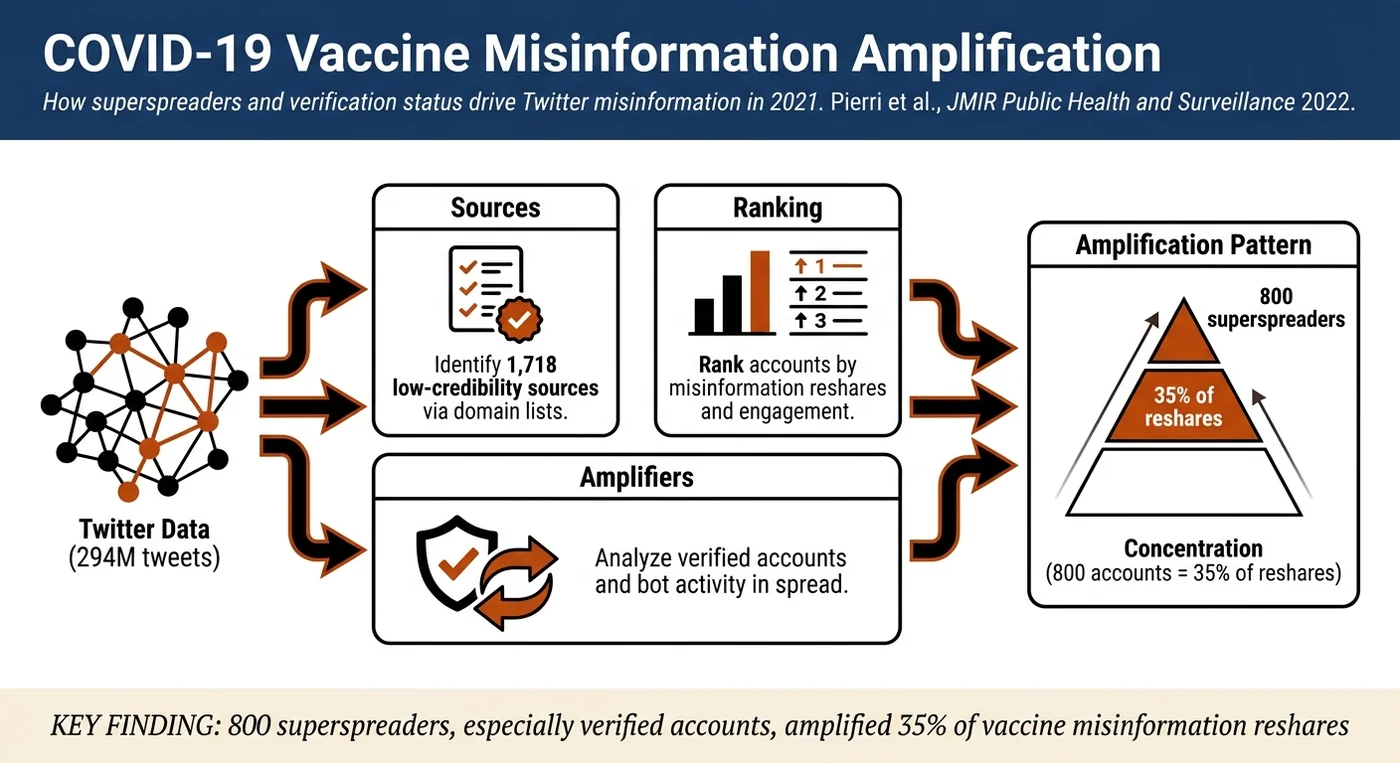
Pierri et al. (2022) — One year of COVID-19 vaccine misinformation on Twitter: Longitudinal study — Identified ~800 "superspreaders" responsible for 35% of vaccine misinformation reshares during 2021. Verified accounts represented only 6% of content posters but accounted for 43% of low-credibility vaccine content reshares. Top superspreader Robert Kennedy Jr. alone responsible for 13.4% of reshares. Demonstrates concentrated impact of small number of accounts.
-
Bradshaw, Bailey & Howard (2021) — Industrialized Disinformation: 2020 Global Inventory of Organized Social Media Manipulation — Global inventory of computational propaganda campaigns in 57 countries; catalogs organized networks of accounts deployed for strategic amplification.
-
Broniatowski et al. (2018) — Weaponized Health Communication — Analysis of 1.79M tweets showing Russian trolls tweeted vaccine content at 102× rate of average users, amplifying both pro- and anti-vaccine content to maximize discord.
Related topics
- Misinformation — false or misleading information
- Social media misinformation — misinformation on platforms
- Social bots — automated amplification accounts
- Computational Propaganda — organized inauthentic behavior
- Information diffusion in social networks — cascade and network spread mechanisms