 Andrew J. Flanagin
 Miriam Metzger
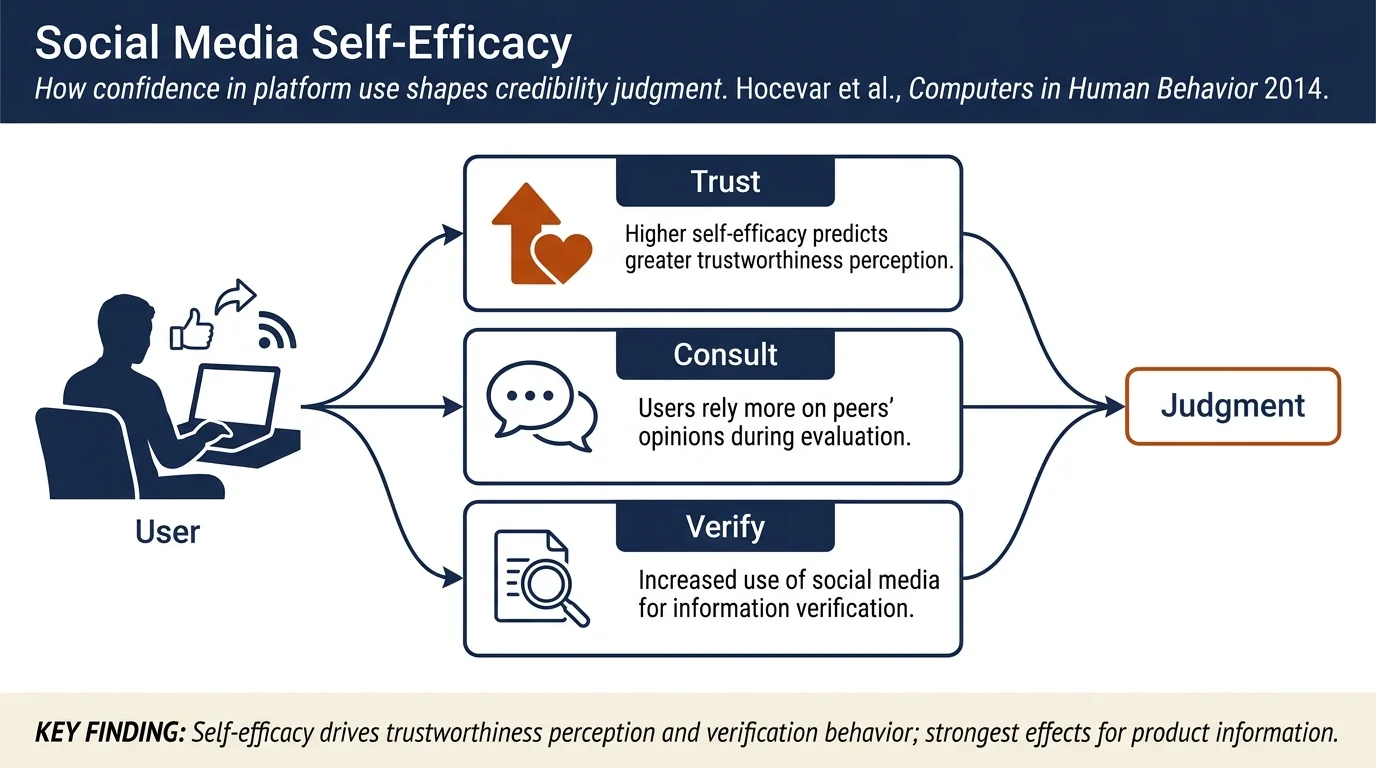
Contributions
- Social media self-efficacy construct: Proposes that self-efficacy, operationalized as perceived social media skill, confidence in finding information online, and content production/consumption frequency, is distinct from general internet self-efficacy.
- Self-efficacy as credibility predictor: Demonstrates that higher social media self-efficacy positively predicts perceived trustworthiness of social media information relative to offline sources ($r = .24$, $p < .001$).
- Domain moderation effect: Shows the relationship is stronger for product information ($\beta = .76$) than health ($\beta = .48$) or news ($\beta = .43$), possibly due to greater potential harm from health misinformation.
- Social evaluation strategies: Higher self-efficacy users more frequently consult others' opinions ($r = .30$, $p < .001$) and use social media specifically to verify information ($r = .50$, $p < .001$).
Method
Sample: Representative survey of 3,568 US adult internet users via Knowledge Networks' probability-based panel. Survey developed through iterative pre-testing to ensure comprehension of social media definitions and items.
Measurement:
- Social media self-efficacy: Composite of perceived skill (11-point scale), confidence finding information (11-point scale), content production (8 items, 5-point scale, $\alpha = .89$), and content consumption (5 items, 5-point scale, $\alpha = .81$). Normalized across components and averaged ($\alpha = .78$).
- Perceived trustworthiness: Single item per domain (product, health, news) on 7-point scale comparing social media to offline sources.
- Social credibility assessment: Four items, 5-point scale ($\alpha = .83$), measuring reliance on others' opinions during credibility judgment.
- Use of social media for verification: Averaged responses across five social media sources (blogs, Wikipedia, ratings sites, etc.) on 5-point likelihood scale ($\alpha = .90$).
Analysis: General linear model (GLM) for moderation hypotheses; simple slope analysis to probe interactions.
Results
H1 (supported): Self-efficacy positively predicts trustworthiness perceptions ($r = .24$, $p < .001$). Aligns with prior work showing familiarity and prior experience influence trust judgments.
H2 (supported): Domain moderates the relationship. Product information shows the steepest slope; health and news show weaker relationships, consistent with barriers-to-trust theory (greater potential harm = higher distrust of unfamiliar sources).
H3 (supported): Self-efficacy predicts social credibility assessment frequency ($r = .30$, $p < .001$). Effect size for self-efficacy ($\eta_p^2 = .10$) substantially larger than domain effect ($\eta_p^2 = .02$), suggesting self-efficacy is the dominant predictor regardless of information type.
RQ1 (not significant): No significant interaction between self-efficacy and domain in predicting social credibility assessment, $F(5,3533) = 1.90$, n.s.
RQ2 (supported): Domain moderates the relationship between self-efficacy and social media verification use, $F(5,3487) = 3.37$, $p < .01$, $\eta_p^2 = .01$. At low self-efficacy, domain-specific information (news, entertainment, health, product) is less likely to be verified via social media than general information. Effect persists at high self-efficacy but is attenuated.
Notes
Strengths:
- Large, representative sample with rigorous survey design and pre-testing.
- Introduces a psychologically grounded construct with strong empirical grounding in Bandura's theory.
- Examines both outcomes (trustworthiness perception) and processes (social credibility assessment, verification behavior), not just attitudes.
- Domain-moderated analysis reveals important nuance: self-efficacy's effect is not uniform across information types.
- Addresses practical risk: self-efficacious users may be particularly vulnerable to trusting unverified social media content, especially in health domains where accuracy carries real consequences.
Limitations and open questions:
- Cross-sectional design; cannot establish causality (does experience build self-efficacy, or does existing self-efficacy lead to more social media use?).
- Trustworthiness measured as perceived trustworthiness relative to offline sources, not actual accuracy of information trusted. Users higher in self-efficacy may trust misinformation.
- Social media self-efficacy measured as aggregated across all platforms; venue-specific efficacies (blogs vs. wikis vs. Twitter) might show different relationships.
- Sample is US-based internet users in 2014; findings may not generalize to other cultures or current mobile-first social media landscape.
- Authors note potential confound: similarity with other social media users (perceived shared identity/interests) may predict both self-efficacy and trust, but was not directly measured.
Implications for the field:
- Extends self-efficacy theory beyond traditional performance domains into social judgment and credibility assessment.
- Suggests information literacy interventions might need to target not just skills but also the overconfidence that accompanies skill, particularly in health/news contexts where stakes are high.
- Relevant to understanding echo chambers: users confident in their ability to evaluate social media may be less likely to seek expert corroboration.